Baseball player helps a breast cancer cause in Salt Lake City

Story and photos by CARLY SZEMEREY
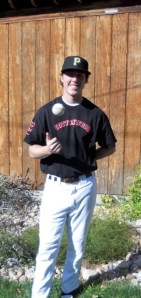
Sam Kaplan wearing "Swing for Life" jersey for the breast cancer awareness game.

Ever since Sam Kaplan can remember, he has been doing two things — playing baseball and helping others.

While growing up in Cottonwood Heights, a suburb of Salt Lake City, Kaplan’s parents, Neil and Kitty, taught him that service is a small meaningful act that goes a long way.

Because of this lesson Kaplan, now 19 and a University of Utah student, has donated his time to many efforts in hopes of bettering other people’s lives. He has raked yards, served food to the homeless and worked at the Utah Food Bank to sort food for the homeless and those in need.

He remembers one specific moment of volunteer work that touched him deeply. While he and his father were delivering food they came upon a Sudanese household. Once they had knocked at the door to deliver the packaged food, they were invited in the home. The family fed Kaplan and his father all of the food they had to offer. “It was really touching and nice of them,” Kaplan said.

When Kaplan was not volunteering his time helping others, he enjoyed playing centerfield for Cottonwood High School’s baseball team. Baseball has been a big part of Kaplan’s life for many years. His parents had enrolled him in T-Ball when he was just 3 years old and he has stuck with it ever since.

Kaplan has placed his focus on being the best player he can be. “I worked hard every single day of my life,” Kaplan said. “I didn’t take a day off ever.”

With this hard work and dedication Kaplan received multiple awards throughout his high school baseball career. Some of these awards included an All-State award his senior year and the All-Region award two years in a row.

“Sam was a great player who is an extremely hard-working kid,” said Jon Hoover, Kaplan’s baseball coach at Cottonwood High School.

Given Kaplan’s commitment to volunteerism and baseball, few were surprised when he brought up the idea of a breast cancer awareness game to raise money for research.

“[The idea of the game] just hit me one day,” Kaplan said. “I just wanted to help out a cause and raise money.”

In early spring 2010 many things happened. Kaplan had suggested to his coach and teammates the idea of a baseball game targeted at raising funds for breast cancer, the game was played to raise funds and  a longtime family friend, Toba Essig, was diagnosed with breast cancer. This diagnosis pushed Kaplan to make sure that this game happened and really became a driving force of the whole plan.

With the knowledge of a Cottonwood vs. Brighton baseball game coming up, Kaplan felt this was the perfect opportunity to implement his plan.

Essig’s son, Brian, played on Brighton’s team so Kaplan contacted Brian and asked if he would be willing to help him out with this cause.

Brian agreed so Kaplan approached his coach about the game.

“When Sam approached me about making our game against Brighton a breast cancer awareness game I thought it was a really good idea,” Hoover said. “Out of everyone I’m not surprised it was Sam to do this.”

"Swing For Life" designed the logo for jerseys to be worn in the game.

After speaking to his coach Kaplan began contacting different breast cancer organizations such as the Huntsman Cancer Institute and “Swing for Life” — a nonprofit organization that is dedicated to raising money in breast cancer research — to see if they would be willing to set up booths at the game.

His focus became more targeted when speaking with Kathy Howa, from “Swing for Life,” and Brighton’s baseball.

“Howa was really helpful,” Kaplan said. She helped plan the event and supplied the teams playing with pink and black jerseys to wear.

After all the planning the breast cancer game was ready to begin. On April 3, 2010, many people attended the game to support a cause.

Parents of the kids from Cottonwood’s baseball team took shifts in the goody shack — the snack shack at Cottonwood’s baseball field. All the proceeds raised during the game at the shack were donated to “Swing for Life.”

In addition, the players’ black jerseys were auctioned off to the highest bidders at the end of the game. This money was also given to the organization.

Kaplan and his supporters were able to raise more than $1,000 to be donated to breast cancer research.

“This game was one of my prouder moments and I’m so glad that I was able to help out,” Kaplan said. “I just hope that I am able to continue both of my passions and hopefully combine them together once again in hopes of making a difference.”

Following Kaplan’s graduation in 2010 he moved to Forest Grove, Ore., to play college baseball for Pacific University. After his freshman year he moved back to Salt Lake to get surgery on his shoulder in August 2011. Now a student at the U he hopes to continue playing baseball again after his shoulder has healed and he has completed the necessary rehabilitation.


Matt Ellis

MY STORIES:

MY BLOG:

Most college students become big fans of their universities during their time on campus, and I am no different. I have been taking classes on and off at the University of Utah for about five years now, in what I jokingly refer to as my “extended four-year plan.” My focuses for my stories stem from the pride I feel in being a part of a great University.

I was having trouble finding a subject for my profile, so I decided to find a U graduate who had been successful in their career. Fortunately James Clegg was going to be in town for a weekend, so I had the opportunity to sit down with him and find out how he got to a prestigious law firm in New York City.

The main thing I would have done better if I had the chance to do it over would be to come up with better interview questions. The ones I had certainly provided me with sufficient information, but I think being a little bit more in depth and comprehensive would have served me well. Since the initial draft, I have had to check back with James and his wife multiple times to clarify the notes I had.

I think that I did a good job of making my profile appealing to readers. For University students, it can be interesting to read about alumni from your school who have gone on to be successful, especially for one who may not be entirely sure of their future career path.
I think I ended up with a good piece, but it was definitely a learning experience.

ABOUT ME:

I am currently a junior at the University of Utah majoring in mass communication with a focus on journalism. I am an avid fan of almost any sport, but my focus is often on football and basketball, both college and professional. I ultimately hope to be a sports journalist for ESPN.

During my younger years, I was blessed with the opportunity to travel around the world with my family, and lived in Tokyo, Japan, from 7th grade until I graduated from high school in 2006. Since high school I have held a number of different jobs, from lifeguard to restaurant worker to salesperson.

On a nice day I enjoy longboarding or getting some friends together for a football or basketball game at the park. During the colder months I try to get on the mountain for some skiing or snowboarding, both of which I have been doing for years. I have also been playing the guitar since I was in middle school, but school and work don’t always allow me time to sit down and play.

I currently work as a sales professional for Clearlink, primarily selling AT&T home services. After I finish school here in Salt Lake, I plan on pursuing a graduate degree but do not have a specific school in mind.

University of Utah alumnus takes his talents to New York City law firm

Story by MATT ELLIS

Photo taken by Shanna Richmond

When James Clegg graduated from the University of Utah in 2006 he had a career plan. But he had no idea that, in a few short years, he would be working as a lawyer in New York City.

After the U, James spent years at two more universities before he ended up at Mayer-Brown, one of the leading corporate law firms in downtown New York City.

James, or “Jace” as he is known to family and close friends, was born in Farmington, Utah, in 1981 but spent three years in England while his parents fulfilled religious duties for the Church of Jesus Christ of Latter-day Saints. He graduated from Davis High School in 2000 and then served his LDS mission in Hong Kong.

James met his wife, Christy, after he got back from his mission. They had both spent time overseas while growing up, and having that in common led to almost immediate chemistry. They were married in August 2004, about eight months after they had started dating.

After earning a degree in English from the U, James attended law school at Cornell University in Ithaca, N.Y. Even as early as 7th grade, he knew he wanted to be a lawyer; at the time, though, he was partial to Yale.

“Growing up, I always thought that I wanted to be a lawyer,” James said. “People told me they felt like I had an aptitude for it because I like to argue.”

He decided to go to Cornell because it had the best international law program of all the schools he was accepted to. James learned one form of Chinese, Cantonese, on his mission in Hong Kong, and took six classes at the U learning Mandarin Chinese. He had originally hoped to return to China to practice law.

“When I was interviewing at different firms, that’s why I picked Mayer-Brown. … They have a large Hong Kong office,” James said. Along the way, however, he discovered that he might want to take a different path. “As I went through law school, I found that I had an aptitude for tax,” he said.

“In the legal world, if you want to do tax law, you have to have a specialization,” James said. So, after graduating with honors from Cornell in 2010, James decided to enroll at the tax law program at New York University, which is widely regarded as the “gold standard” of tax specialization. Tax law was something that really resonated with James, and he enjoys his current duties with Mayer-Brown. The firm handles contracts for loans, mergers and securitizations for multiple large companies, including BlackBerry.

He finished the program at NYU in 2011 and now works full time at Mayer-Brown. “I really like that it’s very cutting edge, very high-level legal work,” James said. “It’s really scary when you think about, ‘If I screw this up I could literally cost this person millions of dollars.’”

James’ wife Christy, also a University of Utah alumna, does social work in New York City. She does adoption work with adoptive parents, as well as counseling for adults. Though both are very serious about their career paths, things are not all business all the time.
Asked for one word to describe James, Christy responded, “He’s a jokester. He is kind of silly.”

James did concede that he tries to be funny, and that includes having a little fun with friends who are not very familiar with his Mormon faith. He once told a friend that Mormons believe that it is sacrilegious to eat turkey on Thanksgiving.

James is an avid follower of the U’s football team, and so far has been disappointed by the first season in the Pac-12 conference.

“I think that it’s pretty evident that we don’t have Pac-12 talent just yet,” James said. He misses going to football games in Rice-Eccles stadium, and was glad he could attend the Utah-Washington game on Oct. 1, 2011, while he was in town for the weekend.

While in New York, he catches the Utah games in the Flat Iron area of the city at a bar that is the official sports bar of the local chapter of the U’s alumni association. On any given game night, James said, between 70 and 80 Utah alumni show up to enjoy the game.

James has always had a plan for his next four or five years, but says that right now he is not sure where he wants to go. One option he has considered is going to work for a private equity firm, an area where he does have some experience from an internship he did while he was studying tax law at NYU. Although James would be open to opportunities overseas, both he and Christy plan on being in New York for some time to come. Christy even said she would like to start a family sometime soon.

Javan Rivera

MY STORIES:

MY BLOG:

She went skydiving.

There it is. The single most interesting part of the interview I had with Natalya Sergeyevna Nizkaya, and it didn’t even make it into my profile on her.

It was near the end of my interview with Nizkaya. We were sitting there in her cubicle, talking about everything she had accomplished in her time at the University, and I was trying to get a better sense of who she was as a person. What better way to get to know a person then to discover what they consider to be their greatest accomplishment?

So I ask. She smiles, and I expect her to say something in regards to the incredible story she’s just told me about her time in Russia and how she came to America. Instead, she tells me about her friend’s desire to do something special for their birthday. She describes the events surrounding the idea of skydiving, how she and her friend were the only two to go through with the jump.

I sit back and think on what she’s just told me. It’s such an interesting story that, for a moment, I consider changing the perspective of my article so that I can include it. But then I look at the clock and see that 39 minutes of the interview have already passed. I decide to move on instead.

Later that evening as I was writing the first copy of the profile, my mind continued to wander back to that story. It was so out of place, such a random event when compared to the rest of my notes. The more I played with it, the more I came to realize that it just wasn’t going to fit with the focus of the article. In the end, it was left on the cutting-room floor, as the only thing I heartily regret about the article.

This story, more than anything else, has stuck with me this semester. Thinking about the sheer wealth of information that I gather as a student-journalist, and even what I hope to gather as a career reporter, is more than I could ever hope to include in my articles.

This surely isn’t something that’s limited to my own writing. The process of sifting through one’s notes to find what fits within a particular article is something journalists around the world do on a daily basis. So then, what interesting tidbits get left out of the articles I read every day? What simple, but interesting topics are cut or are simply never included in the stories that go up in newspapers around the world?

These questions are something that only those who’ve written the articles can really answer, but I think I’m all right with that. Interviews can be unpredictable, and I doubt this will be the last time I have some small anecdote that doesn’t fit with what I’m covering. Rather than fret over it, I think I’ll just write them down and keep them as unique perspectives on stories past.

ABOUT ME:

Writing has been a part of my life since my childhood. Whether it was my obsession with a good book, or the little storybooks I would write when I was younger, word crafting has always been something that has drawn my interest.

It wasn’t until high school that I first began to write with any real fervor. I spent many hours writing fictional content in those years, and I believe they were a time of discovery for me. I learned how to hone my skill with the pen, how to breathe life into paper and ink, and ultimately, how to express the wonder of the surrounding world through the marvelously expressive English language.

I did not discover my desire to craft stories based on real happenings until I began attending the University of Utah. I first came to the U in fall of 2009, and beyond a shadow of a doubt I knew I was going to become a novelist. That is, until I took my first English course. While I could never condemn the works of Shakespeare or Twain, it quickly became apparent to me that what I was learning would never be practical for the life I wanted.

So began my search for a major that would allow me to combine my love of writing with a career path that I could genuinely enjoy. It didn’t take me long to discover the journalism track at the U. At 20 years of age, my life is just beginning. I look to a future in which I desire to write and gain further knowledge to improve that writing.

The majority of my work this semester is related to my courses, but as I pursue a new opportunity at The Daily Utah Chronicle this semester, I hope to continue to practice the craft that I love.

International graduate student at the U inspires pursuit of language studies

Story and photos by JAVAN RIVERA

Natalya Sergeyevna Nizkaya has been interested in foreign languages and their mechanics since her childhood.

Growing up in the Amur region of Russia that borders China, she harbored a desire to work with languages from around the world.

“I’ve wanted to connect my future life with languages since I was in the fifth grade,” Nizkaya said.

Nizkaya, 30, has studied five languages and currently is a teaching assistant in the University of Utah Department of Languages and Literature and is also a graduate student. She speaks English and Russian fluently and has experience in both Turkish and Chinese. She also has just begun studying Arabic.

Nizkaya’s master’s program work is based in the university’s Comparative Literary and Cultural Studies program (CLCS), and focuses on the Russian translation of African American literature. A paper she wrote in her first fall semester about a Toni Morrison novel inspired her work.

The time Nizkaya has been able to study and help teach in Utah has provided her with the opportunity to further her own linguistic knowledge and to inspire the same love for foreign languages in her students. She has accomplished this through the classes she teaches and a conversational group that she founded at the university.

Natalya Sergeyevna Nizkaya inspires her students through her classes.

In an interview Nizkaya talked about the impact she’s had on some students who have taken her Russian-language courses, citing one student who changed his major from mathematics to linguistics.

“When I heard about this, I thought ‘wow.’ It was very rewarding for me,” Nizkaya said. “Part of it was probably the Russian class that inspired him.”

Nizkaya was interested in creating a language-based activity on campus and was given an idea by her supervisor, Rimma Garn, who has a doctorate in Slavic languages and literature. This brought about the creation of the Russian Table.

The Russian Table consists of students from all Russian-language classes ranging from first- to third-year fluency. The group has eight to 10 regular attendees this semester, but that’s not how it began.

Nizkaya said that when the group began it was extremely large, but it quickly dwindled to only four students. They would meet and talk about random subjects in Russian. She said the whole idea of the group was to “break class walls.”

“It was great to see first-year students participating when they could hear and understand words,” said Maria Fedorovna Rezunenko during a Skype interview. She was one of Nizkaya’s colleagues and was also placed in Utah as a foreign-language teaching assistant.

Both Nizkaya and Rezunenko were placed at the U through the Fulbright Institute of International Education. One of Fulbright’s programs works to match foreign-language speakers with universities where they can help teach. For Nizkaya, it was a perfect fit.

“She tried to deepen her knowledge of foreign language,” Rezunenko said.

Nizkaya described how the Russian school system differs from its American counterpart and said she spent five years mastering English while also studying German. The system now mirrors the American degree system, but during Nizkaya’s time at Amur State University it was under the old system that revolved around five-year specialties.

By the time she graduated in 2004, she was qualified as both an interpreter and translator in English and Russian and had a specialty, the American equivalent to a major, in linguistics and intercultural communication.

Nizkaya is also studying as a graduate student in the CLCS program at the U.

Nizkaya wanted to apply this knowledge somewhere. An opportunity presented itself in 2007 when she participated in an exchange program between her university in Blagoveshchensk and Jackson State University in Mississippi.

The program consisted of teaching English as a second language and helping students to prepare for the Test of English as a Foreign Language (TOEFL). The program offered Nizkaya a chance to practice the skills she had learned in her schooling in Russia, and created a desire to do more work in America.

“When I came home, I was already thinking of what other ways I could go to the States,” Nizkaya said.

This led to her eventually teaching Russian at the University of Utah in fall 2009. It was here that she first met Rezunenko in person, though they had been in communication online for some time.

“It was amazing,” Rezunenko said, describing the program. “It was teaching us to teach.”

She said the forms of teaching in the Russian school system are different, and that their supervisor wanted them to teach the classes in a more “American style.” She feels this benefited both herself and Nizkaya.

While the work has allowed Nizkaya to impact her students, she now looks to her future, both in finishing her master’s degree at the U as well as her career path outside of academia.

Yet even as these studies come to a close, Nizkaya said how proud she is of everything she has accomplished thus far in her academic career both as a student and a teacher.

“That I’m here now,” Nizkaya said. “That’s already an achievement and I’m proud of it.”

Lisa Hendry

MY STORIES:

MY BLOG:

Writing a news story was different than I expected. News, to me, had always seemed like the most obscure form of writing. Research papers, I can do. Creative writing, easy. News writing fits somewhere between the two forms, combining the use of facts and knowledge with a zest and flavor that attracts an audience. Research papers are used to portray information, not to entertain, and creative writing hardly uses hard facts to make a point.

Thus my main dilemma first came from this hybrid style of writing that seemed so foreign to me. Trying not to take myself too seriously, I took to news writing the best way I knew how. I donned my coat, gathered my notebook for my interview and dived in.

Finding a topic I was eager to report about was crucial. I am a lover of good writing and one of my favorite ways to spend my time is reading. Being able to report on my favorite local bookstore was easy. It was something I loved, and something I wanted to share.

Playing the part of a reporter, a role I didn’t think I fit, required some digging. I knew less about my subject matter than I thought, and I had a lot to learn before interviewing anyone. By finding out some background information, I also learned who was best to interview.

I’m a first-time news writer. The interviewing process was something new to me. Here, I learned the most about writing and about me. This was the exciting part. To speak with others about a shared interest, to find out I had more in common with a person than I initially thought, and to watch a person speak about something that they are passionate about made my job as a news writer seem important. In the interview process, the story began to unfold. Not the outlined story I thought I would have, but a real, alive and breathing story. About people and life. My focus seemed to change with every question and every answer. I learned that asking the right questions is important, but letting the answers help develop a story was vital. One little question could lead to a branch of something I didn’t even think to cover; it showed what was exciting, what would stick out.

Writing this story showed me that news writing isn’t about making deadlines and breaking news. It can also be about people. It has been a process that I have enjoyed leaning about.

ABOUT ME:

As a junior in college, this is my first semester at the University of Utah. I have spent my last three years school hopping and soul searching.  Born and raised in Salt Lake City, I spent my college years trying to get away. I’ve been to two other universities, in Logan, Utah, and in Hawaii; now I find myself back where I started.

I value hard work more than I value talent. I have had to work hard to get to where I want to be and don’t regret a minute of it. I had to take a year off of school and work full time to pay off my adventures and learned more than I ever expected of the work field. Now juggling school and work, I appreciate my time in the classroom and love being around other students. No atmosphere is so enriching than a place where everyone wants to learn as much as I do.

I live life on a whim and don’t know where it will take me next.