Specialized Chair Helps Veterans Go Paragliding

Story by Sean Gustafson

On Sept. 3, 2011 five veterans tested a new type of paraglider over Sun Valley, Idaho. What made this an event noteworthy was that all five of these veterans are suffering from spinal cord injuries (SCI).

The veterans were able to participate in the paragliding by means of a set of specialized chairs called “Phoenix 1.0” and “Phoenix 1.5.”  The “Phoenix” chairs were made from one inch aircraft aluminum tubing allowing for a sturdy 35lb craft.

These chairs were the product of four months of researching and testing from four University of Utah students under the direction of professor Don Bloswick.

Mark Gaskill, of ABLE Pilot, provided the training for the chairs an organization committed to help people with spinal cord injuries, amputations, and neuromuscular diseases into flying-type actives.

To see test runs on the “Phoenix” chairs, go to http://www.youtube.com/watch?v=y9j33A0UV8A

ABLE Pilot Program Helps Veterans With SCI Learn to Paraglide

Story by: Laurie Carlson

“ABLE Pilot is an organization committed to getting people with spinal cord injuries, amputations and neuromuscular diseases safely into the air, piloting and flying with the minimum amount of assistance,” said Mark Gaskill, director of the training.

 
In Sun Valley, Idaho, this weekend, five veterans with spinal cord injuries (SCI) will learn how to paraglide.  They will learn how a paraglider works, functions and how to pilot it.

 
The veterans will use two flight chairs named Phoenix 1.0 and Phonenix 1.5. The original flight chair Phoenix 1.0 was built under the direction of Don Bloswick, a professor of mechanical engineering at the University of Utah. The chair was built by four mechanical engineer undergraduates at the University.

 
Gaskill is the developer of the ABLE pilot program and is the developer of many paragliding-training programs for people with disabilities. Gaskill is the person who initially came to the U of U team with the idea to develop the adaptive flight chairs.

 
The veterans will train all weekend long Friday, Saturday, Sunday and Monday. During the first day of training they will learn about paragliding. They will also learn how to paraglide 3 feet off the ground. They veterans will then take several tandem flights with ABLE Pilot’s certified instructors. Finally by Monday they will be able to fly solo.

 
For more information about the ABLE Pilot program visit http://ablepilot.com/

Two Utah women tell how they survived domestic violence

Story and slideshow by CHELSEA EBELING

Baffled, afflicted, and despondent, Khloe James sat hugging her knees to her chest with tears streaming down her face in the corner of her room, paralyzed by shock.

“This didn’t just happen … not to me … I’m not that girl … this didn’t just happen,” she repeatedly told herself.

But it did happen, and she was that girl. James, who is using a pseudonym to protect her identity, fell victim to domestic violence that night in 2007 when her on-again, off-again boyfriend of two years raped her while he was high on methamphetamine.

“He was always very possessive, controlling and manipulative, even pulling a gun out once, but he never actually got physical until that night,” James said.

She suffered in silence for the next year, not telling anyone what had happened. “I didn’t think anyone would believe me if I told them because he was my boyfriend,” James said. She even continued dating him until he went to jail for unrelated charges in 2008.

“When he finally went to jail I looked at it as my escape. He wouldn’t be able to stalk me, call me and convince me to get back together with him,” James said.

This story is frighteningly common. One in every four women will experience domestic violence in her lifetime, and most of those cases are never reported to the police, according to statistics by the National Coalition Against Domestic Violence.

Many victims know what is happening is wrong, but for various reasons still stay with the perpetrator. “It’s easy for somebody outside of the situation to say what should be done, but you never know what you’d really do until it happens to you,” said Asha Parekh, the director of the Family Justice Center in Salt Lake City.

For Chelsea Waters, that statement was all too true. Mistreatment was her reality for four years while dating her then-boyfriend. “We had a really quick-paced relationship,” Waters said. “Things got serious one month in.”

Their passion quickly turned from romance to violence. “We got in arguments a lot, even about the littlest things,” Waters said. “He called me every name in the book.”

Those small arguments turned physical after a month of dating when Waters’ boyfriend tackled her to the ground and repeatedly slapped her during a disagreement. After realizing what he had done, Waters’ boyfriend came to her crying and apologized for his actions, and swore he’d never do it again. But within hours she was attacked for a second time.  “After that door was open it was never closed,” Waters said about the abuse.

Subsequently, arguments were no longer disagreements but full-blown attacks. “Things were bad, but I stayed because I loved him and saw the best in him,” Waters said. “He was extremely affectionate, you know, bringing me flowers for no reason … I forgave him quickly.”

But it was that forgiving nature that got her into more trouble. Three years into their relationship, and shortly after their son was born, Waters’ boyfriend asked to borrow her car keys to go somewhere with his friend while they were in the middle of moving. Her refusal led to one of the worst altercations of the relationship.

“I was very calm and told him he could take the car after we were done packing,” Waters said. But her boyfriend didn’t like that answer and told her to come inside with him while they left his friend outside. With his hands behind his back, Waters’ boyfriend asked once again if he could borrow the car. When she told him no for the second time, her boyfriend pulled out a roll of duct tape he had been concealing and told her that he was going to kill her.

He taped her hands together then punched her repeatedly in the face, pushed her, kicked her in the stomach and pounded her head against the floor. “I knew his friend was right outside the door and I kept screaming thinking he would come in and help me, but he never did,” Waters said.

What made things worse is that their son was just a few feet away from where Waters was beaten. “Looking up and seeing my son crying in front of me was my breaking point,” Waters said. She had been beaten before, but not like this. She didn’t want her son to live this way and she certainly didn’t want him to witness her death.

Waters might have been killed that day, had her mother not come over to check on things. Her mom called the police and her boyfriend was arrested shortly after the call was made. Waters was taken to the hospital and treated for a fractured jaw, a serious concussion, a fractured eyebrow and cheekbone, broken ribs, and a broken nose. She was also blinded in one eye for three days after the attack due to an eye contusion.

Despite her injuries, Waters went back to her boyfriend and even spoke on his behalf during the court case in an effort to get the charges of abuse dropped. It wasn’t until a few months later when she met someone new that she finally left him.

“Meeting someone that treated me good was the only thing that got me to finally leave,” Waters said.

The Family Justice Center website notes, “For an abused woman, leaving the relationship is never a single act. It is always a continuous process.” It’s not always a matter of making a decision; often it has to do with safety and finances.

Whatever the reasons for staying may be, the time has to be right and support is crucial. “It takes a lot of time and patience until someone finally is ready to leave,” Parekh said. The best thing to do is to let the victim know that they are loved, supported, that they deserve better and it’s not their fault.

The struggle isn’t over once women decide to get out of the relationship either. Sometimes that’s the hardest and possibly the most dangerous part. “The danger can increase when a victim decides to leave the relationship because the abuser may feel like he is losing control over her. They may take drastic measures to maintain that control,” Parekh said.

In order to minimize danger, it is recommended that abused women contact resources to set up an exit plan. The Family Justice Center has staff members who can help create a safety plan and get victims in touch with counselors, law enforcement, lawyers, career counselors, and other personnel who can help with the transition.

James and Waters are the few lucky ones who were able to get out of an abusive relationship without getting help. Waters says she is finally getting closer to “normal” and can actually talk about what happened. “I have to work on it every day, but … I’m healing,” Waters said.

In hindsight James contributes getting out of that relationship as the start of her happiness and hopes her story might help influence other potential victims to be cautious about who they’re dating. “Leaving that relationship was by far the best decision I’ve ever made,” James said. “I wish I had known there were people out there who could’ve helped me and told me I’m not the only one this has happened to.”

This slideshow requires JavaScript.

For more help:

The first step in fighting back against domestic violence is to know what it actually is. The National Coalition Against Domestic Violence defines it as “the willful intimidation, physical assault, battery, sexual assault, and/or other abusive behavior perpetrated by an intimate partner against another.”

Knowing the signs of an abusive person could potentially save your life or the life of someone you love. The YWCA lists 14 signs of domestic abuse.

Sharing the Olympic dream: The storytellers of US Bobsled and Skeleton

Story by MEGAN SWEENEY

What’s the story of the storyteller? Meet Amanda Bird.

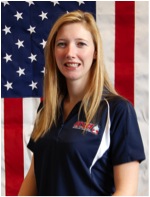
Amanda Bird, marketing and communications manager for USBSF, was a member of the US National Skeleton team.  Photo provided by AMANDA BIRD

Her current title is marketing and communications manager for the United States Bobsled and Skeleton Federation (USBSF). She makes it her career to share those unknown stories of the less than 300 athletes who compete every four years in the Winter Olympic Games.

Bird says her favorite part of the job is relating those elite athletes to the public vs. focusing on the finish times ad medals around their necks. She was a former skeleton athlete for more than 10 years. She would hurtle herself face first down an ice chute, at speeds exceeding 70 mph. However, she discovered there was “more than showing up to train.”

Being an athlete is more than lifting weights, eating right and training hard. It also entails being a stand-up citizen, a semi-professional marketer and a savvy salesperson.

These revelations in place, Bird started to simultaneously compete and blog. After graduating from the University of Albany with a master’s degree in English, she began her career at the Albany Times Union of upstate New York as one of the initial bloggers.
With her skills as a writer and her passion for the sport of skeleton her dream of “marrying her two passions” became a reality.

Sometimes, though, reality can be harsh. Transitioning from the Albany Times Union to the USBSF was difficult. Within her first week with the organization, she had to write a press release about the death of Captain Brian Freeman, her former teammate and a member of the US Army Reserves World Class Athlete Program, who had been killed in Iraq.

She was tested again when 2010 Olympic athletes John Napier and Christopher Fogt decided to take a leave of absence from sliding in order to serve in the Middle East. “It’s difficult and emotional to go on and off the record,” Bird said in a telephone interview.

It isn’t all negative though. Bird has the opportunity to make a difference in athletes’ lives. She gets to share details about two-time Olympian Eric Bernotas of USA Skeleton. Bird wrote about the triumphant comeback of Noelle Pikus-Pace after she was hit by a bobsled in Calgary, Canada, which postponed her Olympic dreams and made her determination grow stronger for the 2010 Games.

Bird also wanted to shed light on the transitional athletes such as Bree Schaaf who started her career as a skeleton athlete and moved on to become a 5th-place finisher in the 2010 Olympic Games for the women’s bobsled team. She yearned to expose the struggles of Olympic gold medalist Steven Holcomb who pilots the No. 1 sled for USA men’s bobsled. Despite being almost legally blind, he challenged the odds by positioning himself as one of the most prominent bobsled drivers in the world.

Bird’s positive movement was enhanced within the federation in the form of negotiating contracts with sponsors such as Under Armour. This provided more athletes with national team clothing.

She was challenged by the prospect of attaining additional sponsors in order to provide the USBSF athletes funding so that they weren’t paying out of pocket to travel and race on the international circuit.

Athletes such as Erin Pac and Elana Meyers are recipients of those sponsorships. They’re also the subjects of Bird’s most memorable and favorite story she ever wrote. It began on Feb. 24, 2010, at the Whistler Sliding Centre in Whistler, Canada.

From the moment the team of two women crossed the finish line and stepped off the ice, Bird accompanied them. The trio made their way through mix zone after press conference after meet-and-greet. Then, finally (two days later), ended up at the medals plaza to receive their bronze medal in the awards ceremony. After all was said and done, Pac and Meyers turned to Bird and thanked her.

“Amanda was awesome during that entire experience!” Meyers wrote in an email. “It was great to have a familiar face with us and someone to share that moment with. She really helped make winning the medal that much more special — and we were super excited to share all our experiences with her.”

Meyers also wrote, “Having Bird definitely changed our relationship. She has shared moments with me that I’ve only shared with Erin. It was a magical experience.”

Bird agreed. “In the end it was so special that I felt I needed to share it with the world. The ride of emotion was almost indescribable,” she said.

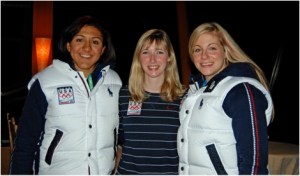
From left: Elena Meyers, Amanda Bird and Erin Pac. Photo provided by AMANDA BIRD

While reporting on passion creates a good read, one major issue for Bird in dealing with the media today comes from an athlete’s ability to share through social media.

The USBSF is known for being one of the last sports announcing its Olympic team. Explaining the long, drawn out and complicated process to “outsiders” might be worse than trying to decipher ancient Egyptian hieroglyphics.

In a single tweet an athlete can tip off a reporter without even knowing. One tweet or status change that may be as simple as a smiley face followed by “20XX Here We Come!” can trigger an irreparable Google effect.

However negative social media can be, its power can extend into other avenues of Bird’s job and actually help her sponsorships.

The reason athletes look like a walking billboard on a regular basis is due to the support they receive from sponsors. A single tweet or picture of a bobsled or skeleton athlete raving about the upgraded car rental that Budget gave them for vacation goes beyond a plug to their fans.

It can result in athletes receiving Range Rovers to drive around Europe for the entire six-month season.

Another obstacle that can be difficult to overcome are time zones. This is particularly challenging when one is trying to balance both a personal and professional life. Being awake at 2 a.m. to catch results from the first heat of a bobsled race in Cesana, Italy, doesn’t allow for sleep but Bird’s fiancé, Jason Hartman, understands.

He was the former strength and conditioning coach at the Lake Placid Olympic Training Center.

Hartman has worked closely with most of the athletes of the USBSF. He has a personal and emotional investment in these athletes as well and this enables him to realize that the stories Bird has to report on are more important than sleep.

At some point, an athlete transitions from competing as a hobby to competing as a career. This makes Bird’s career one of status and prominence. She is responsible for the visibility and livelihood of the athletes who represent the USBSF.

Many look to achieve her portfolio and have the ability to report on such stories as she does. In order to get there she believes that being able to communicate clearly and fully express a thought is more valuable than anything. Bird believes that practice makes perfect and she says no matter what you’re writing about, just write.

Every story Bird reports on she executes like a racer would: with a purpose and a passion.

Sarah Minen’s massage business in Salt Lake City

Story and photos by SHERYL CRONIN

Exterior view of Sarah Minen's office.

Young entrepreneurs often do not do as well as they expected in this economy. But businesswoman Sarah Minen has made her personal career successful with a growing clientele.

She recently moved her business Sarah Minen LMT from her home into an office in downtown Salt Lake City at 24th South and 600 East. Her new office is more spacious and more professional looking for her clients.

One of Minen’s clients, Chris Nizzardini, has been seeing her for three years. He said the massage room in her house was very nice. She was able to transform the room into a professional atmosphere for massage, but he says that the new office is more like an official place of business.

Interior of new office.

Minen says she is more likely now to socialize with her clients before and after the massage because she doesn’t have her roommates there to make things awkward.

Minen, 26, grew up in a small town, Tracy, Calif., and moved to Salt Lake City in her teens. Raised by two professionally successful parents, they instilled their work ethic within her and her siblings.

Minen was always interested in the profession of massage but was discouraged by her parents because they did not feel that it was an adequate career. She ended up getting an associate degree in sociology at Dixie College in southern Utah to try to please her parents, but she still felt that she wanted to do massage.

After obtaining a school loan and a small loan from her sister, Minen was able to enroll in the Utah College of Massage Therapy in 2007. She obtained her massage license while attending school only part time for one year and graduated in 2008. She was able to pay off the loans while still in school by working in restaurants as a server to make ends meet.

While in massage school she said she was taught how to market herself. At first it was really difficult to sell herself to others. She said it has become easier for her and has been beneficial as a self-employed young adult.

In a few of her past massage jobs she has been a manager, which also contributed to the transition into managing her own business.

“I love to help people feel better,” she said. One of her most memorable clients was a woman who was suffering from daily migraines that were so severe she could not work. The woman had come to her for three sessions and the migraines had disappeared.
“I feel that I changed her life,” Minen said.

Most massage therapists have a specialty massage and every year there are conferences around the country where the therapists go to learn about new types of massage. Minen’s specialties are deep tissue and trigger point.

Deep tissue is a type of massage in which therapists use their fist or elbow that work to get to the deeper muscles. With this technique the therapist must massage very slowly to mold the muscle. This method works the muscles that are not normally reached with a regular massage.

Trigger point massage is a method that focuses on particular points on the body that the therapists lean on with their elbow. When leaned on for a long enough time the muscle will release its tension.

Trigger point and deep tissue are both really good techniques to use on athletes. Minen was thankful that those two methods were the first she learned to do because they were the most useful to her athletic clients.

Minen said Utah is a great place for massage because of the number of outdoor athletes. The mountains in the Salt Lake area bring in a lot of clientele. Many of her clients run, ski, bike, snowboard, and there are even some triathletes who see her for sports-related muscle issues.

Some of the physical effects from doing massage can be carpal tunnel and disk degeneration. Minen said that eventually she would like to have her own business with her own employees to avoid the risk of getting carpal tunnel after working with her hands for so long.

One of the greater benefits of not being employed by a salon or chiropractic clinic is the hours. She only has to work about 20 hours a week. She keeps all of the profit instead of having to give a portion of it to a company she works for. This was one of her main goals to accomplish from being self-employed.

Minen’s business looks like it will continue to grow and provide her with a fulfilling career. She’s glad she did not listen to her parents when it came to her career. “I would choose this same career if I could do it all again,” Minen said.

Baseball player helps a breast cancer cause in Salt Lake City

Story and photos by CARLY SZEMEREY

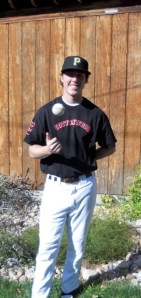
Sam Kaplan wearing "Swing for Life" jersey for the breast cancer awareness game.

Ever since Sam Kaplan can remember, he has been doing two things — playing baseball and helping others.

While growing up in Cottonwood Heights, a suburb of Salt Lake City, Kaplan’s parents, Neil and Kitty, taught him that service is a small meaningful act that goes a long way.

Because of this lesson Kaplan, now 19 and a University of Utah student, has donated his time to many efforts in hopes of bettering other people’s lives. He has raked yards, served food to the homeless and worked at the Utah Food Bank to sort food for the homeless and those in need.

He remembers one specific moment of volunteer work that touched him deeply. While he and his father were delivering food they came upon a Sudanese household. Once they had knocked at the door to deliver the packaged food, they were invited in the home. The family fed Kaplan and his father all of the food they had to offer. “It was really touching and nice of them,” Kaplan said.

When Kaplan was not volunteering his time helping others, he enjoyed playing centerfield for Cottonwood High School’s baseball team. Baseball has been a big part of Kaplan’s life for many years. His parents had enrolled him in T-Ball when he was just 3 years old and he has stuck with it ever since.

Kaplan has placed his focus on being the best player he can be. “I worked hard every single day of my life,” Kaplan said. “I didn’t take a day off ever.”

With this hard work and dedication Kaplan received multiple awards throughout his high school baseball career. Some of these awards included an All-State award his senior year and the All-Region award two years in a row.

“Sam was a great player who is an extremely hard-working kid,” said Jon Hoover, Kaplan’s baseball coach at Cottonwood High School.

Given Kaplan’s commitment to volunteerism and baseball, few were surprised when he brought up the idea of a breast cancer awareness game to raise money for research.

“[The idea of the game] just hit me one day,” Kaplan said. “I just wanted to help out a cause and raise money.”

In early spring 2010 many things happened. Kaplan had suggested to his coach and teammates the idea of a baseball game targeted at raising funds for breast cancer, the game was played to raise funds and  a longtime family friend, Toba Essig, was diagnosed with breast cancer. This diagnosis pushed Kaplan to make sure that this game happened and really became a driving force of the whole plan.

With the knowledge of a Cottonwood vs. Brighton baseball game coming up, Kaplan felt this was the perfect opportunity to implement his plan.

Essig’s son, Brian, played on Brighton’s team so Kaplan contacted Brian and asked if he would be willing to help him out with this cause.

Brian agreed so Kaplan approached his coach about the game.

“When Sam approached me about making our game against Brighton a breast cancer awareness game I thought it was a really good idea,” Hoover said. “Out of everyone I’m not surprised it was Sam to do this.”

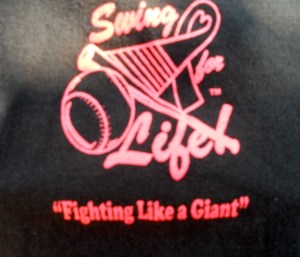
"Swing For Life" designed the logo for jerseys to be worn in the game.

After speaking to his coach Kaplan began contacting different breast cancer organizations such as the Huntsman Cancer Institute and “Swing for Life” — a nonprofit organization that is dedicated to raising money in breast cancer research — to see if they would be willing to set up booths at the game.

His focus became more targeted when speaking with Kathy Howa, from “Swing for Life,” and Brighton’s baseball.

“Howa was really helpful,” Kaplan said. She helped plan the event and supplied the teams playing with pink and black jerseys to wear.

After all the planning the breast cancer game was ready to begin. On April 3, 2010, many people attended the game to support a cause.

Parents of the kids from Cottonwood’s baseball team took shifts in the goody shack — the snack shack at Cottonwood’s baseball field. All the proceeds raised during the game at the shack were donated to “Swing for Life.”

In addition, the players’ black jerseys were auctioned off to the highest bidders at the end of the game. This money was also given to the organization.

Kaplan and his supporters were able to raise more than $1,000 to be donated to breast cancer research.

“This game was one of my prouder moments and I’m so glad that I was able to help out,” Kaplan said. “I just hope that I am able to continue both of my passions and hopefully combine them together once again in hopes of making a difference.”

Following Kaplan’s graduation in 2010 he moved to Forest Grove, Ore., to play college baseball for Pacific University. After his freshman year he moved back to Salt Lake to get surgery on his shoulder in August 2011. Now a student at the U he hopes to continue playing baseball again after his shoulder has healed and he has completed the necessary rehabilitation.