Evan Teng

AAEAAQAAAAAAAAa0AAAAJDVmYjhkMmZhLTQyNDEtNGM4My05ZTJlLWRlZDFmNDhiOGZhNQ

I am an aspiring journalist and writer who loves learning and writing about interesting subjects such as technology, politics, and animals.

I have had my pieces published in the University of Utah student newspaper, The Chronicle, and have written for The Catalyst Magazine, a local magazine based in Salt Lake City.  I am always looking for fascinating stories and love keeping up with current events.

I am currently a staff writer at the University of Utah student newspaper, but I would love to expand my resume with other unique positions and experiences.

Alicia Hopkins

MY STORIES:

ABOUT ME:

Writing has always been an important aspect of my life. Ever since I was little, I have always been creating little poems and stories in my spare time. However, I wish I could say I always knew it was the field I wanted to go into. When I arrived at the University of Utah in fall of 2013, the possibilities were limitless and I had no idea what I wanted to do with my life. I changed my major at least four times before discovering the wonderful world of communication. I will be graduating from the U in spring of 2017 with a BS in communication, an emphasis on strategic communication and a minor in business. At 20 years old, I wish I could say I know what I want to do with my life now. However, I still have no idea. I can at least say that I am happy with where I am at and my journey is just beginning.

Danielle Haddad

WordPress Bio

Currently, I am a strategic communication major and sophomore at the University of Utah. I am striving to further my professional education as well as accumulating work experience in the fields of public relations, advertising, and marketing.

Feel free to find me on LinkedIn

Link

Madison Facer

My Stories:

The Gray Crane 

Holidays to Getaways

About Me: 

For me life has always been a wild adventure with no particular direction and to be honest it still is that way. When I was a child I wanted to be everything and nothing in particular. As I’ve gotten older, well, that hasn’t really changed.

I am now in the midst of the adventures of being a Strategic Communication student at the University of Utah. I am hoping to minor in Creative Writing and see where the adventure takes me.

I am from Utah and have lived here my whole life, and becoming a Ute has been a great experience for me. I lived in Jackson Hole, Wyoming for a summer and have explored a lot in my 21 years. I am excited to keep exploring and with any luck, share my explorations with readers and others.

Nick Jacobs

About Me:

I am a Sophomore at the University of Utah studying political science and economics and interested in a career in law and politics.

Since I arrived at the University of Utah a little over a year ago I have been constantly involved in student leadership, and I am always excited for the next opportunity to take my skills and involvement to the next level. I keep busy by challenging myself with with hard courses, engaging in leadership positions on campus, and participating in local politics. I like to spend my spare time hanging out with friends, hanging out at coffee shops, and reading about and discussing politics.

Check out my articles here

Jitterbug Antiques and Toys

Education on the Rise

Caitlin Jones

About Me:self.picture

I can tell you that I have always known that I love to write. More so, I love to write fictional stories about danger and adventure. Imaginary things have always come easy to me and I never seem to run out of ideas. I have been an artists since I was a child and still love expressing myself through art and creative ways.

One thing I can tell you for sure is you wouldn’t expect me to love the things I do by looking at me. Never judge a book by its cover. On the outside I look like a normal girl but in my mind it’s everything horror. I love the dark side of things, morbidity and gore. I don’t know where I get it from but I can express it freely when I go to work at Nightmare on 13th haunted house. I have been there for four years and enjoy every minute of it. I am an actor in the house along with being Costume Girl that deals with all of the costumes and props that go with the actors every night.

I am not a normal person, but who would want to be?

Chris Ayers

me

About Me:

Well, I guess I’ll have to go back to my days in middle school to begin. I was 12 years old when I made my first stop motion video and I continued to make them until I was 15. During those years, I made live action videos with my brother and his friends. At that age, I started doing some Flash animation and started getting into photography. Originally more into video, I did research about DSLR cameras (that was when they starting having video) since I was going to receive a new camera for my 16th birthday. As I learned more about DSLRs, I learned more about photography, and made the jump (while still doing the occasional video).

It took me a while, but I started to build a reputation for my photography skills, never missing a single home football, basketball, or hockey game at my high school.

Coming into the U declared as a film major, I still wanted to continue photography, but didn’t know how I’d get on the field for sports games. That was when I saw an ad in The Daily Utah Chronicle saying photographers were wanted. Without hesitation, I applied and got the job. I (again) gained notoriety for my photographs, but my reputation rose much quicker than in high school. I got to go to Las Vegas for the 2014 PAC-12 basketball tournament: at the age of 18.

After being told I probably wouldn’t get to, on the day of the concert, I was told I would get to cover the east coast hip-hop group Wu Tang Clan; my first concert I got to cover.

In November of 2014, I received an email confirmation confirming a press pass for the legendary Judas Priest (the day before the concert). That was perhaps my biggest moment.

In May of 2015, I asked to take photos of Passion Pit for the Red Butte Garden concert series and my request was granted on one condition: write a review while I was at it (something I’ve never done before).

While not my best article (being my first ever), it was good enough for the art’s desk to ask me to write a review for an upcoming concert: Royal Blood. This one was much improved, and the art’s desk was so impressed with my writing that they asked if I was interested in becoming a writer for the art’s desk. Seeing this as an incredible opportunity to expand my horizons, I gladly accepted. As far as the staff at the Chrony is knows, I am the first person to have a position on the photo desk and a writing desk at the same time.

On the first day of school my junior year, I got to write a concert review for my childhood hero: Weird Al. On the Thursday of that week, I had to take pictures for the St. Vincent concert (more on that later). Two days later, I was at the Dazed Out hip hop festival: with headliners Atmosphere and Snoop Dogg.

Guitar manufacturer Ernie Ball contacted me a week after St. Vincent was in town, asking for a non-exclusive agreement to purchase my pictures of her with her guitar (it was her second show playing it). They have used it for their Facebook cover photo.

I have also written album reviews, my own opinion pieces, and covered the heavy-metal band Korn since then.

I’m still doing photography and writing and have declared as a communications major (journalism) on top of my film major. Oh, and I decided to minor in writing.

My ultimate goal is to be hired as either the official photographer for the SF Giants or a band photographer (have not decided which yet). Or write for Rolling Stone.

When I’m not taking pictures or writing, you can find me playing guitar, listening to music, watching Giants baseball, or at a concert (just for fun).

Even if I end up not making it into the real world of journalism, I can at least look at my work and know I tried my best; considering all the events mentioned above occurred before I even graduated college.

The positivity of Alex & Ani

profile story photo

Story by Carly Adair

         Alex & Ani is a jewelry company that has recently excelled in the business world. Currently at its peak, the company is not expected to excel for many more years. The company’s mission statement is to create jewelry that changes lives. Each piece of jewelry is handmade in America, made out of eco-friendly materials, and has a deeper meaning to it that gives it importance.

Based out of Providence, Rhode Island, Alex & Ani started in 2004. According to Chad Cox, a manager at the Alex & Ani in Salt Lake City, the store is always busy, and the workers have almost have no down time because they are always helping customers. Chad said “on Black Friday last year, there were lines out of the door for people wanting to shop at Alex & Ani.”

Alex & Ani is a trend company, primarily making bangle bracelets with charms on them. Each bangle bracelet comes in a gold or silver finish; essentially there is something for everyone. Each piece of jewelry is supposed to bring positive energy into your life and make a lasting impact. Chad spouts information about how many of the pieces are classic, and how some of them are trend pieces. The jewelry that Alex & Ani makes is designed to be classic, but with how popular the company is at the moment, the jewelry may just be a fad.

Alex and Ani does not have a primary demographic but a “wide variety of people who shop at Alex & Ani, young teenage girls, mothers, grandmothers, husbands shopping for wives, or even boyfriends shopping for girlfriends. There are even guys on occasion that shop for themselves.”

Something very amazing about this company is how much they give back. With a line of jewelry called “Charity By Design”, 20 percent of each piece of jewelry goes to a different charity, cause, or foundation. There are almost 50 different organizations that Alex & Ani gives back to, each one holding a 2 year agreement with the company. Charity By Design is what keeps Alex & Ani alive, with giving back to a good cause, the company will hopefully continue to excel. Although, Alex & Ani is a trend company, and is not expected to stay as popular for much longer, Charity By Design helps them strive for greatness. In just the year of 2015, Charity By Design has already given back 2 million dollars to the American Heart Association.

According to Chad, “Alex & Ani also has a very special process of who works for the company. With many interviews and background checks, it is important that we find people with a positive outlook on life that are willing to help people make a positive impact in their life with meaningful jewelry”. There are certain charms that Alex & Ani makes that really create a positive impact. For instance, the Path of Life charm, means strength, motivation, and knowledge. It is great for people that need a change in their life or that are going through hard times.

Chad explains that people come in with life altering stories and look for charms to remedy their lives or bring themselves happiness through the charms. Chad says that, “working for Alex & Ani is such a reward in itself. I get to see how the jewelry makes people happy, and how it makes such an amazing impact on our community—not to mention, the people I work with are pretty amazing as well, we’re like a tight-knit family”. In a nutshell, Alex & Ani aims to be the cure-all for anyone looking to incorporate positive vibes into their daily lives.

Camp Kostopulos Offers a Memorable Experience for Everybody Involved

Story by Evan Teng2014-03-23 18.42.36Every Thursday, participants in the Community Horse Program meet in an indoor arena nestled on the slopes of Immigration Canyon. The Community Horse Program is part of an equestrian program that is run by Camp Kostopolous, an organization which serves individuals that have physical or mental disabilities. Participants display their traits to volunteers and staff that may have been overshadowed by their disabilities, such as their unique sense of humor, top notch horse riding skills, and bravery in the face of incredible adversity. Riders also experience dramatic physical and mental improvement as a result of interacting and working with volunteers, instructors, and horses.

“Riders get increased balanced, strength, posture, self-awareness, and social skills,” says Equestrian Program Manager Taylor Timmerman who oversees everything horse related that takes place at Camp Kostopolous. “The degree of improvement depends on the individual and how frequently they come to the program,” remarks Timmerman putting a special emphasis on “individual.” “There are really no blanket statements that you can apply when it comes to horse therapy. Individuals can respond poorly to something that worked [well] for someone else [with the same disability].”

The need to keep in mind that each rider is an individual is integrated into lessons in several ways. Instructors create a unique objective at the beginning of each lesson that students try to meet. At the end of the month, the instructor evaluates how well pupils meet the assigned goals. Once they evaluate the student, they share the information with the appropriate parties, such as the student’s parents. Instructors can also create a one of a kind courses out of equipment for students to navigate or instructors can just hang out with a student. There is a lot of variance between each lesson.

Instructors need to be detail oriented, attentive to their students, able to read the rider and horse, and have a great deal of experience due to the integral role that they play in lessons. “These are skills that take time to acquire. All of our instructors have 10+ years of experience working with horses,” Timmerman remarks. Instructors also need to match riders with the appropriate horse. Timmerman states, “Each horse has a very distinctive personality. This means that each horse is suited to work with a particular type of participant.” But sometimes a participant will select a horse without an instructor’s input.hsN8HFmnQ84tFaU7xGT40t6yO6LvjnzodaQjFteTzcc

Horses are good at interacting with the types of individuals that the Camp serves because of their fight or flight nature. Once a horse has determined that it’s safe and in no danger, they become very attentive and perceptive. This attentiveness allows them to interact more effectively with participants than humans in some cases. It also allows them to help participants that are nonverbal since they are able to pick up on cues that humans are not able to. Horses’ rhythm and gait can also heighten participants’ self-awareness. These factors can help patients advance from people who don’t speak to people who speak their first words on horseback.

Although there are some variations between horses, all horses that are suited for therapy share a certain set of traits that enable them to excel at interacting with individuals that have disabilities. First, horses need to be “bomb proof,” which means that they are not startled easily. Second, they must enjoy doing work. If horses are unable to cope with the repetitive nature of their task, they can become depressed and burnt out. Therapy horses are selected for the equestrian program at Camp Kostopulos through a combination of networking and donations. A horse must go through a 30 to 60 day trial period before it is fully accepted in to the program in order to insure that it has the necessary ingredients to become a good therapy horse. Once a horse has proved it has what it takes, a transfer of ownership will occur between the current owner and the future owners. This process is optional in other states but is taken very seriously in Utah.

The quality of the equestrian program has attracted a diverse group of volunteers and attendees who enjoy interacting with each other. This sort of interaction has created an environment that’s going to serve the community in the coming years.

iEaYBjYMFY51BySD6CSgkaU4stJZqcHV4SgkRHkb5WU

The Gray Crane

Story by: Madison Facer
Images by: Gary Crandall

Image taken at Schwabacher Landing in Grand Teton National Park

Image taken at Schwabacher Landing in Grand Teton National Park by Gary Crandall

Nestled in a small shop in Jackson, Wyoming near the Grand Tetons with George Harrison’s guitar gently weeping in the background a 1970’s transplant from New Jersey is busy printing, mounting and framing stunning images of wildlife and wild spaces.  Gary Crandall is the professional photographer and has made it his personal responsibility to share his creative images and their meaning with the world.

When not in the studio printing and framing his work Crandall spends up to three weeks in the outdoors capturing the perfect shots of critters in their wild settings.  It is an isolated life and requires patience and vision along with cooperating weather conditions, the right lighting and undisturbed backgrounds. Rising at 4:30 am to get in place for a photo shoot and sometimes staying there for several hours, it also requires thousands of shots to capture the perfect image.  
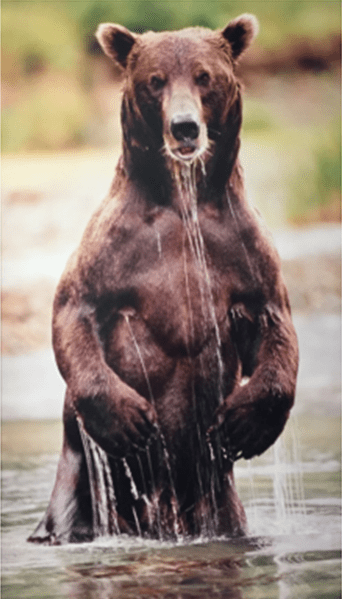
Grizzly Bear photographed in Katmai Alaska

“Standing Bear” photographed in Katmai Alaska by Gary Crandall

Crandall began our interview with one of his favorite stories about an adventure he had in Alaska on location to photograph the massive grizzlies during the summer salmon run in 2010.  Crandall with a group of 5 other men and their local guide Buck set off for a 3 week stay in the Katmai region of Alaska.

Very few people venture to this remote location so it was the perfect place for the party to get uninterrupted access to the local grizzly population there.  At high tide everyday hundreds of thousands of salmon swim through the river here with dozens of bears gorging on the fish.  The danger of encountering the grizzlies is high and the group set up camp with three electric fence perimeters.

Crandall tells of how the bears would come nightly to test the fences for a chance to get the food and possibly the humans invading their territory. Gary explains that “Buck was very adamant about turning the fences back on after going in or out, but one night the idiot went to get a beer and forgot to turn the fence back on.”  Early the next morning Crandall got up and went to start breakfast and the cooler containing all of the group’s 48 beers was tipped over and the complete stash of beer cans was punctured and consumed by a thirsty bear during the night.   Crandall had to do his work for the next 2 ½ weeks without a beer to quench his thirst and calm his nerves. Needless to say, Crandall was severely upset. However he laughed off the incident and stated “I just wish I could have seen the bear stumbling around after drinking all our beer.”

The trip was saved however and became a great success.  Crandall shot this amazing photo of one of the grizzlies standing in the river.  The “Standing Bear” shot became one of his most popular images and Gary deemed it his “money shot” for the season.

Crandall was always an avid reader and books about the West captured his imagination at an early age.  After high school when he traveled west on vacation he said he fell in love with beauty of the Teton Mountains in Wyoming.

During his younger years he enjoyed camping and backpacking in the more populated eastern US.  He was always interested in animals and like many kids he brought home wild “pets” from his explorations around his home.   But something changed in Crandall when he vacationed with his family in the West.  The tall mountains surrounded by wide open valleys inhabited by the majestic creatures of the American West captured his spirit and his imagination.   His awe and wonder led him to his talent and to his home in Jackson, WY where he finds peace and solitude in the Grand Teton Mountains surrounded by the subjects of his stunning images.

Crandall had a friend from high school whose parent moved west and opened an electrical wiring business in Utah. So in 1978 the 25 year old moved to Utah and worked in construction for 15 years while also enjoying his hobby of wildlife photography.  His passion and love of everything wild especially the grand creatures of the Rockies, Western Canada and the vast wild spaces of Alaska, and encouragement from his boss Rick Wangsguard led him to exhibit his images at various local photography shows.  His work started to get noticed and popular and he decided to transition from construction to professional photography.

In 1991 with Arron Goldenberg as his partner, Crandall opened his first gallery in Trolley Square in Salt Lake City, Utah.  The gallery was popular and at the time there was not very much competition in the Salt Lake market for this kind of work. The gallery stayed open in Trolley until 2004. With his images becoming more popular from exposure in the gallery he decided to try out showing his craft at larger regional photography and art shows in the intermountain west.

Crandall photographed this Wolf in West Yellowstone National Park - it was deemed his

Crandall photographed this Wolf in West Yellowstone National Park – it was deemed his “money shot” for 2014 – the name is “Pride of Yellowstone”

In 1994 Crandall took his images to the Indian Market Show in Denver.  A local Jackson Hole Wyoming businessman Sean Love and his father were attending the show that year. Love and his father were viewing the various works of art and photography with the hopes of finding and artist they could commission to sell the images in their store the Jackson Trading Post. The men discovered the stunning images shot by the young photographer Gary Crandall. They started a conversation with Crandall and thus began a long friendship and business partnership that continues today.

In the years following the pairing of Crandall and Love, the gallery business thrived.  They marketed and displayed the work in several galleries in the west and opened the Wild Spirits Gallery in Park City the mid 90’s and remained there until 2010. After closing in Park City Gary decided to move the main gallery and all production and framing operations from Utah to Jackson in 2011 so he could be closer to the Tetons and the creatures he loved to photograph. The move proved to be a very positive decision for the company and their sales.  The Jackson Trading Post bought out an adjoining space last year and remodeled it into a larger 1500 square foot gallery exclusively exhibiting the photography of Gary Crandall.  Besides the main gallery in Jackson, his work is displayed in Steamboat Colorado, Yellowstone Park, and the Grand Teton National Park and other destinations in the west.
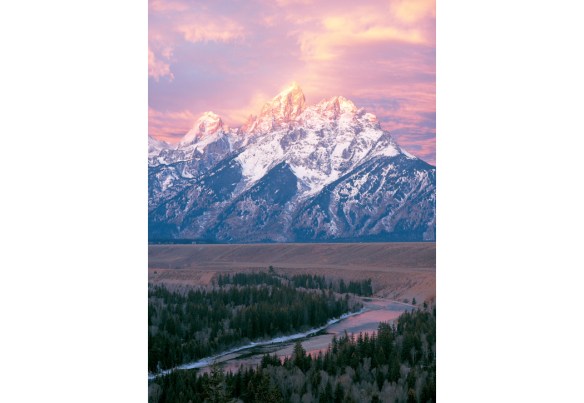
Image taken in Grand Teton National Park expressing the beauty of the park

Image taken by Gary Crandall in Grand Teton National Park expressing the beauty of the park

By doing all of his own photography and producing his own work into the final product Gary is able to keep his costs lower than his many competitors and sell his images at a rate more affordable to many customers.  Gary said, “I want anyone to afford our stuff.”

Contributing to the overall sales are multiple internet venues selling Crandall’s work.  However the works are best appreciated in person to realize the excellence and uniqueness of the scenery and wildlife captured on film. In the gallery setting you are surrounded by the beauty and majestic nature contained in Crandall’s photographs.

Hawk Watch, Lake Conservatory for Birds, Cornell Ornithology and the Nature Conservancy are just a few of the groups Gary donates his time and resources to in an effort to protect our wild spaces and our wildlife. While Crandall has won awards and accolades for his work, his most valued recognition comes from the conservation groups he works with and donates some of his profits and time to. 

While most people dream of turning their passions into their professions, Crandall has managed to actually do that.  While enjoying a good income, the rewards that he reaps are in making people gain an understanding and appreciation for our precious earth and all of her inhabitants.  He hopes his photos lead people to respecting and treasuring all animals and nature as he does.  

A shot showing the vast expanse of the Teton Range and the beauty of the park

A shot by Gary Crandall showing the vast expanse of the Teton Range

All photos by Gary Crandall with Gray Crane Studios
http://www.graycranestudios.com/
Jitterbug Antiques and Toys: a nostalgic toy shop faces tough times, happy customers

Story by Nick Jacobs

“Do you collect all of this yourself?” a woman asks Dee Jackmon, owner of Jitterbug Antiques and Toys, as she looks around with wonder at the thousands of antique toys, games, and airplanes. It’s hard to imagine that one man collected the countless brightly colored toy cars, retro neon signs, and dolls and action figures that line the walls of the shop. It’s also hard to imagine that in downtown Salt Lake City in a bustling economy such a magical little antique toyshop is doing about half the amount of business as last year.

The last year has been rough said the seventy six-year-old Dee Jackmon who said that many other stores on third south, known as the Broadway district, are having a tough time as well. However, Jackmon isn’t a cynical man, and the outlook at Jitterbug hasn’t always been this way.

Jitterbug has been around for more than 30 years. The original idea came from Jackmon’s wife, Kay, who gave up a lucrative job as a farmer’s insurance agent to start the shop. “She had all kind of things when I met her”, Jackmon said smiling, “She got it from her dad who was a junker”. He saw things in dumps and on the side of the street that were perfectly salvageable. He had a keen eye for perfectly usable items people had thrown away, and Kay brought the same collecting skills with her when they opened the shop in 1981.

“The first two years it was a rollercoaster ride”, Jackmon said explaining that they had no idea what to expect each day they opened, “but after 10-12 years it settled down.” They successfully ran the store together for 17 years before Kay was diagnosed with cancer. She died within the year. Jackmon has kept the shop open, running it by himself.

Dee Jackmon has collected a lot in the 34 years it has been open. Some of the toys and antiques are older than he is. There are all kinds of toys and antiques at Jitterbug: lunchboxes from cartoons aired in the 60’s, toy soldiers, collectible pins, brightly colored dolls, and several model airplanes. “Model airplanes have been my hobby my whole life” Jackmon said. Some of the airplanes he even made himself. He also collects marbles, though, there’s so many toys the shop you could say Dee collects practically anything. There’s even a whole display table full of old sodas in the shop.

Jackmon says that he still gets a lot of people in his shop; however, not as many people buy the toys and antiques anymore. Considering the low sales but high traffic the store gets, the shop almost serves as museum. Though there aren’t descriptions on every item, one could learn as much as from the store as from a museum by just asking a few questions. There’s toys and antiques from every era: radios from the 1930’s, election buttons from various campaigns, dolls from 1980’s sitcoms, and even pins from the Olympics. However, lately he has had a hard time selling all the toys and memorabilia.

Jackmon believes the downturn in business is due to the economy and new bike lanes put up last year. Yet, blaming the economy for the downturn in business is a hard sell considering sales-tax receipts were up 7 percent across Salt Lake City and up 8.75 percent along 300 South from 600 East to 300 West according to the city Finance Department by the Utah Tax Commission. The bike lanes, however, are a different story.

The bike lanes, which run all the way from 600 East to 300 West, were part of Mayor Becker’s push to make Salt Lake City more bike friendly. While Utah is the fifth most friendly state for bicyclists according to the American League of Bicyclists not everyone is so happy about the new bike infrastructure around the city. While a progress report from City Hall touts the bike lane as success increasing riders and sales, there is no concrete evidence that it increases the later. Business owners along 300 South, as well as residents, have mixed opinions on the lanes.

Jackmon has been very vocal about the bike lane having spoken to Mayor Becker and city officials as well customers and other business owners on 3rd South. He points to practical and aesthetic issues with the lanes: the lack of trees in front of store make it look like a “wasteland” he said. He also says that his elderly customers are confused by parking, and that the parking meters charge too much.

But if you can figure out the parking—or can get there some other way—Jitterbug Antiques and Toys is worth the trip. There is so much history in the store that it is practically a museum. One can get lost for quite some time browsing through all the unique toys and knick-knacks, and every time you go in there’s always countless new antiques and toys you didn’t notice last time. There isn’t another toy store in Salt Lake City that’s quite like it. Though business is down Jitterbug Antiques and Toys will most likely stay open, hopefully for another 30 years.

A cardiologist’s tale

Being a doctor certainly is not easy; it means having to work long hours and holidays. It also means seeing multiple patients a day and hoping not a single one gets bad news. It is a hard job, but for Abdallah Kfoury, this is what he has worked for his entire life. Kfoury is a cardiologist for Intermountain Healthcare who specializes in advanced heart failure and cardiac transplantation. He has always been fascinated with the medical field, but it definitely was not an easy route to get there.

Born and raised in Lebanon, Kfoury did not come to the United States until 1987. While he came to go to med school and earn residency, one of his main reasons for coming was to escape the war in Lebanon. The Lebanese Civil War lasted from 1975 to 1990 and still to this day is facing many hardships trying to recuperate. Kfoury knew better opportunities awaited in America, so he boarded a plane and created a new life for himself here.

Originally wanting to be an architect, Kfoury found his way to the field of medicine after going to a hospital when he was younger. He observed how the doctors gained the attention of everyone. It was an experience that peaked his interest and he was determined to make his dream a reality.

“Back home is such a small country. Everyone was either an engineer or a doctor or a lawyer.”

Kfoury followed this path and started his long journey to become a cardiologist. He pursued an education at the American University of Beirut Lebanon in New York. After that, he received his residency at Union Memorial Hospital in Baltimore, MD in Internal Medicine from 1988 to 1991 and was invited to continue his practice with a fellowship at the University of Utah Medical Center in Cardiovascular Disease from 1991 to 1995.

One can choose from many specialties when entering med school. For Kfoury, he drew a particular interest into cardiology because he liked the logical aspect of it. He especially liked that cardiology had a mixture of both science and medical factors.

“There are not a lot of organs in the body like the heart,” he said enthusiastically.

Cardiology is an extensive specialty. Kfoury dedicated many years learning the practice and becoming proficient in it. Apart from what he called “basic stuff,” for example measuring images of the heart and learning to read EKGs, he also had to learn to be a consultant.

On a typical day, when Kfoury is on clinical service, his day starts at 8 a.m. He can see anywhere from 35 to 40 patients a day. If he is at the hospital, he does rounds with his team, which includes a nurse, a fellow, and a pharmacist. They go around and see a patient and discuss how they can treat them. They can also gather together to discuss research and publish a future paper.

The job is very demanding and “high intensity,” but Kfoury still finds motivation in doing his job. “We are in a specialty where it is very rewarding.”

Kfoury finds hope in seeing the transformation of someone who is near death to someone quite healthy after treatments. He is able to help multiple people and to him, this is what motivates him to move forward. However, the job is not always happy. Sometimes, he has sick patients that he has to learn to let go. “Show compassion, and show you care. Tell it the way it is,” he said with a somber expression.

Being a cardiologist requires and extreme amount of patience and understanding. Kfoury spends countless hours in office, but he is proud to be able to help so many people. He wants to retire soon, but is looking forward to fostering and mentoring others who hope to enter the field.

Rising above adversities and helping others do the same

RyanMoodyJump

copyrights owned by: Nathan Biddle

Story written by: Nathan Biddle

Who would have thought that the sound of a tire on a bike skidding across the ground, or a friendly game of basketball would impact someone’s life so much that they would still be affected by those things years later? Ryan Moody did not.

Moody has held multiple world records with Guinness for the highest Standing Box Jump and highest Running Box Jump for several years but achieving those titles will not be easy. In his life he would sustained multiple injuries that he should have been paralyzed from, but those injuries were a launching pad for him to help others to travel through dark times in their lives. One event in his life will begin the process of changing him.

When Moody was about 8 years old he ran past his mom and sister, who were outside in the yard gardening, to jump onto his bike. He and his friends were challenging each other with a feat that seems impossible: to see who could skid their tire the longest and ultimately make it burst.

Moody wanted to be the first kid to succeed this feat. He jumped onto his bike and began to pedal as hard as he could for as long as he could. Pushing one foot in front of the other he began to accelerate to speeds that seem insane. Once he got up to his top speed he slammed on his breaks.

At this moment his life would be forever changed. At that moment his break cable broke. The lose cable found its way into the rim of the bike causing the bike to stop immediately. The abrupt stop caused Moody to travel over the top of the handle bars and through the air. He came crashing down face first onto a manhole cover. As he began to get up he noticed that there was some white powder on the ground. Confused a little, Moody continued to look around to see what has happened. He noticed that his mother was running, what seems to be in slow motion, over to him. The terrified look on the face of his mother still lingers in his mind. At this point he realizes he was in trouble. He also realized what that white powder on the ground was, it was his teeth that has been smashed when he hit the ground. His mother ran Moody to the hospital to make sure everything was okay. Upon closer inspection Moody had suffered neck and back injuries. To this day he still suffers from that accident.

After the bike incident Moody went back to being a kid. He did not know that another event in his life could change his life possibly forever.

Growing up in the Church of Jesus Christ of Ladder Day Saints he was privileged to serve a mission to Portugal for two years. Moody still being an active person wanted to play some basketball. He went out and began to play with some other people that were there. As he was playing he noticed that he had an opportunity to dunk the ball so he took it.
As he was coming down he landed on the edge of the pavement that caused him to fall. When he fell he hit the ground with a great amount of force. While he was lying on the ground he began to notice that there was an enormous amount of pain in his body but he could not move. He began to get nervous.

He found out through doctors that he had an incomplete spinal cord injury. This means he could feel the pain from the injury but he could not move any of his muscles. This pain has been with him to this day. While he was trying to recover, he would be bed ridden for a month in the middle of the summer heat in Portugal. After about a month he would regain some of his movements allowing him to return home.

When Moody arrived home he would be treated by doctors and therapist for the injuries that he sustained. This injury that he had obtained made the doctors nervous. They warned Moody that he may be at risk of further injury and recommended that he should never play sports or be as active again.

Moody did not know what to think. He began to slip into a dark place. His mind began to wonder thinking of the, “what ifs.” His life that he knew was gone. He could not see what is in store for him. He felt that he had no hope, no escape from the reality he was now living in.

RyanMoodyPortrait

copyrights owned by: Nathan Biddle

During a moment in this dark thinking is when a light flipped on for him. He knew that he had more life in him. He knew he had a lot more fight left in him. He sought for the help that would push him through this. With the help of family, friends, and doctors he began to fight back. He fought back so hard that he began to astonish doctors by achieving world records for box jumping. But he knew he had something more to give.

He has begun to seek out others that have suffered from a traumatic event. He wanted to let them know that this is not the end. There is hope if you are willing to fight. He would also teach them about fear. He found that fear for him means “False Evidence Appearing Real.”

He would also help teach the family members what they can do to help. The number one worst thing you could say to someone is that you know what they are going through. Chances are that you don’t understand. He would help the family members try to understand that they cannot fight the battles for their love ones. Moody tells the love ones the best thing you can do is to be there for them. When their love ones are ready to get to work you will right by their side. Let them know that they are not alone.

“There may be a greater purpose for you,” he tells people who have been affected by a major life event. He also tells them, “Focus on the positive.” One of the biggest take away from listening to Moody is, “It’s not a matter of what happens but what we decide to do in that moment.” Moody has helped people regain their confidence and showed them that there is more. “What has happened is not the end. What happened is the start of a new chapter.”

Bryan Luftglass: The man behind Expansion

Story by: ALICIA HOPKINS

“I thought there was a story worth telling,” says Bryan Luftglass as he discusses his career and the birth of his book Expansion: How Natural Gas Fuels are Reshaping Transportation in America. Luftglass has lived a fascinating life. He has experienced the best of both worlds, spending much of his childhood in suburban California near the ocean and in rural Connecticut. Luftglass attended Colgate University, a private liberal arts college in New York, where he received a good general education, but specialized in geology. He later attended graduate school at the Scripps Institution of Oceanography in La Jolla, California, where he specialized in “not specializing”. He tried to keep his studies as broad as possible, learning about physics, biology, chemistry, oceanography, and climate. He especially enjoyed studying coastal lagoons, which is how he received the nickname of “Bryan Lagoon”.

In his professional career he has spent about 10 years in the natural gas fuels business. He has over 20 years of experience as a business consultant and is also an author. Luftglass is currently trying to help start up 3 businesses: one that involves a new solar energy technology, one that involves recycling antifreeze, and one that would build on a social media/e-commerce concept he developed. In his spare time, he also does a bit of business consulting in green chemistry, environmental technologies, and fuels and energy. Currently Luftglass resides in Solitude, Utah, where he takes full advantage of having the majestic Utah mountain ranges in his backyard by hiking, skiing with his friends, biking, and teaching ski lessons part-time to beginners.

Luftglass’s love for the environment was planted as a young child. He reminisces, “I loved spending time in the woods in Connecticut and at the beach and tide pools and in the mountains in California. When I was a teenager, widespread environmental consciousness was coming into being and I attended a big event during the first-ever Earth Day. I also had a teacher in 9th grade who started a student club called ‘Protect Your Environment’ that I joined.”

Luftglass decided to put his knowledge and passion for the environment to use by writing a book. “I spent about 10 years in the ‘natural gas fuels’ business and thought that it was an important area that didn’t get a lot of attention, unlike electric vehicles, which was a popular topic because of champions like Elon Musk,” he says. He realized by working in the natural gas fuels business and in others, that important changes don’t just happen, but they do so because of the actions of individuals who are willing to take chances. He wanted to tell the stories of risk takers through the lens of the natural gas fuels business.

To a great degree, his whole career has involved writing in order to communicate concepts. “I just figured I had this book in me and wanted to get it out,” says Luftglass. He wanted to write a book that was very personality-driven and he had originally planned to frame it around a few key individuals, writing about each of them in great depth. He used the books of Michael Lewis as a template. However, he faced a couple of challenges. The first was that writing in the detail he originally planned to about these key individuals would possibly disclose too many personal details about them. He worried it would be professionally damaging for everyone involved. He also didn’t want to expose himself to the threat of lawsuits, which is why he kept discussions about individuals at a superficial level.

Luftglass wrote most of the book during the winter and spring of 2014. Most days he would go skiing in the morning, then ditch his friends and hunker down to write. He had originally planned to write a book that was at least 60,000 words and to write 1,000 words per day. However, only about 500 words would come out on most days and he didn’t want to push it. When he felt he had the book he wanted, it was only about 36,000 words. However, he was pleased with the final product.

Along with being an author, Luftglass is also a successful business consultant. He came to be successful by building up his credibility over many years of working in various areas of business. He says, “It has been very important to whatever success I’ve had to have a handful of people who know me well and are willing to hire me over and over or to refer me to their acquaintances.” According to Luftglass, it is very hard to free-lance in most businesses. He postulates, “It’s probably important to have a few clients who value you deeply rather than try to cast a broad net out to many prospective clients. Obviously, know your stuff and if you don’t know it, then be prepared to learn it fast!” He believes when you’re beginning your career and want to build up your own credibility or self-brand, the most important thing is to know yourself deeply, including your strengths and limitations. Luftglass advises to “be scrupulous and humble, and focus, focus, focus on what you can do better than others. Be prepared to give away a lot of free thinking, but balance that by not letting yourself get taken advantage of.”

Motherhood and the army

Story by Caitlin Jones

The ideas that women are weak and over dramatic are a conspiracy theory, women today often do what men do and more. But what happens when a woman has a family to raise, is a full time student and is in the army? Mackenzie Conn lives in North Carolina with her husband, Tyler and 2-year-old son Connor. She was stationed there almost three years ago and hasn’t complained about it yet.

Despite Conn’s father being in the army since before she was born she never thought of joining herself, until she started dating Tyler Price. He was already signed up for the Military and hyped about getting into all of the training. This gave Mackenzie the idea and soon after she enlisted for the army. When I heard what she had to say I asked her why she wanted to join. She told me “I will feel better knowing that I have helped my country defend themselves.” I never thought about going into the army and I am glad that I never joined but for her to feel better about herself I am glad that she found something she is proud of.

After returning from her Basic training Mackenzie had some really big news for me. She was pregnant. She was 19 at the time and I was a little concerned Tyler and her got married in Salt Lake City, Utah during the month of June and that coming December Connor was born at Womack Army Medical Center. But soon after Tyler was shipped overseas for training and left Mackenzie to take care of Conner on her own.

“Its hard knowing that my husband is overseas while I have to take care of Connor along with doing the medical things that I am doing.” She said with a stressed look on her face. She had just started taking classes at the local community college and that put a lot more stress on her than was necessary.

Two years ago I flew out to see how things were going for her and Connor. Tyler had just left again for more training and she needed some help. Back then Connor was a little over a year old and seemed happy doing almost everything but sleeping.. Now Connor is almost 3 and looks more like Mackenzie than I ever though was possible. When talking through Skype with Mackenzie, Connor looked at the screen and I heard him say “is that Aunt Caity?”

Mackenzie is now 22 and still working hard to keep their lives happy. She owns a house and has made a successful family for herself. Connor is going to preschool and sadly enough is growing into video games because of his dad. Tyler has been back more often but is currently overseas doing another mission. I ask Mackenzie what it is like now with Tyler gone compared to when he first left?

“it’s a lot easier now knowing that he is going to come home and not worrying if I am going to get a call. But Conner understands some things about where his dad goes and helps me out a lot when he is gone. Although Conner’s video game skills are getting scary good, he is better than me now.” She said with an amused smile. “I just enjoy knowing that here is always a part of Tyler in the house no matter what.”

Mackenzie is also doing full time schooling that the army is paying for due to her services. She is happy with her bio and anatomy classes and fascinated about the human body. She says that going to school, working for the army and taking care of a 2-year-old is a lot to juggle but she “wouldn’t have it any other way.”

Once a Fan, Now a Pro

andy larson

Story by Daniel Tate

As I drove to the Noodles and Company in Sugarhouse, Utah to meet up with Andy Larsen, I found myself talking out loud. I had even turned the radio down without even really meaning to. It was as if I was on my way to a very important test and I was trying to cram in as much information as I could before walking into class. The whole week leading up to this interview I was totally laid back about the whole situation, but as time drew near those nerves of mine began to set in. I was not nervous to meet up with Larsen, as we had met and talked multiple times before, but I found myself more nervous to talk with him as a professional and not just two fans talking about the team we cheer on.

“You’re the right guy to do it. You’re young, but professional. You’d be a good fit. You would receive credentials, free ticket to every game, you get to interview the players, and you have the opportunity to have your work published on ESPN.com. It was a big deal. I remember fist pumping.” Listening to Larsen speak these words I could still see the young, excited fan boy in him. At the wise old age of 24, Larsen has accomplished so much, but it could be said that he has been that lucky guy who was in the right place, at the right time to get where he is today.

Today Larsen makes a living, as a sports writer for KSL.com, but it was not always sports writing or even sports that was a passion for him during his adolescent years. It was actually mathematics. As I sat listening to stories of his childhood, this new information about his passion for math was somewhat surprising, but was also not surprising at all.

I first became familiar with Larsen through Jazz stats. Do not fear college students; this is not some kind of new math term that you will need to learn to become a successful sports writer or a math professor. You see Larsen and I are big Utah Jazz fans, and it was our passion for the team that brought us together. I first spoke with Larsen like most of us do these days on the social media web site Twitter. At the time he was writing articles for SLC Dunk, which covers the Utah Jazz for SB Nation. I really enjoyed reading his work, but there was always one thing I had a hard time comprehending about his articles and that was the stats. His articles were always heavy on Utah Jazz stats. I eventually sent a direct message to Larsen asking why he always felt the need to include so many stats in his articles and he replied with the generic answer of him wanting to give readers all the detailed information and then providing stats to back up his words. However it was this new information I had learned during our interview that provided me with what I felt was the real answer to my question.

So he is a math nerd. But how exactly does a math nerd end up with such an amazing sports writing job? “I got grounded and my mom said I couldn’t use the computer unless it was for school activities and so I figured I would just have to make my schoolwork fun” Larsen explained when asked how he first got into sports writing. He went on to tell me how he had an upcoming math presentation and he decided to mix in some baseball stats to give the presentation a little extra zing. While doing research for his presentation he began reading articles written by Nate Silver and random post on the web site Baseball Prospectus. Larsen recalls these articles as really being the spark that really got him interested in sports writing. However unlike the common sports fan that reads articles to just get updates on there favorite teams, Larsen was much more interested in how these writers were mixing in stats (aka math) into their writing. Thus in lies are answer to the question. The math nerd becomes a successful sports writer by finding a unique way to mix in his passion for mathematics into text that sports fan will find interesting.

Larsen graduated from Westminster College in 2012 with his degree in mathematics and it was not long after that he was given the chance to show off his writing skills to a much larger audience.

In May 2013 Larsen was approached to become the new managing editor of Salt City Hoops, which is the ESPN Truehoop blog for the Utah Jazz. Larsen accepted the offer and was on cloud nine. Before accepting the offer Larsen was a Jazz season ticket holder who went to every Utah Jazz home game. With his new job he would now be going to every game, every practice, interview players, and interview coaches. It was a dream come true, for a man who had never really dreamed of sports writing.

With two years of managing editing under his belt, Larsen was once again given the opportunity to move up in the sports writing ladder. In May 2015 Larsen accepted a sports writing position with KSL.com, one of the top news stations in Salt Lake City. In just a few short years, Larsen had gone from a teenager who decided to bring baseball stats into his math project, to a respected sports writer.

As my time with Larsen came to an end I was happy to learn some new things about a man I consider a friend and even some one I consider a role model in a way. Here was a man who had a passion for math since he was a young boy and he was able to mix in his passion into a successful career. It was also very refreshing to hear how calm about everything. Throughout the whole interview I never felt he was stressed about anything that came up throughout his life. When I asked him about this he smiled and recalled feeling very confident going into each new experience. Confidence was the key for Larsen’s writing and it should be the key for anyone looking to keep his or her passion alive while looking for a successful career.

A rise to the top: the story of Danny Vidal

Story by Kayla Vidal

Six years ago, Danny Vidal was lying on the cold concrete outside of the Fourth Street Homeless Shelter in a tattered jacket and ripped jeans. As he lay there staring up at the bitter winter sky, in a daze from being on the eighth day of a drunken binger, he realized that this was not the life he wanted.

Walking inside of a mansion sized home, glancing around all the ceiling to floor windows, expensive furniture and even fancy flooring, it wouldn’t have been obvious that the owner was a homeless alcoholic less than six years ago. Vidal sat seated across from me on a stark white couch. Wearing jeans, a button down t-shirt and some flip flops, looking far different from the business tycoon he is today, he claims he likes to stay close to his roots. He is more than prepared to open up about his troubled but inspirational past.

From the beginning, Vidal never had it easy. As a child, he carried a lot of burdens that most children shouldn’t. Being the man-of-the-house over his mother and four other brothers became too much for the young man, and at the age of 12, is when Vidal had his first drink of alcohol. In that moment, he had no idea that that one drink would lead to a huge addiction that would affect the rest of his life.

What started out as a way to let loose soon led him on a downward spiral that impacted the rest of his life. His addiction caused him to impregnate and marry his high school girlfriend. “It was too much. I was done. I wasn’t ready for it and I wanted a way out.” After a bitter divorce and custody trial left him with nothing, Vidal entered the lowest point of his life. His drinking became an everyday occurrence and he started losing everything.

“I didn’t realize how big my problem was until it was bigger than me and I couldn’t stop it from growing.” Before he knew it, Vidal woke up one cold Christmas morning a 30-year-old man living on the streets, with no job, no family and nothing to live for. “It was the darkest moment of my life. I realized that I either had to die because there was nothing for me to live for, or get my act together so I can find something to live for,” he says. After that life-changing morning, Vidal realized that he was going to change his life. He had hit rock bottom and was going to crawl out of the hole he’d dug for himself.

Two decades after his first drink, Vidal decided it was time for help. “This time was different,” he says “This time it was me going to them for real help, and not them pushing the help on me.” His new life began that day. He entered different facilities that help addicts, attended the Alcoholics Anonymous program and fought to change his life. Vidal claims that it was the hardest change he ever had to make, but it was worth it. In 2011, he started Pro Image Concrete in, and has reached rapid success since then. He’s maintained sobriety for the past five years and continues to fight every day against the drinks that ruined his life. “I make charity a big part of my life because I was given a second chance. I had the ability to completely reinvent my life and that’s not something I take lightly. I need to give back in order to show thanks for the gift I was given,” Vidal says.

Vidal wants to use his story as an inspiration to others and wants them to realize that nothing is too hard to overcome. He claims that one of the reasons he’s able to stay strong in his sobriety is because of the positive impact he’s seen his story have on others. “My main goal is to be the person that I want to be and make him better everyday, but also helping others become that person that they want to be,” he says. “I was given another shot, and everyone else should too.”

Dr. Taylor Hartman speaks out about the Color Code

Story by AJ Anderson

Dr. Taylor Hartman is most known for The Color Code. Published in 1987, the Color Code is a personality test that looks for the driving core motive in a person’s behavior.

Hartman is religious, and claims that he was inspired when he discovered The Color Code. He describes his moment of clarity as “One of the most powerful moments in my life  . . . I received the most beautiful power, intimacy, peace, and fun; with those you have clarity that you could never gain without.” Reds are driven by power, blues by intimacy, whites by peace, and yellows by fun.

People receive their results in different ways. According to Hartman, “People who like who they are have no problem with being identified . . . those who are struggling with the identification are not complete themselves and are having trouble being identified.”

In talking about his career Dr. Hartman says “I have been far more successful in business than I have been in education . . . Business lives more in the real world because they could apply it tomorrow.” Hartman talked about how his take on The Color Code is not backed by the evidence and research that educators demand, but how people in business could use it because it logically works and they are more pragmatic.

The success of The Color Code being business oriented could also be explained by its origin. Hartman explains that business men “were saying to me ‘I don’t want to talk about my problem; I want solutions,’ and I wasn’t taught solutions, I was taught to talk about the problem, and I liked what they were saying. Why shouldn’t we have something that is just as simple as two plus two is four?” When Hartman saw the need for immediate solutions he saw an opportunity.  The Color Code helps people to understand themselves and others now. It lists strengths and weaknesses. It is something that has been found to work, even if it is not backed by all of the academic research.

Dr. Hartman explained some of his philosophy in counseling by stating, “I think that nobody is fired because of their strengths . . .You lose a marriage because you are screwed up emotionally somehow. You lose a job because your weaknesses get in the way of the gifts that you bring. So I think it is foolish to not pay attention to our limitations. However, it would be foolish not to play to our strengths.”

When examining those strengths and weaknesses further Dr. Hartman took his explanations color by color.

For reds he said, “I can say your strengths lie in causing things to get done, creating energy, leadership . . . I would use your natural gifts of vision and charisma to get you where you want to go . . . Your flaws might be that you are insensitive . . .you do not follow through as well as you should with details, and you need to know that there are people that will be criticizing you because you see a vision, but you have no idea how get across a bridge.”

For the blue personality Hartman’s advice was, “I would say you’re excellent with follow through and the details, but you are not good with vision. You do not see where it needs to go. So you would do well to align yourself with somebody to create that for you and respect you for what gifts you bring. You should learn how to speak your mind more articulately because if not you will find that the reds and the yellows you need will be bored and inattentive.”

Counsel for the white personality was, “You are so good at seeing things. Your clarity is phenomenal. You must learn to speak your mind. You must learn to have confidence.”

The yellow personality, which Dr. Hartman identifies with the most he said, “To yellows I would say you are cute, but you are not that cute. I mean it is great that people like you, but you have got to realize that life is not all about you, and you need to show up sometimes because it is the right thing to do; not just because you want to.”

Hartman’s main philosophy is, “Play to your strengths, and acknowledge and work on your limitations.”

When asked how often Hartman uses The Color Code in marriage counseling he responded, “Every time. They may not know that I am using it. I will give a red or blue homework that has to do with attitude because that is where they are weakest, and I will give a white or a yellow behavioral homework because that is where they are weakest.” Dr. Hartman finds his counsel well received, “I think people want advice, and I think they want to figure things out.” He also talks about why he can be direct with people and they will still come back. “I am yellow so when I say it it does not have the same weight as it would have if I were red or blue. I’m not judgmental. I can be more direct and not have that weight. I think change is hard. I think going home and changing that is hard to do.”

The Color Code has had a wide circulation. On this topic Hartman expounded, “I’ve let The Color Code be used more than it probably should, and it is great if it helps people. I’m happy when people use it in a beneficial way. I don’t like it when it gets misused when people say I’m yellow so that is why I’m always late. I don’t want to be used as an excuse. That offends me.”

When asked about other personality tests like Which Frozen Character Are You? Hartman said, “I hate it. If math did what psychology does no one would trust it.” He talked about how psychology is a scientific field, and needs to be treated with respect.

The Color Code and Dr. Taylor Hartman are not two separate entities. Dr. Hartman views The Color Code as divine inspiration that has shaped and continues to shape his life.

Kevin Kirk’s record store still stands as one of the best

Story/photos by Chris Ayers.

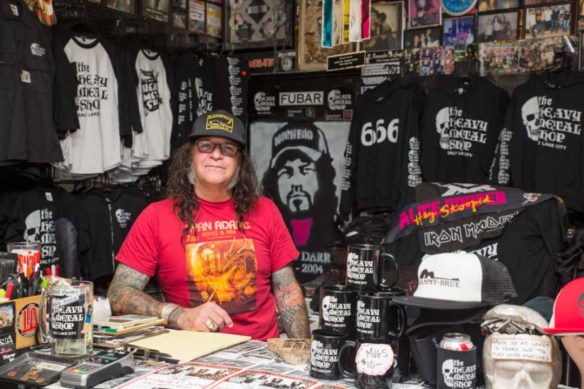
A Salt Lake music store that sells heavy-metal/hard rock music exclusively, and is a local business? Sounds like a recipe for disaster in 2015. But these obstacles have not stopped Kevin Kirk, who has been the sole owner of The Heavy Metal Shop and has been “Peddlin’ Evil Since 1987!”.kev

Although a fan of many music genres, harder and heavier music has a special place in Kirk’s heart. Kirk likes a wide variety of music, but the most popular genres at the time he opened his first store (The CD Shop) in 1986, such as jazz and new age, were not his shot of whisky. “I’d rather know about everything I sell,” he said. In 1987, he changed the direction of his shop and rebranded. The Heavy Metal Shop was born.

Living in an age of digital and piracy makes survival difficult for music stores, especially local music stores selling specific genres of music. In 1994, Kirk ordered 1,000 copies of Slayer’s “Divine Intervention” and sold them all in a matter of weeks. Today, he would be lucky to sell at least 50 copies of any big band’s release.  Kirk doesn’t dwell on what should’ve been done to combat piracy: “I think it’s too late to fix that problem!” he laughs. Although still a record store at heart, Kirk followed the lead of many famous bands whose record sales have slowed down: merchandising.Sticker

The classic skull logo came from a former customer from The CD Shop. Not knowing much about heavy metal (Kirk payed him with old jazz CDs), the illustrator originally drew half a record as part of the logo, which was a great idea—for a normal record store. After hearing Kirk’s feedback, he changed it to the half-skull logo we now know today.

Kirk sold store t-shirts to his customers, like other businesses. Except most businesses don’t have their merchandise worn by famous bands and musicians. Tom Araya and Jeff Hanneman of Slayer, the pioneers of thrash-metal  were among the first to wear THMS shirts, and the store’s phone line was flooded with orders after Araya represented the shop on the cover of the September 1991 issue of “Kerrang.”  The increasing popularity of the logo ended up creating an entire line of merchandising such as hats, coffee mugs, sweatshirts and sweatpants,  patches, and even booty shorts; none of which Kirk ever planned on.

Perhaps the biggest metal celebrity to wear the store’s shirt is Kirk’s favorite musician of all time: Alice Cooper. Kirk first met Cooper when he came into his shop in ’87, and met him again in ’91  during the “Operation Rock ‘N’ Roll” tour with Judas Priest and Motörhead. Cooper casually mentioned that he wore a t-shirt with the store’s logo during an interview with KUTV. Kirk contacted the news immediately after the concert and got a recording of it. “That was probably one of the biggest thrills, you know, in all the years I’ve been in business; just having him do that… that was really cool.” Cooper continues to wear the shirt and sees many of his fans in the audience wearing the shirts as well.

“Metal people are real loyal to their bands and it seems like they’re loyal to me too,” Kirk said about the die-hard loyalty of metal heads (some of Slayer’s fans are crazy enough to carve the band’s logo in their body). Customers that have been around since the beginning of the store still come in to buy the latest album releases; a tradition that is passed down to their children as well. No doubt a factor that has helped keep THMS in business.HMS

Despite being smaller than a gas station convenience store, there is just enough room for a small gig. The original Heavy Metal Shop was a combination of a record store with a small venue in the back. “I’d have ‘Open for bizand then the back room would be for shows. And then when I moved to Sugar House we started doing a lot of in-stores with bands where they would do signings…” Having a band already in his store? Might as well have them play their music there live too. After the landlord sold the property, and the new owners tore the building down, Kirk relocated to where the shop has stood since 2001. Moving to 63 Exchange Place, the heart of downtown Salt Lake, turned out to be a blessing in disguise. He again built a small stage and continues to have local groups perform a short concert for people and sell their records. “It’s funny how that works, because things come back around.”

Cooper is not the only musical god that Kirk met because of his store. When asked who he hasn’t met, he had to actually think about it. “Uh… God, you know, I’ve met most of my heroes. I’ve met Iggy Pop, Alice and Ozzy [Osbourne, known as “The Godfather of Heavy-Metal”], [Ronnie James] Dio…  I haven’t met Tony Iommi… that would be pretty awesome… I can’t really think of anyone else.” That dream might become a reality when Black Sabbath visits USANA Amphitheater in September 2016 on their “The End” tour. Slayer, Lemmy of Motörhead, and the late great Dimebag Darrell of Pantera and Damageplan are also on the list of Kirk’s heroes he has met. Having the actual “Metal God” Rob Halford visit his store also makes his list of “biggest thrills.”

The spirit of record stores will always live on. Those who are “old school” will continue to shop there and will make it a tradition for their offspring to go there as well. Owning a piece of merchandise is a great conversation starter for some, and because it’s free advertising many will give the shop a visit. And with a record store that plays live concerts for local bands, The Heavy Metal Shop will, no doubt, continue to thrive for many more years to come.

Visit the Heavy Metal Shop website.

Poll : Federal Deficit Top Election Issue for US voters

SALT LAKE CITY – As the GOP primary nears an end, voters prepare for the general election between what appears to be Governor Mitt Romney versus President Barack Obama.  Monday’s Gallup poll shows that the federal deficit, unemployment, gas prices and healthcare are the most important issues to voters while government birth control policies rank lowest.

Seventy-seven percent of all voters said that the federal budget deficit and national debt is extremely or very important in the coming election.

Emily Jorgenson, a newly registered voter that is studying accounting at Brigham Young University explained why this issue is so important to her.

“You can not spend money you do not have.  When will it ever stop? If my family lived the same way as the government we would be looking at a sad future.  I think this country has the same outlook if we don’t stop over spending in Washington,” said Jorgenson.

Seventy-nine percent of all voters polled showed that unemployment is extremely or very important in the coming election.

“Everyone in government is just trying to make the rich richer and make the poor poorer,” said Marty Stevenson, a janitor at the University of Utah.

Chris Christiansen share similar feelings regarding the issue of unemployment.

“I have been in college for almost four years and it looks like it will be extremely hard to find a job.  I just hope I am not an unemployed college grad,” said Christiansen.

The Gallup poll was conducted March 25 – 26 with a random sample of 901 registered voters.  The poll has a margin of error of four percentage points.

The Dirty War that Few Americans Know About

SALT LAKE CITY – Human rights groups estimate that over 30,000 people were tortured and killed in Argentina from 1976 to 1983.  The seven years of disappearance and killing by Argentine government is known as The Dirty War.  Many Americans have never even heard of it.

On Saturday, Feb. 25, nearly 100 people gathered in the Salt Lake City library to learn more and to watch the documentary titled “Las Abuelas de Plaza de Mayo and The Search for Identity.” The documentary is made of 40 interviews and historical that vividly shows The Dirty War.

The film shows that nearly 500 mothers had their newborn children taken away during a time of political unrest.  Some of the women were pregnant or were new mothers when they were captured and the infants ended up in the homes of government officials and others sympathetic to the regime.  The new parents changed the babies’ names, birth dates and other details about their identities.

Dr. C.A Tuggle, professor and director of the journalism program at the University of North Carolina at Chapel Hill, had not even hear of The Diry War until he went to teach in Argentina for five weeks.

Originally Tuggle’s daughter began a project to study The Dirty War for her sister Bethany Parker’s broadcast journalism class at UNC.  After living in Argentina and learning more of their studies, Tuggle realized they not turn down taking their project even further.

Tuggle said, “It was just too powerful of a story to break up into two or three two-minute stories.  We had that a-ha moment where we decided to do a documentary.  We love human interest stories and realized that not many Americans were familiar with this story.  The documentary could help them know and understand the history and the current effort of these women searching for their identity shown in the documentary.”

Brynne Miller, an Elon University graduate of the Masters of Arts in Interactive Media program does most of the interviewing in the film.

Miller poses the question.  “Is the right to know who you are a basic human right?

Through extensive research and persistent efforts, Las Abuelas has done just that as they located more than 100 of the missing children, many of whom had no knowledge of their past nor of their true identities.  Some 400 still remain to be located.

“Our main goal is to get the word out about the film and these stories,” Tuggle explained after the show.

The documentary is set to show in over 90 Universities across the country.  In the Salt Lake City Library, the crowd was full of questions.

“I had no idea that these horrible things were taking place while I was in college.  You would think that we could have heard something,” said Greg Henderson, a local business owner.

Students questioned whether similar things are taking place today in other countries.

“It makes you think that there has to be all sorts of events like this that other countries keep secret.  It is probably happening in Syria and all over the Middle East right now.  I bet China would do stuff like this,” said Jeff Johnson, currently studying political science at Salt Lake Community College.

To find out more about “Las Abuelas de la Plaza de Mayo” visit the website http://searchforidentitydocumentary.com