Utah Transit Authority, Salt Lake Arts Council team up to bring artwork to TRAX stations

Story and slideshow by LISA HENDRY

This slideshow requires JavaScript.

The platform is dotted with people. Some wear backpacks, some carry briefcases; other people clutch coffee cups, or push over a bike. The brakes sound on the track. A button is pushed, the doors open.

The automated voice fills the air, “You are on the Red Line train to Daybreak.” The brakes lift, people settle into their seats and TRAX is on its way.

Stop after stop, people come and go. The next station is reached. The doors open onto the TRAX station. More can be found there than just the dull grind of commuters. A flash of color, a crop of shaped metal, a reflection of glass. There is art.

Amid the scattered travelers, signs, schedules and benches that line each TRAX station, there are shapes and designs, colors and murals — art that Utah’s students, children, artists and government have all contributed to bring life to the urban landscape.

To bring about these pieces of art, the Utah Transit Authority (UTA) partnered with the Salt Lake City Arts Council in a project called Art in Transit.

“It is really designed to enhance the character of our transit system,” said Jerry Carpenter, a UTA spokesman, in a phone interview. UTA works with local art commissions of different cities to select artists.

Roni Thomas, project manager at the Salt Lake City Arts Council, has worked with UTA for the Art in Transit program. She is currently involved in the most recent project of developing the North Temple line, which will feature its art pieces in fall 2012.

“When this line is done, we would have worked with the UTA at 20 stations,” Thomas said in a phone interview.

Thomas said the Arts Council is involved in the artist selection process from start to finish. The council presents a call to artists to commission their artwork, based on requests for qualifications and requests for proposal. The Salt Lake design board, made up of  Council members and members of UTA, makes a recommendation to the mayor and CEO of UTA to approve the artwork after it has been proposed.

Each project is commissioned $90,000, an amount split by UTA and the city. After completion, the artwork is owned and maintained by the UTA. Some stations are open to national artists, while others are left exclusively for Utah artists.

“We are supporting local artists,” Thomas said. “When visitors come in town and see ‘oh that’s done locally,’ it is something the community can look at and take pride in.”

The Trolley TRAX station, located at 625 E. 400 South, was one of these stations. It was a project not only done by local artists, but also by children of Salt Lake City. Bad Dog Arts, located in downtown Salt Lake City, undertook the art project and allowed children to create the artwork.

“We’re all about art,” said Victoria Lyons, co-founder and co-director of Bad Dog Arts. The Bad Dog Arts program is a nonprofit organization that works with children ages 5 to 18 and allows them to create art as a positive outlet. The station provided an ideal landscape for the Bad Dog Arts project.

“The imagery is different reflection and action of community from kids’ perspectives.” Lyons said in a phone interview.

The station contains several different elements. Mosaic tiles line the station, both on benches in bright, colorful patterns and outlining the station ramps. Some drawings are engraved into granite pavers. Art and poetry is displayed under the canopies; that artwork resulted from a Bad Dog Arts writing program.

“Art can be life changing,” Lyons said. “It makes a huge difference in kids’ lives and can sometimes be one of the ways to reach kids to communicate and allow them to contribute to the community in a positive way.”

Just like this beneficial project, each piece of art is about speaking to the particular area.

“It’s a way that we enhance the riding experience and give them (the riders) something to look at that is typically reflective of the community,” UTA spokesman Carpenter said.

According to Thomas, it is up to the artists to speak to the area by researching the location, community and history of the area.

For example, the “Flame Figure” by Michael Stutz, located at Rice Eccles Stadium, is representative of the line that was installed just as the 2002 Winter Olympics came to Salt Lake City. The artwork there ties together the theme of the Olympics, blending the human form with the energy of fire.

All future UTA art projects will continue to say something about the rich history of the location and appeal to the area.

Each individual project has goals the Salt Lake City Arts Council wants to accomplish. For example, all six of the stations along the new North Temple line will emphasize the feeling of moving from the downtown area to the more open area surrounding the airport. “We want to create a sense of arrival in the city,” Thomas said.

Other artwork still in progress can be seen at the Midvale Bingham station, which will feature art titled “Utah Bit and Mine.” Carpenter said it is an interactive artwork that uses a great amount of creativity and shows just how neat art can be. The art is designed to highlight and reflect Utah’s deep mining history.

As the TRAX lines expand, the new art that is being proposed will take a different approach in representing the city of Provo. It will be using bright, whimsical figures to give the city that bright, offbeat and dynamic feel. Instead of representing Provo’s history, the art will demonstrate that Provo is a modern, developing city.

“The thing that is interesting about art is what is appealing to some people others might not like. So you want to find something that is part of the community,” Thomas said.

That is exactly what these pieces of art do. In supporting local artists and giving shape to Utah’s history and background, the art at the TRAX stations enriches the experience of those riding public transportation. It is something that the commuters can take pride in, and feel a part of.

“It helps make a more viable and bright community,” Thomas said, “and that’s what public art does.”

Do Ethics Exist in Journalism?

Story by Mitch Waite

“I have a feeling that by the end of my talk, you’ll decide that no one is ethical,” said Jim Fisher, a professor in the Department of Communication.

Fisher gave a lecture to a class on Monday about moral and ethics in journalism and guidelines to follow when writing a story.

Fisher also stated “ethics is a process of making decisions.”  Sean Gustafson, a student who was present during the lecture, said, “It got me to think about what ethics really is. I’ve taken some philosophy classes so it was a good reminder of what really is ethics and morality.”  Aside from ethics, Fisher explained the purpose of a journalist.

Fisher further said, “journalism says that this is where I got the information, now you decide.”  He further stated that purpose of a journalist is to comfort the afflicted and to afflict the comfortable.  Also, Fisher emphasized the importance of the full story and getting the accurate truth.

Fisher explained that, “Nine times out of ten, weak-ass journalism is the result of presenting only two sides of a story.”  He stressed the importance of seeking the truth and properly gathering and reporting the right information.

Students who heard the lecture, such as Megan Hulet, felt that the overall goal of the lecture was to teach proper ethical journalism.  Fisher gave a guideline sheet to each student for their future story writing.

The Natural History Museum of Utah opens new state-of-the-art museum

Story by Chris Washington

After several years of construction and planning, the Natural History Museum of Utah’s (NHMU) new facility is finally open to the public.

Construction on the Rio Tinto Center, as it’s called, dates back to around 2005 and didn’t officially open until Saturday.

Many of the people involved have high hopes for the new museum.

“I think we put together a great museum in a great location,” said Patti Carpenter, director of public relations for the museum. To celebrate its grand opening, admission was free for the entire first day.

NHMU, which is located at the University of Utah, is a major research institution that focuses primarily on both the natural and cultural history of the Great Basin Region.

A unique aspect of the museum is its ability to display multiple forms of information in one given area.

“One of our goals was for families to be able to experience the museum together and so in each area you’ll find something to look at, something to listen to, something to smell we have smells, and something to do,” said Randy Irmis, the curator of paleontology for the museum.

The new Rio Tinto Center is 163,000 square feet, with a staggering 51,000 feet as public gallery space. Todd Schliemann, the design architect for the building said that his goal was to “symbolize the beauty and magnitude of the state’s unique landscapes.”

Not only is the new facility state of the art, it is also highly energy-efficient with radiant cooling and heating systems, as well as water-efficient landscaping and plans for a solar-paneled roof that could power more than 25 percent of the museum. The facility also used recycled materials for more than 25 percent of the structural and architectural resources. If that wasn’t enough, over 75 percent of the museum’s construction waste was recycled.

Trust in Media Accuracy is Declining

Story by Steven Blomquist

Trust in news media has changed over time according to a recent poll by Pew Research Center published in Sept. of 2011
In 1985, 34 percent of people believed stories published in the media were inaccurate. Today, 66 percent of people believed that stories are inaccurate.
Local news organizations tend to be the most trusted of the news media, as 69 percent of people trust their local news organizations. The survey showed that large organizations such as Yahoo and Google tend to be most common where people get their information.  These national organizations tend to only have 59 percent trust approval.
“Google and Yahoo have… so much news information that it makes it a one stop shop,” said Alex Rasmussen, at student of communication at the University of Utah.
Receiving information from national organizations such as CNN and FOX News is the second most common form. According to the survey 77 percent of the people surveyed believe that those press organizations tend to favor one side of a point of view.
Tyson Phillips, a mass communication student, said he believes, “It’s good to get information from multiple sources to receive your news.”
The percentage of people who believe that the press is influenced by powerful people is up from 53 percent in 1985 and is now 80 percent in 2011.
Bryant Jacobson, a Democrat, US Army veteran and current student at the University of Utah, said, “News organizations have their own agendas, thus making it hard to trust what they say.”
The Pew Research Poll has shown throughout their study of many different aspects trust in media has changed over the past 25 years. People tend to not trust news media as much as they once did.

Floyd Norris Speaks On The American Economy

Story by Mitch Waite

“We used to take for granted, that the government should try and improve the economy, and that there were things that it could do,” said Floyd Norris, chief financial correspondent of the New York Times.

Norris gave a lecture addressing the question, “What’s wrong with the American economy?”  He offered reasons for the cause of the recent recession, and possible solutions for what can be done to improve the economy.

Norris addressed the current issues with the nation’s economy, and what he believed to be the primary reason for the financial woes of the United States.  He mentioned the main reason as to why the economy is in its current poor position.  “A lot of the suffering that we are undergoing now, and that is affecting your lives was brought on by people who bought homes that they never should have purchased, and paid more than they could possibly afford,” he said.

Norris further mentioned that as much as there is little sympathy that exists for the people who borrowed. Also, there is great hostility towards the banks that made those loans.  As Norris put it, “They reduced the lending standards and in some cases, they helped borrowers lie about their income or assets to qualify.”  Citing these reasons, Norris offered solutions that could help in reviving the economy.

One solution that is heavily debated is that of stimulus spending.  Through 2008 and 2009 there was a period of stimulus spending that the Federal Reserve implemented.  By 2010 it appeared to be working with huge gains, but ultimately, those gains were lost.  However, Norris stated, “It seems to me that the analysis is since stimulus didn’t work, we shouldn’t try it.  It’s similar to the analysis that a student who studies for a test does poorly and thinks, ‘well there is obviously no point in studying’.  There is another conclusion.  You could read which is perhaps to do more.  To me, that is the answer on stimulus.”  Norris said that stimulus could work, but it isn’t the only answer.

Actually, Norris said that inflation could help as well.  Though the majority of people feel that inflation is a bad thing, Norris said that “good” economists are lobbying for inflation.  In an interview after the presentation, Norris further explained that inflation could help reduce debt burden by counteracting deflation.  Simply put, if a person owed $2,000 in the 1940s, it would take maybe a year to pay it off, but today, they could pay it off in a matter of weeks.  Norris outlined one other option for combating the poor economy and a way of getting rid of debt.

Norris said he wishes that the practice of mortgage cramdown had been adopted.  Last year this would have given judges the ability to reduce what is owed on a loan for those declaring bankruptcy.  One attendant to the conference, Brad Toone, mentioned having heard that mortgage cramdown was aggressively fought against due to the belief that it would create even more uncertainty in the value of mortgages.

Individuals who heard the lecture, such as Shandi Beckwith, said she felt that Norris was able to narrow the scope of such a broad subject as the economy in America.

Norris Covers Economic Issues

Story by Steven Blomquist

Norris Covers Economic Issues

“Capitalism messes with a lot of things up but it’s better than the alternatives” said Floyd Norris.
An audience of eager students packed the Marriott Library’s Gould Auditorium to discuss the challenges with the US economy with Floyd Norris, chief financial correspondent for The New York Times.
Norris began by remembering one of the most influential men in American government Andrew Mellon, who served as Treasury secretary in the early 1900’s. Who is said by many “three Presidents served under him.” according to Norris. Mellon was supporter of free-market ideas, urging government to refrain from getting involved.
Quoting Herman Cain, Norris said “Don’t blame Wall Street, don’t blame the big banks, if you don’t have a good job blame you.” There is a lot of talk lately about the struggling job market and expectation for the government to provide jobs for the people.
“While we don’t really have a lot of faith in government now, that lack of faith may have been earned” through a stimulus plan that hasn’t fulfilled on its promises and bad regulation, according to Norris.
This country needs more stimulus, Norris said, comparing it to a student who studied for an exam and did poorly on it doesn’t mean the student shouldn’t study.  The student may need to take the next step and study a bit more or in this case of the economy it may need more stimulus.
“Bad regulation and lack of regulation got us into this mess,” Norris said. “The financial crisis would not have happened if either the financial system or the government regulators had performed better.”
Norris said that the banks are also partly to blame for the today’s economic issues, for allowing people to purchase houses knowing they wouldn’t be able to pay back the loans. Norris said, “We should have intervened before the foreclosures happened.”
Norris also said that it is time to extend a helping hand. One thing Norris mentioned was to give lower interest rates. That would make it so the American people can begin to dig us out of economic downturn.  He said we the economists/American public don’t know how long it is going to take to bounce back but went on to say bounce back could take an upward to seven years from the time economy blew up.
Norris began to close the forum by saying “I love this country… proud to pay taxes and wouldn’t mind paying more to help us get out of this crisis.
“Norris also went on to say, “ (while) capitalism messes… a lot of things up but it’s better than the alternatives.”
Rachel Thomas, a communication major, said it was a good opportunity to learn about the complicated issue of the economy.
“There is so much going about the state of the economy its hard to follow with all the homework we have,” said Thomas. “Opportunities like this allow for college students to take a brake and get informed on what’s going on in the economy.”
Makaylee Pettit, a communication major, said “It was very informative and a great opportunity to hear a national financial journalist take about the current state of the economy.”
“Norris’s presentation was great opportunity for college students to understand why we are in this economic downturn. For college age students don’t have time to focus on todays issues as they are so busy studying textbooks.” Thomas.

Media watch politicians, but who watches the media?

Story by Shannon Hunter

“Our audience is the biggest fact checker we have,” said reporter John Daley referring to the role of citizens in journalism.
This was one of many topics discussed during a panel at the University of Utah’s Hinckley Institute of Politics on Friday, Oct. 28.
The panelists included: Matt Canham, Washington correspondent for the Salt Lake Tribune; John Daley, a reporter for KSL and Deseret News; and Susan Tolchin, a professor at George Mason University.
The importance of reader participation was emphasized throughout the discussion. All three panelists agreed that journalism is different today. The pressure to publish things daily, even hourly, has created a lack of fact checking, thereby increasing the amount of mistakes.
“When you as a reader see a mistake it is your responsibility as a media reader to tell us,” said Canham.
The panelists also talked about the importance of the corrections the readers send in. They also mentioned the effect that mistakes can have on a piece, even when a correction is made. Tolchin confronted the matter of how few people read the corrections, including herself among those who don’t.
Canham said there are different kinds of errors that can be made, not only factual errors. He explained that a mistake can be made in the way a reporter words things in his or her writing and that it can have just as much, if not bigger, of an effect on the piece. According to Canham, this is one of the many ways journalism has changed in this generation.
Canham believes this is an “interesting time to be in the business,” and that the upcoming generation can accomplish the role of journalists.
“It’s the best of times (and) the worst of times,” said Daley when referring to the difficulty in finding jobs while new technology helps reveal more information.
For example, journalists now not only compete with other journalists but also with citizens who can download information or videos from their cell phones to the web and post stories before reporters do. Sarah Vaughn, a member of the audience, considered this an “important issue.”
Tolchin expressed that she’s excited for the current state of the media. She hopes that the future of journalism will correct government issues and keep politicians honest.
Canham said he disagrees with how politics are being reported and that in his reporting he wants to spend his time most effectively and find a way to give his readers both what they need and want.
“It’s like you’re watching coverage for the NFL (and) who’s going to get that touchdown… It’s a big problem,” said Daley, referring to the current trend of reporting about polls and standings instead of proposed policies from the candidates.
Canham agreed, pointing out the importance of the media in elections by influencing what the voters do or don’t know going into the booths. He emphasized that they “are part of this process.”
Laura Qualey, a member of the audience, found the distinction between “reporting relevant things” from irrelevant topics to be the most important issue discussed by the panelists.
When coming to an end, it was clear that all three panelists agreed that while the media needs to keep an eye on politicians citizens need to keep an eye on the media.

Family-Friendly Natural History Museum Opens

Story by Elysia Yuen
The new Natural History Museum of Utah is a place of interactive learning and growth for people of all ages.
The museum opened on Nov. 18, 2011. It displays 10 new galleries including three learning labs to enhance learning opportunities for its visitors.
“This is a place where we can inspire that curiosity early on and get kids trying their hand at observation, at study, at really trying to figure things out on their own,” said Becky Menlove, exhibit director for the museum.
Randy Irmis, curator of paleontology emphasized that a goal of the museum was to encourage families to enjoy the experience together.
“In each area you’ll find something to look at, something to listen to, something to smell and something to do,” said Irmis.
The museum connects visitors to several branches of science instead of focusing on only one subject. It also focuses on informing patrons of Utah’s natural surroundings and Native people.
The new exhibits include: Utah Sky and View Terrace, Native Voice, Life, Land, First Peoples, Lake (Great Salt Lake), Past Worlds, Utah Futures, Minerals and Our Backyard. Each display emphasizes the unique characteristics and history of the Utah area.
The design of the building also reflects Utah’s history. Todd Schliemann, the building’s architect, spent many years studying the geography of Utah.
Schliemann said he wanted the space to “symbolize the beauty and magnitude of the state’s unique landscapes.”
All of the displays and architecture are an integrated effort to enhance learning and interactivity among its visitors.
For those on a budget wanting to visit the museum, free admission days will be offered during the 2012 season. The dates are as follows: Jan. 9, April 9, July 9 and Sep. 22. More information can also be found on the museum website, http://nhmu.utah.edu/.

Word Count: 256

Natural History Museum Offers New, Interesting Exhibits

Story by Kourtney Mather

After years of planning and much anticipation, the Natural History Museum of Utah opened to the public this weekend at the Rio Tinto Center.
The NHMU has many new exhibits in the 51,000 square foot center ranging in topic from the ancient Lake Bonneville that covered most of the state of Utah, to a storytelling area featuring Utah’s Native American tribes and their histories.
The broad spectrum of topics and exhibits at the museum, however, was no accident. Becky Menlove, the exhibit director for the museum, explained that they wanted to “create very interdisciplinary exhibits so that you’re not learning about rocks at a particular time, but also about plants…paleontology…hydrology…because that’s really how we learn when we’re out in nature ourselves.”
Of course, no natural history museum would be complete without a dinosaur exhibit. The display features “one of the largest duck-billed dinosaurs to be mounted anywhere in the U.S.,” explained Randy Irmis, the curator of paleontology for the museum. “We’ve tried to lay it out as it was found in the field to give people a sense of what it’s like when you find these fossils.”
Todd Schliemann, the design architect for the building, spent years studying the geography of Utah to create the perfect design for the building in relation to the unique landscapes of Utah.
“When you walk into it, yes you feel a little small,” Schliemann explained, “but maybe you also feel like you’re in a cathedral and the space is beginning to lift you up and getting you ready to learn…”
The museum is open every day from 10 a.m. to 5 p.m. with special extended hours on Wednesdays when it is open until 9 p.m. For more information visit http://www.nhmu.utah.edu.

Salt Lake’s ‘Little Chocolatiers’ take many steps toward a successful business

Story and slideshow by CARLY SZEMEREY

“I think there are some similarities with us and Steve Jobs,” Steve Hatch said in a phone interview. “We are both very picky about our businesses.”

Hatch, 41, is one of the owners and founders of Hatch Family Chocolates. Along with his wife Katie Masterson, 41, they are working hard to make their business successful.

After Masterson and Hatch were married, they knew they wanted to start a business at some point. However, these two didn’t know what kind of store they wanted. They weren’t sure if they wanted to open a coffee shop, a bakery or something else.

With a bit of background in chocolate-dipping, Hatch thought a chocolate factory might be a good option.

“My family dipped chocolates all their lives,” Hatch said. His grandmother dipped chocolates and taught his father, who then went on to continue this tradition for many years. He would do it as a hobby and give these chocolates to friends and neighbors. Then, after he retired he began selling his specialty treats at boutiques.

With this experience and tradition, Hatch and Masterson felt confident that this was the business they wanted to go into. So they got to work.

First, Hatch and Masterson searched for a suitable location. They toured several buildings before finding the right space to start their business. “It just fell into place,” Hatch said.

The next step was to prepare for the business aspect of the company since Masterson, who received her culinary degree at CHIC — Cooking and Hospitality Institute of Chicago — had the baking side covered. Hatch enrolled in some business classes at Utah State University and the University of Utah to aid him in this preparation.

They opened their shop, Hatch Family Chocolates, on April 19, 2003. The shop at 390 E. 4th Ave. was small, because they didn’t know if their business was going to be successful.

To boost their business, Hatch and Masterson starred in their own TV series on TLC called the “Little Chocolatiers.”

The series followed Hatch and Masterson through their days at work and described the effort that is put into their products and creations.

After just 12 episodes the couple found themselves with a growing business.

“[The national coverage from TLC] absolutely helped,” Hatch said. “[It] brought in new faces from all over the country.”

With the boost in customers came an increase in sales, which led to some new complications. After four years their 4th Ave. location was beginning to become too cramped. The need for more space, combined with the fact that Hatch and Masterson didn’t own the building, led to their decision that it was time to move.

They began looking for another store, searching from Sugar House to Pioneer Park. The couple didn’t know what to do because they “loved the mom-and-pop shops in the big-city feeling” that the Avenues neighborhood offered them, Hatch said.

Fortunately for them, a grocery store located at 376 E. 8th Ave. was for sale. They felt that this was the perfect location, so they bought the property.

“It helped moving to a bigger shop but was also scary,” Hatch said. With the move came increasing costs, the process of starting all over again and a loss of customers. Moving caused some customers to think that Hatch Family Chocolates had gone out of business, since Hatch and Masterson relied only on word-of-mouth advertising.

“I was convinced that the store had just went out of business,” said Vickie Edmunds, a customer of Hatch Family Chocolates. “I was overjoyed when someone finally told me that they had just moved locations.”

Megan Murdock, a regular customer, said, “I prefer the new location. It’s a lot bigger, which is nice for loitering afterwards.”

Relocating allowed them to refocus their efforts on their business and continue dipping all of their products by hand every day. The freshness is now one of the main attractions of Hatch Family Chocolates and keeps customers coming back.

Not many shops hand dip or make their candy from scratch anymore, Hatch said, but that is exactly what Hatch and Masterson do and will continue to do.

“We want to keep the high quality of our [hand dipped] chocolate and products,” Hatch said. So changing to machinery is not in the cards at the moment.

Aside from their delicious and fresh products, the owners of Hatch Family Chocolates are also known for their great customer service.

“People walking into the doors are the most important thing,” Hatch said.

“My employees probably think that I am picky and strict because I can be in the middle of a personal conversation and if someone walks into the shop I will drop the conversation and turn all my attention to the customer,” he said.

This attention to service has worked well for Hatch and Masterson.

“The customer service there is great and I always feel well attended, especially when the owners are present,” said Murdock, who loves Hatch’s chocolate-dipped bananas with peanuts.

Hatch and Masterson are content with the current state of their business. The store is still evolving and things keep changing but, even so, they want to remain a local spot and do not want to lose the neighborhood feel.

They have recently incorporated an online store to their website and in the future they are considering bottling their caramel — one of the customers’ favorite treats at Hatch Family Chocolate — to be available for purchase.

This slideshow requires JavaScript.

Brewvies manager, U professor weigh in on DABC fine

Story and slideshow by JACOB W. MAXWELL

The Utah Department of Alcoholic Beverage Control fined Brewvies Cinema Pub, a locally owned and operated restaurant/movie theater in Salt Lake City, during the summer of 2011.

Andrew Murphy, the pub’s general manager, said Brewvies quietly paid a $1,627 fine for screening “The Hangover Part II,” a movie that the DABC thought violated a section of the Utah Alcoholic Beverage Control Act.

This was Brewvies’ first DABC violation since opening its doors in 1997.

Murphy, speaking for the first time about the fine, the law and how they have affected the theater, said Brewvies attracts a variety of customers.

“You don’t have to partake in alcohol to come. So we get LDS people that come in to enjoy a nice meal and a movie. That’s kinda the beauty of the place,” he said.

Murphy said Brewvies screens popular PG, PG-13, R- and G-rated films based upon what the owners think their clientele, 21 years and older, wants.

He said many Brewvies patrons and concerned citizens were outraged to hear about the fine. “We’ve had tons of support. We made national news and have had people writing in from all over the country. Mostly curious because they don’t understand why Brewvies was fined and they think that the issue was deeper than it really is,” Murphy said.

He said many people also questioned why the DABC sent undercover Utah Highway Patrol officers into Brewvies to watch the film at the taxpayers’ expense.

Why was Brewvies fined for showing a summer blockbuster that simultaneously premiered with other local theatres?

Francine Giani, interim director of the DABC, said in a letter that Brewvies was fined because “The Hangover Part II” ran afoul of a Utah law “prohibiting films or pictures depicting sex acts on premises that sell alcohol.”

Giani said Utah’s law is modeled after a similar law in California that was upheld in a 1972 decision by the U.S. Supreme Court.

The only case seen before the Supreme Court regarding sexually oriented entertainment during the time period was Miller v. California (1973), in which a business owner conducted a mass-mail campaign to advertise pornographic material.

In a 5-to-4 decision, the Supreme Court ruled in favor of the state and held that material considered obscene was not protected by the First Amendment. The court developed the Miller Test, a legal standard where four qualifications have to be met in order for speech to be considered obscene.

David Vergobbi, an associate professor in the University of Utah’s Department of Communication, said he hasn’t seen the movie, but he doesn’t believe the film depicts sex acts in the same manner that the Miller obscenity test would apply to.

There are parts of “The Hangover Part II” that depict full frontal male nudity. During the end credits of the movie, the character portrayed by Ed Helms is seen having sex with a transsexual.

“If [Giani] is indeed referring to Miller v. California, the Miller obscenity test, it’s moot anyhow because the film isn’t rated obscene,” Vergobbi said. “The R-rating is nowhere near reaching the level of obscene speech and indecent speech is protected under the First Amendment. Obscene speech is not.”

The DABC has the ability to financially force Brewvies to censor movies that violate the section concerning films in the Alcoholic Beverage Control Act, despite the content being protected under the First Amendment.

The act allows the DABC to regulate the content of any film depicting the act or simulated acts of sexual intercourse, masturbation, oral copulation, whipping, etc. in an establishment that serves alcohol. Also, if characters in a film fondle or show their genitals, breasts or anus, it is in violation of the law.

After reading the act, Vergobbi said, “Heck, this [law] could cover almost anything,” in reference to what Brewvies is legally allowed to screen.

Vergobbi received a Ph.D. in Mass Communication Law, Ethics and History. He teaches U students about media ethics and mass communication law.

He said the DABC could make a claim that they are only carrying out the law as written. The problem Vergobbi sees is that Brewvies would have to sue the department that holds its liquor license in order to get the law changed. But, he said this scenario could prevent Brewvies from taking legal action.

Brewvies has thought about fighting back but Murphy said the cinema pub doesn’t have the money to do so.

“It’s a considerable amount of money to get the proper lawyer and paperwork filed. And what would it really gain us?” he said. “The law could get changed or we could get back our fine.”

Vergobbi believes the law could be challenged on vagueness and over-breadth, which is the standard test for whether a statute is constitutional.

“I’m sure they were referring to pornographic films,” Vergobbi said regarding why the law was written. “But by just saying ‘showing a film’ it opens it up for this kind of application.”

Giani said Brewvies, upon receiving its alcohol license, was cautioned by a licensing and compliance officer about the law and urged to prescreen movies to avoid any possibility of a violation.

Brewvies had the opportunity to screen “The Hangover Part II” because other Warner Bros. films like “Super Bad” and “Knocked Up” had done well at the theater. The owners had to agree to premier the film before they knew about the content. And to Murphy’s knowledge, the film wasn’t prescreened in Utah.

“We were selling out shows to the first ‘Hangover’ six weeks into the run, which gave us the opportunity to premier more films,” Murphy said.

In the 14 years since Brewvies has been open, it has only premiered a small handful of films.

Murphy said Brewvies has always taken every precaution to not violate DABC regulations, Utah State laws and Salt Lake City and County mandates. Yet he is not sure where to draw the line as far as what films the theater can screen in the future.

“Film is art and as soon as you start regulating what people can put in their art then you are really having a heavy hand on the culture,” Murphy said.

This slideshow requires JavaScript.

Salt Lake Valley schools and shops adapt to changes in the photo industry

Story and slideshow by RIKKI ALLIE

Digital photography has taken the photo scene by storm and is changing the dynamic of both classrooms and photo shops in the Salt Lake City Valley.

Frank Langheinrich, East High School film photography teacher, talked about how the increase in digital photography has changed the dynamic of his classroom.

Students are coming in to his classes without the knowledge of how to use simple point-and-shoot cameras. Students do not know how to adjust the outcome of a picture from a point-and-shoot, including how to change the shutter-speed for action shots.

Langheinrich learned photography during family road trips. His dad would take him and his brother on weekend trips and would stop the car when he saw a good photo subject. Langheinrich would get tired of sitting in the back seat with his brother, so his dad bought him a small 35mm camera and showed him how to use it.

Langheinrich said he chooses to still teach analog photography because photo galleries prefer silver gelatin prints. They are more archival and last many years. Digital photography can be printed but the ink used is not proven to last for many years; it fades easily and can be smeared.

But it is so expensive to operate the film lab because of  the chemicals used for both developing film and printing the pictures, the school district is remodeling East High photo lab to have more computers. The photo lab would only have three to four enlargers — a projector used to enlarge a negative onto photographic paper — instead of the eight to 10 that the school has now.

According to National Geographic, photography dates back to the early 1800s. The first known photograph was taken with an obscura camera. This camera is different than a 35mm camera because instead of a negative film strip there is a piece of photo paper behind a covered pinhole. When the hole is uncovered the light is let into the box and a picture is imprinted on the photo paper. Once the photo paper is developed in chemicals a picture is revealed.

The first camera was released in 1888. The camera had a strip of film that could take 100 pictures. When a roll of film was full with pictures, photographers would send the entire camera and the film to be developed, according the website. Once the pictures were developed, the camera, along with a whole new roll of film, would be delivered back to the camera owner.

The 35mm camera was developed in 1913-1914. The camera gets its name from its reduced film size. Photographers would then enlarge the photo once the negatives were developed, according to National Geographic.

The first digital camera came out in the mid-1970s once Kodak scientists invented the world’s first megapixel sensor. This meant that light could be converted to digital photography, according to the website.

With all this advancement it isn’t surprising that people are starting to depend on the preprogrammed settings to take care of the technical part of the photo. This includes both the shutter speed and lighting.

Genna Boss-Barney, a student at Salt Lake Community College, took an introduction to photography class in spring of 2011. She said the class covered the basic information about both film and digital photography.

Once the class was over she realized she had known nothing about her digital camera. She hadn’t even known how to change the settings on her camera to make the pictures look better before it was taken.

“We learned about how to work the controls [aperture and shutter speed] on both cameras,” Boss-Barney said.

Unlike East High, which is being remodeled for a smaller wet lab — the workspace that uses chemicals to develop film — SLCC will be moving the wet lab from the Redwood extension to the South Jordan extension to expand the lab space.

“Sadly our wet lab was under construction, so we weren’t able to learn that part of the developing,” Boss-Barney said.

Students were advised to take their film to Inkley’s Camera. It was not recommended to go to Walgreens or Walmart. Boss-Barney said her professor told his students that the quality of those mass-produced prints would not be as good as the prints from Inkley’s.

Like Langheinrich, Boss-Barney’s teacher focused a majority of the term on digital photography.

“I don’t know if it was because we had no wet lab, so it was just a hassle to get the film developed or because he was more passionate about the digital aspect,” Boss-Barney said.

She said that even though the class has been moved to the South Jordan extension, it would be worth the drive to take it again. It was an interesting class and has helped with her digital photography hobby.

Though classes for analog photography are still in Salt Lake Valley, over the past few years it has become less popular. Borge Anderson, local owner of Borge Anderson Photo Digital in Salt Lake City, said on average, they are only using the wet lab about 10 percent of the time.

“We are completely digital,” Anderson said.

Once the film is developed it is digitally scanned to digitize the negatives onto the computer. The prints are then made from those scans. Anderson and his employees do not use enlargers to create photos anymore.

Not only has the developing and printing process changed, but Anderson’s business has changed too. He has gone from 33 employees to only eight in the past five years. Anderson is planning on retiring and the shop will be closing down.

“Unless the employees want to keep it running,” Anderson said. “But that hasn’t been decided at this moment.”

If his shop closes, there will be fewer than 10 shops in the Salt Lake City area that develop film on site.

This slideshow requires JavaScript.

Sharing a love of books

Story and photos by LISA HENDRY

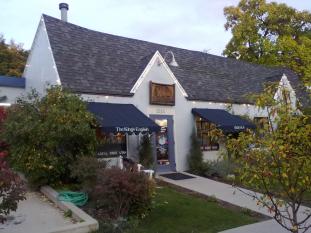
In the center of Salt Lake City, on the corner of 15th and 15th, crammed between houses is a bookstore that could be missed in an ill-timed blink of an eye.

As you walk through the old faded blue door of The King’s English, you hear the gentle tinkle of a bell and enter into a world of literature. No structured shelves or chain-store uniformity can be found here, just wall upon wall of titles and spines, in differing colors and textures. Books. People crowd in and out of the narrow hallways, say hello to the familiar faces or settle into worn wicker chairs adorned with blankets for a nice place to read.

Paul Rose is a local resident and frequent customer of The King’s English. On a Monday evening, he can be found wandering the store with his son in a stroller looking for a new book. Rose is one of the many Salt Lake residents who has become acquainted with the bookstore and is on a first-name basis with all the booksellers.

“It’s nice that we live in walking distance, but we spend far more money here than we should,” Rose said. “Our son likes books, I like books, and we read a lot.”

It is not only the books that attract people to this local bookstore, but also the friendly environment and commonality book lovers find within its walls. They all share the enthusiasm that comes with recommending a favorite book to others and the adventure and excitement of a new read.

Among the familiar faces is Anne Holman, who as manager of The King’s English spends her days sharing her love of books with others.

For Holman, books have always been a major part of her life. Growing up, Holman’s father worked in a retail company called Skaggs and his job took him all over the West. From Salt Lake to Phoenix, Denver and Dallas, Holman spent her childhood moving from place to place, always with a book in tow.

“Even if I didn’t know anybody in a new town I always had a book or I could always go to the new library; and that was always the first thing I did,” Holman said. “It’s where you want to spend your time.”

Holman’s love of books continued into college as she attended the Miami University in Ohio while her family lived outside of Cincinnati. Sparked by her enthusiasm for reading, she majored in English literature.

Finally, Holman stumbled back to the place where she was born: Salt Lake City. Although she had frequently moved around, the feeling of home seemed to ring truer for Holman in Salt Lake than anywhere else. Holman was looking for a part-time job. She discovered The Kings English, an independent bookshop that was established in 1977 by Betsy Burton as a safe haven for readers. The shop was known for its vast selection of children’s books and involvement in the community. Holman took the job. It was a perfect match.

“I was one of those people who said my dream job is to work for a bookstore,” Holman said. “I never did that coming out of college because I didn’t think you could make a living out of it. I was delighted to find out that it’s a great industry and a lot of people make a living doing it. So I feel like it was a happy accident.”

Now manager of The King’s English Bookstore, Holman has worked there 13 years and has become part of its legacy. In such a small company, everyone does everything, Holman said. Even as a manager she takes out the trash, answers phones and helps out on the floor.

Holman’s main focus is planning events and book signings. As part of its local charm, The King’s English hosts book signings of Utah’s many local authors, readings on the patio, an annual New Year’s Day sale and in September 2011 threw a party for its 34th anniversary.

The bookstore has seen many successful turnouts and returning authors to its events. Acclaimed children’s author Lemony Snicket has visited Salt Lake multiple times for book signings. His signings were met by hordes of eager fans, and went as late as 2 a.m. as Snicket would laugh, sing and play the piano for his readers. Local authors such as Shannon Hale, author of “The Goose Girl” series, have also made several appearances at The King’s English. It is these events that make the book business worthwhile to Holman and bring out the very best of books.

“These are the real celebrities,” Holman said. “And this is what literature does. It transforms people into who they want to be.”

Holman gets to see and participate in this transformation every day as a bookseller. By engaging with the books she sells and the people who come in the store, she helps readers become who they want to be.

In her book, “The King’s English,” founder Betsy Burton explains the joys of a bookseller. “We’re natural born matchmakers, and the truth is that most of us would do anything to sell a book,” Burton wrote. “But not just any book, and not just to make a buck. … The real pleasure in bookselling comes in pairing the right book with the right person. That’s what drives us as we look. Listen, assess, and ask questions … until bingo! We come up with a match.”

Local man brings family entertainment to the Hogle Zoo and Willard Bay for the holidays

Story and photographs by CHELSEA EBELING

Clyde “Sonny” Gilbert set a strict rule for his 2011 entertainment projects: be successful.

December 2011 will mark the ninth year for Gilbert’s Fantasy at the Bay light park at Willard Bay State Park in Willard, Utah. It’s also the fourth year for Zoo Lights at Utah’s Hogle Zoo  in Salt Lake City. And for the first time, Gilbert opened an all-inclusive Halloween light park at Willard Bay in October 2011.

After having three light parks under his belt, one might say Gilbert has met his goal. But his success didn’t come without lots of dedication and hard work.

Sonny Gilbert and wife LeAnn at Fright at the Bay

Gilbert was born in Brigham City, Utah, but raised about 20 miles south of there in Ogden. He didn’t return to Brigham City until later in his life. As a teenager, Gilbert’s priorities were focused more on skipping school than actually attending classes. After high school Gilbert planned on being a barber for a career, but was set off track by painting and doing bodywork for cars, passions that he carried from his childhood into his adult life.

In 2002 Gilbert went to Branson, Mo., for vacation and visited the Port of Lights, a Christmas light park. While walking through the park he noticed how much business the lights attracted.  Custom car work hadn’t allowed Gilbert to save as much money for his retirement fund as he would have liked. Seeing all the people at the light park gave him a new idea about how he was going to acquire that money. After examining the craftsmanship of the lights he thought to himself, “I could build this stuff.”

Once Gilbert returned home, he developed plans about where he wanted to create a light park. He then hired a local artist to get ideas for the characters he would build. After everything was approved by Willard Bay, he got a second mortgage on his house in order to finance the project. It took him a year to build the lights for the park and in late November 2003 he opened Fantasy at the Bay.

Fantasy at the Bay is a Christmas-themed light park that has animated winter characters built out of lights throughout it. The park includes everything from a reindeer flight school showing the successes and failures of Santa’s reindeer-in-training to snowmen and snowwomen having snowball fights. Spectators have the option of driving through the park on car paths lined with sparkling lights and hidden speakers playing Christmas music, or taking a ride on the carriage pulled by horses.

For the convenience of customers, Fantasy at the Bay includes a heated room at the beginning of the lights where Santa is awaiting visitors and a concession stand to purchase some treats or hot cocoa.

These days families are spending less and less time together and Gilbert’s light parks are becoming tools to help bring people back together. “It’s so nice to get away from stress and escape into the fantasy and spirit of the holidays with my family,” said Debbie Bouck, a visitor of the Fantasy at the Bay.

After seeing how well the Christmas light park did, Gilbert wondered where else he could expand his talents. He had gone to the Denver Zoo in Denver, Colo., where he saw lights incorporated into the zoo. That visit influenced Gilbert to approach the Hogle Zoo in 2006 about doing something similar there during Christmas time. The zoo agreed and contracted with Gilbert stating that as long as he created animals that were currently there he was free to create his masterpieces. The first Zoo Lights premiered on Dec. 1, 2007.

Zoo Lights features more than 100 animated safari animals placed in between thousands of illuminated trees with Christmas lights strung along them. Gilbert will be allowed some creative freedom for the first time in December 2011. He’s premiering some newer animal lights this year, but is keeping what they are a secret until they are set up in the park.

Animated light display at Fright at the Bay

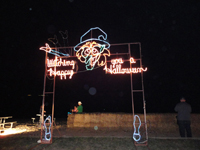
Also new this year was Fright at the Bay, a Halloween-themed family entertainment area at Willard Bay. Gilbert set up animated light characters depicting witches stirring pots with children in them, skeletons and other scary creatures all along the park to entertain the whole family.

“There’s something for everybody,” Gilbert said. “There’s the lights for parents to entertain their small kids while their teenagers can go be freaked out in the tent and shoot each other in laser tag.”

Speakers playing Halloween music were set up along the car paths for extra effect. A tractor-pulled hay ride that took visitors through the lights was also available. The park included concessions to quench hunger and thirst, a haunted tent, face and pumpkin paintings, haunted mazes and an area designated for laser tag.

Creating these light parks and doing what he loves makes him happy. “I never was educated, so people telling me how good I do is a motivation for me to succeed,” Gilbert said. “If you’re not happy what else is there?”