Junior League of Salt Lake City: Tradition in the 21st century

Story and multimedia by MEGAN SWEENEY

In 1901 Mary Harriman founded the women’s society called the Junior League. Her selfless efforts were focused on the immigrant children living on the Lower East Side of Manhattan. She wanted to improve the health, nutrition and literacy of those who had recently come to America.

Since 1934 the Junior League of Salt Lake City (JLSLC) has been an active chapter. It is currently comprised of 555 members. According to the JLSLC website, the focus of the league has shifted from the arts, social welfare, child welfare and criminal justice system education to the critical environmental issues, women and substance abuse, mentally ill adults, and health care issues.

The name “Junior League” is derived from the 80 original members who were recruited by Harriman.She was just 19 at the time.In the beginning Harriman herself was only 19-years-old at the time but gathered about 80 other “juniors” to aid in her mission.

In 1903, Eleanor Roosevelt became inspired by Harriman and decided to join the League. Her contribution was teaching calisthenics and dancing at the College Settlement House for girls.

Roosevelt is just one of many famous women to join the League over the years. The alumni consist of people such as Barbara and Laura Bush, Betty Ford, Shirley Temple Black, and Katharine Hepburn.

The Junior League became an international society in 1912 when the first Junior League of Canada was founded in Montreal. The organization’s mission was becoming cross-cultural.

With 292 sectors, the needs of the community from London, England, differ from those of Mexico City or Greenwich, Conn.

In Utah there are two separate leagues that focus on the community needs in their respective areas. One league is located in Ogden while the other is in the Salt Lake valley.
Both Utah leagues are focused on nonprofit work and fundraising but in different ways to be more specific to the community needs.

The League creates networks among women who are both members and non-members. The Junior League is also more than events and fundraising for the community. It is a training organization.

There is an education and training committee that focuses on recognizing the members’ skills and setting up workshops to help educate women and children on things such as computers, marketing, public relations, etc.

Lindsay Stahl sorting mass amounts of clothes.

The efforts to help better the community along with the League’s active members is what enticed Lindsay Stahl to start becoming involved.

The initiation process for new members can take a couple months. According to the website, during this process they are called “Provisionals.” New members start with a hands-on introduction and overviews of the fundraising events hosted by the JLSLC. At the end, they will be voted into active membership.

Stahl, who is now special events director at the Junior League of Salt Lake City, first joined the League because she was interested in giving back to the community. She said she “liked how the league was different from the normal Utah society” that she had grown up in.

Before she joined the League Stahl had no idea about its history but soon found out the significant impact the organization has made over the years. After getting to know other members she realized how important the League is and how long members have been involved.

Members such as Wendy Warner has been with the League for eight years. Warner is a Preferred Active. That means she isn’t on a specific committee but rather volunteers her time on various events. Her love of cookbooks was how Warner was initially introduced to the League.

Over the years, she has acquired 11 Junior League cookbooks from all around the United States. Her excitement is focused now on the newest release of SLC’s “Salt and Honey,” which will be released in early 2012.

What Warner has realized about the League is how it balances her life. “There are a lot of people, even here in Salt Lake, that don’t have a fraction of what we have,” she says. “It is also a great way to network.”

Both Stahl and Warner realize there a lot of misconceptions surrounding the League.

Warner says non-members would describe the members and functions of the league using  terms such as hoighty-toighty, party, elitist group of women. In reality, they are focusing on the community and pulling together events for Kids in the Kitchen or Women Helping Women.

Kids in the Kitchen focuses on tackling the increasingly alarming issue of childhood obesity and malnutrition. In Salt Lake City there are over 250 children in grades 3-5 who are taught various aspects of maintaining a healthy diet. There is an emphasis on how important exercise is along with portion control for your overall health.

Women Helping Women is a boutique founded in 1996 at 526 East and 300 South. Since then it has helped professionally clothe more than 12,000 women in the Salt Lake community.

The recipients of the clothing are transitioning into a self-sufficient lifestyle.The initial steps in this process start with first impressions. To a potential employer their appearance is extremely important.

Example of what to find at the boutique.

Jennifer Kelsey, president of the Junior League of Salt lake City, says that her favorite job is working in the Women Helping Women boutique.

Kelsey describes the League as “a nice place to link up and join other women who are likeminded and have something in common.” She knows each woman joins the league for different reasons but the common bond that the women share is the focus on helping women and children in the community.
Since 1901 the Junior League has brought together women from all over the world to help make the community a better place and to encourage a better future for the children. This was the initial dream when Mary Harriman started with just 80 people almost 110 years ago.

Since then the League has grown to more than 155,000 members in 292 countries because of the success and the message that the League shares throughout the world. That message, the outstanding members and what Warner calls “getting the fuzzies” from volunteering is what makes the League timeless.


This slideshow requires JavaScript.

Specialized Chair Helps Veterans Go Paragliding

Story by Sean Gustafson

On Sept. 3, 2011 five veterans tested a new type of paraglider over Sun Valley, Idaho. What made this an event noteworthy was that all five of these veterans are suffering from spinal cord injuries (SCI).

The veterans were able to participate in the paragliding by means of a set of specialized chairs called “Phoenix 1.0” and “Phoenix 1.5.”  The “Phoenix” chairs were made from one inch aircraft aluminum tubing allowing for a sturdy 35lb craft.

These chairs were the product of four months of researching and testing from four University of Utah students under the direction of professor Don Bloswick.

Mark Gaskill, of ABLE Pilot, provided the training for the chairs an organization committed to help people with spinal cord injuries, amputations, and neuromuscular diseases into flying-type actives.

To see test runs on the “Phoenix” chairs, go to http://www.youtube.com/watch?v=y9j33A0UV8A

ABLE Pilot Program Helps Veterans With SCI Learn to Paraglide

Story by: Laurie Carlson

“ABLE Pilot is an organization committed to getting people with spinal cord injuries, amputations and neuromuscular diseases safely into the air, piloting and flying with the minimum amount of assistance,” said Mark Gaskill, director of the training.

 
In Sun Valley, Idaho, this weekend, five veterans with spinal cord injuries (SCI) will learn how to paraglide.  They will learn how a paraglider works, functions and how to pilot it.

 
The veterans will use two flight chairs named Phoenix 1.0 and Phonenix 1.5. The original flight chair Phoenix 1.0 was built under the direction of Don Bloswick, a professor of mechanical engineering at the University of Utah. The chair was built by four mechanical engineer undergraduates at the University.

 
Gaskill is the developer of the ABLE pilot program and is the developer of many paragliding-training programs for people with disabilities. Gaskill is the person who initially came to the U of U team with the idea to develop the adaptive flight chairs.

 
The veterans will train all weekend long Friday, Saturday, Sunday and Monday. During the first day of training they will learn about paragliding. They will also learn how to paraglide 3 feet off the ground. They veterans will then take several tandem flights with ABLE Pilot’s certified instructors. Finally by Monday they will be able to fly solo.

 
For more information about the ABLE Pilot program visit http://ablepilot.com/

Brewvies manager, U professor weigh in on DABC fine

Story and slideshow by JACOB W. MAXWELL

The Utah Department of Alcoholic Beverage Control fined Brewvies Cinema Pub, a locally owned and operated restaurant/movie theater in Salt Lake City, during the summer of 2011.

Andrew Murphy, the pub’s general manager, said Brewvies quietly paid a $1,627 fine for screening “The Hangover Part II,” a movie that the DABC thought violated a section of the Utah Alcoholic Beverage Control Act.

This was Brewvies’ first DABC violation since opening its doors in 1997.

Murphy, speaking for the first time about the fine, the law and how they have affected the theater, said Brewvies attracts a variety of customers.

“You don’t have to partake in alcohol to come. So we get LDS people that come in to enjoy a nice meal and a movie. That’s kinda the beauty of the place,” he said.

Murphy said Brewvies screens popular PG, PG-13, R- and G-rated films based upon what the owners think their clientele, 21 years and older, wants.

He said many Brewvies patrons and concerned citizens were outraged to hear about the fine. “We’ve had tons of support. We made national news and have had people writing in from all over the country. Mostly curious because they don’t understand why Brewvies was fined and they think that the issue was deeper than it really is,” Murphy said.

He said many people also questioned why the DABC sent undercover Utah Highway Patrol officers into Brewvies to watch the film at the taxpayers’ expense.

Why was Brewvies fined for showing a summer blockbuster that simultaneously premiered with other local theatres?

Francine Giani, interim director of the DABC, said in a letter that Brewvies was fined because “The Hangover Part II” ran afoul of a Utah law “prohibiting films or pictures depicting sex acts on premises that sell alcohol.”

Giani said Utah’s law is modeled after a similar law in California that was upheld in a 1972 decision by the U.S. Supreme Court.

The only case seen before the Supreme Court regarding sexually oriented entertainment during the time period was Miller v. California (1973), in which a business owner conducted a mass-mail campaign to advertise pornographic material.

In a 5-to-4 decision, the Supreme Court ruled in favor of the state and held that material considered obscene was not protected by the First Amendment. The court developed the Miller Test, a legal standard where four qualifications have to be met in order for speech to be considered obscene.

David Vergobbi, an associate professor in the University of Utah’s Department of Communication, said he hasn’t seen the movie, but he doesn’t believe the film depicts sex acts in the same manner that the Miller obscenity test would apply to.

There are parts of “The Hangover Part II” that depict full frontal male nudity. During the end credits of the movie, the character portrayed by Ed Helms is seen having sex with a transsexual.

“If [Giani] is indeed referring to Miller v. California, the Miller obscenity test, it’s moot anyhow because the film isn’t rated obscene,” Vergobbi said. “The R-rating is nowhere near reaching the level of obscene speech and indecent speech is protected under the First Amendment. Obscene speech is not.”

The DABC has the ability to financially force Brewvies to censor movies that violate the section concerning films in the Alcoholic Beverage Control Act, despite the content being protected under the First Amendment.

The act allows the DABC to regulate the content of any film depicting the act or simulated acts of sexual intercourse, masturbation, oral copulation, whipping, etc. in an establishment that serves alcohol. Also, if characters in a film fondle or show their genitals, breasts or anus, it is in violation of the law.

After reading the act, Vergobbi said, “Heck, this [law] could cover almost anything,” in reference to what Brewvies is legally allowed to screen.

Vergobbi received a Ph.D. in Mass Communication Law, Ethics and History. He teaches U students about media ethics and mass communication law.

He said the DABC could make a claim that they are only carrying out the law as written. The problem Vergobbi sees is that Brewvies would have to sue the department that holds its liquor license in order to get the law changed. But, he said this scenario could prevent Brewvies from taking legal action.

Brewvies has thought about fighting back but Murphy said the cinema pub doesn’t have the money to do so.

“It’s a considerable amount of money to get the proper lawyer and paperwork filed. And what would it really gain us?” he said. “The law could get changed or we could get back our fine.”

Vergobbi believes the law could be challenged on vagueness and over-breadth, which is the standard test for whether a statute is constitutional.

“I’m sure they were referring to pornographic films,” Vergobbi said regarding why the law was written. “But by just saying ‘showing a film’ it opens it up for this kind of application.”

Giani said Brewvies, upon receiving its alcohol license, was cautioned by a licensing and compliance officer about the law and urged to prescreen movies to avoid any possibility of a violation.

Brewvies had the opportunity to screen “The Hangover Part II” because other Warner Bros. films like “Super Bad” and “Knocked Up” had done well at the theater. The owners had to agree to premier the film before they knew about the content. And to Murphy’s knowledge, the film wasn’t prescreened in Utah.

“We were selling out shows to the first ‘Hangover’ six weeks into the run, which gave us the opportunity to premier more films,” Murphy said.

In the 14 years since Brewvies has been open, it has only premiered a small handful of films.

Murphy said Brewvies has always taken every precaution to not violate DABC regulations, Utah State laws and Salt Lake City and County mandates. Yet he is not sure where to draw the line as far as what films the theater can screen in the future.

“Film is art and as soon as you start regulating what people can put in their art then you are really having a heavy hand on the culture,” Murphy said.

This slideshow requires JavaScript.

Don’t Ask Don’t Tell; how it has affected people in Salt Lake City

Story and slideshow by SHERYL CRONIN

The long-awaited repeal of the Don’t Ask, Don’t Tell policy occurred Sept. 20, 2011, following certification signed by President Barack Obama on July 22.

“Homosexuals have a right to be in the military,” said Ryan Newman, 28, of Salt Lake City. Newman is currently enrolled in the National Guard. He has been in the National Guard for approximately a year and a half and says he is happy about the Don’t Ask, Don’t Tell policy change.

The guidelines that were previously in place for the U.S. Military stated that bisexual, gay, or lesbian individuals were prohibited from being enlisted within the armed forces. Don’t Ask, Don’t Tell went into effect in December 1993 after President Bill Clinton signed the policy. According to section 15 of the Don’t Ask Don’t Tell policy concerning homosexuality in the armed forces, the military could not discriminate against a person simply for being gay, but for openly being gay.

Don’t Ask, Don’t Tell was a step in the right direction to protect homosexuals. Previous guidelines banned anyone who was gay from serving in the military.

This policy was made to decrease the number of people discharged from the military, but it failed to stop discrimination. The intent of the policy was to benefit the gay community but in turn it continued to isolate.

According to section 15, “The presence in the armed forces of persons who demonstrate a propensity or intent to engage in homosexual acts would create an unacceptable risk to the high standards of morale, good order and discipline, and unit cohesion that are the essence of military capability.” Therefore, the U.S. Military was allowed to discharge any member who would disclose their sexual orientation.

But, according to Newman, the Salt Lake man serving in the National Guard, people were commonly known to be homosexual but it just was not talked about due to the repercussions.

Derek Kjar, 26, who is gay, dated Scotland Briner from 2005 to 2010. Briner was a cadet in the U.S. Army Reserve who served a year in Afghanistan before they met. “There were areas of Salt Lake City that we didn’t feel comfortable being a couple, especially at the University of Utah because that is where Scotland did ROTC.”

Before the change of the policy, Briner and Kjar had to be careful of where they showed affection because Briner could have been discharged from the Army. Kjar said that Briner had to act more masculine in public and put on a persona due to fear of being ostracized.

Kjar recalled a time that the couple and another gay friend went to a restaurant near the U for lunch. One of Briner’s sergeants walked into the restaurant and Briner had to act like he was straight. Kjar said he was nervous the sergeant would see through his act.

The repeal of Don’t Ask Don’t Tell will make it so situations such as this will not be an issue anymore to the gay community. Individuals will not be forced to hide who they are in or outside of the military.

Under the Don’t Ask, Don’t Tell police the military was prohibited from investigating a person’s sexual orientation, unless there was an eyewitness account of homosexual behavior. That behavior never was sufficiently defined. These are some of the difficulties the military had to deal with under the policy.

Briner mentioned to Kjar that there were a few men who came out to him in private while he was serving his country. “It was just something people didn’t talk about publicly,” Kjar said.

According to the code, “A member of the armed forces shall be separated from the armed forces [if] the member has engaged in, attempted to engage in, or solicited another to engage in a homosexual act or acts.”

Brian Robbins, 26, who has been in the Marine Corps since April 2004 and served a year in Iraq, said that even though he supports homosexuality he thinks that getting rid of Don’t Ask, Don’t Tell could cause more problems than solutions. “The people who come out in the military might end up being harassed because they came out of the closet,” he said.

Robbins said the policy was working just fine before the change. Some people may argue against this idea, but the risk of being harassed now will be much greater in Robbins’ opinion. Now that individuals can be open with their sexual orientation, the unit might be unaccepting of the information and could intensify homophobic tendencies.

Robbins felt that the risk for overtly homosexual individuals could be more harmful rather than not talking about it. He said that before the change there wasn’t an issue with homosexuality, but as a straight man he may not have felt the kinds of pressures facing gay  soldiers.

Robbins has not been deployed since the policy change but can be called into duty until April. He said he doesn’t know what kinds of changes will occur but he thinks that within his all-male unit it may be difficult if someone were to come out.

This slideshow requires JavaScript.

The repeal of the Don’t Ask, Don’t Tell policy has encouraged same-sex couples to speak out against unequal rights. This will be the next battle to overcome for the LGBTQ community.

Sharing a love of books

Story and photos by LISA HENDRY

In the center of Salt Lake City, on the corner of 15th and 15th, crammed between houses is a bookstore that could be missed in an ill-timed blink of an eye.

As you walk through the old faded blue door of The King’s English, you hear the gentle tinkle of a bell and enter into a world of literature. No structured shelves or chain-store uniformity can be found here, just wall upon wall of titles and spines, in differing colors and textures. Books. People crowd in and out of the narrow hallways, say hello to the familiar faces or settle into worn wicker chairs adorned with blankets for a nice place to read.

Paul Rose is a local resident and frequent customer of The King’s English. On a Monday evening, he can be found wandering the store with his son in a stroller looking for a new book. Rose is one of the many Salt Lake residents who has become acquainted with the bookstore and is on a first-name basis with all the booksellers.

“It’s nice that we live in walking distance, but we spend far more money here than we should,” Rose said. “Our son likes books, I like books, and we read a lot.”

It is not only the books that attract people to this local bookstore, but also the friendly environment and commonality book lovers find within its walls. They all share the enthusiasm that comes with recommending a favorite book to others and the adventure and excitement of a new read.

Among the familiar faces is Anne Holman, who as manager of The King’s English spends her days sharing her love of books with others.

For Holman, books have always been a major part of her life. Growing up, Holman’s father worked in a retail company called Skaggs and his job took him all over the West. From Salt Lake to Phoenix, Denver and Dallas, Holman spent her childhood moving from place to place, always with a book in tow.

“Even if I didn’t know anybody in a new town I always had a book or I could always go to the new library; and that was always the first thing I did,” Holman said. “It’s where you want to spend your time.”

Holman’s love of books continued into college as she attended the Miami University in Ohio while her family lived outside of Cincinnati. Sparked by her enthusiasm for reading, she majored in English literature.

Finally, Holman stumbled back to the place where she was born: Salt Lake City. Although she had frequently moved around, the feeling of home seemed to ring truer for Holman in Salt Lake than anywhere else. Holman was looking for a part-time job. She discovered The Kings English, an independent bookshop that was established in 1977 by Betsy Burton as a safe haven for readers. The shop was known for its vast selection of children’s books and involvement in the community. Holman took the job. It was a perfect match.

“I was one of those people who said my dream job is to work for a bookstore,” Holman said. “I never did that coming out of college because I didn’t think you could make a living out of it. I was delighted to find out that it’s a great industry and a lot of people make a living doing it. So I feel like it was a happy accident.”

Now manager of The King’s English Bookstore, Holman has worked there 13 years and has become part of its legacy. In such a small company, everyone does everything, Holman said. Even as a manager she takes out the trash, answers phones and helps out on the floor.

Holman’s main focus is planning events and book signings. As part of its local charm, The King’s English hosts book signings of Utah’s many local authors, readings on the patio, an annual New Year’s Day sale and in September 2011 threw a party for its 34th anniversary.

The bookstore has seen many successful turnouts and returning authors to its events. Acclaimed children’s author Lemony Snicket has visited Salt Lake multiple times for book signings. His signings were met by hordes of eager fans, and went as late as 2 a.m. as Snicket would laugh, sing and play the piano for his readers. Local authors such as Shannon Hale, author of “The Goose Girl” series, have also made several appearances at The King’s English. It is these events that make the book business worthwhile to Holman and bring out the very best of books.

“These are the real celebrities,” Holman said. “And this is what literature does. It transforms people into who they want to be.”

Holman gets to see and participate in this transformation every day as a bookseller. By engaging with the books she sells and the people who come in the store, she helps readers become who they want to be.

In her book, “The King’s English,” founder Betsy Burton explains the joys of a bookseller. “We’re natural born matchmakers, and the truth is that most of us would do anything to sell a book,” Burton wrote. “But not just any book, and not just to make a buck. … The real pleasure in bookselling comes in pairing the right book with the right person. That’s what drives us as we look. Listen, assess, and ask questions … until bingo! We come up with a match.”

University of Utah alumnus finds path to desired career proves difficult

Chris Jex supporting the Utes at the 2010 Maaco Bowl in Las Vegas, Nev.

Story and photo by JACOB W. MAXWELL

Chris Jex, 28, a 2011 graduate of the University of Utah, has had difficulty transitioning from student into his desired career path.

One week before he graduated in August, he was hired by Fanzz online apparel stores, Larry H. Miller Corporation’s online sports apparel and merchandise retail company.

“Working in online and new media marketing is something I enjoy,” Jex said.

But it isn’t his dream job.

For Jex, his formative years were spent mastering the guitar, online gaming and skipping school. In 2001, he decided to pursue higher education. He received his GED diploma later that year, and started at Salt Lake Community College in 2002. He graduated in 2006 with his associate degree in general studies.

He entered the University of Utah in 2007 knowing that he wanted to major in political science.

In the summer before graduating with a Bachelor of Arts in both political science and economics, Jex decided he would start working toward his career path and forego graduate school for the time being.

Unemployed and with graduation approaching, Jex began to feel the burden of repaying his student loan debt, affording his living expenses and finding a well-paying job during this recession. This forced Jex to put his career plans to work in finance or the public sector on hold, and look for a job he knew that he could get quickly.

He had worked for five years for Mrs. Fields, an online retailer for baked goods. When he saw a job listing for the Larry H. Miller Corp. that was relevant to his prior work experience, Jex jumped at the opportunity to apply.

He adds descriptive captions to online items such as jerseys, hats and key chains for the website. He was quickly promoted after only a few weeks on the job to run an online marketing team.

Jex said his promotion came with only a slight increase in pay and the responsibility of managing a team of five people in which he is still paid hourly.

Many graduates, like Jex, hope those four years of schooling and thousands of dollars will reap them the financial rewards of a well-paying job in the field that they had studied.

A study of 571 men and women who graduated between 2006 and 2010 from four-year colleges found that 53 percent were employed full-time, 14 percent were still looking for full-time employment and almost half were working in jobs that don’t require a degree.

The report, published in May 2011, measured how prepared college graduates were to enter the job market. Graduates also were asked how much of their education was financed. Researchers at the Edward J. Bloustein School of Planning and Public Policy at Rutgers University concluded that this generation exhibits a “diminished expectation of financial success.”

Dana Sowby, associate director for the Career Services at the U, said that “a degree doesn’t get you a job. It’s a foundation you base your career on.”

For example, Sowby feels that Jex’s education provided him with that foundation by teaching him critical thinking skills.

Sowby is a firm believer that there are plenty of jobs out there waiting for U students to fill. Over the past 20 years, she has made sure that U students who seek the center’s help are prepared to enter the workforce.

The center helps students and alumni choose a career path, write resumes and find internships. The staff also hold mock interviews to help individuals prepare for a real-life situation.

Sowby recommends that current students take advantage of internships to explore career options and determine whether they are on the right course. “Take internships during school. Internships are critical, but not required,” she said.

The Rutgers report found that students who took advantage of internships during school saw a median income of $34,680, which was $6,680 more than those who chose to not participate in them.

“Internships give students a chance to implement their knowledge, gain real-world experience, network and add to a resume,” Sowby said.

Jex never took an internship while in school.

He is still strongly considering graduate school to further his education and hasn’t yet taken advantage of the Career Services to help jump-start his career path.

But Sowby suggested that Jex find relevant work experience first. “Not finding a job isn’t the right reason to enter graduate school,” she said.

She said both political science and economics are great majors. However, she feels that having a degree alone isn’t enough.

“You need to take it a step further and apply your knowledge,” Sowby said.

Jex feels that there already have been many opportunities to apply his university training with his current job at Fanzz. He is grateful to the Larry H. Miller Corp. for employment in this rough economy, even though it’s not his dream job.

So what’s next for Jex?

“My long-term goals are to have the flexibility and options to pursue an eventful and fulfilling career in an increasingly diverse job market,” Jex said.

Two Utah women tell how they survived domestic violence

Story and slideshow by CHELSEA EBELING

Baffled, afflicted, and despondent, Khloe James sat hugging her knees to her chest with tears streaming down her face in the corner of her room, paralyzed by shock.

“This didn’t just happen … not to me … I’m not that girl … this didn’t just happen,” she repeatedly told herself.

But it did happen, and she was that girl. James, who is using a pseudonym to protect her identity, fell victim to domestic violence that night in 2007 when her on-again, off-again boyfriend of two years raped her while he was high on methamphetamine.

“He was always very possessive, controlling and manipulative, even pulling a gun out once, but he never actually got physical until that night,” James said.

She suffered in silence for the next year, not telling anyone what had happened. “I didn’t think anyone would believe me if I told them because he was my boyfriend,” James said. She even continued dating him until he went to jail for unrelated charges in 2008.

“When he finally went to jail I looked at it as my escape. He wouldn’t be able to stalk me, call me and convince me to get back together with him,” James said.

This story is frighteningly common. One in every four women will experience domestic violence in her lifetime, and most of those cases are never reported to the police, according to statistics by the National Coalition Against Domestic Violence.

Many victims know what is happening is wrong, but for various reasons still stay with the perpetrator. “It’s easy for somebody outside of the situation to say what should be done, but you never know what you’d really do until it happens to you,” said Asha Parekh, the director of the Family Justice Center in Salt Lake City.

For Chelsea Waters, that statement was all too true. Mistreatment was her reality for four years while dating her then-boyfriend. “We had a really quick-paced relationship,” Waters said. “Things got serious one month in.”

Their passion quickly turned from romance to violence. “We got in arguments a lot, even about the littlest things,” Waters said. “He called me every name in the book.”

Those small arguments turned physical after a month of dating when Waters’ boyfriend tackled her to the ground and repeatedly slapped her during a disagreement. After realizing what he had done, Waters’ boyfriend came to her crying and apologized for his actions, and swore he’d never do it again. But within hours she was attacked for a second time.  “After that door was open it was never closed,” Waters said about the abuse.

Subsequently, arguments were no longer disagreements but full-blown attacks. “Things were bad, but I stayed because I loved him and saw the best in him,” Waters said. “He was extremely affectionate, you know, bringing me flowers for no reason … I forgave him quickly.”

But it was that forgiving nature that got her into more trouble. Three years into their relationship, and shortly after their son was born, Waters’ boyfriend asked to borrow her car keys to go somewhere with his friend while they were in the middle of moving. Her refusal led to one of the worst altercations of the relationship.

“I was very calm and told him he could take the car after we were done packing,” Waters said. But her boyfriend didn’t like that answer and told her to come inside with him while they left his friend outside. With his hands behind his back, Waters’ boyfriend asked once again if he could borrow the car. When she told him no for the second time, her boyfriend pulled out a roll of duct tape he had been concealing and told her that he was going to kill her.

He taped her hands together then punched her repeatedly in the face, pushed her, kicked her in the stomach and pounded her head against the floor. “I knew his friend was right outside the door and I kept screaming thinking he would come in and help me, but he never did,” Waters said.

What made things worse is that their son was just a few feet away from where Waters was beaten. “Looking up and seeing my son crying in front of me was my breaking point,” Waters said. She had been beaten before, but not like this. She didn’t want her son to live this way and she certainly didn’t want him to witness her death.

Waters might have been killed that day, had her mother not come over to check on things. Her mom called the police and her boyfriend was arrested shortly after the call was made. Waters was taken to the hospital and treated for a fractured jaw, a serious concussion, a fractured eyebrow and cheekbone, broken ribs, and a broken nose. She was also blinded in one eye for three days after the attack due to an eye contusion.

Despite her injuries, Waters went back to her boyfriend and even spoke on his behalf during the court case in an effort to get the charges of abuse dropped. It wasn’t until a few months later when she met someone new that she finally left him.

“Meeting someone that treated me good was the only thing that got me to finally leave,” Waters said.

The Family Justice Center website notes, “For an abused woman, leaving the relationship is never a single act. It is always a continuous process.” It’s not always a matter of making a decision; often it has to do with safety and finances.

Whatever the reasons for staying may be, the time has to be right and support is crucial. “It takes a lot of time and patience until someone finally is ready to leave,” Parekh said. The best thing to do is to let the victim know that they are loved, supported, that they deserve better and it’s not their fault.

The struggle isn’t over once women decide to get out of the relationship either. Sometimes that’s the hardest and possibly the most dangerous part. “The danger can increase when a victim decides to leave the relationship because the abuser may feel like he is losing control over her. They may take drastic measures to maintain that control,” Parekh said.

In order to minimize danger, it is recommended that abused women contact resources to set up an exit plan. The Family Justice Center has staff members who can help create a safety plan and get victims in touch with counselors, law enforcement, lawyers, career counselors, and other personnel who can help with the transition.

James and Waters are the few lucky ones who were able to get out of an abusive relationship without getting help. Waters says she is finally getting closer to “normal” and can actually talk about what happened. “I have to work on it every day, but … I’m healing,” Waters said.

In hindsight James contributes getting out of that relationship as the start of her happiness and hopes her story might help influence other potential victims to be cautious about who they’re dating. “Leaving that relationship was by far the best decision I’ve ever made,” James said. “I wish I had known there were people out there who could’ve helped me and told me I’m not the only one this has happened to.”

This slideshow requires JavaScript.

For more help:

The first step in fighting back against domestic violence is to know what it actually is. The National Coalition Against Domestic Violence defines it as “the willful intimidation, physical assault, battery, sexual assault, and/or other abusive behavior perpetrated by an intimate partner against another.”

Knowing the signs of an abusive person could potentially save your life or the life of someone you love. The YWCA lists 14 signs of domestic abuse.

Jakob Jensen: Swim instructor to strategic communication professor

Story and photo by TOM CROWELL

Jakob Jensen, an assistant professor of strategic and health communication at the University of Utah, never imagined himself in the classroom.

Jensen was born and raised in the tiny copper mining town of Circle, Mont. He remained there until it was time to pursue higher education at Concordia College in Morehouse, Minn., since there were no colleges or universities anywhere near his hometown.

After receiving his bachelor’s degree in political science and East Asian studies, Jensen earned his master’s degree in communication at the University of Illinois. He received his doctorate in communication from the same university in 2007.

Like most college students, Jensen had a job while going to school. He first worked for Sprint as a communications specialist. His primary responsibility was to retain the business of Sprint’s corporate clients and make sure they were happy with the services they were being offered. Following his time at Sprint, he went to work for grocery distributor Supervalu in its human resources division and eventually became the director of HR for the entire company.

Jensen did not plan on remaining in corporate employment, though. While he was working on his doctorate, he was offered an assistant professor position in 2007 with Purdue University teaching health communications. Teaching wasn’t his first choice of employment, but someone noticed it might be a good fit for him while he was a swimming instructor in his hometown. He remained at Purdue until 2011, when he and his wife decided it was time to move west.

Professor Jakob Jensen.

David Vergobbi, an associate professor of communication at the U who chaired Jensen’s search committee, shed some light on the process of hiring new faculty members. To be considered for tenure-track positions at the U, a candidate needs a doctorate and to be adept in three specific areas: teaching, service and research. A secondary specialty is also required for employment; Jensen’s is health communication. Pointing out Jensen’s qualifications, Vergobbi said, “He is the complete package.”

Jensen was driven toward academia by a desire to help people, especially his students. It is not uncommon for him to point out certain items during lectures that students will be tested on and reemphasize those items throughout the unit of focus. He will also give his students bits of advice on how to become successful in strategic communication, including getting involved in the community, joining the PRSSA chapter on campus and applying for and participating in internships. As Jensen puts it, “I want you to succeed, I want you to do well.”

In addition to his responsibilities at the university, Jensen is also a family man. He has been married to his wife, Robin, also an assistant professor at the U, since 2001 and together they have a 5-month-old son, Jor.

Baseball player helps a breast cancer cause in Salt Lake City

Story and photos by CARLY SZEMEREY

Sam Kaplan wearing "Swing for Life" jersey for the breast cancer awareness game.

Ever since Sam Kaplan can remember, he has been doing two things — playing baseball and helping others.

While growing up in Cottonwood Heights, a suburb of Salt Lake City, Kaplan’s parents, Neil and Kitty, taught him that service is a small meaningful act that goes a long way.

Because of this lesson Kaplan, now 19 and a University of Utah student, has donated his time to many efforts in hopes of bettering other people’s lives. He has raked yards, served food to the homeless and worked at the Utah Food Bank to sort food for the homeless and those in need.

He remembers one specific moment of volunteer work that touched him deeply. While he and his father were delivering food they came upon a Sudanese household. Once they had knocked at the door to deliver the packaged food, they were invited in the home. The family fed Kaplan and his father all of the food they had to offer. “It was really touching and nice of them,” Kaplan said.

When Kaplan was not volunteering his time helping others, he enjoyed playing centerfield for Cottonwood High School’s baseball team. Baseball has been a big part of Kaplan’s life for many years. His parents had enrolled him in T-Ball when he was just 3 years old and he has stuck with it ever since.

Kaplan has placed his focus on being the best player he can be. “I worked hard every single day of my life,” Kaplan said. “I didn’t take a day off ever.”

With this hard work and dedication Kaplan received multiple awards throughout his high school baseball career. Some of these awards included an All-State award his senior year and the All-Region award two years in a row.

“Sam was a great player who is an extremely hard-working kid,” said Jon Hoover, Kaplan’s baseball coach at Cottonwood High School.

Given Kaplan’s commitment to volunteerism and baseball, few were surprised when he brought up the idea of a breast cancer awareness game to raise money for research.

“[The idea of the game] just hit me one day,” Kaplan said. “I just wanted to help out a cause and raise money.”

In early spring 2010 many things happened. Kaplan had suggested to his coach and teammates the idea of a baseball game targeted at raising funds for breast cancer, the game was played to raise funds and  a longtime family friend, Toba Essig, was diagnosed with breast cancer. This diagnosis pushed Kaplan to make sure that this game happened and really became a driving force of the whole plan.

With the knowledge of a Cottonwood vs. Brighton baseball game coming up, Kaplan felt this was the perfect opportunity to implement his plan.

Essig’s son, Brian, played on Brighton’s team so Kaplan contacted Brian and asked if he would be willing to help him out with this cause.

Brian agreed so Kaplan approached his coach about the game.

“When Sam approached me about making our game against Brighton a breast cancer awareness game I thought it was a really good idea,” Hoover said. “Out of everyone I’m not surprised it was Sam to do this.”

"Swing For Life" designed the logo for jerseys to be worn in the game.

After speaking to his coach Kaplan began contacting different breast cancer organizations such as the Huntsman Cancer Institute and “Swing for Life” — a nonprofit organization that is dedicated to raising money in breast cancer research — to see if they would be willing to set up booths at the game.

His focus became more targeted when speaking with Kathy Howa, from “Swing for Life,” and Brighton’s baseball.

“Howa was really helpful,” Kaplan said. She helped plan the event and supplied the teams playing with pink and black jerseys to wear.

After all the planning the breast cancer game was ready to begin. On April 3, 2010, many people attended the game to support a cause.

Parents of the kids from Cottonwood’s baseball team took shifts in the goody shack — the snack shack at Cottonwood’s baseball field. All the proceeds raised during the game at the shack were donated to “Swing for Life.”

In addition, the players’ black jerseys were auctioned off to the highest bidders at the end of the game. This money was also given to the organization.

Kaplan and his supporters were able to raise more than $1,000 to be donated to breast cancer research.

“This game was one of my prouder moments and I’m so glad that I was able to help out,” Kaplan said. “I just hope that I am able to continue both of my passions and hopefully combine them together once again in hopes of making a difference.”

Following Kaplan’s graduation in 2010 he moved to Forest Grove, Ore., to play college baseball for Pacific University. After his freshman year he moved back to Salt Lake to get surgery on his shoulder in August 2011. Now a student at the U he hopes to continue playing baseball again after his shoulder has healed and he has completed the necessary rehabilitation.

University of Utah alumnus takes his talents to New York City law firm

Story by MATT ELLIS

Photo taken by Shanna Richmond

When James Clegg graduated from the University of Utah in 2006 he had a career plan. But he had no idea that, in a few short years, he would be working as a lawyer in New York City.

After the U, James spent years at two more universities before he ended up at Mayer-Brown, one of the leading corporate law firms in downtown New York City.

James, or “Jace” as he is known to family and close friends, was born in Farmington, Utah, in 1981 but spent three years in England while his parents fulfilled religious duties for the Church of Jesus Christ of Latter-day Saints. He graduated from Davis High School in 2000 and then served his LDS mission in Hong Kong.

James met his wife, Christy, after he got back from his mission. They had both spent time overseas while growing up, and having that in common led to almost immediate chemistry. They were married in August 2004, about eight months after they had started dating.

After earning a degree in English from the U, James attended law school at Cornell University in Ithaca, N.Y. Even as early as 7th grade, he knew he wanted to be a lawyer; at the time, though, he was partial to Yale.

“Growing up, I always thought that I wanted to be a lawyer,” James said. “People told me they felt like I had an aptitude for it because I like to argue.”

He decided to go to Cornell because it had the best international law program of all the schools he was accepted to. James learned one form of Chinese, Cantonese, on his mission in Hong Kong, and took six classes at the U learning Mandarin Chinese. He had originally hoped to return to China to practice law.

“When I was interviewing at different firms, that’s why I picked Mayer-Brown. … They have a large Hong Kong office,” James said. Along the way, however, he discovered that he might want to take a different path. “As I went through law school, I found that I had an aptitude for tax,” he said.

“In the legal world, if you want to do tax law, you have to have a specialization,” James said. So, after graduating with honors from Cornell in 2010, James decided to enroll at the tax law program at New York University, which is widely regarded as the “gold standard” of tax specialization. Tax law was something that really resonated with James, and he enjoys his current duties with Mayer-Brown. The firm handles contracts for loans, mergers and securitizations for multiple large companies, including BlackBerry.

He finished the program at NYU in 2011 and now works full time at Mayer-Brown. “I really like that it’s very cutting edge, very high-level legal work,” James said. “It’s really scary when you think about, ‘If I screw this up I could literally cost this person millions of dollars.’”

James’ wife Christy, also a University of Utah alumna, does social work in New York City. She does adoption work with adoptive parents, as well as counseling for adults. Though both are very serious about their career paths, things are not all business all the time.
Asked for one word to describe James, Christy responded, “He’s a jokester. He is kind of silly.”

James did concede that he tries to be funny, and that includes having a little fun with friends who are not very familiar with his Mormon faith. He once told a friend that Mormons believe that it is sacrilegious to eat turkey on Thanksgiving.

James is an avid follower of the U’s football team, and so far has been disappointed by the first season in the Pac-12 conference.

“I think that it’s pretty evident that we don’t have Pac-12 talent just yet,” James said. He misses going to football games in Rice-Eccles stadium, and was glad he could attend the Utah-Washington game on Oct. 1, 2011, while he was in town for the weekend.

While in New York, he catches the Utah games in the Flat Iron area of the city at a bar that is the official sports bar of the local chapter of the U’s alumni association. On any given game night, James said, between 70 and 80 Utah alumni show up to enjoy the game.

James has always had a plan for his next four or five years, but says that right now he is not sure where he wants to go. One option he has considered is going to work for a private equity firm, an area where he does have some experience from an internship he did while he was studying tax law at NYU. Although James would be open to opportunities overseas, both he and Christy plan on being in New York for some time to come. Christy even said she would like to start a family sometime soon.

International graduate student at the U inspires pursuit of language studies

Story and photos by JAVAN RIVERA

Natalya Sergeyevna Nizkaya has been interested in foreign languages and their mechanics since her childhood.

Growing up in the Amur region of Russia that borders China, she harbored a desire to work with languages from around the world.

“I’ve wanted to connect my future life with languages since I was in the fifth grade,” Nizkaya said.

Nizkaya, 30, has studied five languages and currently is a teaching assistant in the University of Utah Department of Languages and Literature and is also a graduate student. She speaks English and Russian fluently and has experience in both Turkish and Chinese. She also has just begun studying Arabic.

Nizkaya’s master’s program work is based in the university’s Comparative Literary and Cultural Studies program (CLCS), and focuses on the Russian translation of African American literature. A paper she wrote in her first fall semester about a Toni Morrison novel inspired her work.

The time Nizkaya has been able to study and help teach in Utah has provided her with the opportunity to further her own linguistic knowledge and to inspire the same love for foreign languages in her students. She has accomplished this through the classes she teaches and a conversational group that she founded at the university.

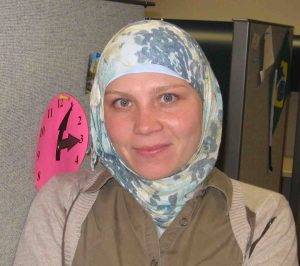
Natalya Sergeyevna Nizkaya inspires her students through her classes.

In an interview Nizkaya talked about the impact she’s had on some students who have taken her Russian-language courses, citing one student who changed his major from mathematics to linguistics.

“When I heard about this, I thought ‘wow.’ It was very rewarding for me,” Nizkaya said. “Part of it was probably the Russian class that inspired him.”

Nizkaya was interested in creating a language-based activity on campus and was given an idea by her supervisor, Rimma Garn, who has a doctorate in Slavic languages and literature. This brought about the creation of the Russian Table.

The Russian Table consists of students from all Russian-language classes ranging from first- to third-year fluency. The group has eight to 10 regular attendees this semester, but that’s not how it began.

Nizkaya said that when the group began it was extremely large, but it quickly dwindled to only four students. They would meet and talk about random subjects in Russian. She said the whole idea of the group was to “break class walls.”

“It was great to see first-year students participating when they could hear and understand words,” said Maria Fedorovna Rezunenko during a Skype interview. She was one of Nizkaya’s colleagues and was also placed in Utah as a foreign-language teaching assistant.

Both Nizkaya and Rezunenko were placed at the U through the Fulbright Institute of International Education. One of Fulbright’s programs works to match foreign-language speakers with universities where they can help teach. For Nizkaya, it was a perfect fit.

“She tried to deepen her knowledge of foreign language,” Rezunenko said.

Nizkaya described how the Russian school system differs from its American counterpart and said she spent five years mastering English while also studying German. The system now mirrors the American degree system, but during Nizkaya’s time at Amur State University it was under the old system that revolved around five-year specialties.

By the time she graduated in 2004, she was qualified as both an interpreter and translator in English and Russian and had a specialty, the American equivalent to a major, in linguistics and intercultural communication.

Nizkaya is also studying as a graduate student in the CLCS program at the U.

Nizkaya wanted to apply this knowledge somewhere. An opportunity presented itself in 2007 when she participated in an exchange program between her university in Blagoveshchensk and Jackson State University in Mississippi.

The program consisted of teaching English as a second language and helping students to prepare for the Test of English as a Foreign Language (TOEFL). The program offered Nizkaya a chance to practice the skills she had learned in her schooling in Russia, and created a desire to do more work in America.

“When I came home, I was already thinking of what other ways I could go to the States,” Nizkaya said.

This led to her eventually teaching Russian at the University of Utah in fall 2009. It was here that she first met Rezunenko in person, though they had been in communication online for some time.

“It was amazing,” Rezunenko said, describing the program. “It was teaching us to teach.”

She said the forms of teaching in the Russian school system are different, and that their supervisor wanted them to teach the classes in a more “American style.” She feels this benefited both herself and Nizkaya.

While the work has allowed Nizkaya to impact her students, she now looks to her future, both in finishing her master’s degree at the U as well as her career path outside of academia.

Yet even as these studies come to a close, Nizkaya said how proud she is of everything she has accomplished thus far in her academic career both as a student and a teacher.

“That I’m here now,” Nizkaya said. “That’s already an achievement and I’m proud of it.”