Victoria Tingey

Me 1Blog:

When I was coming up with ideas for story topics, I tried to think of something interesting that would grab the reader’s attention and also create a subject that could hold true meaning. As I ran through a couple ideas, I remembered our old Murray Theater located on the corner of downtown State Street. This is a building that truly captures the charm and history of Murray. It has an old-fashioned neon sign that welcomes people as they drive by. There is such an appeal about the building that has held so many memories for citizens of our city. It was used for great live entertainment, shows, concerts and also hosted Judy Garland and more recently Adele.

I was able to locate my sources by speaking with city developers directly in charge of the downtown area projects and gain their insight on the building. It was helpful to get information from their perspective and understand their thoughts on the building. They were the best sources to be able to communicate with because they have all of the information on the building. They are the people who are directing the project to reestablish the building.

I didn’t really encounter any issues during this project. Everything ran pretty smoothly. I was able to get information right from the start. They were all willing to speak to me and help me contribute to this story. I was given a lot of information so there was a lot that I wanted to make sure to include for this story. I wanted to maintain though focus of repurposing the building and finding out the history as well. I wanted to make my story unique and informative on what people have to look forward for this future of this unique building. I wanted to capture the essence of what it stands for and what it means to Murray.

The writing process was interesting because I gained new insights and knowledge. It was fun to put my story together. I feel like I learned so much on the special qualities of the building during this process. There were details that I had to leave out of the story to make sure that it met the requirements, however, I did include as much detail as possible.

I would say the most surprising aspect of my story was that I found out so much new information on the building. It was amazing how much history was a part of it that really added so much character to the Theater. I loved being able to learn more about it and piece together information. There are so many great qualities about this downtown theater. I believe it is important to keep as much history alive in our local cities and try to repurpose building that keep our city alive and unique. I really appreciated the opportunity that I had to research information and create a story out of the Murray Theater. It was such a wonderful experience. I appreciate the Murray city directors who took time out of their day to let me ask them questions and teach me more.

This was a great opportunity and I have grown to love this special little theater with so much character and charm even more so. This city definitely has an exciting future!

About Me:

My name is Victoria Marie Tingey and I am a student at the University of Utah. My plan is to graduate in Strategic Communications and later get a job in marketing or Public Relations. I love the University of Utah and I am grateful to the opportunity to attend. I plan to graduate in the spring of 2019.

I have a passion for learning and setting new goals for myself. I love to write and learn skills. I grew up playing tennis in high school. I love to travel and learn about new places. History has also been an interest of mine as well. I also love photography and the outdoors. I am proud to be from Utah. I enjoy having all four seasons within our state.

I am excited to learn and to be able to broaden my views and perspectives on writing. I love to accomplish things and better myself every day.


Lois Brady Reflection Blog

For my enterprise story I chose to write about women in the film industry because, as a woman looking to be a filmmaker, I feel passionate about the changes taking place in the industry in the wake of movements like #MeToo and #Time’sUp which are finally drawing public attention to the issue of inequality and sexism in film.

This past semester I took a film course called Woman Directors that had a huge impact on the way I think about film, particularly when it comes to defying common tropes in film writing. In this class I was introduced to the concept of “The patriarchal language of film,” which includes not only the literal language we use to talk about films but also the assumptions about how a film is written, directed, shot, and performed and the  gender inequality behind the camera as well as in front of it. I interviewed the professor who teaches this class, Dr. Sarah Sinwell, for this piece because she introduced me to new ways of thinking about film and the roles women play in building the collective narrative of film and media. Her ideas on the importance of finding ways to include and value diverse voices in filmmaking, especially when they don’t adhere to the traditional cinematic structural ideals, helped me to frame my understanding of where I wanted to go with this story.

In particular she emphasized that different institutions have different values when it comes to filmmakers and there is a difference in promoting equality in, for example, the Sundance Film Festival and the Sundance Institute. When films are awarded at the festival it is based on their merits as a film within its category, they aren’t necessarily focused on who made the films, though some festivals have mission statements like Sundance’s that value diversity and try to promote equality. The Sundance Institute, however, recognizes that much of the actual inequality of opportunity occurs before a film is even submitted to a festival during the process of finding funding and support for the actual creation of the film and so has created programs specifically to aid female filmmakers. With this distinction in mind I was able to better focus on the actual source of the problems I wanted to address and better frame my questions for future interviews.

Read the story here.

Bio.

Deaven Dell

MY STORY: Utah Speedy Drivers 

fullsizeoutput_8f3

MY BLOG

ABOUT ME: 

I am a Junior at the University of Utah studying Strategic Communication BA. I work full time at the Jewish Community Center here in Salt Lake as an Aquatics Supervisor. I love swimming, hiking and biking. I have a passion for music and dancing and enjoy expressing myself through creative outlets. I love connecting with other people and learning new ideas. I am very active in my church and enjoy connecting with my inner spiritual self through prayer, scripture study and attending church meetings.

LINKEDIN


Sarah Terry

MY STORY: Salt Lake City youth respond to revealed intentions behind Bears Ears and Grand Escalante Staircase shrinkage

MY BLOG:

27459496_10204441059341964_1536578359639639342_n

ABOUT ME: 20 year old Sarah Terry moved to Salt Lake City in August of 2015 from Los Angeles, CA. She currently is the Utah Symphony | Utah Opera Public Relations / Marketing intern, and is enrolled full time at the University of Utah Honors College as an Art History and Strategic Communications double major and Ecology minor. When not at work or school, Sarah can be found snowboarding at Brighton resort. She loves reading, yoga, music, art, climbing, traveling, and hanging with her friends in the Chi Omega sorority. Sarah plans to continue with Arts Administration, hoping to eventually assist in the operation of non-profit art organizations. Sarah can be contacted at sarahterryy@gmail.com, and can be followed on Twitter at @scterrywrites.

Noelani Blueford

Photo by Codi Shandel Kline

MY STORY: 

ABOUT ME:

Does a poor conversationalist make a for a good interviewer? You tell me.

I’ve always struggled with chatting and small talk, preferring to keep them talking so I can listen. In polite conversation, many people find this behavior a little bit rude. When it comes to interviewing, however, it’s a valuable skill.

I’m a senior at the University of Utah studying Communications. When not in classes, I work for an online used bookstore. My free time is spent playing board games and gardening.

Courtney Ruttan: About Me

 University of Utah students voice their opinion on Bears Ears

Reflection Blog: Response to My Story 

ABOUT ME: Courtney Ruttan is currently a sophomore at the University of Utah. She is studying strategic communication and plans on pursuing a career in Luxury Real Estate. Courtney was born in Glendora California and was raised in Park City, Utah. Courtney is passionate about environmental issues, health, and the economy. She enjoys spending her time with family and friends as well as enjoying the outdoors. In the summer she loves to wakeboard, go out on the boat, travel, and catch some sun rays. In the winter she enjoys snowboarding, sledding, and snowmobiling. Courtneys plans on enjoying all this beautiful life has to offer. 

LINKEDIN: Courtney Ruttan

Brandon Ong

540888444.943768

MY STORY 

MY REFLECTION BLOG              

Story Gallery                                                

ABOUT ME:  Brandon is a sophomore majoring  majoring in strategic communication at the U. He is choosing a minor in business or Korean. He is currently applying for internships and looking to study abroad next year. Eventually, Brandon would like to work in the public relations field. Evidently, journalism is not his strong suit.

MY LINKEDIN:


Redefine beauty with positive body image

Story and gallery by MORGAN STEWART

“In the last decade, there was a 446 percent increase in the number of cosmetic procedures in the U.S., with 92 percent performed on women. The majority being liposuction,” according to Beauty Redefined.

Today more than ever women and young girls are facing unrealistic ideals about beauty and body image. Coming from every media outlet, these beauty standards are becoming extremely harmful to the thoughts and minds of young girls and women all over the world.

Identical twins Lexie and Lindsay Kite recognized this issue and established the nonprofit organization Beauty Redefined in 2013 after obtaining their doctoral degrees from the University of Utah. After great research and study the twins have made it their mission to shine light on the effects of the beauty standards that are portrayed in the media and to start a different conversation about body image.

Their Story

As young girls, the twins were avid competitive swimmers starting at just 6 years old. The girls loved to swim until their attention moved from their actual performance to the way they looked in their swimsuits, Lindsay writes on the organization’s website. This started the girls’ “preoccupation with weight loss” that consumed so much of their thoughts and actions during their developmental years.

But the girls were not alone. Many of their friends were experiencing the same thoughts and emotions toward their bodies and appearances. The common factor that the girls believe attributed to some of these thoughts was the “easy access to media our entire lives,” Lindsay wrote.

Movies, television, social media and magazines all portray a certain standard for beauty. What is cool, what is not cool, what is thin, what is fat, and even what it means to be successful. And the list goes on.

Today

Today, Beauty Redefined has become a successful tool for spreading awareness of the damaging cultural standards that are portrayed in the media. Lexie and Lindsay travel the world teaching about positive body image and their strategies for developing what they call “body image resilience.”

In an online interview with the women they described body image resilience as “the ability to become stronger because of the difficulties and objectification women experience living in their bodies, not just in spite of those hard things.”

Through their speeches, website, blog, social media accounts and eight-week body image resilience program the twins are helping women and girls all around the world to shut down these ideals and to build positive body image from within.

The Beauty Redefined “Body Image Resilience Program” is an eight-unit online program. The program is designed to teach women how to recognize harmful messages in the media and how to reflect on the ways in which those messages impact their daily lives. Furthermore, the program guides women through the process of redefining beauty and how we think about beauty, health and self-worth.

Though there are many “well-intentioned” people who promote positive body image by telling women to embrace their beauty and bodies, Beauty Redefined takes a different approach. “Beauty Redefined is changing the conversation about body image by telling girls and women they are MORE than beautiful,” Lexie told me. “We assert positive body image is about feeling positively toward your body overall, not just what it looks like.”

The Beauty Redefined mantra is: “Women are more than just bodies. See more. Be more.”

Because media in all forms are becoming increasingly easy to access, the popularity of various social media platforms has skyrocketed in the past few years as well as the negative effects that accompany them.

I asked the women how they felt the rise of social media has been affecting women today. “As image-based social media content like Instagram and Pinterest have soared in popularity, so has the endless self-comparison so many girls and women engage in. That self-comparison is a trap, a ‘thief of joy,’ and leads to unhappiness,” they said.

To avoid the harm of self-comparison and the other dangerous messages portrayed in the media the sisters recommend going on a “media fast.” Avoid the use of any and all forms of media for a few days to “give your mind the opportunity to become more sensitive to the messages that don’t look like or feel like the truths you experience in real life, face to face with real fit people and your own health choices,” Lexie suggested. By eliminating media for a period of time you allow yourself to become more aware of these messages and the way they truly make you feel.

Another tip the women shared with me is to “stay away from mirrors while exercising.” Research has shown that women who work out in front of mirrors are less likely to perform to the best of their ability because their focus is on how they look rather than what their bodies are able to do.

Finally, “use your body as an instrument, not an ornament: When women learn to value their bodies for what they can do rather than what they look like, they improve their body image and gain a more powerful sense of control,” Lexie said. This is the mantra that much of the organization’s content stems from.

Moving Forward

Though there are many issues concerning female body image and the way women’s bodies are portrayed in the media, the biggest issues are that “women’s bodies are valued more than women themselves,” Lexie said.

Objectification is the root of these issues and both men and women must fight to stop it.

The sisters believe that “progress for all of society requires valuing women for more than our parts, not simply expanding the definition of which parts are valuable.”


University of Utah students discuss their passion for medicine and science

What university students are enduring now to be successful later on.

Story and slideshow by Ryan Matthew Thurston

It’s late on a Saturday night, and while most students are sleeping, partying or hanging out with friends, Ben Battistone, a freshman from Salt Lake City, is busy studying.

“I spend 15 to 20 hours a week on homework, conservatively. If it’s a test week I spend probably about 30,” he said.

He has a good reason to study. Although Battistone is only 19, he has big plans for the future: He wants to be a doctor.

“My dad is a doctor, so I grew up around it,” he said. “I’ve always been a quantitative person, so the sciences come naturally.”

Battistone has been studying at the University of Utah for almost a year. He’s not entirely sure what kind of doctor he wants to be, but whatever his specialty, his primary focus is helping people.

“I want to make a positive difference,” he said. “I really hope people don’t do it for money or job security. You’re sacrificing quality of care. If someone’s in it for the money, they won’t be as passionate and motivated as if they’re in it for the people.”

Helping patients is an essential part of any medical profession. As one doctor told Battistone, “They don’t treat patients, they treat people.” But he says the extra workload is worth it.

“Students in general are under a lot of pressure,” Battistone said. “You have to balance a lot of things in class while being asked to somehow take extracurricular activities. It’s crazy sometimes.”

The tremendous workload is a common theme among science, technology, engineering and math (STEM) majors. Ben Adams, a biomedical engineering major from Salt Lake City, has experienced similar trials in his pursuit of going to medical school.

“I don’t know that the major is the most important part of it,” Adams explained. “I’ve been considering changing my major to biochemistry or kinesiology.”

Between taking classes and studying, Adams also plays defense for the No. 1 ranked lacrosse team in the nation. Participating in sports has also influenced his career path.

“This summer I had a hip surgery done,” he said. “That doctor was incredible. He did such a great job that it made me think this is maybe something I want to look into.”

Like Battistone, Adams only takes four classes a semester, but considers his workload to be significantly more. Each class requires more work outside of it and contains harder concepts within.

“I’m in 12 credit hours, and it’s supposed to be a lighter load,” he explained. “But I probably spend upwards of four hours a day on calculus and bioengineering.”

Such a workload might seem unfamiliar to students with different majors. But for STEM majors and pre-med students, it’s a common thread that binds them together.

“I think about how the workload differs between majors a lot,” Adams said. “Some kids have 16 credit hours and have more free time whereas I’m swamped the whole day.”

Adams isn’t complaining though. He understands the work he has to put in might be more than someone else, comparatively.

“The end goal is very desirable,” he said. “Helping other people is something I want to do. It’s challenging but worth it.”

Helping people is a consistent theme across STEM majors, even for those who don’t want to go to medical school. Stella Ray is a chemistry major from Park City, Utah, but says she eventually wants to teach the subject in high school.

“I took chemistry all three years in high school,” she said. “I was a teaching assistant and tutor for it as well, and that’s how I decided I wanted to teach it at the high school level.”

Although Ray is only 19, education has always been something she’s wanted to work in. She explained that while chemistry can be challenging, having to work hard to understand the material has given her a greater appreciation for it.

“I like the challenge that chemistry poses,” she said. “Physics makes like no sense to me, but chemistry poses enough of a challenge that I had to work at it, and because of that I ended up liking it more.”

Ray also puts a lot into her studies, but often does so with friends to make things easier.

“The classes that require the most effort are my calculus and chemistry classes for sure,” she said. “It doesn’t feel like a ton of work though, since I have such a good support group of friends.”

Interaction with others is something Ray anticipates as she pursues her career.

“I think maybe more so than the subject of chemistry I love teaching,” she said. “That is my No. 1 priority, to become a teacher.”

Ray explained that in high school, she was amazed how different teachers led to different experiences for students.

“A lot of my peers have had different teachers,” she said. “Usually if they didn’t like chemistry it was because of the teacher they had. If you have a good teacher, even if the subject doesn’t come naturally, you’re still going to enjoy it more. I want to be the teacher that makes this subject accessible to everyone.”

Whether they are studying anatomy, chemistry or biology, the students at the University of Utah all seem to be tied together by more than just their workloads. Those who really work at it all seem to have one goal in common: helping others.


Young Entrepreneur Will Stop at Nothing to Quench his Thirst for Success

Story by ISABELLA GENTILE

Ethan Cisneros should have been out of breath.

Like all 20 year olds faced with another day of multitasking, the University of Utah student was rushing through the motions of class and work. But unlike most on a recent Wednesday afternoon, Cisneros found himself in between classes hustling to Fox 13 News Station’s studio. The baby-faced junior was there to film a segment for the station’s afternoon feature, The Place, which showcases small local businesses.

Cisneros had a new haircut and was dressed to impress with a striped polo. It was clear this young entrepreneur meant business. Stepping out of his truck packed with catering menus, bins of Torani syrups, soda and fliers, he was fully equipped to pitch the impact his soda shop, Thirst, is making on Salt Lake City.

He finds his comfort in operating a shop that runs on the concept of making a “happy impact.”

Cisneros is a contributor in a wave that seems to be spreading throughout the Salt Lake City area. Young entrepreneurs, both enrolled in school and not, are leveraging social media and a vision to launch businesses. And making money doing it.

The traditional education system is designed to bolster the workforce, but Generation Z, which has an age range from six to 23, has rearranged the progress from school to work. In Salt Lake City, there seems to be a ripple of eagerness within this age group – a crescendo of young individuals moving toward a less traditional path.

From lemonade stands to soda shop

Cisneros began his entrepreneurial climb at 7, when he would ride his bike to the store, purchase lemonade, and sell it at a stand in his neighborhood. He recalls standing on the street and dancing around with a sign to attract customers.

He learned to ride his bike at 2, because, “When you’re a businessman, you need to be able to get around,” he said. At 10, he and his neighborhood friend wanted to make some money, so they started a lawn mowing business. “Zack and Ethan’s Lawn Mowing” grew over the span of six years, but by then, Cisneros was ready to move on.

During the 2014 Christmas season, he thought he’d try his luck hanging Christmas lights —  and he ended up with another business. But as the snow melted and summer came around, he noticed a hype around shaved ice shacks. His curiosity sparked, and Cisneros scoped out prospects – and potential competition. He sat at a local shaved ice shack and observed the operation, watching the lines and counting customers.

Shortly after, “Olympus Ice” was born. Lively music drew in high school students to the shack throughout the summer. They gathered under string lights at picnic tables, playing board games and “Twister” as they enjoyed their frozen delicacies. Come winter, Cisneros started his light-hanging business back up. He continued this seasonal cycle throughout his high school career. Little did he know, however, bigger opportunities were headed his way.

When Cisneros turned 18, his business partner reached back out to him. She said she had noticed the long lines at soda shops such as Swig and Sodalicious.

“Girls were driving all the way out to Provo for this stuff,” he said.

His ambition kicked in, and he began visiting all of the soda shops he could find in Utah, and soon learned there wasn’t one in Salt Lake. That’s when the idea for “Thirst” was born.

Thirst is located at 38 East 1300 South, Salt Lake City.

Cisneros developed plans, secured a location and assured his business partner it was a good investment.

“If you invest in this, I won’t let you down,” he told her. “Either this is going to succeed or I’m going to die.”

Cisneros had a clear idea of what he was getting into.

“I told myself, ‘This is not a lemonade stand anymore, this is a big deal,” he recalled.

Making a ‘happy impact’

A few blocks east of the Salt Lake Bees Stadium, Thirst’s bright orange roof cannot be missed. A long line of idling cars waits to reach the drive-through window, where customers order drinks such as the “Dr. McCreamy” and “Frat Star,” or sweet treats such as their signature “Scotcharoo.”

Inside the shop, Cisneros mixes drinks and serves smiles from the 8:30 a.m. open to 9:30 p.m. close, leaving only to make it to class on time. Thirst has been in business for nearly three years, and Cisneros spares no effort to keep its three locations running. Work is all he knows, and he expressed that it’s what makes him comfortable.

“I want to build massive success and prosperity, and I like to match my work ethic to my words,” he explained.
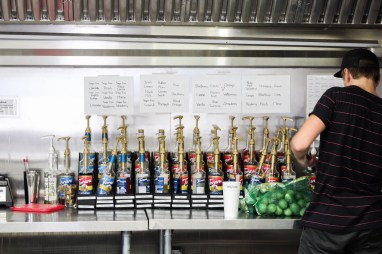
Cisneros mixes Thirst’s signature drinks for his customers. He enjoys being involved in the day to day operations of his shop.

It was this eagerness and determination that brought Cisneros to the lobby of Fox 13 News, anxiously prepping his equipment for showcase.


“I wonder if Big Buddha remembers me,” Cisneros said, in reference to Thirst’s Fox feature with Big Buddha from last year. “He likes my photos sometimes.”

Cisneros takes a story for Thirst's Instagram account. He actively keeps his followers engaged in what he's doing.

Cisneros takes a story for Thirst’s Instagram account. He actively keeps his followers engaged in what he’s doing.

He pulled out his phone and began taking a video for Thirst’s Instagram story. These Instagram updates are constant throughout Cisneros’ day to day – he prides himself on keeping his followers engaged and informed of what he is doing. An advocate of social media marketing, Cisneros is convinced that for his target demographic, nothing else works. He interacts regularly with his 3,000-plus followers, delivering to them a bona fide customer experience inside – and outside – his shop.

One evening, Cisneros recognized the driver of a car involved in a nearby accident as one of his loyal customers, and went out of his way to hand deliver her favorite drink to her at the scene of the accident. It’s this extra effort that helps build Thirst’s reputation for stellar customer service.

As each car pulls up to the drive-thru window, Cisneros greets it with a smile. He models his friendly interactions with his customers after his company’s mission statement: “Make a happy impact, one experience at a time.” With Cisneros’ level of enthusiasm and animation, it’s no wonder customers are driving away with a grin on their face. This contentment permeates the kitchen as well.

One of Cisneros’ employees, Conner Nelson, shared why he enjoys working at Thirst.

“It’s a pretty fun work environment, everyone just kind of laughs and has a good time,” he said, adding that he admires Cisneros’ work ethic. “I don’t really know how he does it to be honest.”

But Cisneros’ busy schedule doesn’t stop him from maintaining a healthy and happy workplace. Even as the boss, he remains friends with his employees, promoting teamwork through staff parties, movie nights and retreats. He even plans to take his team on a weekend trip to St. George.

Learning the ‘sexy skills’

Cisneros is thriving in the era for entrepreneurs when essentially anyone can buy something and resell it online. Through the indisputable power and reach of social media, as well as the drive and ardor that’s surging among the younger generations, the possibilities are endless. Young high school graduates no longer need to follow the long-established path laid out by their predecessors.

Cisneros has plenty of advice to give when it comes to entrepreneurship, and he emphasizes the importance of being willing to put in the work.

“It comes down to sacrificing the things that you may want in the moment, like a party or anything, for what you want in the long term,” he said. “I know what I want in the long term, which is massive.”

In Cisneros’ case, this desire for success has driven him from the moment he set up his first lemonade stand. He is working to develop a set of “sexy skills,” as he calls them.

“I’m getting my hands dirty doing it. I’m the one mopping the floors,” he said. “I’m gonna learn the sexy skills by not doing the sexy things, and then I’m gonna transfer those skills to a sexy business.”

Cisneros knows that he doesn’t want to run a soda shop forever, but he’s not ready to move on until Thirst is an undeniable success. However, he believes he will never be fully satisfied and hopes that Thirst will continue to prosper beyond him. When asked what sets him apart from the rest, his answer was simple:

“I’ll outwork everyone.”
Isabella Gentile

MY STORY

Young Entrepreneur Will Stop at Nothing to Quench his Thirst for Success

MY BLOG

When presented with the freedom of choosing my subject for the Enterprise Piece, someone immediately came to mind. I knew of Ethan Cisneros from mutual friends on campus, and noticed that he had been featured in news stories before. His soda shop, Thirst, was a frequent conversation topic, and I knew he would be a great subject to do a story on.

When determining what sources I wanted, I knew the most important voice would be Cisneros himself. I wanted allow him the opportunity to tell his story in his own words, so I reached out to him first and foremost. I had an idea of what I wanted to cover, but he gave me even more content than I could have hoped for. He provided me with the answer to every single one of my interview questions, as well as answers that gave me additional directions to take. After just one interview, I knew I had my hands full with a fantastic story.

I then moved onto a Thirst employee, Connor Nelson. I had seen Nelson featured on Thirst’s Instagram before, so I knew that would be my outlet to reach him. I chose Nelson because he is someone who sees and observes Cisneros every day in a work environment, so I wanted his insight on Cisneros’ mannerisms throughout a typical work day. Nelson confirmed what I had already expected. Cisneros is just as pleasant to work for as he is hard working.

Thankfully, I encountered no ethical issues or obstacles in my research. Everything I needed was presented to me very easily, and I found the story writing itself before me. The only obstacle was the surprising amount of material that I was granted from my subject. I had original intentions to include several different elements in my story. Kiley Money from ELK Clothing, individuals from Cisneros’ fraternity, reputable members of the Entrepreneurial department here at the University of Utah, etc. But Cisneros provided me with more than enough content to build a riveting story.

Though the continuous theme of my story was Cisneros and his entrepreneurial climb, I found myself unable to pick merely one focus. He balances so many elements in his life, it seemed unfair not to address them all, and give credit where deserved for all of the projects he has devoted and currently devotes his time to.

And so, a great story was born. But after I got it all down on paper, it was nearly triple the required word count. The content flowed in more heavily than I had anticipated. Once I began the writing process, I knew it would be difficult to achieve a clean, newsworthy draft. It took a lot of revising to effectively summarize my story into a layout I was satisfied with. I completely rearranged my entire piece at least three times, and the addition and removal of different elements took a lot of time. As the due date came down to the wire, I dove even further into the editing process. Maybe a better way to put that would be the “hacking away at my story” process. Like previously mentioned, it took a lot of editing and collaboration with Professor Becker in order to achieve the story structure I wanted and determine the relevant pieces of information needed to be featured. I learned one very pertinent lesson about my writing during this process.

What I realized within my craft is that I am a wordy writer, always have been and always will be. I have a tendency to gather a lot of information, and once I put these details into my story, I have a hard time letting go and prioritizing. It’s important to be able to differentiate great details from exceptional details, or as Professor Becker put it, know when to kill your babies. But overall, I am satisfied with my piece, and though it’s still lengthy, I feel it’s important to do Cisneros justice for all the work he is doing. He stands out among everyone else his age, and that’s a story worth telling.


ABOUT ME

I am a student living in Salt Lake City, currently enrolled at the University of Utah. I am spending my four years attaining experience and knowledge to someday work as a creative director for a respectable company, ideally. I am majoring in Strategic Communication, so I am learning skills in marketing, advertising, branding, as well as public relations. Though I am not currently pursuing a career in journalism, I do have a piece of work that I am proud of and I believe to be worth reading. 

University of Utah Climbing Team prepares to defend its title

Story and media by ERIC JEROME

“Keep it up guys’ just one more set,” Danny Popowski shouts encouragingly to the three University of Utah Climbing Team members he is currently working with.

Using impressive strength and determination, the women pull themselves up the campus board, a  series of wooden rungs designed to improve power and contact strength by executing vertical hand movements without the use of one’s feet. Hand over hand they repeat various exercises, going up and down the board athletically

In another area of The Front Climbing Club, located at 1470 S. 400 West in Salt Lake City, team members are simulating the format of a competition. The athletes are trying to onsight boulder problems that are difficult for them. This means that they are trying to complete a climb that they are seeing for the first time within four minutes without any outside assistance.

Those who specialize in sport climbing, longer endurance-based climbing utilizing a rope, are climbing laps on tall overhung walls. They’re pumping their forearms with lactic acid to increase their endurance.

Elsewhere, climbers planning to compete in the third and final discipline, speed climbing, are busy dashing up the 15-meter regulation speed climbing wall. They are trying to improve their times by making up for small errors and dialing in their muscle memory.

In April 2017, the U Climbing Team became collegiate national champions after a grueling two-day competition in California. This year, the team is hungry to defend its title and is training harder than ever.

Popowski, 24, has recently purchased a 2,800-square-foot house in the Marmalade district of Salt Lake City. He has been working to remodel and furnish the two-story place. It isn’t for him, however. Popowski is getting the house ready to be rented as an Airbnb. It’s a lofty and ambitious task, but he is accustomed to those.

After finishing his competitive youth climbing career, Popowski moved to Salt Lake City from Maryland to pursue climbing and attend the U. Collegiate competitions seemed like the next step for him. However, there was no climbing team, and Popowski attended nationals in 2014 as the U’s only competitor.

In 2015, Popowski founded the team along with friends Casey Elliot and Ben Roa. Under Popowski’s coaching, the team placed third overall that year at nationals in San Diego.

Elliot, Roa, Popowski, and another team member made the U.S. team and qualified for the World Cup in Shanghai, China, that fall.

Continuing its momentum, in 2017 the team took first place overall at nationals.

That September, the climbing team had its largest tryout and saw a lot of new talent from across the country. After a difficult round, the team was trimmed down to 15 men and 15 women.

Monica Barnes, 19, from Golden, Colorado, is one of the many new additions to the team.

Although she only started climbing in January 2017, Barnes said she loved it so much she climbed every single day for three months. During this time she heard about the climbing team and it became a big motivator for her.

“I climbed really poorly during tryouts and was very sure that I hadn’t made the team. So when the list came out and I saw my name was on it I was super stoked,” Barnes said.

Since joining the team in September 2017, Barnes said she has become a much better climber. She attributes her improvement to the presence of more experienced climbers on the team. “Having good climbers around you to boost your mental game and convince you that you can succeed and be confident in your own climbing was huge for me,” Barnes said.

Barnes has been training hard, but having never seriously competed before, her main goals for the Collegiate National Championships are to have fun, try her hardest, and feel as though she climbed her best. Additionally, Barnes looks forward to supporting her teammates. “It will also be really fun to watch my friends compete in finals, because I am sure that several people from the team will make it,” Barnes said.

In contrast to Barnes who only recently started climbing, Sam Enright, 19, from Boston, Massachusetts, is a sponsored athlete who has been competing at a high level since the age of 10 and moved to Utah to pursue climbing.

Enright says that being on the team has helped to keep him on a strict training plan and he has also made a lot of friends from it.

Enright, who has attended many national championships and world cups, is looking forward to collegiate nationals. “I am excited for collegiate nationals because it’s a bigger competition and has that big competition feel, but it is a little more relaxed and doesn’t come along with as much intensity and pressure. I’ve been told it is more social and all the teams from around the country hang out and have fun together,” Enright said.

A seasoned athlete, Enright’s goals for the competition are lofty. He wants to make finals in all three disciplines (sport, speed and bouldering), and also make it onto the podium in at least one of those.

As practice winds down Popowski tells the team, “Remember, all of this hard work will pay off when we are smiling for the cameras as back-to-back national champs.”

The Collegiate National Championships will be held April 20 and 21, 2018, at Momentum Indoor Climbing in Houston.


This slideshow requires JavaScript.


Jake Phillips

FullSizeRender 4

My Story:

BEYOND THE WATER CYCLE

My Blog:

I initially had a difficult time gaining inspiration for my enterprise story. I am honestly less than passionate about journalism and found it hard to find an interesting topic which I felt capable of tackling as a student journalist.

I wanted to do a story about the environment but didn’t know where to start. That winter had been especially dry and the inversion had trapped a lot of pollutants in the Salt Lake Valley so I thought that now would be a pertinent time to write a story about the environment.

Inspiration for my story came during a class one evening where my journalism class interviewed Patrick Shea, former director of the Bureau of Land Management. The class was interviewing Shea to practice interviewing subjects and writing profile pieces. While the class was interviewing Shea mentioned that he taught a class about water conservation to fourth graders at Rose Park Elementary.

I decided to write about water conservation education in Salt Lake City. I started my search by calling the city’s Department of Public Utilities, but I did not get a lot of information from officials there. I decided to ask my professor for Patrick Shea’s email so I could try to interview him.

When I contacted Shea he invited me to tag along with him when he went to Rose Park Elementary School to teach his class.  I was really excited to be allowed to come and see how Shea was teaching this group of fourth graders about water science and conservation.

Being able to go with Shea to Rose Park Elementary and eventually on a field trip with the class was crucial to me writing my story. Being able to talk to the students in the class and their teacher gave me an interesting perspective on why teaching water conservation to students is important and how the students were reacting.

About Me:

I am originally from Greenville, SC, where I lived for most of my life before moving to Salt Lake City to attend the University of Utah. I am a sophomore at the U where I am studying strategic communication. I began newswriting while taking a required journalism class in the spring of 2018.

Cali Felts

A57A9082

My Story:

New Development in Holladay, Utah

My Blog:

For my enterprise story, I chose to write about a possible new development site in my hometown of Holladay, Utah. I was curious to look at all of the different aspects of this new project, which is slated to be built on what has been an empty lot for years. Looking at the benefits and drawbacks of what will come about of Holladay was my goal for the story. I am personally against overdevelopment, which is why this particularly sparked my interest. This lot would be going from an empty lot where nothing occurred to bringing in more than 3,000 extra people into the town.

Finding information about this site was fairly easy considering how many news sources were covering it. I was able to go out and ask citizens of Holladay their opinions of the new development, and I was even put in touch with Cindy Taylor from Ivory Homes. Ivory Homes also has a website specifically for the proposal, including a slideshow attached that explains every little detail of the project. There are signs all over Holladay, an Instagram account against it and a website Holladay citizens created in opposition to the new development proposal. There have been multiple hearings about all the proposals and a time where Holladay citizens have been able to voice their opinion on the development.

After doing this whole project, my vision has shifted about overdevelopment. I still do believe we need to save some forest and not develop everywhere but at the same time, this lot was originally a mall. Holladay was built to accommodate the traffic of the mall and can handle the traffic of this possible new development – not to mention the economic bonus it would bring to Holladay.

About Me: 

I am a freshman at the University of Utah studying communications. I plan to graduate with a major in Strategic Communication and minor in Marketing. Upon graduation, I want to work in public relations for a company.

I grew up in Utah and was lucky enough to attend the University of Utah starting in the fall. In high school, I was part of a service group and held a leadership position in my high school dance company. I am interested in singing, dancing, traveling and boating. I work as a nanny for multiple families and absolutely love it. I am currently a Chi Omega at the University of Utah and I am travelling whenever I can get away.


Emilie Nielsen

emilie 1My Story:

Is Social Media Reality Ruining our Actual Reality?


Blog:

For my enterprise story, I wanted to take on and bring up the issues involving younger generations. For young people, social media is king, queen and court as it literally rules the lives of many.

As this takes on even greater relevance in our lives, particularly with the current focus on Facebook, privacy and what we give up when we share our photos, stories and thoughts, I wanted to talk to some of the people who deal with this issue on a daily basis. I chose the sources whom I knew would have the knowledge of growing up or dealing with the stress of creating the perfect life on Instagram.

I wanted to have both young girls’ thoughts on this and the reflections of administrators and counselors to see what the prevailing view of social media was.

Estelle Andreasen was someone I wanted to bring into this story. I met her in Denmark where, she shared, she would skip class multiple times a week. This piqued my interest so when I decided to write this story I wanted to FaceTime with her and ask her thoughts on why she wasn’t going to school, or what was elevating her anxiety.

Sisters Annie and Emma Black were girls I wanted to talk to, knowing that they are fraternal twins who are different in almost every aspect of life. Annie — the more social media-minded of the two — and  Emma, who could never use social media and be content, each had points of view I wanted to include in the story.

Amber Black is their mother. I wanted to ask her about her most interesting insight into her daughters’ social media use. The girls had just gotten their first smartphones and I thought to ask Amber whether a major shift in  attitude would make a difference in how her kids use social media and its impact on their anxiety and social stress.

Debbie Perry is a counselor at Woods Cross High School. I thought that she would be an interesting person to ask about social media and phone usage at the school and what are the major generational differences that affect the phone usage.

I also wanted to talk to Deanne Kapetanov, the principal at Mueller Park Junior High School, to see how social media has affected the school dynamic and if its use has caused any problems at the school.


About Me:

I was born and raised in Utah and am now a senior at the University of Utah majoring in strategic communication.

I love photography, traveling and spending time with friends. I have always loved  Denmark, and was able to travel there for a study abroad year when I was a college junior. While there I was able to meet many different people from all around the world which broadened my love and desire to travel.

I have had many different jobs, including photographer, model, sales representative at Reynolds Car Wash, baby clothing boutique Over the Moon and Pictureline, which is a camera store.  I modeled in Denmark, where I also worked as a photographer for the main newspaper in Aarhus, the country’s second-largest city.


Kelsey Mae Rathke

MY STORY:

MY BLOG: 

My desire to write about urban beekeeping came from the many conversations regarding my own experiences with honey bees. My hope was to communicate how safe they are and how easy they are to keep for those who are interested.

Prior to writing this story, I knew Albert Chubak – the designer of the hive that my family uses. He has been a great resource as we have grown into beekeeping. Albert provided additional resources for the story, advising that I reach out to Beth Conrey as an additional expert and advocate for pollinators and Marlene Jacobsen Schnabel for her experiences with novice beekeeping.

Albert and Beth are extremely involved in the bee community in the United States. They both own businesses working with bees, regularly attend honey bee conferences as speakers and create material around beekeeping. Marlene has extensive experience bee keeping on a personal, non-business level, and can speak to her growth in the hobby.

Initially, I wanted the article to be more educational and less fun. However, preparing for the interviews and then consolidating my notes from the interviews redirected me toward highlighting particular opinions and experiences. The interesting pieces of what I had gathered were stories, not lists of facts.

My writing process truly began with preparing for the interviews and brainstorming the direction of those interviews. Once the interviews were complete, I condensed all of my notes into bullet points and sifted through what would be interested to someone with no experience with bees. I then wrote my first draft with only two additional major editing drafts. Through the editing process, I moved pieces of the story around and rewrote the lead. Through this process, I learned how important it is to have another person take a look at your work. Collaboration with multiple voices really helped strengthen the article and moved it in a more interesting direction. It also really keep me in line with what information I needed to explain to the reader that I had originally assumed they would understand.

The biggest surprise that came out of the interview and writing process for me was learning about why honey is so beneficial (antimicrobial, antibacterial, antiseptic, etc.) I was also surprised that Marlene was so successful in beekeeping and learning that she had started multiple hives on her own and helped get hives going for family and friends.

AUTHOR BIO:
Rathke_Headshot

Kelsey Rathke is a Utah native and University of Utah Utes enthusiast. She is a senior associate in Digital Servicing for Discover Financial Services, and a junior at The University of Utah studying strategic communication. Rathke has extensive experience in corporate writing and is currently enrolled in a news-writing course. She is an honors student at The U and will be the Marketing Officer for the Crimson Transfer Honor Society for the 2018-2019 academic year.

Legalizing Medical Cannabis in Utah: Does the LDS Church Get to Decide


SALT LAKE CITY- The subject of religion influencing politics is a major discussion in Utah particularly concerning the Church of Jesus Christ of Latter Day Saints ( LDS) influence in legislation regarding legalizing medical cannabis. The LDS (Mormon) church, last year, made a statement regarding legalizing medical marijuana saying “We urge a cautious approach to legislatures”. Some Utah voters question if religious views should even be involved on the floor, and if the church should be allowed such influence (verbally); especially when it comes to the well-being of the citizens of the state.

According to the most recent census numbers, sixty percent of Utah citizens are Mormon as are 80 percent of Utah legislators.  Medical marijuana (MM) supporters are concerned that LDS legislators are making their decisions based on personal religious views. While the LDS church has made their views regarding the use of cannabis very clear,  75% of Utah voters; still favor medical cannabis and are pushing to have the vote to legalize it on the 2018 ballot. Some argue that the Utah house should be pushing legalization more because the Utah public is expressing interest, and it should be the public choice rather than the senates with possible influence from the church.

“I strongly dispute the narrative regarding poll numbers,” Rep. Brad Daw (R) said when asked about public opinion regarding legalizing medical cannabis.  He discussed how under polls he conducted [not scientific] the question asked was “what level of cannabis legalization do you support” and more people, many of those who are LDS, are in favor of carefully supervised legalization rather than a full allowance of medical cannabis,. This past February, the house passed Daw’s bill (197) that requires the state to grow medical marijuana, and allow chronically ill patients to “try it. They also completely legalized cannabinoid with 10% THC for over the counter sales. “This can benefit the people who need it, and for those who need higher THC, the bill will allow research patients under careful supervision to be allowed access”

When asked if the Church had influenced decisions made by legislatures, Daw responded by saying “Removing religious opinions from politics would be hard to do…. the people on the board are elected by Utahan’s and their belief is their belief” stating that politicians would not be elected into office if the public had an issue with their decisions and personal beliefs. While the church is not opposed to limited and monitored medical use, they do make statements that the church would prefer that there be no use of cannabis; thus possibly affecting the opinion of those in Utah Senate.  Daw explained, that we don’t want to “stifle the voice of public opinion” and the LDS church has the right to freedom of speech and to represent voters just as any other organization or citizen.

Voter Ann Cook, a non-Mormon who has lived in the state for more than 45 years, sees the idea of religion and its influence on the state differently. “The LDS church really does have control, if they just came out in favor of this, the bills would pass,” she said regarding the issue. Cook is in favor of citizens of Utah voting on this rather than the legislature, believing that the church’s opinion would primarily be removed if done in this manner. “ I myself suffer from chronic arthritic pain and had to retire because of it. I’m limited in what I can do and I deserve the right to legally try out cannabis to alleviate my pain.” Cook also added that she could make the effort to get products in states which have legalized them, but she does not feel comfortable obtaining such until they are legalized here in Utah.

“We regard cannabis medicine as a medical, scientific, and sociological matter,” According to TRUCE (Together For Responsible Use and Cannabis Education)  reps said in regard to the influence the church has had on Utah’s position on legalization. “Our LDS TRUCE members are generally of the opinion that medical cannabis use is not a doctrinal issue, and LDS patients in medically legal states are considered members in full good standing… as are members anywhere taking prescribed opioid medications.” TRUCE has been pushing for the decision to be put on the 2018 ballot, rather than putting it the hands of the legislature. This is in belief that voters will support full access to medical marijuana, and will keep religious affiliations away from the decision. TRUCE advocates that the church does not need to be “speaking with representatives” as it grants too much power of the state to the church. They are not advocating for recreational use, and that they simply wish that patients with chronic illnesses have the option to use cannabis to assist with their treatments.

The issue regarding church and state in Utah is easily a debatable subject. While some believe the LDS church has too much influence or control over Utah politics, others see the affiliation only as freedom of speech. With terminally ill patients begging to allow for the public to vote on the subject the legislature is moving slowly towards the idea, and many are concerned if the LDS church’s views regarding cannabis, could be conflicting with progression towards legalizing it for medical purposes.

Ellie Cook

MY STORY

IMG_1066_preview ABOUT ME: Ellie Cook is a 20-year-old undergrad studying Communications and Psychology at the University of Utah. She also is a writer for the humanitarian fashion magazine “Trend Prive”. She is also an animal and genocide prevention activist, as well as someone who frequently volunteers with children and animals. Ellie enjoys spending her leisure time participating in community theater and works as a model/actress for NIYA management. Ellie aspires to one day put her love of writing to work by publishing pieces aimed for teen audiences in regards to mental health, in hopes of reaching out and contributing to the well being of troubled teens.

Website

Linkedin

Paula Garcia

MY STORY: The cruelty-free cosmetics market is booming image1

MY REFLECTION BLOG

ABOUT ME:

I am a journalism student at University of Utah and a cat mom. I am passionate about feminism, social justice, music, makeup, animals, and blogging. I run a blog called Ask Nicely (https://asknicelyblog.wordpress.com) in which I cover music and lifestyle news. I am of Ecuadorean and Spanish descent.

Instagram: daydreamdoom

LinkedIn 

Local entrepreneurs discuss new wedding business in Salt Lake City

Story and gallery by JOE WOOLLEY

Simon Morris, 36, a local entrepreneur who was born in Salt Lake City, has always dreamt of one day owning his own business. When his fiancée, Sarah Beale, 34, pitched the idea of starting a business together late one night he jumped at the opportunity.

“All dreams are possible if you work hard and believe they can happen,” he said.

Morris grew up in a military household and was expected to follow his brothers into the Army. Morris had other interests such as fashion but felt so much pressure from his father to join the military, so he kept his passion to himself.

After a childhood full of expectation, Morris joined the Army at the age 18 and was due for deployment September 2001. However, his world changed as it did for so many when the World Trade Center in New York was hit by hijacked planes.

“The experiences from the Army will follow me in every aspect of life, but it was time for a change,” Morris said.

His priorities had changed and he no longer wanted to be a part of the Army. “I know to some people it may be foolish, but I didn’t sign up to be fighting terrorists. I wanted to  follow my dreams and be involved in fashion,” Morris said.

In 2001 Morris went to New York and attended Fashion Institute of Technology to study fashion. He was finally content with his job and never looked back. After graduating in 2005, he went straight into the fashion world and began designing wedding dresses for Roma weddings.

During his period in college he met Beale during one of his art classes. He claimed that it was “love at first sight,” and the two of them hit it off straight away. He admitted that he’s not sure where he would be without the help of his companion.

In 2012 Beale owned a Toni and Guy hairdressers in Nottingham, United Kingdom. She loved the responsibility of owning a business. However, unforeseen circumstances forced her to leave and move onto a new chapter. “I loved satisfying people and giving them makeovers is one of the most rewarding jobs out there,” Beale said.

After learning the couple shared the same ambition of owning a business, Beale thought it would be a great idea for them to follow their dreams. She said, “I didn’t really know what business he wanted, but I gathered we could integrate our skills and create something amazing.”

After many discussions the couple decided to create a company which focuses on wedding days. They both agreed that they could incorporate their skills and give the special day something extra.

Morris committed to the wedding dress designs along with the choice of venue, while Beale would take the responsibility of hair and makeup. He said, “It was really a dream come true for me, when Sarah first pitched the idea to me I was very concerned, however, after going over the risks I decided it would be a good idea for us to give it a try.”

The business is yet to officially be launched as Beale is still in the works of getting her medical aesthetician certificate, but once that is completed they can offer their services to the public. While they cannot officially start their business, they are currently in negotiations on where to set up the main office.

“The whole process has been a blur, it only seems like yesterday since I pitched the idea to Simon,” Beale said. Even though they can’t make the company public yet they have been offering people a free makeover session to experience some of the work that they will be offering.

Lindsay Bollschweiler, one of the people who experienced this free makeover session, said, “This is one of the most amazing makeovers I have ever had. My wedding is sometime next year so I will certainly be using the services of Simon and Sarah to help with the big day.”

Another person who experienced this free makeover was Maddison Kemp, who could not speak highly enough of the professional approach Beale took. “The things that this woman can do with a makeup brush is amazing. Not only did I love the makeup, but I enjoyed the company from both Sarah and Simon. They were so welcoming.”

The pressures of starting a business had been much different than what Morris expected, but he reassures himself daily that all of the hardship will be worth it in the future. “I never thought that this process would be easy, but every single day comes with a new challenge,” Morris said.

Going from the Army then to fashion was a major change for Morris, but he said the challenges created from this project have been much more difficult for him.

The wedding dress designs seem like a breeze to Morris who learnt his trade during his time at school. He took several designated classes to learn how to design wedding dresses and holds the ability to create a dress for personal specifications. However, the venue choice did seem to unnerve him a little. “I often know what people like, but weddings are such a particular case, so I have to be extremely careful when judging a person’s character,” he said.

Beale said that she has never seen Morris this stressed about life. But, she continues to remind him of the end product. “I have been doing makeup and hair for a long time, so I am very much in my element, whereas Simon is not so much in his comfort zone so it’s difficult for him,” she said.

Morris added, “We just want to make people happy. I understand how important their wedding day is and I want to make it my duty to give them the best day of their lives. If I can put a smile on just one person’s face a day then I’ve achieved something.”


Business owners discuss their journeys and advice for U students with start-ups

Story and gallery by ANDREA BECERRA

By making a business out of a personal interest, working will never feel like a drag. Many people have had at least one great business idea, but have never gone through with it due to fear of failure.

The majority of business-owners will admit that they have failed many times, but learning from mistakes allows a business to thrive. What do business owners have to say to people who want to start their own business?

Amber Barron, a junior at the University of Utah, is a part of a business called SHERO. SHERO first began when Barron, her classmates, and professor, saw that there was a real need for biodegradable products because there is a great amount of waste associated with feminine care. They quickly began to create a start-up business.

Barron said SHERO makes affordable biodegradable feminine hygiene products. The business name stands for Sustainable Hygiene Engineering Research and Operations, but it was initially named due to the combination of female-hero. The founders of SHERO are Jeff Bates, Alicia Dibble, Ashlea Patterson and Barron. Since then, several others have joined the team.

The average woman disposes of 6,000 pounds of feminine hygiene products over the course of her lifetime into landfills, so this is an issue they are resolving. Barron said SHERO is trying to target two groups. The first group is women who have access to feminine hygiene products but are wanting to be more sustainably minded. The second group is women who don’t have access to affordable products. SHERO will provide the pads at a discounted price.

SHERO is currently working on research and development of materials, specifically fine-tuning the super-absorbent polymer, a key component to their unique pads. Once they complete the fine-tuning, Barron said they will be sending it out for manufacturing.

The U students who are running SHERO participate in Lassonde’s mentoring program. The Lassonde Entrepreneur Institute is a nationally ranked hub for student entrepreneurship and innovation at the U. The mentoring program allows students to use the space, materials and 3D printers.

The students who run SHERO participated in the “Get Seeded Monthly Milestone Funding Program” — a program that is sponsored by Zions Bank. This is a pitch event to help aspiring student entrepreneurs by receiving a grant to get a business idea off the ground. SHERO received $3,000 from this program, which Barron said helped tremendously.

Another competition that the U students participated in was called, “Bench to Bedside.” SHERO was awarded funding from that as well.

Barron always imagined that starting a business would be difficult. “There are a lot of hoops to jump through, but there is a really strong program at Lassonde,” Barron said. Her advice to University of Utah students who are wanting to start their own business is to make use of the amazing resources that are offered at Lassonde, like attending their events and activities.

Barron suggests to students that if there is a professor who has a lot of experience in the field one is interested in, feel free to pick their brain. Professors can oftentimes connect you to people who may be helpful.

Connections are very useful when you have a business. Richard Becker, a Utah business owner, shared how important networking is. “I sign up to attend as many business events in my field of interest, as I can,” Becker said. He owns the company, Rota Farms, with a long-standing tradition of growing and producing fruits with biodynamic systems that he designed and developed. Rota Farms not only controls its own fields but also third parties worldwide.

Since Becker’s interest is based on agriculture and exportation, he attends many events hosted by Utah World Trade Center.

“University of Utah students have many resources at their fingertips, that they should be using. Especially students who are starting their own business,” Becker said. He also recommends students do as much research as possible, as well as work in the field of interest first in order to learn what one should and shouldn’t do.

Bibi Paredes co-owns Rota Farms with her husband, Richard Becker. She has advice for students as well. “Working every day with your spouse or friend not only requires a lot of patience but also the ability to separate your work and personal life as much as possible,” Paredes said.

She mentions that owning a business has great ups and downs, which can cause stress at times. “It is crucial to save as much money as possible, even when the business is doing really well. Most times businesses have seasons of high profit, and others when money gets tight, so one must have funds for emergencies,” Paredes said.

Overall, Becker and Paredes say that having your own business is very rewarding, and they wouldn’t trade the experience they have had for anything. “Never let fear get in the way of pursuing your dreams and passions,” Becker said.


Joe Woolley

MY STORY:

MY BLOG:

profile picMy story about an exciting new company in Salt Lake City really caught my attention when I saw an advertisement on Instagram. I didn’t know the person who uploaded the advertisement, however, I had a friend who shared it on to my Explore page. After witnessing this advertisement, I knew that this was something that I wanted to share with more people.

I was able to locate my sources through the advertisement. It documented the number of the owners and allowed me to reach out and make contact with them. I was also lucky enough to get some personal accounts from people who have had makeovers by the two owners.

The founders were the best sources for my story. Their insight into what it really takes to create a new business which nobody had ever tried before is something that no one else could have offered. I really hope that everybody can witness from my story how they overcame certain challenges.

Thankfully, I did not encounter any problems that affected my story or the way it was told.

I made sense of all the information I gained by constantly going back over my writing and absorbing all the information. I was making constant little changes to my writing until I saw a pattern which really made the story flow.

I would say the biggest challenge I encountered during this story was the writing process. It took a lot of time and stress to figure out how I wanted to portray the company, however, after learning how I wanted to write the story it became much more efficient and free-flowing.

I couldn’t have added more detail to the story without it becoming too much for the reader.

I surprised myself with how well I was able to adapt when an interview wasn’t going according to plan. In my first interview I came across some trouble when I wasn’t getting the information I wanted out of my source, but instead of settling for what he gave me I asked a few more questions which gave me some much-needed answers.

ABOUT ME:

I am a 20-year-old junior studying Journalism at the University of Utah. I have enjoyed my time here at the U, but I am excited to pursue my dreams in sports broadcasting. I am a proud member of the Utah men’s tennis team and I love giving back to the university community. I also plan on joining the U athletics council next year.

Sports has always been a massive part of my life and being able to incorporate that with my Journalism major is a dream come true for me. I would be thrilled to use my knowledge of sports and inform people about it through the form of broadcasting. I have an internship at the BBC next summer and I plan to take full advantage of the experience I gain to further knowledge on reporting.

When I am not in class you will find me on a tennis court, at a dog park, or sitting at home watching sports. I am currently writing an article about my time as a University student-athlete and plan to publish it when I graduate.


Three dessert shops in the Salt Lake Valley you need to try

Story and slideshow by ELIZABETH NYGAARD

Dessert is the best meal of the day.

If you’re looking for a delicious dessert for date night, family night or a birthday party, there are many Salt Lake City restaurants and bakeries where you can get your dessert fix. The list of desserts ranges from edible cookie dough, to out of the box ice cream, and gourmet desserts.

Edible cookie dough would have sounded weird a few years ago but Dough Co. a local Utah-based company, is doing dessert right, with eggless cookie dough options.

Dough Co. has a location in the Sugarhouse neighborhood at 2121 S. McClelland St. They are open Sunday through Thursday 11 a.m. to 10 p.m. and Friday through Saturday 11 a.m. to 11 p.m.

Dough Co. is opening a second location in South Jordan later this year.

Dough Co. offers a variety of edible cookie dough options, including milk n’ cookies, which is a scoop of edible cookie dough and ice cream and A shake with your choice of dough flavor blended with ice cream.

The Sander Family and Myles Sander, a student at Westminster, studying neuroscience were at Dough Co. to celebrate family night.

“We’ve been coming here for awhile now, my little brother loves cookie dough so whenever he picks dessert we come here.” he said.

Myles and his family shared the p’zookie, a warm skillet of melted cookie dough with ice cream on top.

Dough Co. has edible cookie dough in many different flavors ranging from: Chocolate Chip, Loaded Brownie, PB Explosion, Cake Batter, S’mores, Red Velvet, Oreo Thin Mint, Mexican Hot Chocolate and Salted Caramel Pretzel.

The March 2018 flavor of the month is Cookies & Cream.

Dough Co. gives out samples of dough for guests that are unsure of what to get.

If edible cookie dough isn’t your thing and you’re more of an ice cream person head to Trolley Square to try Normal ice cream.

Normal ice cream is a food truck located at 600 S. 700 East inside Trolley Square for the winter season. The shop is open Wednesday through Friday 4-9 p.m., Saturday 1-7 p.m. and Sunday 1-5 p.m.

Normal is a local food truck and it is women owned and operated.

Gabby Snow, a student at the University of Utah and her boyfriend, Weston Don Merkey, love Normal ice cream.

“We went to Normal for ice cream for date night tonight. We love it here!” Snow said. “I got the Tutti Frutti (earl grey and pomegranate twist, fruity pebbles, passion fruit caramel, and toshi cherry) and Weston got a cone of the London Fog (Earl Grey soft serve, dark chocolate dip, lavender ganache, and cotton candy).”

Snow tells her friends, “The flavors are all diverse so if you’re looking for out of the box ice cream come here!”

Normal ice cream changes its ice cream flavors, but they are always diverse and exciting.

Normal serves composed cones, which are six specially created cones, and on Sundays Normal offers a doughnut ice cream sandwich. Other ice cream sandwiches include dulce de leche filled banana ice cream served between shortbread cookies and dipped in dark chocolate.

The base ice cream flavors right now are Earl Grey, Vanilla Bean, Pomegranate, and Nutella.

If you’re looking for an all-around dessert shop, Last Course is the place for you.

Last Course has two locations: at 115 South Regent St. in Salt Lake City and at 185 E. 12300 South in Draper. Both shops are open Monday through Thursday 11 a.m.-10 p.m. and Friday and Saturday 11 a.m.-11 p.m.

Mayra Repetto, a student at the U studying biology, raves about Last Course.

“My friends surprised me with a trip to Last Course for my birthday! I’ve always loved Last Course and the desserts here,” she said.

Last Course has gourmet desserts and ice cream, such as Strawberry Nachos, 24 Karat Cake, and Glamping S’mores.

“My favorite is probably the Upside Down Caramel Apple Pie, it’s so dreamy,” Mayra Repetto said.

The Upside Down Caramel Apple Pie is a cinnamon roll filled with layers of warm apples covered with salted caramel sauce and a streusel topping.

Last Course isn’t limited to just desserts. It also features gourmet ice cream scoops.

Everyday flavors include Tahitian Vanilla, Breakfast Cereal, Smoked Maple Bacon, and Olive Oil.

The breakfast cereal ice cream is cream infused with Trix Cereal, with chunks of Lucky Charms throughout.

The workers at Last Course offer an unlimited amount of tastes for guests.

Last Course is a Utah company that uses local ingredients to make its desserts.

The dessert shops around the Salt Lake Valley are not limited to these three. There are many options. These three shops cover all dessert favorites and happen to be many people’s top-three places to go.

Just as Mayra Repetto believes: “Dessert is spent better with friends and family!”

This slideshow requires JavaScript.