Ryan Matthew Thurston

MY STORY: 

Processed with VSCO with a6 preset

MY BLOG: 

While doing my research and formulating my story, I was really unsure where my thought process would take me. I figured that it would either turn out really successful and that I would gain valuable insight into the lives of STEM majors, or it would be a flop and I would be left with meaningless interviews and struggling to find an angle.

However, I’m happy to say that this was not the conclusion I came to. My experience was really enjoyable, and I did end up learning a lot about what I was studying. My favorite part was getting to know the people on a more personal level and learning about what motivates them, what they hope to accomplish, and the kinds of impact they hope to have.

The sources I interviewed were my friends and classmates, which is usually a bad demographic to tap into. However, I felt that for this story, it would allow me to access the beat I was looking for best. Interviewing a doctor or former medical student wouldn’t be as effective because they would already be far along in the process of practicing medicine. Instead, I wanted to talk to people who were just starting out and see what their thoughts and experiences were like. This gave me a better grasp on what it’s like to pursue these kinds of majors and helped me answer my questions I had beforehand. I was most surprised by my sources’ insistence on staying dedicated and not straying from their long-term goals.

ABOUT ME: 

Ryan Matthew Thurston is a freelance writer and sports journalist from St. George, Utah, who now resides in Salt Lake City. During high school, Thurston was the captain of the debate team and won the 3A state tournament in 2016. He also swam and played volleyball for Snow Canyon High School. In college, Thurston has worked as an athletics communication intern for Utah Athletics, the Pac-12 conference, and ESPN. Thurston hopes to one day publish articles for ESPN, Vox, or FiveThirtyEight. His favorite sports include basketball and baseball and his favorite teams include the Utah Jazz, Chicago Cubs, and Philadelphia Eagles.

Chandley Chynoweth

MY STORY:

MY BLOG:

For my enterprise story I wanted to make sure I was writing about something really meaningful to people. I thought about what could make a difference in people’s lives and I decided to write about opioid addiction and if medical marijuana could be a better solution.

I wanted to educate people about opioids and let them know the dangers of taking them. I also wanted to find out if there are better alternatives so people can avoid starting them in the first place. A family friend works as a neurologist in Provo, Utah, and I knew he would be a great source to interview. I also know a medical assistant so I interviewed her as well. My final source was a friend who lives in California who currently uses medical marijuana as a replacement forhis pain pills.

Some issues I encountered was that the neurologist wanted to remain anonymous because medical marijuana is not legal in Utah. I asked him what I could refer to him as and he said Dr. R. The medical assistant also wanted to remain somewhat anonymous, so she said I could use her first name and last initial, Michelle C.

After my interviews it became clear that all three of my sources believed medical marijuana was a better alternative than opioid medication. So while writing this I tried to tell each of their stories in an informative way that correctly represented their beliefs. I wanted to interest my readers while giving them the facts about opioid use and the destruction it can cause.

I really enjoyed interviewing Dr. R because he was so knowledgeable about this topic. I learned a lot about opioid addiction and how common it is in Utah. I was surprised by how many patients come to a doctor just seeking opioids, or to try to sell them. It was also surprising that two medical professionals both thought medical marijuana could really help people, and yet it’s not legal in Utah.

I enjoyed writing this story and I am glad I chose this topic. I think it is really important to spread awareness of this opioid epidemic and show people there are other alternatives to these drugs. If anything I hope my story can stop people from taking them because all it takes is one prescription to ruin a life.

New profiel

ABOUT ME:

I am 25 years old and currently attending the University of Utah. I love to read and I’m obsessed with Harry Potter. I love traveling and exploring new places. After I graduate I hope to travel around Europe before starting a career. My family is the most important thing to me, along with my cat named Khaleesi.

I will be graduating from the U in fall 2018 with a degree in communication. I have been planning on applying to law school but I am still keeping my options open. I enjoy working with people and working in the business industry. If I don’t end up going to law school I will hopefully start a career in business.

Peter Johnston

MY STORY: 

MY BLOG:

Every Wednesday and Friday morning, I arrive at the Catholic Community Services of Utah building in Salt Lake City, where a colorful mural depicts likewise colorful people giving and receiving help. I’m an intern there for the Preferred Communities Department, where I assist the star source of my story, Leul Mengistu, with the fledgling Men’s Wellness Support Group.

Peter-JohnsonCan someone say, “conflict of interest?” I in fact reported on the same program I am working to launch. I scratched my head for a bit over whether I was the right person for the feature or some other reporter-in-training should handle it. But then again, I was and am the only student in COMM 1610 with close access to the Men’s Wellness Support Group. So I gave it my scout’s honor to be as unbiased as possible and proceeded to write.

My focus was difficult to drill into. Should I tell the story of a single refugee in the support group? What about a feature story on Mengistu and his program? But there were problems with these: no male refugees were yet recruited and I doubted 850 words could fit a good feature on Mengistu’s past and his program’s future. It was Mengistu who delivered the story’s focus — a local charity was starting something new in the world of refugee resettlement: a curriculum-based program tailored to men. There’s the slice of the ham I wanted!

Leul Mengistu and Aden Batar were the best possible sources for such a story. Both men experienced the difficulty of American integration and were now heading programs to help people like them. I especially loved Mengistu’s quote: “I don’t want them to fall between the cracks.” It proved a good backbone for the story and captured the urgency to help male refugees today.

Batar surprised me when he dropped this bomb of a quote: “The most welcoming state in the U.S. is Utah.” I doubted him and thought, “Really? The beehive state? What about New York or California? Massachusetts or Washington?” But because it came from the man in charge of the Department of Immigration and Refugee Resettlement, it carried some legitimacy.

I intended for the story to shed light on why the Men’s Wellness Support Group is needed and what Mengistu is doing to start it in Salt Lake City. However, certain grandmothers made the valid point that although the story is about refugee men, it fails to include their perspective. The story’s done and submitted, but if I had another go, I would include a lead about one of the very refugees who currently needs help.

ABOUT ME: 

I’ve given up a lot for stories.

My time, money, grades and even eyesight have been swallowed by my voracious appetite for a good story. My eyesight left when I read books by the light of a Happy Meal glow toy when my parents thought I was sleeping. My grades went after I couldn’t put “Fablehaven” down in elementary school.

In high school, I wrote the beginnings of stories about people trying to cheat fate or run futuristic governments. But my dreams of being a novelist took a turn when I went on an LDS mission and discovered the flesh-and-blood face of stories.

I met people all over Louisiana who suffered. Old ladies whose kids never returned home, fathers who raised children in the shells of battered houses. These people had stories that changed my own. My narrative was no longer about Peter Johnston climbing the academic ladder or Lisa and Jeremy’s son wasting time with a book — it became one of Elder Johnston praying with and for the downtrodden in New Orleans and Baton Rouge.

Nearly a year later, I’m an Eccles Scholar with a major in International Studies at the University of Utah. A main focus of mine is my internship at Catholic Community Services, where I’ve developed a support group for refugee men in Salt Lake City. Theirs is an untold story, and I aim to help them write a better one for themselves in this strange land called America.

I doubt the cards hold a job in print journalism for me. But I am still a storyteller and will both write and build the stories of people who need it most.

Stories have given me so much.

Ashleigh Zaelit

MY STORY: 

MY BLOG: COMM1610 BIO

After reading the syllabus for my news writing class for my upcoming spring semester I was terrified. I had never taken a news writing class and have always had a hard time writing papers for school. This was a whole different kind of writing. The AP style rules that you have to follow, the short paragraphs, it was completely different from what I had grown up learning, and after reading about the requirements for the enterprise story. I was very overwhelmed.

When I was thinking of ideas for my enterprise story I really wanted to do something that interests me as well as other people. I am very into skin care and when I heard a new medical spa was opening up in Salt Lake City I had to find out more.

I got the phone number of one of the owners of the medical spa and contacted her about possibly setting up a time I could meet with her and the other owner of the business because I wanted to do a story on the spa they were opening.

I have never met up with someone I didn’t know and having to ask them personal questions about their life was scary. Coming up with questions that I felt comfortable asking was also a battle. But when I met Devynne at her medical spa she was so nice! She answered all of my questions without hesitation. She was an open book. These experiences made making this article fun and enjoyable.

ABOUT ME: 

My name is Ashleigh Zaelit and I am currently working toward a bachelor’s degree at the University of Utah studying communication. I also have an interest in interior design. After getting my bachelor’s degree at the University of Utah I plan to get an interior design degree.

Megan Christine

MY STORY: 

MY BLOG: 

I chose to write about feminism in the Church of Jesus Christ of Latter-day Saints because I was raised in the Mormon church but growing up I always noticed inequalities between women and men, especially when it came to things like leadership. To me, it is important that women are visible leaders. I wanted to see what other people thought.

I located sources in two ways. First, I utilized my contacts and they helped me a lot by pointing me in the right direction. I interviewed Dr. Martha Bradley and Prof. Margaret Toscano because they have both done research on Mormon history and feminism. I also utilized the Facebook group Aspiring Mormon Women to find people who did not have research backgrounds but instead personal experiences with the Mormon church and feminism. This is where I connected with Marjorie Smith and Joseph Peterson.

At first it was difficult to decide on a focus because after the interviews I had gathered a lot of great information. I had a lot of information on the history of feminism in the Mormon church as well as people’s personal experiences. I decided to narrow the focus to personal experiences because I believed this would be more interesting to readers. Also, I wanted to write something that had not been written before, and there has already been quite a bit of writing on the history of Mormon feminism.

The writing process was difficult. It was hard to explain some things related to the Mormon church. Since I was raised LDS, I often forget that some of the things in the religion might not make sense to others outside of it. Also, writing in a news style in which you need to be concise and quick was new to me. Overall, it was a challenging but worthwhile experience in which I got to strengthen my interviewing and writing skills and learn more about a topic I am interested in.

ABOUT ME: 

I am currently a sophomore at the University of Utah studying strategic communication. I work as the campus representative for Universal Pictures and as the social media coordinator at the Bennion Center.

I hope to work in the entertainment industry in the future. I have loved comedy and television for as long as I can remember, and I plan on focusing on these two things throughout my career. I want to create content that is uplifting and funny, while also having honest and accurate representation.

Erin Marie Sleater

MY STORY: 

MY BLOG: 

I have never been as passionate about an organization as I am when it comes to Girls on the Run Utah, so it was a clear choice to highlight the organization in my enterprise story. The nonprofit has been close to my heart for years, and it is important to me others are able to learn about the work it does and how to become part of it themselves.

I was able to get in touch with Executive Director Heidi Moreton as well as Marissa Ulibarri, who served as a coach through the program. Both provided me great information to utilize throughout my story. Understanding Girls on the Run Utah’s vision, as well as having the best sources for my story, made it easy for me to gather and use all the information with ease, creating an informative and effective story for my audience. I watched my writing style and the flow of my piece improve through each and every draft produced. Additionally, gaining important feedback from others was immensely helpful throughout the process.

Completing this story resulted in a greater appreciation for what the organization stands for and everything that is done behind the scenes, giving me a better understanding and becoming so much more proud of the work it does. I am truly lucky to have gotten such insight into GOTR and attempt to shine a light on it. I can only hope by publishing my story this organization will touch more individuals, continue to grow and succeed, and truly change lives.

ABOUT ME: 

Erin Sleater is currently a sophomore at the University of Utah pursuing a strategic communication degree. Though born and raised in Utah, she has an immense passion for traveling.

Erin is a proud member of both Her Campus Utah and Alpha Phi sorority on campus. She serves as the director of media and marketing for Her Campus Utah, and hopes to continue a career through social media marketing as she is happiest when showcasing her creativity.

IMG_1728 3.jpg

Charles Buck

MY STORY:

PortraitMY BLOG:

For my enterprise story I wanted to write about the struggles behind building a brand, since college students quickly have to develop a successful strategy for marketing themselves. I wanted to focus on something more abstract than branding a product, and looked for a story about the successful strategy behind branding a person or organization.

Deb Peterson, the chief development officer of The Leonardo, offered me the opportunity to see the unique challenge of branding the museum. She offered great insight behind their strategy and the challenges they face, and explained some of the brand partnerships they’ve established.

The Leonardo currently hosts an exhibit featuring LEGO, and I was able to interview Mariann Asanuma, a LEGO master builder, who travels the world, marketing herself as the “first freelance female master builder.” She brought great insight into how LEGO has used the LEGO movies to reinvigorate the brand with a younger generation, and showed me how her social media presence helped build her personal brand.

The main obstacle that I encountered was trying to find the right sources, and gain access to them in the given timeframe. I quickly learned that in any large organization only a few key people developed the brand strategy, and they usually had pretty hectic schedules. I was able to engage with Deb Peterson through professional connections, and she was then able to get me access to any information I needed.

At the end I had a lot of great information about The Leonardo and the challenges of building its brand. The hard part was to distill the information to stay within the boundaries of the story. The Leonardo, LEGO, and the strategies behind branding are all great topics, and when writing about them collectively I had to focus on the common threads in order to not dilute the story.

The biggest lesson I learned was to always ask myself if I’m still focused on the original story, and what can be added or taken away to clarify the message for my readers.

ABOUT ME:

I hope to turn my passion for communication into a career focused on brand strategy. I have a great appreciation for the science behind verbal and visual communication, and I’m passionately interested in how social media ties into this field.

Before coming to the University of Utah I spent some time in the military, and worked in Iraq as a political and foreign influence analyst for the 101st Airborne Division. The work was fascinating and sparked my interest in professional communication and brand strategy.

I’m currently a sophomore student at the U, with a double major in business and strategic communication. When not in class or at work I spend my time at the Lassonde Entrepreneur Institute where I love working with startup companies on their brand identities.

During the next few years I intend to develop my ability to elegantly tell the stories that fascinate me and tie into the industries that I’m focused on, hopefully in ways that reward and fascinate my audience.

Joseph Parker

IMG_2902MY STORY:

MY BLOG:

When initially told about our enterprise story, I was unsure of what I would write about. I thought about the project for a while. My biggest concern was choosing a subject for which sources would be difficult to locate. It was just a few days before our story pitches were due that I decided to write about my friend, Will Rhoads. I had known Rhoads since I was 13 or 14 but had never really gotten in-depth details about his ski jumping career. I wanted to use this project as an opportunity to get to know my friend even better than I had before.

Sources were relatively easy to get in touch with. Rhoads would be my primary source and getting in contact with him was as simple as sending a text message to him. I told him about the project outline and he said that he would be honored to help me out. While I was interviewing Rhoads, he mentioned several other sources for me to explore, one being his former coach and the other being his mother. Since Rhoads knew these two people very well, it was easy for me to reach out and get in touch with them for interviews.

I believe these were the best sources for my story because they were all closely involved with Rhoads and his development in the sport. My primary source, Will Rhoads, was a phenomenal source because the story revolves around him. He is the Olympian and was able to provide firsthand information about his life. My second source, Clint Jones, was another great source because he was the one who shaped Rhoads throughout his youth. Jones had known Rhoads for years and was able to provide insight not many people were privy to. My third source was Rhoads’ mother, Christine. She was able to provide a parent’s point of view in regard to Rhoads’ early developments and struggles in the sport.

I only faced one real obstacle while writing this story, which was timing. When the project was initially assigned, and we needed to begin exploring options, Rhoads was already in South Korea preparing for the Olympics. I was unable to know whether I could write my story about him until a week or so before our first significant due date for the project. Even after I was able to conduct the interview with him, I still needed pictures for the story. After the Olympics, Rhoads needed to travel to Norway to finish the regular ski jumping season. I wasn’t able to meet with him in person to get my story pictures until three days prior to our publishing date. Even though our timing was tight, Rhoads and I were able to complete everything necessary in order to complete my story.

During the interview process I was provided a lot of information. In order to write my story, I decided to write a spotlight on Rhoads and his athletic career rather than focusing on one highlight in particular. Because I was interviewing people directly associated with Rhoads, there were times I was provided with three different perspectives of the same event. It was interesting to see how Rhoads viewed a particular moment of his career as compared to his mother or former coach.

The writing process proved to be somewhat difficult for me. I had never written a journalistic article before which made the transition to AP style a challenge. The only extensive writing I had done were scholastic essays about topics that could be easily researched online. Writing an article and needing to do primary research along with interviews proved to be a new and unique experience. I learned that with practice, like most things, AP style becomes easier. I would say that I am still far from proficient, but I am learning more and more with every passing assignment.

Unfortunately for the readers of my article, there are many hilarious details that I was unable to include in my story. Because I have known Rhoads for so long, there were things he disclosed to me during interviews that needed to remain off the record. Because I was a friend of his, he was able to “be real with me” in a way that he typically couldn’t with a professional reporter. Out of respect to my friend, I am leaving these details out of my story and blog.

Not much surprised me while writing this story. The only thing that surprised me was listening to the lengths competitors are willing to go to in order to maintain their competition weight. I am a foodie and could not imagine having to restrict my diet to the bare minimum in order to maintain a certain body weight.

In conclusion I would say that this article was a good way for me to be introduced to journalistic writing. I was able to cover a story that was interesting and provided me an opportunity to learn even more about a good friend. If anyone out there ever gets the chance to meet Will Rhoads, I would suggest getting to know him as best as you can. He is a unique individual with an incredible charisma and bright sense of humor. I am happy to call him one of my good friends.

ABOUT ME:

“This is your captain speaking. I want to thank you for choosing to fly with us today.”

I have dreamed of saying that sentence for as long as I can remember.

I have always wanted to be an airline pilot. Both my mother and father worked for Delta Airlines and I was fortunate enough to fly for free most of my life. Because of this, I have been able to travel the world and experience things I otherwise would have only been exposed to through BBC or Discovery Channel documentaries. It is my passion for travel and fear of remaining stagnant that fuels my desire to one day fly for a living.

Ever since I was young, I have found enjoyment at altitude. Looking out the window and seeing a sea of clouds, or city lights against an otherwise dark earth brings a sense of peace over me. I have always felt “at home” in the sky. Being able to fly for free has given me the opportunity to visit places like Rome, Paris, Kenya, South Africa and Australia just to name a few. The idea of making a career out of travel is what I find appealing. I cannot imagine spending my life working in the same office, with the same people, at the same location nearly every day until I retire. I want every day at work to have the potential of showing me something new.

Currently, I am finishing my junior year at the University of Utah. Throughout my time at the U, I have gained innumerable experiences and lifelong friendships. I am expecting to graduate in the spring of 2019 with a major in strategic communication. I have always had an interest in videography and hope to work in the field of marketing until I am able to establish myself as a commercial airline pilot.

I am eager to finish my education at the University of Utah so that I can start down the road to a career as an aviation professional.

Madeleine M. Porter

MY STORY:

MY BLOG:

News writing is much different from what I had originally expected. I thought it was only about crime, new technology, and the weather channel. I have come to find out that news has to be a story that people want to read and feel they should share with friends and family. The audience wants to gain knowledge in an entertaining light which comes from the style of writing presented.

This style of writing was hard for me to master at first. I had a difficult time trying to find a balance between entertainment and factual evidence. I usually separate the two realms into research papers and writing for popular culture however, I found a way to combine the two for this article.

My first step was to do research on my broad topic of the different advantages of the UCard that is given to faculty staff and students of the University of Utah. After finding there are so many different advantages I narrowed my topic down to the Arts Pass developed by the College of Fine Arts. By researching more into the different aspects of the Arts Pass, I found that I had a great topic to write about.

This research also gave me more insight into how I wanted to shape my article, who I wanted to interview, and how I wanted the outcome to look. However, because I already had an idea of my direction it was hard to conduct my interviews without bias.

During my interviews I was very surprised because even though they all started with the same questions, they all ended with different outcomes. I interviewed people who were both younger and older than I and who are from different majors within the U. This was my favorite part because I was able to learn more about their involvement with the Fine Arts which was much different from my involvement. I liked their different opinions because even though they were different I found their interviews enhanced my story only further.

Overall, this article was very challenging to me because I had to learn many new rules, tactics, and themes. Although incorporating different opinions became difficult at times, I found that I flourished in figuring out a new organizational pattern. This class has taught me to incorporate entertainment with factual evidence to make my article exciting and intriguing for my audience to read.

ABOUT ME:

Blog PhotoRESIZEDWriting was not my original passion in 2014 when I first began at the University of Utah. I wanted to become a physical therapist because I love being able to work with all types of people. However, after a few failed science classes I knew it was time to search for a field of studies that I felt confident in.

I took a few different communication courses to broaden my studies and found that I flourished in the studies of people. The ability to communicate with people and learn to build mutually beneficial relationships excites me. Expanding further beyond person-to-person experiences resulted in my newfound passion for writing and rhetoric.

One of my strongest attributes comes from the vast subjects of my writing pieces I hope to one day publish. I believe that moving from Palos Verdes Estates, California, to Salt Lake City broadened my horizons into learning more about myself and the new community where I now reside. It has also greatly influenced what I choose to write about.

Most of my writings this semester have been closely related to the many writing courses I am enrolled in. From creative storytelling to news writing I have only found room to improve. I found a passion in telling my own life stories because they are personable and true.

These personal stories help me communicate to my audience in hopes of finding a common ground to become relatable. I want my audience to know that I am a person just like them with passions and fears. But, I overcome my fears through research and find passion in my writings as a result of hard work and dedication.

Mary Naylor Bio

My name is Mary Naylor and I am a Junior pursuing a strategic communications degree. I am a Southern California native, however I have lived in Arizona and Utah for a lot of my life. I went to high school in Salt Lake City, and have been at the University of Utah ever since I graduated. I am interested in social media and public relations, and my sophomore year I did an internship at a non-profit organization. I ran their social media accounts and set up seminars with local businesses to educate them about the organization. After I graduate next spring, I plan to move to Phoenix, Arizona to work for a professional sports team as a social media advisor. Since I was little I was always involved in sports and I have always been surrounded by friends and family who were involved in different sports teams. I have a love for all sports and am always interested in learning about the different rules. My favorite sport to watch is baseball, and my favorite team is the Dodgers. I have been to too many games to count and look forward to going to the spring training games at Camelback Ranch in Arizona.

Joseph Coles

Since he was four years old, Joseph Coles has had a passion for sports and writing. In the mornings, Joseph would wake up, make a bowl of cereal and read the sports section. Now 21, Joseph is a writer for the Deseret News and has worked at the News since 2016, covering sporting events ranging from Utah Jazz games, to Utah gymnastics, to the Salt Lake Bees, to rodeos. Joseph is majoring in Communications, with an emphasis in journalism at the University of Utah. He has written for The Daily Utah Chronicle, the Deseret News and various sports blogs. You can follow him on Twitter at @JoeAColes.

Enterprise story

LinkedIn

K9bAIwRB_400x400

Reflection Blog: Latifa Yaqoobi

I was inspired to write this story due to the influx of events that occurred on my own college campus at the University of Utah, and other events that were taking place on college campuses nationwide regarding race.

I read an article by the researcher William A. Smith about Racial Battle Fatigue last year, and found it really interesting. After all of these events took place, I found myself thinking about his research quite often. After a little bit of digging I found that his work corroborated with other studies and research as well. I then interviewed students I found around campus about all of the research I found, and asked how they felt about it.

The best source for my story was an African American student that I was able to interview who was familiar with William A. Smith’s work, and had quite a few thoughts about about all of the events that happened on campus and nationwide that regarded race.

I was incredibly surprised to learn that sterotypes, microaggressions and institutional racism can have such a negative impact on a students health. I assumed that it would take a toll on their mental health, but never really considered that it could take a toll on their physical health as well.

After writing this article, and reading all of the research behind it, I am most surprised this isn’t discussed more often, and more widely by everyone who is affiliated with higher education institutions.

Link to my Bio!

Latifa Yaqoobi

Latifa Yaqoobi is a nineteen-year-old student at the University of Utah, and is in her sophomore year. She is majoring in Psychology and Communications (with an emphasis on Journalism). She hopes to graduate from the University of Utah with her degrees, and continue her education by pursuing a Doctoral degree.

My Linkedin Account17264880_1314748788573096_7258028318145870422_n

Reflection Blog: The Effect of Racism in Academia

I was inspired to write this story due to the influx of events that occurred on my own college campus at the University of Utah, and other events that were taking place on college campuses nationwide regarding race.

I read an article by the researcher William A. Smith about Racial Battle Fatigue last year, and found it really interesting. After all of these events took place, I found myself thinking about his research quite often. After a little bit of digging I found that his work corroborated with other studies and research as well. I then interviewed students I found around campus about all of the research I found, and asked how they felt about it.

The best source for my story was an African American student that I was able to interview who was familiar with William A. Smith’s work, and had quite a few thoughts about about all of the events that happened on campus and nationwide that regarded race.

I was incredibly surprised to learn that sterotypes, microaggressions and institutional racism can have such a negative impact on a students health. I assumed that it would take a toll on their mental health, but never really considered that it could take a toll on their physical health as well.

After writing this article, and reading all of the research behind it, I am most surprised this isn’t discussed more often, and more widely by everyone who is affiliated with higher education institutions.

The Effects of Racism in Academia

By Latifa Yaqoobi

SALT LAKE CITY — Research indicates that discrimination at institutions of higher education has negative impacts on the mental health of students of color.

Recently, students of color have led protests at universities across the country. Many are protesting the implicit and explicit racism they are facing on their college campuses. Numerous studies back these claims, that students of color, especially African-American students have a more challenging collegiate experience than their white peers.

William A. Smith, a researcher at the University of Utah, studies how “microagressions” —the casual degradation of any marginalized group— affect African-American students on predominately white campuses. Smith’s research indicates that African-American students have trouble concentrating, worry constantly, develop headaches, and become fatigued when they are in personal and professional spaces that are predominately white, which is how he coined the phrase “racial battle fatigue.” Smith’s work also disproves the notion that once students of color enter institutions of higher learning the playing field levels.

Amaal Sharif, a student at the University of Utah, identifies with Smith’s work.  “People are beginning to acknowledge institutional racism, which is great, but that’s only half the battle. What people have yet to grasp is that microaggressions are real, and that after a while it can really take a toll on a person. For example, microaggressions such as ‘I bet you received Diversity Scholarships’ or ‘you must be grateful for Affirmative Action’ make me feel like I have to prove that I belong here at the University of Utah, and that is mentally exhausting.”

A national survey conducted by The Steve Fund & JED Foundation in 2015, asked 1,500 first-year college students about their first-year experience, and the results suggest that African-American students may be struggling at with college when compared to their Caucasian peers. According to the study, only 36 percent of African American students felt prepared both academically and emotionally for college, whereas 50 percent of Caucasian students felt more academically prepared than their peers. African-American students are also more likely to feel that “everyone has college figured out but them.” When asked if they keep their feelings about the difficulty of college to themselves, 75 percent of African-American students responded yes, whereas only 61 percent Caucasian students responded yes. Only 47 percent of Caucasian students claimed college wasn’t “living up to their expectations” compared to the 57 percent of African American students. According to a statement released by The Steve Fund & JED Foundation in 2016, “Research indicates that students of color at American colleges and universities are almost twice as likely not to seek care when they feel depressed or anxious compared to white students.” Additionally, a recent online Harris Poll of 1,000 college students conducted by JED Foundation and the Steve Fund (with equal samples of African-American, Latinx, White and Asian-American students) found that students of color are significantly less likely to describe their campus as inclusive than white students (28 percent to 45 percent) and more likely to indicate that they often feel isolated on campus (46 percent to 30 percent).”

Mariah Henry, a freshmen at Salt Lake Community College, was unsurprised by the findings. “When you enter an institution that already feels like it is going against you, it is hard to feel supported when things start getting hard. I think I am less likely than my white peers to go ask for help, because I don’t want to seem incompetent, or incapable. I think this is where the problem really lies, and is the reason why myself and others from my community struggle within academia.”

Ebony McGee, an assistant professor of diversity and urban schooling at Vanderbilt and David Stovall, an associate professor of African-American studies and educational policy at University of Illinois at Chicago authored a study about how racism affects the ability of high-achieving African-American students to have healthy mental attitudes toward their college experiences. McGee explained in a research blog:

“Weathering the cumulative effects of living in a society characterized by white dominance and privilege produces a kind of physical and mental wear-and-tear that contributes to a host of psychological and physical ailments. We have documented alarming occurrences of anxiety, stress, depression and thoughts of suicide, as well as a host of physical ailments like hair loss, diabetes and heart disease. We have witnessed black students work themselves to the point of extreme illness in attempting to escape the constant threat of perceived intellectual inferiority. The psychological and emotional energy required to manage stress in academic and social contexts as well as systemic and everyday racism can be overwhelming and taxing.”

Tehya Clark, another Sophomore at the University of Utah believes that “higher education institutions need to acknowledge that racism, even microaggressions, can take a toll” on the mental health of students of color. “Perhaps if colleges and Universities recognized this,” Clark says, “they could potentially prevent more protests from occurring on their campuses because they will get to the root of the issue, instead of simply addressing a specific controversy on campus.”

Link to my reflection blog!

Abuzz on campus: the University of Utah Beekeepers’ Association

Story by HENRY ALLEN

SALT LAKE CITY – It’s a quiet fall evening on the University of Utah campus, that is, aside from the constant buzzing. Resting underneath the windowsill of a dorm room in Shoreline 829 is a flat glass case filled with thousands of Apis mellifera, the European honeybee.

The glass case is an observation hive, and it is used by education-eager beekeepers to demonstrate the workings of a beehive. Behind the glass panels, sturdy wooden frame, and fine mesh, is a hive that writhes and squirms; a colony of constant churn. Frankly, it’s unnerving to have nearby for more than an hour, the low thrum of the hive rising and falling just enough so as not to become background noise. I was holding the case as a favor for Quaid Harding, president of the U’s Beekeepers’ Association, while he went to dinner.

Actual beekeepers don’t have a problem with the buzzing – Harding sleeps soundly with the hive next to his bed. “I like it,” he says, “it’s calming, kind of tranquil.” A senior at the U majoring in biology, Harding joined the club last fall, after completing his Global Environmental Issues community service hours with the club. Upon finishing, Harding wanted to do more – “I went up and talked to the club’s advisor, and asked ‘how do I get more involved?’” Harding says. “There wasn’t anybody taking initiative to set up meetings or recruit, so I offered to take on the leader’s position. We really needed more members.”

Harding has an infectious enthusiasm for bees, and has been an active and capable recruiter for the club. The observation hive was a boon: nothing attracts interest quite like walking around with several thousand bees.“The bees do the recruiting for me,” he says. Leota Coyne, a new member of the club, says the observation hive caught her interest immediately. “I saw the hive at Plaza Fest, I couldn’t just walk past that.”

The Association maintains four sets of hives on campus: one on the fourth-floor of the Union; another outside the Health Sciences Library; and two in the Marriott Library.  The hives are nestled in easily-seen but unobtrusive outdoor locations, carefully placed for both bee and human safety. “There are roughly four beehives at each spot, and each hive can house anywhere between 20,000 and 60,000 bees,” says Harding. The hives need regular inspections for bee health and maintenance checks, which Harding uses as field trips for the Association.

It begins with proper clothing – a full body beekeeping suit. The white canvas outfits look like space suits made out of leftover painters’ smocks, but thicker and with mesh face masks instead of helmets. Once suited up, the inspectors use coffee-tin-like smokers to puff smoke onto the hives. “The smoke simulates a forest fire” Harding says, and “the bees’ response is to gorge themselves on honey to protect it, which makes them docile and sleepy. It’s kinda like how people are tired after stuffing themselves on Thanksgiving dinner.”

Some weeks later I attended a honey-extraction event, where I met Amy Sibul, the club’s faculty advisor. “We use the honey to help fund the club,” says Sibul. “We sell bottles of honey, as well as tubes of lip balm made with the beeswax.” The events are open to the public, which the Beekeepers’ Association uses to teach people, both about the club and the bees. “The main importance is the awareness it raises,” Sibul says, “we need to be aware of the impacts humans have on honeybees.”

Beekeepers around the world have reported precipitous decline in their hive populations – a loss of around 30 percent annually. This phenomenon is referred to as Colony Collapse Disorder (CCD), and the full cause is still being investigated. What we know for sure, however, is that humans play a big part in the disorder through their use of pesticides. Some countries are making strides to curb their impact on bees – such as the European Union’s push to ban various bee-harming chemicals – but other countries are lagging behind. CCD is in an odd position: people acknowledge that it is a problem, but don’t understand the gravity of the issue.

One reason why CCD is so alarming is that bees are more than honey-makers – they play a huge role in pollinating the world’s agricultural industry: “One in every three of our bites of food depends on honeybees” says Sibul. The loss of honeybees would be a huge hit to the global food supply, and losing millions of agricultural jobs would be economically devastating.

Clubs like the Beekeepers’ Association are important for combating CCD.  The Association does its part to help stabilize the bee population by maintaining healthy hives and raising public awareness.  Every bit of progress, from the local level to the global level, helps keep the bees – and the world – buzzing.

This slideshow requires JavaScript.

Reflections on Beekeepers’ Association story

Post by HENRY ALLEN

The Beekeepers’ Association story wasn’t my first choice; initially, I had planned to write an article about the University of Utah’s scholarships for competitive video gaming. The video gaming article didn’t pan out well – I found myself completely uninterested in the topic. During one of my writing session for the article, I ended up calling my dad to take a break, and happened to mention some of the activities I’d done with the Beekeeping Association. My dad suggested switching my topic to something involving the Association, which ended up being a much more interesting topic. There had been articles written on the club before, but none that shaped up like mine.

Locating sources wasn’t a problem because I was already part of the Beekeeping Association – contacting Quaid (the student president of the club) and Ms. Sybul (the faculty adviser) for interviews was fairly simple and seemed like a no-brainer. For my third interview, I picked a fellow member of the club (Leota) who happened to be at a club event I attended.

Quaid and Ms. Sybul were the obvious interview choices because they’re the most knowledgeable members of the club and organize everything it does. They were able to answer pretty much any question I could come up with, and their answers actually held weight because the president and adviser can speak on behalf of the club. Interviewing Leota felt right because I wanted a few quotes from a regular member of the club who was relatively new, which allowed me to get a new member’s perspective.

I didn’t encounter any noteworthy obstacles while gathering information for the story. Frankly, the hardest part was writing it all together within the word limit. After I wrote my first draft, I had to go back and trim a bit of fat. It was pretty tricky to keep the article condensed, yet engaging and informative. I did encounter an ethical dilemma: it was difficult to prevent the story from becoming an advertising piece for the club. One example is a sentence I had to cut where I talked about where the Association sold its honey and lip balm – the club member part of me wanted to include it, but it always came off as an advertisement.

Deciding my focus came easily – I wanted to write an article about the club process, but with more emphasis on the club aspect; most of the other articles focused only on the bees. “Making sense” of the information wasn’t difficult because I took a chronological approach – I discussed information and events in the order that I’d experienced them as a new member of the club.

The writing process came quickly once I’d gathered all my interviews, assets, and information. My main issue was writing something that sounded good – I’m my biggest critic.

I did have one paragraph I had to take out of the story, where I described the honey extraction process – I ended up converting portions of it to captions on pictures, but it would be fun to write out a detailed description of the process on the blog.

Frankly, I was most surprised by my own interest in the story. I had expected the interviews and writing to be a slog, but I ended up enjoying the process immensely and found that I had too much to say about the subject.

Henry Allen

About Me

pasted image 0

My name is Henry Allen and I am a Political Science and Communications double major studying at the University of Utah. I was born in Anchorage, Alaska and shortly thereafter moved to Hawaii, where I grew up on the island of Oahu in the town of Kailua. My experiences on the island shaped the person I am today – the island lifestyle is decisively different from the “mainland” United States mindset, and I like to think it allows me to approach life from an alternative direction. My dad has been an avid outdoors-man his whole life, so I grew up camping, kayaking, and hiking throughout the U.S. (albeit begrudgingly at times) with him, my mom, and my brother. It was that outdoorsy lifestyle that led me to attend the U, which my dad also attended in the 1970s. I spend most days chained to a keyboard, but I always try to find some time for the outdoors.

My Enterprise Story can be found here.

My reflection on the Enterprise Story process can be found here.

My LinkedIn profile can be found here.

Is living in the dorms good or bad for GPA?

Is living in the dorms good or bad for GPA?

Story by Taylor Lenci

SALT LAKE CITY — Living in the University of Utah dorms is more than just processed food and social interactions. Aside from the fun of living in the dorms, studies show that living on campus can lead to better performance.

The University of Utah has grown rapidly within the last decade, due to growth in state as well as its high regard, affordability, and location. Students from all over the nation apply to the U with hopes of receiving a great college experience, and part of the experience includes living in the dorms. As enrollment and non-resident populations increase, the number of students living in the dorms increases each year.

In 2006, 27,420 students were enrolled at the U. In 2017, that number increased to 31,860, and 15 percent of those students live on campus. The U’s population is growing rapidly each year which results in more students living on campus. Though there has been no increase in capacity of the dorms, Chapel Glen has increased the amount of roommates per room.

The U markets the experience as one that allow students to surround themselves with peers who have similar interests and goals, which guides students to their ultimate academic success, says the Director of Student Living on the U’s website.

“The dorms were helpful in staying on track with academics,” said Leah Farrington, a sophomore at the U who lived in Chapel Glen her freshman year, “Chapel Glen is freshmen only so everyone was in the same boat and it was hard to not stay on track when everyone else was doing the same thing or something similar.”

According to the U’s academic guidelines, every student is required to complete a certain number of general education courses and students typically complete them their freshman year. Subsequently, many freshmen are in the same classes and can work together, which indicates a higher GPA for students who live on campus than those who do not.

San Diego State University’s Office of Residential Living reports that “Residential students averaged a 2.81 GPA while off-campus students averaged a 2.38. Residential students living in one of the many ‘learning communities’ averaged a 2.89.” Said the Director of Student Living at San Diego State University after having done a study on the relationship between GPA and living on campus.

Though data shows that there are significant academic benefits that come with living in the dorms, not all students agree. “It is very easy to get distracted in the dorms. Sometimes I end up in the library just to get away from all the the noise,” said Caroline Eckoff, a freshman at the U who currently lives in Chapel Glen.

Regan Crofts, also a freshman at Chapel Glen, moved out after a few short weeks. “I take my academics very seriously, especially because I’m on the track and field team and have little to no time,” she said. “The dorms were a constant distraction and I was never able to study, let alone sleep.” Students typically live in the dorms to receive the full college experience, but what most students do not realize is that part of the experience includes distractions all day, every day.

Some students are able to remain focused despite distractions such as loud noise and many opportunities for conversation, while others need complete peace and quiet.

Still, being on campus all the time is a great way for students to be as involved in their academics as possible. “My GPA increased while living in the dorms because I had a roommate who was studying the same major as me and we studied together all the time,” said Lauren Gnat, a sophomore at the U who lived in Sage Point her freshman year. “This year, I live off campus and I usually abandon my responsibilities as soon as I get home.”

Ultimately, living on campus motivates students to stay on track with their academic responsibilities, according to Lia Bigano, a writer for The Collegian. Students obtain a stronger drive to complete their studies since they are constantly in an academic setting. “The resident halls are closer to things like the library so a student is more likely to head there since it’s five minutes away as opposed to driving to campus but I think it’s more the shared experience with other students going through the same thing,” reported Chris Baylor, of  western Wisconsin’s WEAU 13 News.

A BYU study showed that students living on campus have a higher GPA by an average of a tenth of a point when compared to students who live off campus. Many students who live off-campus dismiss their academic responsibilities as soon as they get home and decide to relax or go have fun after a long day of classes. Living in a learning environment encourages students to focus on their academic responsibilities.

Overall, data collected regarding housing during college shows that the majority of students who live on campus obtain a higher GPA than students who do not live on campus. Living on campus may not be beneficial in every environmental aspect, however students are thriving academically because of their tight-knit relationship to the campus at the U.

Reflections on living in the dorms correlating with GPA

I developed my story idea by talking with some freshman I had recently met at the University of Utah. They told me that the dorms are extremely crowded this school year which made me curious as to why. I decided to go online and research exactly why the dorms are so popular now more than ever before.

I located sources by simply researching on google why the dorms are so attractive to students. Some articles discussed the social attraction and the tradition of living on campus during freshman year, while many articles said it is because living on campus can result in a higher GPA for students.

They were the best sources for my story because they lead me to the correlation between high GPA and living on campus, which became the focus of my paper. I had a wide variety of articles that supported my topic which significantly helped my paper.

The obstacle I encountered involved difficulty finding data that reflected poorly on high GPA and students living on campus. I wanted to find some data arguing against living on campus resulting in high GPA since a couple people I had interviewed did/do not enjoy living in the dorms at the U. I addressed this dilemma by including the quotes from the people I had interviewed with negative comments without including data to support their claims.

The information came together very well, since each source supported each other. I decided my focus by figuring out what each article I was reading had in common, which is that students who live on campus do have higher GPAs than students who do not live on campus. Since there were so many supporting articles, it made my decision to discuss the correlation much easier.

The writing process was difficult yet rewarding because I struggled to find some data but since I gathered so much information, I learned a lot about living on campus and the effects it has on students.

One detail that I did not include in my blog is that a huge factor of living in the dorms is the lack of sleep many students experience. Lack of sleep can lead to numerous health issues including a higher chance of getting sick. I was sick multiple times when I lived in the dorms, which made it difficult to stay on top of my academics. I would have included this in my story, however it was not entirely on topic.

Overall, the conclusion that living in the dorms results in a high GPA surprised me because living in the dorms comes with a lot of distractions that can lead to abandonment of academic responsibilities. However, many studies were done to determine whether there is a correlation and many results proved a positive correlation between living on campus and obtaining a high GPA.

Taylor Lenci

About Me

22046647_1813962718653905_3234046626014394848_n

I am a student at the University of Utah and I am studying Strategic Communications with a minor in Psychology. I love to write and learn about different forms of communication. I was born and raised in California and committed to the U with hopes of a greater outdoor experience. I have been very involved in the U and I am an active member of the sorority Chi Omega. I am planning to get my masters degree in Education once I graduate from the U.

Reflections on Living in the Dorms Correlating with GPA

Is living in the dorms good or bad for GPA?

LinkedIn Profile


Christian Gonzalez

About Me

My name is Chrinew (1 of 1)-4stian Gonzalez I am currently a student at the University of Utah, majoring in Strategic Communications with a minor in Spanish. I received my A.S. in General Studies from Salt Lake Community College. I have been employed full time with Lexington Law Firm for over five years and currently hold a position in  operations.

As I have developed my career I have gained a passion for supporting the Latin community and working with organizations such as “Communidades Unidas” a non-profit that supports Utah Latinos. My family immigrated from Mexico in the early 90’s.

Upon completion of my undergraduate degree I plan to continue my career by attending graduate school in the pursuit of an MBA. Furthermore, I plan to explore career opportunities with organizations that support our communities and strive to influence positive change within them.

https://www.linkedin.com/in/christian-gonzalez-4422a6104/

https://unewswriting.wordpress.com/2017/12/04/reflection

https://unewswriting.wordpress.com/2017/12/04/day-of-the-dead-celebrating-and-remembering-our-dead


Reflection

Day of the Dead, celebrating and remembering our dead. Reflection blog.

I first took an interest in the day of the dead after traveling to Mexico during the month of October in 2015. While there it was interesting to witness various perspectives on death. I noticed that there were two opposing concepts of death: remembering those who have passed on and a more religious aspect, including the worship of death itself. Although I decided to stick with researching “day of dead,” during my research came to further understand both concepts more fully.

Most of my sources came from attendees at the annual day of dead festival in West Valley City. I also had the opportunity to speak with long-time celebrators of this well-known Mexican holiday. I consider these to be good sources because I was able to gain a better understanding of what people were actually experiencing during this event.

One of the obstacles I encountered came when attempting to interview people who were involved in organizing the event. For whatever reason, the individual I interviewed decided she wanted to remain anonymous.

After gathering all of the details for the story I decided that I wanted the story to emphasize the purpose of this celebration as well provide a context for some of the symbolic artifacts used to better understand the intent behind it. Although I did not include all aspects of symbolism I included those that were most common.

Christian Gonzalez

https://unewswriting.wordpress.com/2017/12/04/day-of-the-dead-celebrating-and-remembering-our-dead

https://unewswriting.wordpress.com/2017/12/04/christian-gonzalez


Natalie Mumm

IMG_2470

Born and raised in Southern California, I moved to Utah in 2015 to pursue a Communication degree, focusing on the Strategic Communication sequence, with a minor in Arts and Technology at the University of Utah. I am a part of the Delta Gamma Sorority, which allows me to involve myself with the community, and the campus, in various volunteer opportunities. After graduation, my goal is to work as a social media manager for a company.

Through the course of the Arts and Technology minor, I have taken Intro to Digital Photography. This class is what initially introduced me to The Salt Lake Gallery Stroll. An assignment allowed students to attend the event, and visit a minimum of two galleries. Talking with an artist or representative of the gallery, as well as documenting your attendance with various photos was required.

I found The Salt Lake Gallery Stroll to be very amusing. I carried a goal to introduce the event to college students and young adults through my story. Hoping to enlighten individuals, and increase attendance at future gallery strolls.

Enterprise Story

Reflection Blog


Salt Lake Gallery Stroll aids making art obtainable

Story and Photos by NATALIE MUMM

SALT LAKE CITY — From paintings to photography, contemporary to antique pieces, professionals to hobbyists, the realm of visual arts has a diverse assortment greater than our own imaginations. In Salt Lake City, see it all in one night as select downtown-area galleries open their doors after hours, waive admission fees, and allow guests to browse the various art displayed.

“The gallery stroll is valuable because it allows the public the opportunity to see the talents of local artists while also fostering a sense of conversation about those pieces with others in the community,” said Sara Kemp, a University of Utah student attending the event for a fine arts class assignment.

The Salt Lake Gallery Stroll is a gathering of local galleries and other businesses to promote visual art, and to bring the value of visual art to the forefront of Salt Lake City’s cultural identity.

On the third Friday of each month–with the exception of December, when the event is on the first Friday–the gallery stroll provides educational opportunities to introduce individuals to art. “I am not very educated in the arts, but the more galleries I attend, and more artists I speak to, my interest in art sparks a bit more, and I forget I was simply told by my professor to attend,” said Kemp. “It instantly started feeling like less of a chore to be there, and more eye opening and intriguing to learn more, and become more appreciative of art.”

The Salt Lake Gallery Stroll strives to promote and provide access to expression, interest, appreciation, and understanding of the visual arts throughout the city to further increase the reputation of Utah artists and organizations locally, nationally, and internationally.

Through the event’s website lists participating galleries including an address and a short description of what the gallery carries. Individuals can then choose which galleries are the most convenient and intriguing to themselves.

“Art is one of those things that goes under appreciated in our society, and having events to display this provides easier access to those who are not only interested by art, but inspired by it,” said Connor Cox, an employee for the Gallery Stroll located at 15th Street Gallery. “People should attend the Gallery Stroll in order to expand art culture in Salt Lake City.”

The Gallery Stroll is intended to expand art culture in Salt Lake City, as well as to encourage artists to continue pursuing their careers and developing their skills. The Gallery Stroll does not promote individual artists; it promotes galleries and visual- related businesses. While artists are frequently present  to share their work, some galleries feature work from artists who are physically unavailable. “Some artists come to us, some artists we go to, some artists we just have a standing network relationship with,” said J. Brett Levitre, a partner at ANTHONY’S Fine Art & Antiques, and a participant in the stroll.

“Some of the artists we have on consignment, where we sell it and split the sale price 50/50, involving the artist more in our establishment, while some of them we just like and buy outright and sell for what we like to sell it, displaying the art and artists name in our own possession.” Whether you attend a gallery to see the artist display their work, or view the work of artists not present, educated individuals involved for the time being leave every guest attending the Gallery Stroll, more knowledgeable about the art.

IMG_4758

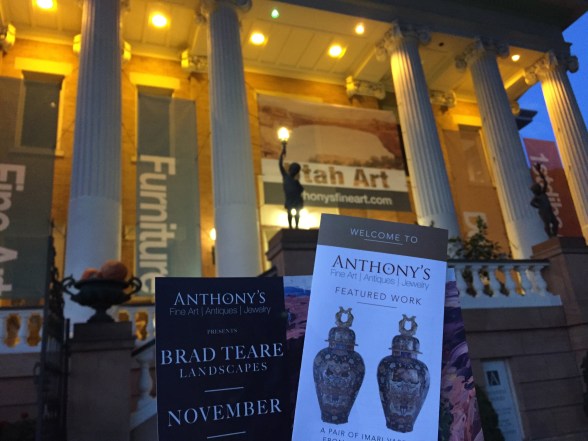
Outside of Anthony’s Antiques located at
401 E 200 S, Salt Lake City, UT 84111
Taken on October 20, 2017 (Photo by Natalie Mumm) Enterprise Assets

With so many possible venues participating in the stroll on any given third Friday, it may seem like an overwhelming art maze. Be that as it may, The Salt Lake Gallery Stroll’s website is simple to navigate yourself through, to finally discover a new gallery in the area that you wish to attend. The level of enjoyment and education received from the event is entirely up to you.

Visual art time and time again surrounds everyone. “I was overwhelmed to see so much art in once place that was so beautiful and not commercialized,” said Kemp. “It reminds you that talented people can do this, and there is more to what we just see on the media.” The stroll takes viewing art to a more interactive and personal level, engaging conversation, and genuine reactions between the artist and the spectator. The Salt Lake Gallery Stroll aids making art more obtainable to the average individual. That being said, it should highly encourage everyone in the area to indulge themselves, and appreciate the art and culture representations their community has to offer for a night.

Reflection Blog