Utah Museum Opens and Astonishes

By Stephanie Graves

Utah History Museum Opens and Astonishes

The Natural History Museum of Utah at the Rio Tinto Center officially opened to the public today after years of planning and construction.

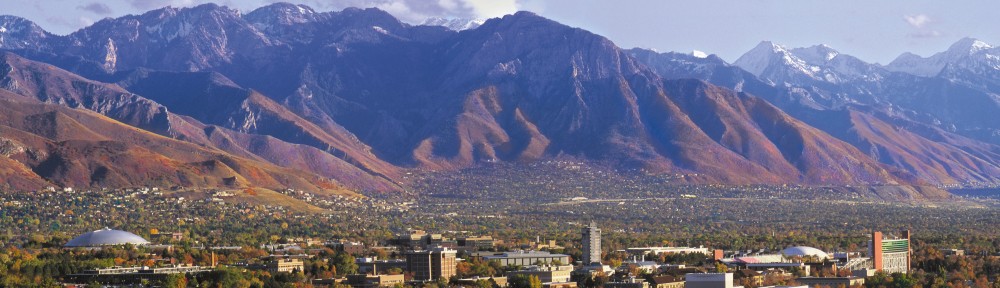
Construction for the museum began in 2005 in the foothills of the Wasatch Mountain Range. The museum incorporates many green features including radiant heating and cooling systems, water efficient landscaping and plans for a solar-paneled roof. This roof will provide more than 25 percent of the energy needed to power the museum.

Todd Schliemann, the design architect for the building, said he wanted the museum to “symbolize the beauty and the magnitude of the state’s unique landscapes.”

Not only did he accomplish this through the museum’s location in the scenic foothills, but also through his efforts to construct a sustainable museum. With more than 25 percent of the structural and architectural materials made from recycled resources, and more than 75 percent of the museum’s construction waste being recycled, the museum expects to be awarded an LEED Gold Certification.

As well as being an eco-friendly building, the museum also boasts 10 new galleries detailing the different land features, history and people of Utah.

“The opportunities for kids to explore science here are endless,” said Becky Menlove, the exhibit director for the museum.  She described the children’s experience at the museum as one where they will be exploring more than just one aspect of science.

“ You are not just learning about rocks at a particular time, but also plants, about paleontology, about hydrology and all the forces that go together.”

The museum is open daily from 10 a.m. to 5 p.m. with extended hours on Wednesdays to 9p.m. The museum is closed on Thanksgiving and Christmas.

Adults: $9 (An increase of only $2 from the prior location)

Seniors, 65+: $7

Youth, 13-24: $7

Children, 3-12: $6

Children, 2 and under: Free

Museum Charter Members: Free

Large groups with 12 individuals or more will be admitted for $5 per person with advance notice.

Journalists are the Best “Watchdogs” of Government

Story by Lacy Jamison

Many analysts are stressing the importance of watching government as the current elections progress, and according to Matt Canham, Susan Tolchin and John Daley, journalists are its main watchdogs.
Canham, Tolchin and Daley spoke during a Hinckley Forum at the University of Utah on Friday, Oct. 28. Canham works as a print reporter, Tolchin is a professor and Daley is a journalist.
The speakers recognized that the state of political journalism is in transition of finding new roles. However, according to Tolchin, who teaches public policy at George Mason University, “Journalism is the best watchdog over the failings of government. Media is terrific-it reveals government flaws.”
Journalists who work in politics are expected to explain to voters who the politicians are, what they believe in and what their actions are. Often this relationship between the politicians and journalists is fraught with tension. According to Canham, who works as a Washington correspondent, “We are one of the only people that confront them [politicians].”
Tolchin said she worries about the demise of print media in cities because this form of media often keeps politicians more honest.
The speakers also had strong views on what material should be emphasized in watchdog reporting, heading into an election year. Recently, most of the coverage has been of the polls and not anything else.
“Horserace politics and horserace political coverage does a huge disservice,” said Daley, who covers stories in the Deseret News and KSL. He claimed the coverage should not be about the polls, but about the policies that will affect millions of people.
Canham said the issue of horserace politics is overblown. He argued that news is more diversified in today’s day and age, and reporters have to find creative ways to get what the audience wants and needs. Each story can only be written once, so the reporter must pick his or her focus and determine which stories create the highest voter interest.
Tolchin said she believes that horseraces must be covered. She brought up the strong correlation between the debates and the money candidates raise. It is important to expose these events because money raising has a strong connection to who wins and who loses.
In reaction to the recent explosion of audience involvement in the journalism field, the speakers agreed that this participation helps journalists become better watchdogs. Reader participation is very important in guiding how journalists give their readers news. Any type of involvement is very important because it could have direct effects on how government is chosen, said Daley.
Audience participation is not always reflected in the polls. Daley said he believes many people do not value their democracy anymore because there has been a significant decrease in voter turnout. Issues and decisions in politics are important, but the public is less involved than it used to be, he said.
Other issues of audience participation include the fact that most people do not research both candidates.
“I always read the other side. Most people don’t like to see the other side and I really hope they do,” said Tolchin. It is important that people participate according to their beliefs, but it is also important that people research the opposing side in order to better understand it, she said.
Audience members of this Hinckley Forum claimed to have very valuable insights from the speakers.
“I think it’s interesting to hear the perspective of current journalists. Journalism, media and politics are intertwining more than they ever did before,” said Laura Schmitz, a senior at the U. of U. who will graduate with a degree in journalism.
Sheena McFarland, a reporter at the Salt Lake Tribune, also gained insight.
“I think what was most interesting to me was to hear the audience questions. People care about the source and credibility of things right now and we need watchdogs,” she said. (640)

The Death of Newspapers?

Story by Connor Wallace

Due to advances in technology the idea that there isn’t a need for newspapers has become a common perception.  On Monday, Oct. 24, a panel of experts at the Hinckley Institute of Politics discussed the changes in technology and how those changes will affect journalism.

The guests speaking were Nancy Conway, Mark Jurkowitz and Clark Gilbert.  Conway is the editor of the Salt Lake Tribune, Jurkowitz is part of the Pew Research Center and Clark Gilbert is a publisher for Gilbert of Deseret News Publishing.  Conway responded to a question regarding the importance of online newspapers by saying “more information is better. We’d be hypocrites if we didn’t think that.”

Clark Gilbert did say that it’s going to be harder for newspapers to do the same amount of work with fewer resources.  He explained that people are “a click away from the best.”
His meaning with this statement is that for the longest time newspapers tried to do many things well in reporting or covering stories in many areas; however now with the Internet people are one click away from finding a story that is more in depth and has more information and resources to cover a certain story. The reason being is there are sites that specialize in a specific topic.

According to Mark Jurkowitz, legacy media are producing the majority of the content because they have bigger newsrooms and more reporters.  The problem is that smaller websites and newspapers are providing the content and reporting the story.  This means that these smaller companies are doing all of the work and not getting paid for it.  This has spurred a debate for whether these smaller media companies should start charging people for the information that they provide.

It was also brought up that not only should the companies that retrieve the content charge their readership but also the legacy companies that are taking the story and putting it on their website.  On the other side these smaller companies also realize that the legacy companies are putting their stories on a larger stage.

Conway pointed out that “the newspaper itself is far from dead.”  She continued to say that the Salt Lake Tribune is gaining readership not only through the online medium but also in print as well.  Conway explained the increase in readership is because the Tribune does have a legacy and people trust the content that the paper puts out.  According to Conway, “The Salt Lake Tribune is serving more readers now than it ever has.”

While there has been a drop off in the number of people relying on print media, journalism is thriving and reaching new readership through online newspapers and by maintaining their older readership through print news.  According to Jurkowitz, “The media doesn’t have an audience problem, it has a revenue problem.”  He explains that the problem is how to “monetize” the online aspect of newspapers.  While the medium may change, people reading the news won’t.

Media watch politicians, but who watches the media?

Story by Shannon Hunter

“Our audience is the biggest fact checker we have,” said reporter John Daley referring to the role of citizens in journalism.
This was one of many topics discussed during a panel at the University of Utah’s Hinckley Institute of Politics on Friday, Oct. 28.
The panelists included: Matt Canham, Washington correspondent for the Salt Lake Tribune; John Daley, a reporter for KSL and Deseret News; and Susan Tolchin, a professor at George Mason University.
The importance of reader participation was emphasized throughout the discussion. All three panelists agreed that journalism is different today. The pressure to publish things daily, even hourly, has created a lack of fact checking, thereby increasing the amount of mistakes.
“When you as a reader see a mistake it is your responsibility as a media reader to tell us,” said Canham.
The panelists also talked about the importance of the corrections the readers send in. They also mentioned the effect that mistakes can have on a piece, even when a correction is made. Tolchin confronted the matter of how few people read the corrections, including herself among those who don’t.
Canham said there are different kinds of errors that can be made, not only factual errors. He explained that a mistake can be made in the way a reporter words things in his or her writing and that it can have just as much, if not bigger, of an effect on the piece. According to Canham, this is one of the many ways journalism has changed in this generation.
Canham believes this is an “interesting time to be in the business,” and that the upcoming generation can accomplish the role of journalists.
“It’s the best of times (and) the worst of times,” said Daley when referring to the difficulty in finding jobs while new technology helps reveal more information.
For example, journalists now not only compete with other journalists but also with citizens who can download information or videos from their cell phones to the web and post stories before reporters do. Sarah Vaughn, a member of the audience, considered this an “important issue.”
Tolchin expressed that she’s excited for the current state of the media. She hopes that the future of journalism will correct government issues and keep politicians honest.
Canham said he disagrees with how politics are being reported and that in his reporting he wants to spend his time most effectively and find a way to give his readers both what they need and want.
“It’s like you’re watching coverage for the NFL (and) who’s going to get that touchdown… It’s a big problem,” said Daley, referring to the current trend of reporting about polls and standings instead of proposed policies from the candidates.
Canham agreed, pointing out the importance of the media in elections by influencing what the voters do or don’t know going into the booths. He emphasized that they “are part of this process.”
Laura Qualey, a member of the audience, found the distinction between “reporting relevant things” from irrelevant topics to be the most important issue discussed by the panelists.
When coming to an end, it was clear that all three panelists agreed that while the media needs to keep an eye on politicians citizens need to keep an eye on the media.

Modern Political Reporting “Snowballing toward dysfunctionality.”- Susan Tolchin

Story by Laura Qualey

University of Utah’s Hinckley Institute of Politics hosted a panel discussion on political reporting and modern media, Friday, Oct. 28.

From the loss of factually driven data to the demise of print media, Susan Tolchin, John Daley and Matt Canham discussed issues regarding political reporting. Panelists discussed the changes in political reporting since technology has made it possible for immediate news updates, civilian reporting and private life exploitation.

John Daley, a KSL/ Deseret News reporter, mentioned that with the pressure of producing for today, journalism is becoming increasingly, “challenging,” adding that with the continually shrinking staff at many news source outlets, the amount of regulation and fact verification has decreased, leading to the releasing of inaccurate information.

Susan Tolchin, a professor in the School of Public Policy at George Mason University, addressed political reporting as the “watchdog over the failings of government,” mentioning that it is the duty of political journalists to confront politicians and be a voice for citizens.

Panelists discussed the growing conundrum of media watching government and who watches media. Political reporting has transitioned into a personal-professional hybrid. With the emergence of technology, politicians’ personal lives have become increasingly more public. With blogs, social media and sites such as YouTube, “a man’s character is his fate,” Tolchin added.

Matt Canham, a Salt Lake Tribune correspondent, discussed that “it is our responsibility as a consumer to point out media errors.” As more interaction between news outlets and consumers develops, the reader can now affect the reporting.

Millions of dollars are invested in political campaigns each year, leading to the unfortunate fact that “money wins,” said Canham.  However despite how much money is invested in a campaign, many politicians’ hopes are destroyed through investigative political journalism. This new-age way of investigating into the personal lives of politicians has led to countless scandal discoveries and numerous YouTube videos that have gone viral.” U. student Sarah Vaughn said she “had no idea there was so much money in politics,” which brought to light a new way of viewing politics.

As political journalism has become more interactive, similar to that of social media sites, many political journalists believe they are in a sense competing against social media. It seems as though it is now just as easy for a reader to receive news from a friend on Facebook, as it is to log onto a news source website to receive information.

“This discussion has made me question how I determine a news source is trustworthy,” Said U. student Shannon Hunter.

As we embark on this new age of political reporting, Susan Tolchin says she is “very excited.” However panelists noted that without regulation and boundary establishment modern political reporting could very well be “snowballing toward dysfunctionality.”

For more information on events held at the Hinckley Institute of Politics visit: www.Hinckley.utah.edu

Citizens Help Correct Errors in Newspapers

Story by Elysia Yuen
The role of common people in finding and correcting errors in newspaper writing is essential to provide accurate information for the public.
This theme was discussed by Matt Canham, Salt Lake Tribune Washington correspondent; Susan Tolchin, professor at George Mason University; and John Daley, reporter for the Deseret News and KSL at an academic forum.
Meeting on Oct. 29, 2011, at the University of Utah, the event was open to students. The title of the panel was “Political Reporting and the Fourth Estate: Who Watches Government.”
A high point interest for the panelists was regarding the discernment of correct information and citizen involvement in media avenues. A plethora of resources are available where one can get information, like Facebook, blogs, friends and newspapers.
Canham said, “I would hope that when you read the news page you would know where the information is coming from.”
With so much information, it is sometimes hard to understand and know which sources are credible.
Canham explained that journalists are currently working in a fast-paced and demanding environment. They are liable to making mistakes. In newspapers there are sections that correct any mistakes that have been discovered from previous issues. How are these mistakes found?
“The audience is the biggest fact checker out there,” said Daley, a specialist in political and investigative news.
Often people will notice a mistake in the media and send corrections to the newspaper agency.
“[When a correction is sent in] we review what they tell us with what we wrote and judge based on the error (or lack thereof) whether to do a correction or not,” stated Brandon Beifuss, editor-in-chief of The Daily Utah Chronicle.
Because the corrections are so important for accurate news reporting, Canham said that every person should be engaged in citizen journalism.
“It is your responsibility as a media consumer to point that [corrections] out,” Canham said.
The panelists said that they felt a degree of pressure to get their facts straight. With the understanding that reporting has changed dramatically in the past several years, with the emergence of new media and ample information resources, journalists feel immense strain. Articles are needed to be written faster and better.
Daley reiterated the anxiety comes from the need of people wanting information at their fingertips.
He also said, “There are fewer people to cover everyday stories, fewer people to dig into stories that need investigating.”
Canham expressed that a positive attribute of the fast-paced environment is that it is relatively easy to fix a mistake. Especially with the age of digital, one can go online and change it instantly.
Nenad Cuk, a mass communication student who attended the forum realized, “I need to be more critical where I get my information from and analyze the information and the sources they use to get the information.”
Junran Jia thought the forum was valuable information.
“I think it is very good because each one gave their own opinion between mass communications,” Jia said.

Word Count: 507

Polls Suggest that United States Citizens Mistrust their News

Story by Lacy Jamison

A recent poll suggests that the majority of United States citizens do not trust the news they receive and believe that most of the stories news organizations report are often inaccurate.

The Pew Research Center published a poll on Sept. 22 that determined whether Americans trust their news and how much they believe politics can affect it. The poll claims that 66 percent of Independents say the stories they read are inaccurate, 64 percent of Democrats say the stories they read are inaccurate and 69 percent of Republicans say the stories they read are inaccurate.
In general, only about 25 percent of those who were surveyed believe that news organizations get the facts straight.
“I feel like people say what we want to hear. I also feel like it’s not 100 percent the truth. I always take it [news] with a grain of salt and pick apart what it’s saying,” said Junaid Sial, a sophomore at the University of Utah.
Only when the survey participants were asked whether the news they use personally seems to get the facts straight, did 62 percent of them respond with a positive confirmation.
“A lot of times I read things from my phone applications. I like to read CNN, BBC and MTV. I don’t think they are always accurate though,” said Nicole Procida, a sophomore at the University of Utah.
The poll also suggests that people tend to trust their local news organizations more than their national news organizations. About 69 percent of the survey participants trust their news a lot, versus the 59 percent who trust their national news organizations.
“I read the local newspapers because I feel they reflect the most truth in what is happening in my nearby community,” said Anna Chuprova, a freshman at the University of Utah.
This survey was conducted under the direction of Princeton Survey Research Associates International. Most of the data in the report is from telephone interviews that were conducted from July 20-24, 2011. About 1,501 adults 18 years of age or older, who were living in the United States, were randomly selected. (347)

Norris Give No One Right Answer To Economy

Story by Stephanie Graves

Norris Gives No One Right Answer to Economy

“The recession officially ended in 2009” said Floyd Norris to a packed room of University of Utah faculty and students.  So if the recession has officially ended then why is the government still actively bailing out banks and companies?  “We can hope that the government has learned its lessons with bailouts.” Said Norris

This is just one of the points that Norris touched upon in his Oct. 26 presentation in the Marriott Library on the U. of U. campus.

With the crowded auditorium of anxious college students and professors, many of who were looking for guidance in this unpredictable job market, Norris summed up how Americans found themselves in a recession.

“When credit is easy, it is a lot of fun” Norris said.  It is no wonder that with banks granting loans of all kinds that the average person would rather take the money now and worry about the consequences later.

80 years ago, the United States was so fiscally conservative that the economist and Secretary of Treasury Andrew Mellon recommended “liquidate labor, liquidate stocks, liquidate farmers, liquidate real estate… it will purge the rottenness out of the system,” to the present day bailout by the government of big companies.  So what has changed?

Norris argued that by setting up the Central Bank in 1913 in the United States, suddenly the Federal Government felt like it was responsible for the well-being of iconic American companies such as Ford, Chrysler and General Motors.

Norris said, “The good news is that Central Bank has learned a lesson.” He affirmed that it would be wise that the government not get involved on such a large scale again.  To this assertion, student Bonnie Adison said, “The government must have some plan for the average citizen, whether it be a bailout or something else.”

Adison was not the only frustrated student after the presentation had concluded.  Shawn Christophson said, “So personal ethics and self-control are the answers to the recession. I just thought there would be more.”

Although the presentation was brief, Norris did drive home his point that “Ethics are not being taught as well as they should be” and there are two parties involved on all loan defaults.

Investors need to do their homework, and if that is not possible, hire someone you can trust,” Norris said.

It is up to the American people to be responsible for their own financial decisions, and while not all newly established laws concerning the economy benefit everyone, it is still those individual’s duty to do their own research, balance their own expenses and ultimately make the decision on what they can afford.

Norris said, “When capital is wasted in a massive way there (are) consequences.”  Whether he meant the government wasting the millions of dollars on the bailout of big businesses or the American population spending recklessly on non-necessities is unclear.

The point that Norris did make quite clear was that it is not wise to wait around for the government to bail out its citizens or solve their problems. One must weigh their own circumstances and make things work to the best of their ability to survive during this recession. (512)

Veterans Will Fly Solo

Story by Sarah Vaughn

Five injured veterans will return to flight with the help of mechanical engineering students at the University of Utah and ABLE Pilot.

Sun Valley, IDAHO- Training will begin and will continue until Monday in Sun Valley, Idaho, for five veterans with spinal cord injuries (SCI) who are learning to fly in adaptive chairs, Phoenix 1.0 and improved flight chair Phoenix 1.5.

The first day of training, the veterans will be trained in paragliding.
They will be taught the functions of the flight chairs and how to pilot it. Furthermore, they will be taught how flight chairs work and experience the paragliders about 3 feet off the ground.

Mark Gaskill, from ABLE Pilot, is working with the veterans; he has been working in the area of flight chairs for injured persons with spinal cord.

“ABLE Pilot is an organization committed to getting people with spinal cord injuries, amputations, and neuromuscular diseases safely into air, piloting and flying with the minimum amount of assistance,” said Gaskill. Gaskill initially came to the U. of. U. with the idea to develop adaptive flight.

Citizen Journalist The Future of Journalism

Story by Brenda Mandujano

In the current society blogging has become the thing of the future. Information and stories are passed through social media and blogs and distributed to thousands in just seconds. The issue is that no one needs a journalist license or be backed by a major media source. A panel of guests joined Doug a Host/Executive Producer of Radio West on Thursday, Oct. 27, 2011, to discuss ‘The Rise of the Audience”. This session concluded Future of Journalism Series at the Hinckley Institute of Politics.  The following information is main points in the future of the society with blogging and social media.

 
Holly Richardson, a member of the Utah House of Representatives from Pleasant Grove and active blogger, stated “Everyone is legitimate to the point where people see them legit.”

 
Those who write about what they know become legitimate and have followers who trust what they write.

 
People today want to read short and to-the-point stories. They use social media to get their information and to repost. As things are changing they need to adjust and “help people raise their media IQ in a way,” as Doug stated.

 
Journalists are responsible for filtering and gathering the information and putting it together in a way that it is easy to read. When the information is released, citizens take it and spread it over the world web through blogs, tweets or Facebook as the information is spread faster.

 
Matthew La Plante, a journalism instructor at Utah State University and a former national security reported for the Salt Lake Tribune, discussed that a reporter and columnist he felt disconnected and felt like he was shooting into the dark. They never see a reaction or comment unless it comes from their editor or they come across someone who read the article. Those who blog or tweets are able to receive immediate feedback from the audience. The responses may not always be positive but they are available.

 
For the future of journalism an education is not required. Blogging, tweeting and using Facebook is accessible by anyone who owns a computer or Smartphone. Taking information from a news story or other post and reposting, instantly make that person a writer.

 
If anyone can be a writer the next step is education citizen journalist. Citizen journalist can also be involved in lawsuits including libel and privacy issues. Which means everything that is written needs to be thought through before being posted. Journalism classes have discussions in the use of privacy, when to use the names in stories or when to stay anonymous.

 
Morgan Heath, a mass communication major, said, “Education is not needed for present journalism, but I feel more prepared by taking the time to learn.”

 
Being prepared in media is important and even if an education is not present one can take the time to learn by reading books or receiving help by others in the profession. In present journalism anyone who writes about something they know whether it is blogging or tweeting becomes trusted sources.

Citizens Stop Bank Robbery

Story by Connor Wallace

Bank couriers Dennis Boushie and Willie Moore aided the police in capturing three bank robbers.

Two men helped police officers capture three bank robbers in Pevely, Mo.

Dennis Boushie and Willie Moore are bank couriers for Boatman’s Bank of Pevely, Mo.  Boushie and Moore were at the bank when the robbery transpired.  The two decided to chase after the robbers because of “just common sense,” according to Boushie.
According to captain of the Jefferson County Sheriff’s Department Ed Kemp, “This is beyond the call of duty.  They acted more like police officers than private citizens or bank couriers.”

The robbery began when according to Kemp a man entered the bank and screamed, “Give me the money or else.”  After the man took the money and ran, Boushie trailed the man on foot until he entered the getaway car.  Boushie then signaled to Moore to track the car via the bank van.  While Moore trailed the getaway car, Boushie went with the police to help track the car.

The police stopped the car on Interstate 55 and arrested two men and a woman.  The police found thousands of dollars in the car, and are pursuing federal warrants for bank robbery.

“Police have booked three people on suspicion of drug possession.  These three were found in the getaway care and being held in the jail at Pevely,” said Kemp.

National poll reveals public’s preferable sources for news

Story by Shannon Hunter

Have new communication technologies, such as the Internet, made the world a better place? Recent reports show that most people, including almost half of nonusers, believe they have.
According to polls, 66 percent of Internet users and 49.3 percent of nonusers believe that new communication technologies have benefited the world.
More than half of the people polled also believe that stories are often inaccurate, with 63 percent of people preferring that their news does not come from a source with a political point of view.
“Reading news on the Internet is always a good way to kill time, but I usually only believe a story once I’ve seen it from multiple sources,” said Hannah Skarsten, a third-year student at the University of Utah.
Her father, Mike Skarsten, also said that the convenience of the new communication technologies does not out weigh his doubt that sources are offering non-biased news. However, he said he is thankful that he has multiple options to go to.
“It may be silly, but I rarely believe a story until I see it reported in a reputable newspaper, but the different technologies let me pick where I look for it,” said Matthew Yessick, a second-year student at the University of Utah.
Out of the people polled, 21 percent, the largest number of people, go to Google to search for news. The largest percentage of people who depend on broadcasts or reporting sources for their news is 13 percent, who go to CNN for their news.
While some people hesitate to believe what they read on the Internet, there is a dominant trend of people who turn to the web for news before reading or watching news from reporters.

Economic Growth Without National Loyalty

Story by: L. Wylie Shepard

The University of Utah and the Hinckley Institute of Politics welcomed Floyd Norris as part of the fifteenth annual Siciliano Forum, which confronted American’s concerns in a series of events called “Considerations on the Status of the American Society.”

As the Chief Financial Correspondent of The New York Times for over 10 years, Norris caught the attention of many University of Utah students and faculty on Wednesday, Oct. 26, with his presentation, “What’s Wrong with the American Economy?”

Norris centralized his speech around the shortage of government support during the current economic crisis while utilizing humor to painlessly discuss a comprehensive range of ongoing economic uncertainties. Norris holds an esteemed and credible presence in the business journalism field, prompting a remarkably large turnout at the event.

During his presentation, Norris expressed his belief that there are actions the United States government can and should take to improve its economy. He said that many Americans have suffered and are continuing to suffer because the U.S. government did not know how to handle economic fallout correctly. He also placed blame on the central bankers, stating that they were unaware that their role is to provide the nation with financial security while promoting the consistent growth and functionality of the nations economy. Norris connected this suffering to the exponentially growing lack of trust that Americans have in their nations leaders.

In a New York Times poll released the morning of October 26, Americans were asked, “how much of the time [they] trust the U.S. government to do what is right.” The choice of “always or most of the time” had hit an all-time low of 10 percent, decreasing from the 2008 national low of 17 percent.

“I never would’ve expected Americans to have so little faith in their government,” said Tyson Phillips, a senior at the University of Utah. “I can’t imagine our economy will improve until that percentage improves as well.”

The use of markets to allocate capital, taxes and the “mess in Europe” were also discussed as key points to understanding the problems with the nations current economic state.

Norris provided ample time for questions from his audience, who were eager to apply his knowledge to their individual financial woes, before concluding his speech.

The event had an apparent impact on many of its viewers. “[Norris] emphasized the importance of receiving financial advice you can trust. I plan on reading his weekly New York Times financial column and continuing to learn from an expert in economics,” Spencer Peters, another Utah senior, said of Norris at the end of his speech.

The Siciliano Forum, held throughout the last week in October, featured presenters who focused on the American government, its economy and the important role of journalism. According to a brochure offered to attendees by the Hinckley Institute, the yearly event was designed to offer “an open, non-biased forum for students, faulty and the citizenry to focus their energies and attentions on the most important, current and long-range public issues facing America today.”

Discussion of Journalism Ethics

Story By Montana Peterson

Professor discusses journalism ethics in university class

Jim Fisher, a professor of communication, discussed the ethics of journalism with a newswriting class on Monday, September 26.

Fisher led into the lecture with the difference between morality and ethics. Fisher defined “ethics [as] a decision making process.”

“It’s not measured against any law book, it’s not measured against any moral code, it’s measured against ourselves,” said Fisher.

According to the Code of Ethics by the Society of Professional Journalists, on which Fisher is a board member, ethical journalists and ethical decisions are based on seeking truth and reporting it.

Reporting the truth may not always be the easiest thing to do when gathering information and reporting it, but it is essential to be a honest and fair journalist.

Reporting the truth can be hard because it is not the only concern of reporters.  According to the SPJ Code of Ethics, it is a reporter’s job to minimize the harm that could potentially come from publishing an article; however, sometimes the harm is unavoidable.

“Journalism ethics is almost always about to publish or not to publish,” said Fisher.

Many of the students found Fisher’s lecture very insightful and helpful.
“Reporting the truth is what you have to do,” said Brenda Mandujano, a student of the newswriting class.

“Fisher’s lecture was extremely useful,” said Scott Stuart, a student of the newswriting class.  “It helped me distinguish the difference between morals and laws and how to make an ethical decision.”

Ethics of Newswriting 101

Story by Joape Pela

Ethics of Newswriting 101

SALT LAKE CITY- In a University of Utah newswriting class last Monday a guest speaker, Professor Jim Fisher, spoke about ethics in newswriting.

Fisher gave a few pointers to the class on how to be a better newswriter.

“He used and illustrated his examples of being a better newswriter clearly,” said Kent Ava.

A few of his examples were to be accountable, minimize harm ,act independently, seek the truth and report it.

In newswriting there are always two sides to a story right? Well not so fast, as Fisher stated to the class, “Every story has multiple sides.”

To some people they might think that every story has two sides. As Brenda mandudujano stated, “We tend to think that every story has a right and a wrong side.” A newswriter  has to get all sides of the story to be as accurate as possible.

As Fisher spoke to class it seems like the class got a good grasp of the ethics of newswriting. (168)


Family-Friendly Natural History Museum Opens

Story by Elysia Yuen
The new Natural History Museum of Utah is a place of interactive learning and growth for people of all ages.
The museum opened on Nov. 18, 2011. It displays 10 new galleries including three learning labs to enhance learning opportunities for its visitors.
“This is a place where we can inspire that curiosity early on and get kids trying their hand at observation, at study, at really trying to figure things out on their own,” said Becky Menlove, exhibit director for the museum.
Randy Irmis, curator of paleontology emphasized that a goal of the museum was to encourage families to enjoy the experience together.
“In each area you’ll find something to look at, something to listen to, something to smell and something to do,” said Irmis.
The museum connects visitors to several branches of science instead of focusing on only one subject. It also focuses on informing patrons of Utah’s natural surroundings and Native people.
The new exhibits include: Utah Sky and View Terrace, Native Voice, Life, Land, First Peoples, Lake (Great Salt Lake), Past Worlds, Utah Futures, Minerals and Our Backyard. Each display emphasizes the unique characteristics and history of the Utah area.
The design of the building also reflects Utah’s history. Todd Schliemann, the building’s architect, spent many years studying the geography of Utah.
Schliemann said he wanted the space to “symbolize the beauty and magnitude of the state’s unique landscapes.”
All of the displays and architecture are an integrated effort to enhance learning and interactivity among its visitors.
For those on a budget wanting to visit the museum, free admission days will be offered during the 2012 season. The dates are as follows: Jan. 9, April 9, July 9 and Sep. 22. More information can also be found on the museum website, http://nhmu.utah.edu/.

Word Count: 256

Natural History Museum Offers New, Interesting Exhibits

Story by Kourtney Mather

After years of planning and much anticipation, the Natural History Museum of Utah opened to the public this weekend at the Rio Tinto Center.
The NHMU has many new exhibits in the 51,000 square foot center ranging in topic from the ancient Lake Bonneville that covered most of the state of Utah, to a storytelling area featuring Utah’s Native American tribes and their histories.
The broad spectrum of topics and exhibits at the museum, however, was no accident. Becky Menlove, the exhibit director for the museum, explained that they wanted to “create very interdisciplinary exhibits so that you’re not learning about rocks at a particular time, but also about plants…paleontology…hydrology…because that’s really how we learn when we’re out in nature ourselves.”
Of course, no natural history museum would be complete without a dinosaur exhibit. The display features “one of the largest duck-billed dinosaurs to be mounted anywhere in the U.S.,” explained Randy Irmis, the curator of paleontology for the museum. “We’ve tried to lay it out as it was found in the field to give people a sense of what it’s like when you find these fossils.”
Todd Schliemann, the design architect for the building, spent years studying the geography of Utah to create the perfect design for the building in relation to the unique landscapes of Utah.
“When you walk into it, yes you feel a little small,” Schliemann explained, “but maybe you also feel like you’re in a cathedral and the space is beginning to lift you up and getting you ready to learn…”
The museum is open every day from 10 a.m. to 5 p.m. with special extended hours on Wednesdays when it is open until 9 p.m. For more information visit http://www.nhmu.utah.edu.

Utah’s Natural History Museum Opens New Center

Story by Kent Ava

SALT LAKE CITY—Utah’s Natural History Museum (UNHM) opened its new Rio Tinto Center to the public on Friday after years of preparation and construction. UNHM, located at the University of Utah, is a leading research center that focuses on Utah’s natural and cultural history.

The museum’s new exhibit galleries were developed by some of the world’s leading scientists, educators and exhibit designers. The new center provides more room for newly dedicated exhibits that range from Utah’s ecosystem to pioneer contributions to genetics and biogeography.

Patti Carpenter, director of public relations for the museum, said about the new space, “I think we put together a great museum in a great location.”

Todd Schliemann, design architect for the center, spent several years studying the landscape and geography of Utah for inspiration.

Schliemann wanted it to “symbolize the beauty and magnitude of the state’s unique landscapes.”

Becky Menlove, who is the director for the exhibits, said that those who visit the exhibit “especially kids” would find that inspiration came from their curiosity.

“Kids who imagine themselves as archeologists or as scientists because this [museum] is a place where we can [help] inspire that curiosity,” said Menlove.

To celebrate opening day, admission is free. The Natural History Museum of Utah is open daily from 10 a.m. to 5 p.m., with hours extended to 9 p.m. on Wednesdays to offer special programming.

In Pursuit of the Perfect Spaghetti Sauce: The Nature of Choice and Happiness

Story by Laura Qualey

Many consumers rarely take a second thought to wonder why one product may have so many variations. Malcolm Gladwell, a New Yorker staff writer, popular blogger and author of four books, has been known to expose the understanding of many things that often remain unknown to the public. What was exposed today? The story of one man’s pursuit to change the way the food industry approaches creating foods that will please the general public.

Gladwell retold the story of renowned psychophysicist Howard Moskowitz this morning and his major contribution to the food industry: the reinvention of spaghetti sauce.

Moskowitz, throughout his career had been approached by companies who asked him to help create a better (or different) product to satisfy their customers.

Moskowitz shattered the assumption that asking a consumer what he or she prefers is the best path to creating a great product. After conducting experiments with perplexing data, Moskowitz discovered that the best way to make the consumers happy was to “group data into clusters.” Gladwell concluded that Moskowitz saved Campbell’s by grouping people’s taste preferences into three categories: plain, spicy and chunky.

After Moskowitz advised Campbell’s to create three new Prego sauces to satisfy its customers, it was reported that over ten years Campbell’s made $600 million in profits off the extra chunky sauce alone. Gladwell’s main point during his presentation: “When we pursue universal principles in food, we don’t just make an error, we do ourselves a disservice.” In short, embracing the diversity of human beings finds a sure way to happiness.

Breaking Through Universals to Experience Variability

Story by Spencer Peters

Malcolm Gladwell’s speech on the American pursuit to discover the perfect spaghetti sauce transcends the food industry but makes a larger argument about the nature of choice and happiness.
What message Gladwell argued for was not meant to revolve around spaghetti sauce and the specific flavor that we enjoy the most but was to express the movement from search for universals to the understanding of variability. He described this movement as “the great revolution in science of the last 10, 15 years.”
The person he accredited much credit to was to a psychophysicist named Howard Moskowitz, who helped people realize the true importance of horizontal segmentation. He helped people realize that everything exists on this horizontal plane.
He described this plane as having no hierarchy between the different types of spaghetti sauce or mustard offered in stores. There is no good or bad, perfect or imperfect. There are only different types of mustard or other foods that suit different types of people.
Through the use of variability, society can now rid itself of the preconceived notion of how things ought to be and experiment with finding happiness through the use of variety.
Gladwell described this theory as, “the Platonic dish,” where people were afraid to challenge what was thought to be the ideal way that something ought to be.  Being able to have a variety in everyday life can help find the greatest level of pleasure or happiness.

A Panel Debate Defines the Change in Journalism

Story by Sarah Vaughn

Members of the panel at the Hinckley Institute Forum shared the stage in the Hinckley Caucus room at the University of Utah; discussing the issues of journalism and political reporting in the 21st century on Friday. Members of the panel were Matt Canham, a member of the Salt Lake Tribune’s Washington Bureau, where he has covered congress; Bush and Obama administration.  Also present was John Daley, a reporter for the Deseret News and KSL and a former social studies teacher. The final member of the panel was Susan Tolchin, a professor in the school of Public Policy at  George Mason University.
The panel discussed the state of political reporting and how it has significantly changed over the years.  Social media is the new concept that is being used as main source of communication, which has put damper on print media.
“ Traditional roles in new media has changed and has impacted journalism,” said Matt Canham.  He furthered discussed the lack of boundaries that is evident, between the media and personal lives of citizens. Tolchin sees political reporting in this era in a different light,
“ The state of political reporting is great,” said Tolchin. However, she discussed later on that the media reveals the horrible things of the government and some reporters are not checking the facts anymore.
“Loved the pointers they gave and made me want to read more print media. The panel motivated me in the selection in what I read and to be more informed about the government,” said Ashtin Miller, a political science student. The panel encouraged the audience to read more print media and get involved with the issues of journalism and politics.
People today rely more on social media to receive information and to express their thoughts on issues through sites like Facebook, Twitter, and Google Plus. Kylee Mecham, a senior at the University of Utah said, “I want to read more newspapers and be more informed. I rely too much on social media and especially Facebook.”

John Daley spoke on the worst of times and the best of times of journalism. Daley explained to the audience that there are fewer people in the newsroom, fewer people to report on issues, and go deeper into stories. However, the best of journalism now is more resources are available to get information and we can get information out faster to the audience. “I found Daley’s points on the times of journalism interesting and I didn’t know that print media was struggling in that way,” said Laura Qualey, a University of Utah student.

The panel left the audience pondering about the revolution of print media and the impact that social media is currently having on society. An society should not abandon the old for the new because both can co-exist.

The Hinckley Institute was established in 1956 through the Noble foundation and Robert H. Hinckley. It serves as a teaching for students for practical politics and to engage university students in the political process.

A Unique View of Utah’s History

Story by: L. Wylie Shepard

After six years in the making, the Natural History Museum of Utah has opened the Rio Tinto Center, an entirely new building that features ten permanent galleries dedicated to Utah’s history. On opening day, Nov. 18, 2011, admission was free for all museum visitors, allowing anyone to experience the new exhibitions.

Becky Menlove, the exhibit director for the Natural History Museum of Utah, explained that their goal was to “create very interdisciplinary exhibits.”

The creators did not want each exhibit to focus solely on one part of nature, but instead to combine multiple “forces” of nature such as rocks, plants, paleontology and hydrology in order to promote multifaceted learning within each exhibit.

The three-story center is focused around its ten galleries: Utah Sky and View Terrace, Native Voices, Life, Land, First Peoples, Lake Past Worlds, Utah Futures, Minerals and Our Backyard, which focus on “Utah’s history, artifacts and objects from every county in the state,” according to a museum press release.

The Rio Tinto Center utilized recycled resources for more than 25 percent of its overall structure and included “green” features such as radiant heating and cooling.  The Museum was also designed with room to expand to over the next 50 years.

Todd Schliemann, the design architect for the building, said he hoped to “symbolize the beauty and magnitude of the state’s unique landscapes.”

Schliemann said he was excited about the space he has created, stating that the “space is beginning to lift you up and getting you ready to learn, to receive information.”

The museum is open daily from 10 a.m. to 5 p.m. and features four days in 2012 with free admission: Jan. 9, April 9, July 9 and Sept. 22.

911 Emergency Call Not Really Important?

Story by Joape Pela


911 Emergency Call Not Really Important?
Salt Lake City- A woman called 911 early this morning at 2 a.m. about a young gentlemen who appeared to be beaten up and naked outside on the streets.
A woman called 911 early this morning at 2 a.m. about a young gentlemen who appeared to be beaten up and naked outside on the streets. The dispatcher sent out a squad car to check up on the 911 calls. The woman who called 911 witnessed the young looking male being molested by an adult male and flagged down a squad car to let the officer know what is going on. The officer clearly see’s the young man bleeding and beaten with his “boyfriend”. The officer figured it was ok let them go and didn’t take the woman’s name or her niece and daughters name as well for the report. The woman called back to ask to see why she wasn’t questioned about the boy who looked to be a miner. The officer assured her that he was an adult with his boyfriend. The woman was very skeptical about the police officers judgment. The “boyfriend” of the beaten young male turned out to be Jeffery Dahmer who later killed the young man who was 14 years of age. Dahmer confessed to 17 other murders and two police officer was suspended with pay.

Beyond the Call of Duty

Two citizens help to apprehend suspects in attempted bank robbery

Story by Megan Combe

Two bank couriers are being hailed as heroes after they aided in the arrest of three suspects in a bank robbery. Dennis Boushie, of Festus, Mo., and Willie Moore, of St. Louis, Mo., went “beyond the call of duty,” said Capt. Ed Kemp of the Jefferson County Sheriff’s Department. “They acted more like police officers than private citizens or bank couriers.”

According to the police report, a man entered the Boatman’s Bank of Pevely, Mo., and demanded, “Give me the money or else!” After the suspect took off with the cash in hand, Boushie and Moore decided to take action. Boushie chased the suspect on foot, while Moore hopped in a bank van to pursue the getaway car.

When later asked why he persued the suspects without a second thought, Boushie answered that it was “just common sense.”

Boushie then helped police identify the vehicle, which was found after a police dispatch was put out. The suspects were traveling northbound on I-55 when police pulled them over and searched the vehicle. Thousands of dollars were found in the suspect’s car, as well as stuffed down the pants of the female suspect, according to Capt. Kemp.

The three suspects are being held in jail at Pevely and have been booked on suspicion of drug possession.

Local Businesses Brace For Lockout Fallout

Story by: Chris Springsteen

Local Downtown Salt Lake businesses and restaurants are struggling and it’s not just because of America’s economic problems.
The NBA will miss the first month and a half of the season because of the NBA lockout. The Collective Bargaining Agreement (CBA) has been settled but the question of the restaurants’ survival still remains. Downtown Salt Lake restaurants that usually flourish around this time of year are struggling to make ends meet. Because of this lockout some businesses have even had to reduce workloads because the lack of customers coming into their establishments.
As Susan Shrum, general manager at Thaifoon restaurant, puts it, “I employ 55 people. It impacts everybody from the prep crew to line cooks to waiters to bartenders.”
The NBA and the players association locked out the league on July 1, 2011. The league was locked out (much like the NFL) because the owners and the National Basketball Players Association (NBPA) couldn’t agree on a deal that both sides thought was fair.
The problem the two sides had agreeing on a deal was the BRI (Basketball Related Income). According to ESPN, the players had 57% of the share last year and the owners wanted them to take as low as 47% in the new deal.
Some of the small market owners (including the Jazz) claimed they were losing money every year and were operating in the red. The Salt Lake Tribune caught up with Greg Miller, current owner of the Jazz and son of first Utah Jazz owner Larry Miller, and he said, “(We) will lose quite a bit of money this season (when asked about it at the end of last year).”
The Utah Jazz is very important for downtown restaurants and bars to be successful in Salt Lake City. Most stores have substantial gains in customers and profit during winter compared to summer. This is directly related to Utah Jazz home games.
Jan Thompson, assistant general manager at Iggy’s Sports Grill, described what her restaurant will be losing from the month and a half long lockout, “We fill up every home game and that’s at all [five] of our locations. Downtown we get the pre- and postgame crowds and a few others who want to watch the games. All the other locations draw big crowds just to watch the Jazz.”
Brady Lambert, supervisor at Ben and Jerry’s, can’t emphasis enough how important the Jazz games are to them, “Our sales almost double on Jazz nights.”
Just recently though, the two sides reached an agreement that will put an end to the lockout on Dec. 9, 2011. This is a breaking development for Salt Lake businesses and will no doubt relieve some of the concerns they had going into a potentially dreary winter. But will this new agreement be able to save some of the failing Salt Lake businesses?
According to the Deseret News, probably but the lost time of November and most of December will no doubt take its toll on local businesses. Hopefully their won’t have to be any businesses or restaurants shut down because of this lost time. The good news is come that Christmas day in December the NBA schedule kicks off and businesses should see the crowds start piling up once again.