Salt Lake Tribune editor discusses changes in journalism and politics with students

By: Meisha Christensen

SALT LAKE CITY – The extreme political division is hazardous for the country, said Salt Lake City Tribune writer of nearly 38 years, Paul Rolly as he addressed University of Utah students on Wednesday.

Rolly has seen it all when it comes to news, from the river flowing down State Street to the first artificial heart transplant in Utah; he has been there to cover nearly every story genre.  For years Rolly found pride in writing the traditional hard fact news story.  Over 13 years ago Rolly’s career changed directions when he became an opinion columnist for the Salt Lake Tribune.

Rolly said, “I was trained to create stories that had fairness and balance through objective writing…. I have learned that sometimes when striving for that balance the truth is lost.”

Writing opinion pieces has helped Rolly in his passion for covering political affairs.  Having graduated from the University of Utah with a bachelor’s degree in political science, Rolly has always been drawn toward covering the on goings of the government.

“I look at things objectively and then listen instead of striving only for balance, I make up my own mind of what is right and what angle I want to take,” said Rolly.

U of U English student Brandon Richards agreed with Rolly that an opinion column is an ideal medium for political conversation.

“So often news is just hard facts.  It is easy to lose the story and the meat that is behind it all…. The opinion column lets you do the investigative reporting with a creative spin and it is easier to find the details behind the facts,” said Richards.

Political matters are usually categorized as heated topics and Rolly noted that by having an opinion column he can more freely express his opinion without feeling obligated to create a balanced argument.  However he did note that he tries to remain open minded to other ideas and thoughts.

Politics are a passionate topic for many but according to Rolly, the political scene has changed from when he first began covering news and not necessarily in a good way.  Rolly said that Democrats and Republicans don’t just have heated debates any more, now they do not even tolerate one another’s views.

There was a time when Rolly was covering a session of the legislature in 1985 and the mentality on Capitol Hill was one of open-mindedness.    Rolly recalled hearing the words, “they need us,” in reference to a day when Republicans could not agree to pass a tax increase and the Democratic leaders were needed to assist with the vote.

Rolly noted that this kind of give and take method would never happen in today’s political world.  When writing his columns he has a strict policy to attack procedures and positions never directly a person individually or personally.  He said this bloodbath attitude can be left to the politicians, for often that seems like all they do.

Sara Seistrand, a political science major at the U and a campus political forum instructor, said she spent a semester in Washington DC and the mindset Rolly described is the same in politics across the board.

“This is a real national problem it is a constant competition and neither side is cooperating and because of it they cannot get anything done,” said Seistrand “an opinion column is the perfect realm to address this issue because he [Rolly] has the opportunity to find the truth and look into the real factors.”

Rolly’s opinion columns are available in the Salt Lake Tribune every Sunday.

Gay/Lesbian Interaction in Utah

By Colton Stanger

Utah plays host to one of the largest and most active gay communities in the nation.  Utah also is known for its political and religious conservatism.

To get an idea on how these two groups interact, one needs to look no further than the people themselves.

Take Spenced Trembe, a business student and singer at the University of Utah.  Trembe is 22 years old and has been openly gay for five years.

“Think of how hard it was to come to grips with your sexuality.  Now imagine how hard that would be if everyone told you it was wrong,” Trembe said when talking about coming of age as a gay man.  “It’s like a right of passage for us.”

Some people, like Lesean “Earsnot” Combs, a shoe storeowner from New York City who moved to Salt Lake in 2006, thinks Utah fits in its own unique niche.

“It’s weird man, people don’t get hateful or hyper-accepting, they just pretend like they don’t notice,” Combs said.

But what about the Mormon influence?  Stories and rumors fill national tabloids on the cruelty and hostile attitude of the church.

“Actually Mormon’s aren’t so bad, I’ve heard the horror stories but most the missionaries I’ve met are, at the very least, conscientious,” Trembe said.

Daniel Page, a member of the Mormon priesthood and soon to be missionary didn’t even have an opinion on the subject of the homosexual population.  Page has been a Mormon all his life, and a member of the ROTC (Reserve Officers’ Training Corps) program for the past three years.

“In my experience sexual orientation has little to do with someone’s ability to do their job,” Page said, adding, “despite any beliefs on the subject, they are ALL still people.”

“Not every Lesbian is what you see on T.V.  Some of us are normal girls looking for other normal girls,” said Lara Buress, a student at Weber State University.

Lara is 23-years-old and is one of the most decorated philanthropists in the state, operating two charities for senior citizens and contributing as a leader of the Neighbor Works Association.  Lara has been openly lesbian for the past eight years.

“You never know when someone is going to say something or do something.  Especially since almost everyone is nice and treats you like everyone else.  I think that’s what makes discrimination worse when it does happen, because it doesn’t happen all the time,” Buress said.

“Any ‘issues’ [someone] has with us is put to private pretty quick.  You really think you the first person to throw an insult our way?  To us, defending ourselves is a way of life,” Combs said.

“Utah isn’t bad,” Trembe said.  “There are places for us and we just make our way.  It actually feels like a friendly environment.”

According to the people that live in it Utah, though not perfect, is an accepting place for any sexual orientation.  And as the community grows, the line between them blurs.  For some individuals, it already has.

W.C. 502

University program works to educate students on the importance of nutrition

By: Meisha Christensen

SALT LAKE CITY – Nutrition for many college students is a low priority especially during finals week according to the Union Programming Council (UPC).

In an effort to combat this, the UPC is providing students with a healthy breakfast on Wednesday, April 24 in the Union at the event Food for Finals.

The UPC is a program with seven student directors that work with the A. Ray Olpin Union to create a friendly home away from home environment for students.  Together these two boards plan activities and events geared toward helping students feel comfortable in The Union throughout their time at the U of U.

One board within the UPC is the Community Service board which has taken on the task of educating students about healthy nutrition in college.

When the To-Do lists get too long healthy eating can get pushed aside, and breakfast is often the first meal to take a hit.

Skipping breakfast has a negative effect on the body for multiple reasons.  One reason being that when breakfast is skipped the body goes into starvation mode and metabolism slows.  Another reason is that without fuel the brain has a more difficult time functioning and focusing.

The UPC provides Food for Finals at the end of every semester.  Heather McElroy is the UPC Director over Food for Finals and has enjoyed providing a free breakfast for students during finals week.

“Finding time for breakfast in the morning can often be a hassle, and we hope this event can take away that burden,” said McElroy.

Chartwells, a food supplier for schools, prepares the food for the event.  There are also items donated from Coke and Einstein Brothers.  The menu for this year’s event includes eggs, bacon, bagels, breakfast potatoes juice and coffee.  UPC anticipates feeding approximately 450 students this semester at Food for Finals.

In the past, the response to Food for Finals has been phenomenal; students eat it up, literally.

“It is such a neat idea because everyone is living at school during that week anyway so eating breakfast at school is convenient.  Also it makes you feel like the school does cares about you,” said Marie Davies a senior studying elementary education.

Alyx Williams is a member of the UPC Service Committee and is one of the directors working to help with student education on nutrition.  Students are busy and in the midst of everything the average university student is involved in, Williams noted that nutrition often gets pushed aside.

“A lot of students get used to eating poorly because it’s cheap and easy to make.  What students don’t realize is that eating Top Roman everyday is eventually going to have a really big toll on their body. I think it’s important for students to realize that it matters what they take into their body,” said Williams.

There may be many students who want to be healthy but feel that healthy eating habits require money and time.  Often the lack of appropriate knowledge on healthy meals that are available and how to prepare them is what keeps students from better nutrition.

This year the UPC started an innovations board on their website titled, Feed U Corner. Recipes are provided for meals that are simple to make as well as frugal friendly. Each week this board offers a different healthy meal option for students. Williams is the creator of this program and hopes to help students understand that healthy options are available.

“We’re trying to change the perception that it’s impossible to eat healthy unless you’re rich and have a lot of time on your hands,” said Williams.

Feed U Corner also literally feeds students for free once a month by showcasing recipes featured on the innovations board. This was the inaugural year of Feed U Corner and Williams felt that it was a good start but they still have many students to feed and educate.

To learn more about the UPC’s effort to increase awareness of nutrition on the U of U campus visit their website at http://www.upc.utah.edu/communityservice.

Holly, Russell & Veganism

by RYAN LITTLEFIELD

Russell and Holly Nix were married on August 19, 2011, a union exemplified by their passion for and belief in veganism.  A couple fairly new to the vegan lifestyle, the inspiration that influenced their diet change were simply videos and books.  Veganism has changed this couple’s lives, although it took time to implement the strict regimen.  Follow the journey Holly and Russell took as they started the transformation that changed their lives for the better with a culture that is quickly becoming a trend.

Inspiration That Started it All

It all began with a video on YouTube concerning animal cruelty.  Holly said the video was about, “How cruelly animals are treated . . . by taking their meat into your body you are also taking in all of their pain, fear and suffering.”  This visual ignited an impression that really stuck with her and she became a vegetarian the very next day.  More research into factory farming and animal cruelty ensued and two years following the shift into vegetarianism, the transition into veganism began.

It took about one year for Holly to fully convert to eating vegan.  For the beginning of her transition, “I started removing animal products from my diet and replacing them with vegan substitutions,” she said.  “I learned to cook vegan recipes and to be vigilant about checking ingredient lists. I started paying attention to cosmetics and other products I buy that test on animals or contain animal products.”  Since her transition, Holly has been fully vegan for two years.  Her influence inspired her partner, Russell, to begin a similar journey.

Russell had read books in the past such as The Jungle by Upton Sinclair and Fast Food Nation: The Dark Side of the All-American Meal by Eric Schlosser, but they didn’t have enough of a lasting impression to cause a change in his lifestyle or diet.  Vegetarian friends also positively influenced him, but didn’t force a change.  It wasn’t until Russell met Holly that an alteration began – he read Eating Animals by Jonathan Safron Foer and experienced, “The accumulated knowledge just suddenly hit and I stopped eating meat.”

The transition for Russell into veganism began after watching a video exemplifying the conditions many cows are kept in: Conklin Dairy Farm by Mercy For Animals.  Russell said, “I couldn’t eat cheese without seeing pictures of animal abuse in my head. So in the same way that meat symbolized suffering, dairy did too. I just gave it up cold turkey and I haven’t been tempted to go back.”

For Russell, the transition from vegetarian to vegan took a split second, “I ate cheese before I watched the Conklin Dairy Farm video; I stopped immediately after.”  He attributes the immediate change to his firm belief in his actions.  He truly believes in what he is doing as he has been fully vegan since September of 2011.

Veganism Changed Their Lives

“Since going vegan, I’ve lost about thirty pounds. I feel healthier and more mentally alert,” said Holly.  Russell has also seen physical changes, losing about 40 pounds since giving up meat, 30 of which resulted from the transition to vegan.

Not only has their physical health been drastically affected, their social health has reaped the benefits as well.  Holly said, “I’ve found a wonderful community of vegan friends in Salt Lake and Provo who are strong and interesting and I look up to them a great deal.”  Even those who do not share her vegan lifestyle are kind and supportive of what she believes.  Russell said, “It’s made me feel closer to Holly because we share this important belief system . . . Veganism has helped us connect in a way that we wouldn’t if we were both omnivore.”  Holly agrees, “Veganism is a little bit like religion for Russell and I. It brings us together. Having a vegan partner makes living a vegan lifestyle so much easier.”  As the couple mature and change through their vegan lifestyle, aspects surrounding their diet modification have also been affected.

Holly has been motivated into animal activism, encouraging other types of activism including feminism, fighting racism and politics.  The biggest change Holly has seen has been through family interaction.  Food is the center of most of her family’s gatherings, “I get a lot of jokes directed my way because I’m now the weird girl that brings her own food to Thanksgiving dinner.”

She has also seen a change in her mother, “She makes a concerted effort to cook vegan food when I come over and she is always interested in learning new recipes.”  The change Holly has seen warms her heart as it not only shows the compassion she has for her daughter, but also encourages her to think more about her own diet and health.

For Russell, “Cooking is easily the first thing that changes,” when transitioning into a vegan diet.  He began cooking more than ever when he became vegan.  Russell also immediately noticed how important food is in social gatherings and holidays.  “When I went vegetarian, I separated myself from the culture of omnivores; when I went vegan I stepped even further away,” he said.

Russell relates how he used to play Dungeons and Dragons with a few friends that would rotate who brought dinner every game-night.  After giving up meat, he felt alienated – there always had to be two pizzas, one of which was vegetarian.  Then he turned vegan and he couldn’t participate in dinner-sharing at all, “It was too much of a hassle for everyone involved.”

“When I went vegan, it wasn’t something I was just trying out.  It’s how I will eat forever,” explains Russell.

It Takes Time to Be Vegan

The transition for anyone to vegetarian or vegan takes time and preparation.  “Being vegan just takes time,” said Holly, “time to research foods, recipes, restaurants and to plan and cook meals. I’ve learned to simplify those processes and there are lots of resources to help. I’ve also learned how to deal with parties and gatherings and it all becomes very natural feeling.”  Some of those resources included local bloggers like meggieandben.blogspot.com and amanda-eats-slc.blogspot.com who review vegan options regularly throughout Utah’s restaurants.

Forgetting to pack a lunch usually leads to starvation, according to Russell, when there are very few fast food places that serve vegan foods.  Holly said, “It’s easier, faster and cheaper to grab a hamburger from McDonalds or heat up some Top Ramen than it is to buy fresh fruits, vegetables, grains and legumes and devote the time it takes to learn to cook them and make them delicious.” Russell supposes his beliefs are what keep him vegan, also relating that the temptation to cheat and eat a cheeseburger may be too much for someone who doesn’t truly believe in the foundation of their diet. Holly believes those without motivation, a low income or who is limited in food choices from eating restrictions would struggle with a vegan lifestyle.

It isn’t easy either, Russell said, “The biggest problem is giving up all the food routines. Anytime we eat out, we have to ask a bunch of questions. People don’t always know what vegan means, so we have to be very specific or end up getting inedible foods. Servers are often uninformed or just lying.”  The transition to veganism for Russell was easy, a split-second decision; for Holly, it took almost a year to change.  Together, the couple progress with their veganism lifestyle and beliefs.

Everyday Vegan Meals

For Holly breakfast is usually a variation of oatmeal, with blueberries, bananas, peanut butter, raisins or almond milk.  With more time, “I’ll make pancakes, french toast, or tofu omelets with fake sausage,” she said.  Snacking on fruit helps to curb her major sweet tooth before or after meals.  Russell usually begins his day with coffee and cinnamon raisin oatmeal with bananas.

Lunch consists of leftovers or a sandwich with veggies, tofurkey, hummus or peanut butter and jelly on whole wheat bread.  Snacking on almonds is a regular occurrence for Russell.

There are many recipes for dinner dishes such as chili, pizza, soups, casseroles, pasta, salads, curries, lentils, marinated tofu and roasted vegetables; one of the couples’ favorites is vegan pho.  “I would say about half of our dinners are vegan versions of stuff we’ve been eating our whole lives.  The other half is from vegan cookbooks or blogs.  We use a lot of spices in our cooking because it’s a low-fat way of adding a bunch of flavor,” said Russell.  Holly deems, “I firmly believe I can veganize any recipe and make it delicious.”

Holly and Russell

The reality is the veganism lifestyle Holly and Russell live by has affected their lives in a variety of positive ways.  Holly said, “The things that make veganism great are the food, the vegan community and the friends I’ve made! I have also loved the opportunities I have gotten to work with animals because they are definitely the reason I do this.” Russell’s favorite part is the food.  He loves to cook new foods, try eating new foods and discovering new recipes.  “It’s also a treat to find out what junk food is vegan.  I will eat a thousand Oreos and not feel any regret,” he stated.

Russell and Holly are continually adding to their vegan lifestyle with creative recipes and a growing community.  According to this couple, joining the vegan lifestyle is simple: it just requires a change of heart.
Retired Professor’s Year in Iraq, Sheds new light on Unpopular War

Story by ELLEN LEWIS

Post 9-11, Americans perceived the war in Iraq as generally unsuccessful, and left our nation with a negative opinion about our country’s role in Iraq, but what if we had been there?  Would our opinion change if we really understood?

Dr. James Mayfield is a retired political science professor at the University of Utah and author of “The Enigma of Iraq”. He specializes in local government systems, specifically in Muslim countries, and has spent the last 30 years focusing on training mayors, bureaucrats and other local government officials for better local government planning across the Middle East. Because of his expertise he was selected by the Bush Administration to spend a year in Iraq.

Dr. Mayfield arrived two weeks after the war ended, in May of 2003, his task: to prepare a country in shambles for their first democratic elections after the treacherous regime of Saddam Hussein.

Contrary to the violent, chaotic images Americans were exposed to over and over again in the press, Dr. Mayfield’s headquarters were in a peaceful, picturesque village called Hillah. The site of the ancient city of Babylon, Hillah is located on the bank of the Euphrates River in the South Central region of Iraq.

“I traveled all over Iraq in the countryside, never was shot at, never saw any violence…(the Iraqis) were so happy we were there,” Dr. Mayfield explained, out of the 1500 districts in the whole country, 95 percent of the violence was occurring in less than 10 percent of these districts, mainly in Baghdad.

Of the 14 providences in Iraq, Dr. Mayfield was in charge of five and immediately he set to work to train Iraqi staff and establish a functioning local government. He had a staff of 40 Americans and about 150 Iraqis, all of whom had advanced degrees and half spoke English well.

Once Dr. Mayfield and his staff had divided their providences into voting districts and elected counsels, who then selected members of state parliament­—his next focus was to help local bureaucrats make decisions. They were accustomed to being told what to do, so it was an entirely a new way of thinking Dr. Mayfield said, “That was really a big challenge, they were waiting for Baghdad to tell them what to do.”

The top leaders of Hussein’s regime were let go, but the U.S. government hired many officials who had previously worked under Saddam, they spoke English well and were very competent. The fact that they could communicate was a huge factor; Dr. Mayfield was “saddened by the Americans in Baghdad, where 95 percent of them didn’t speak Arabic,” he gained the trust of many Iraqi’s because he could speak Iraqi-Arabic well, and he understood the Muslim culture.

The third and most challenging task for Dr. Mayfield: Developing and implementing a budget, “this is where we got into trouble because the American leaders in Baghdad felt like the decisions should be made in Baghdad. Terrible mistake,” Dr. Mayfield said.

An official budget was introduced on July 7, 2003 of which 65 percent was designated for Baghdad and only 35 percent to the providences. Dr. Mayfield remarked, that only 22 percent of the population lives in Baghdad and the remaining 78 percent live in the outside providences. By Aug. 7,Dr. Mayfield’s providences hadn’t received any of the funds, and even by the first of September only 10 percent of the designated 35 percent was dispersed.

“That budget problem in my opinion was one of the reasons for the back lash against Americans,” said Dr. Mayfield, the people appreciated that the Americans were there, but the problem was they were relying on the local government. Many of the local ministries still held ties to Saddam, and the Sunni were taking over again because they were whom the Americans were using.

Dr. Mayfield explained the different types of Muslims within Iraq, crucial to understanding the Iraqi people and their attitude towards Americans, as well as our attitudes towards Muslims and the Middle East in general. Like Christians there are different types of Muslims, each distinct.

Of the 25 million Iraqis, 65 percent are Shia Muslims, although they make up the majority of the country, the Sunni Muslims have traditionally had all control, even though they are a mere 15 percent of the population. Saddam Hussein, a Sunni Muslim, only gave positions of power to other Sunnis during his Regime. He persecuted the Shia, as well as the Curds, another Muslim culture in the North that make up the last 15 percent of the population.

The Shia were “ecstatic” when the Americans came, according to Dr. Mayfield they couldn’t wait to destroy the regime and have a new sense of freedom. “What most Americans don’t realize is that the people who were killing Americans were not Shia.” Dr. Mayfield said, “Most of the killing came from the Sunnis.”

The misconception in the states that the whole country of Iraq was anti-American was due to the Sunni extremists, mostly pro Saddam Hussein, who really wanted the American effort to fail so they could take over again.

As Americans, we don’t understand the difference between the Sunni and Shia, because of this we assumed that the Iraqi’s were against the proposed constitution because the Americans imposed it. This wasn’t the case.

Dr. Mayfield explained that many Americans don’t realize that although the majority of Iraqis are Shia Muslims, the rest of the Muslim countries are Sunni. In fact the only other country that has Shia as a majority is Iran. As a result many foreign Sunni extremist were coming across the border killing Shia Muslims and threatening them not to vote for the constitution, in fear they would lose power to the Americans.

Two years later and the constitution passed in 2005.  Although Dr. Mayfield was not there at the time he explained, with a glow of pride, that 97 percent of the people in his town voted in favor of the constitution. Not only that, but of the expected 10 percent turnout: 83 percent of the Curds voted in favor, 70 percent of the Shia, and even 40 percent of the Sunni­­­—all in favor of the constitution.

Today Dr. Mayfield has “ great hope for Iraq,” it has the second largest oil field next to Saudi Arabia, and the rich agriculture which it lacks.  At 76, he is still active in his NGO, Choice Humanitarian. The organization he started 30 years ago, aims to train village leaders how to recognize and identify need, then learn how to network and leverage in order to fulfill those needs.

Dr. Mayfield offers a perspective on the situation in Iraq, which the majority of Americans are blind to, his compassion for the Iraqis and Muslim culture brings new light to the importance of understanding a culture and its people before making stereotypes and generalizations.

Pre-K Schools Operate With Little Oversight

by Aodhan Hayter

SALT LAKE CITY – For most of our country’s history, parents were content to keep their children at home playing in the yard or having them entertain themselves around the house until kindergarten or first grade. Nursery or pre-schools were considered a luxury of the middle and upper classes.

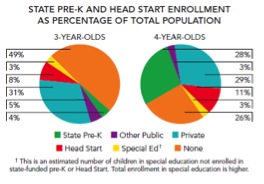
Today, however, it is estimated that 51 percent of the 3-year-old population in the nation and 74 percent of the 4-year-old population is enrolled in some type of pre-kindergarten program.  (See Fig.1)

Pre-K enrollment

Here in Utah the increase in enrollment could be contributed to the large number of women with preschool age children that work outside the home, which, according to the Utah Department of Workforce Services, is 59 percent. Another factor is study after study indicating the importance of learning-development prior to age five.

Pre-K, as it’s often referred to, is a squishy term used for a wide range of programs offered to children the year or two before they enter kindergarten. In a strictly legal sense, pre-K may resemble anything from baby-sitting, group childcare or a traditional kindergarten, depending on the state.

In most states, anyone caring for five or more children for pay must be licensed and follow strict health and safety rules, ranging anywhere from keeping immunization records to limiting the number of children per supervisor and square foot.

Some of these same regulations are applied here in Utah, but many organizations are exempted in the Utah Child Care Licensing Program.

Apple Tree School House is one of those institutions that do not have to obtain a license from the state. This is because Apple Tree’s students attend in two- and-one-half hour blocks. As long as no one student stays at a childcare facility for four hours or more there is no need to have a license.

“We get questions about what kind of licenses the school and our teachers have all the time. Parents are usually fairly surprised to learn that we don’t have some kind of license and aren’t required to have one,” said Mrs. Dansie who’s been running Apple Tree School House since 2001.

The lack of licensing doesn’t seem to turn off parents.

“Every Spring and Fall we have all of our classes full, getting a spot can actually get kinda competitive” said Mrs. Dansie.

After reading through the Apple Tree School House mission statement and curriculum it’s clear that the staff is aware of their student’s needs. Their curriculum clearly lays out the materials and skills that will be developed with the students, with the main goal being preparing them for entrance into kindergarten.

“Apple Tree did a great job getting my son ready for kindergarten this year,” said Allison Birch, a mother of a former and current student of Apple Tree School House.

But Apple Tree is not a unique occurrence in our state. The vast majority of preschool facilities are privately owned and operated with little to no oversight. In fact, only 3 percent of Utah 3-year-olds and 8 percent of Utah 4-year-olds are enrolled in a federally funded pre-K program, which are subject to strict oversight, according to The National Institute for Early Education Research.

“I don’t think there would be a huge benefit to our school if we were always worrying about staying up to date with a licensing procedure every year,” said Jamie Birsdsoel, a teacher at Apple Tree School House.

Parents and teachers seem to agree that in the end all that matters are results. With Apple Tree’s track record of adequately preparing students for kindergarten it’s hard to say their methods are in need of review. Another parent, Brad Fowler, summed it up nicely while explaining why he chose to enroll his daughter in preschool.

“When it came time for kindergarten, I wanted Katy to have real school experience.”

Historian says rock climbing culture has lost social aspect

story by ELLEN LEWIS

“Climbers’ tales cast light on themselves and the central themes of their time, nature, technology, ect,” said an environmental historian during his guest lecture March 5 at the University of Utah Marriot Library.

“Climbing Alone: The Estranging Trend in Outdoor Sports” focused on how climbing, once a social sport, has evolved to be individualized through changes in technology and society’s attitudes toward nature.

“I would have never expected climbing to have such a interesting history,” said Courtney Gaylord. She attended the lecture because of her affiliation with Mountain Hardware and their sponsorship of professional climbers.  “It went from being ‘us’ to ‘me’, it says a lot about climbers, but also about sports in general.”

The problem today is we only focus on the story of heroes said Joseph E. Taylor, a published history professor at Simon Fraser University. Beginning his presentation with a film clip of the 1963 Everest Expedition, Taylor said the sport of climbing has not always been about individuals celebrating risk and pushing boundaries.

Up until the 1960s climbing was a collection of friends out to have fun, environmental clubs with a social focus including dinner parties and often times dating.

“What they did in nature was deeply related to what they did outside,” Taylor said. These “middle class white playgrounds” focused on relationships rather than the individual approach climbing takes today.

Starting in the 1960s, as standards of living were raised and technology increased, the social way of climbing began to die out. Climbers began to separate themselves as heroes Taylor said, and became less collective.

Athletes had their own cars and equipment so the clubs became less necessary. Climbers aimed to separate themselves as heroes. The sport became more of a lifestyle than an activity.

“The ‘us’ had been lost in climbing culture,” Taylor said. Climbers went as far as breaking laws and living in Yosemite Park so they could climb full time.

Taylor’s lecture was based on his most recent book “Pilgrims of the Vertical: Yosemite Rock Climbers and Nature at Risk,” which won the National Outdoor Book Award for History.

Tall and clean cut, Taylor is a climber himself, and the historian in him drew him to find deeper themes within the climbing culture.

“[Utah] is the epicenter of the climbing and industry,” said Taylor. The lecture was hosted by the American West Center and Utah Humanities Council. Matt Bass, director of the American West Center brought Taylor here because of the local interest Utahans have in climbing.


“Shakeout” Attempts to Prepare Utahns for the Worst

by Mark LeBaron

SALT LAKE CITY- “The Great Utah ShakeOut” was not an ice cream eating festival. It wasn’t the latest dance craze either. It was a statewide earthquake drill that was held on April 17.

Many people participated throughout the state at exactly 10:15 am at schools, work and home by dropping under the nearest table or desk and holding on for one minute. Others evacuated their building following the drill.

Bradley Hunsaker, an atmospheric science major at the University of Utah participated, but didn’t think it was worth the effort to have the drill.

“I didn’t really see much point to the drill. It seemed like it was just to set a record for people participating.” Said Hunsaker.

Some students were aware of the test, but didn’t participate.

“Our class was scheduled to take a test. We had been told to ignore any firefighters and just take the test. The rest of the department left, so we were alone in our little room,” said Joe Bolke, a material science and engineering major at the University of Utah. “Nobody got under the desk, or went to rendezvous.”

Joe had been receiving the emails leading up to the drill, however, and felt prepared in case a real earthquake occurred.

Jared Evans, who works in downtown Salt Lake, didn’t participate in the drill either, but only because his work didn’t push to do it.

“I didn’t even know about it until right before it took place. I saw it on KSL and that is when I found out it was happening.” Said Jared. “The building we work in is really old, so it would actually be beneficial to have a fire and earthquake drill to make sure we make it out ok.”

Most of Utah’s residents live along the Wasatch Fault, which runs from the bottom to the top of Utah. According to the Utah Geological Survey, an earthquake generated from the fault is 50 to 100 years overdue. They estimate that the fault shifts every 350-400 years, and the last earthquake was 500 years ago.

According to the Utah Seismic Safety Commission, if a magnitude 7.5 earthquake occurred, approximately 7,600 people would die and $18 billion would be lost to physical damage and loss of jobs and economic activity.

Preparation for an earthquake is key to surviving potentially devastating damage. Water, food and gas may be unavailable, as well as cell phones, Internet and electricity.

Be Ready Utah, the State’s emergency preparedness campaign, urges all households to have non-perishable food storage of at least three days per person, in case of emergency. Other things to prepare are implementing an evacuation plan and having an emergency kit. Information for these and other useful tips can be found at http://beready.utah.gov/beready/index.html.

The ShakeOut has been held at other places around the United States and the World, like California, British Columbia, Canada and Tokyo, Japan. The next shakeout is set to occur on September 26th of this year, in New Zealand. To find out more information on the shakeouts, visit http://www.shakeout.org.

Ellen Lewis

MY STORIES:

MY RESUME:

EDUCATION

      University Of Utah, Salt Lake City

  • Senior
  • Mass Communication Journalism, Bachelor’s of Arts Degree

     Honors

  • National Society of Collegiate Scholars

EXPERIENCE

     Nordstrom

  • Current
  • Sales Associate
  • Customer Service, Styling, Point of Sale, Visual Design

      Foxley and Pignanelli Attorneys at Law

  • January 2009
  • Legislative Intern
  • Client Relations, Schedule, Event Coordinating

 ABOUT ME:

Ellen Lewis is a communications major at the University of Utah. She enjoys reading, classic movies and running with her dogs. She hopes to break into Magazine publishing after graduating.

Zimmerman’s 911 transcripts released in ongoing investigation

by ELLEN LEWIS

The 911 transcripts of George Zimmerman’s emergency phone call made prior to the shooting of Trayvon Martin were released this morning.

The public and media have criticized the Sanford Police Department because the tapes weren’t released earlier.

“Many times specific information is contained in those recordings which is vital to the integrity of the investigation,” said Chief Bill Lee.
According to the transcripts, Zimmerman called 911 to report a suspicious black male teenager in his residential community on Feb. 26.

“This guy looks like he’s up to no good, or he’s on drugs or something,” said Zimmerman to the dispatcher, “now he’s coming toward me.”

Zimmerman was a part of a neighborhood watch program, and was concerned due to recent break-ins in the neighborhood. He told dispatcher that he was following the individual so he didn’t get away until responding officers arrived.

It was after the 911 call that dispatch received reports of shots being fired in the same area, according to the police report.

Upon arriving at the scene officers found 17-year -old Martin facedown shot on the ground and Zimmerman armed.
According to the police report, responding officer Ricardo Ayala reported that Zimmerman’s back appeared to be wet and covered with grass, as if he had been lying on the ground and was also bleeding from his nose and back of his head.
Zimmerman was not arrested because he stated that he acted in self-defense, which at the time was supported by physical evidence, said Chief Lee.

Scientists Warn Northern Europe Could Become Uninhabitable In The Next Hundred Years

By: Bradley Hunsaker

This last winter brought record low temperatures and early freezes in much of northern Europe killing close to 80 people.  Even more people had to be evacuated, mostly airlifted, from their homes due to record snowfalls and temperatures falling below 25 degrees Fahrenheit, making the area unlivable.

Scientists have documented temperatures as the lowest in over 100 years and most are saying this is not the last of the brutal winters for that region.

“No, this is only the start,” said Jay Mace, a climate change professor at the University of Utah. “Unfortunately this pattern is what scientists have been predicting would happen for some time now and it is only going to get worse.”

The temperature shifts are occurring because of a change in the North Atlantic Meridional Overturning Circulation or AMOC, responsible for bringing warm air to parts of northern Europe that on the other side of the hemisphere are seen as uninhabitable.  The AMOC is a global current that is driven by the heat and water vapor exchanged to cold dry air masses from North America.  Cold, salty water tends to be denser than regular water, causing it to sink in the ocean.  The coldest and saltiest waters are formed in the North Atlantic where the current gets most of its drive.

The problem we are seeing, explains Jay, is that the glacier ice melting in the ocean from Greenland and the arctic is bringing in too much fresh water to the current, causing the flow that thrives on salt water to slowly shut down.  When the current shuts down, warm air can no longer be circulated to places like northern Europe.

If the current does shut down, most of northern Europe from Bulgaria to Denmark and especially places in the north like Russia and Sweden will become frozen over and too cold for any civilization to thrive.

Last time the world saw an event like this was when Lake Agassiz which used to be located in North America drained into the Atlantic dumping fresh water into the ocean.  This event shut down the current for two millennia causing a return to ice in the northern hemisphere causing most of what we see today in places like the Yukon in northern Canada.

Even though scientists have been studying events like this very little is known about the current and how to help it.  Most people are unaware of what is actually causing these global freezes and not much is being done to help it.

“I don’t know what is causing these hot and cold temperatures around the world,” said Liz Griggs, master’s student studying piano performance at the U. “I can say it is all about global warming but then I would just be saying what I have heard from the news.  I can’t really say one way or another what is causing this and how to help.”

Even those studying climate change and weather have very little knowledge exactly how the current works.

“It is concerning to have a natural event that we have no control over and we have very little understanding on what impact we really have on it and what we can do about it,” said Scott Elkins, who is pursuing an atmospheric science minor at the U.   “It is sad that we have to be aware of this event yet have little understanding what to do about it.”

Despite the lack of understanding of the current from the general public, Climatologists have been working hard to understand it and try and see what can be done to reverse the change before it becomes too late.

“Oh, there is no doubt about it,” said Jay, “If trends continue how they are and glacier waters keeps flowing into the AMOC, the current will shut down in a few hundred years and we will see an end to life in a lot of places until it can get started again.  And by the time that happens the world will have already undergone another major climate shift.”

Disney Surprises Viewers

by Aodhan Hayter

Disney isn’t exactly known for turning out live-action sci-fi thrillers, so harboring a fair amount of skepticism for their latest production “John Carter” is forgivable. Maybe you’re apprehensions would be quelled to know it was at the direction of Andrew Stanton, who cut his writing and directing teeth on Pixar productions such as “A Bugs Life,” “Monsters Inc,” “Finding Nemo” and “Wall-E”, or maybe not.

If you’re willing to take the risk you’ll be handsomely rewarded with a compelling story that is just different enough to keep you interested but with enough classic elements to keep the sci-fi weirdness from alienating a more traditional audience.

Based on a series of novels written by Edgar Rice Burroughs, “John Carter” is the name of the main character of the story. A 19th century Virginia gentleman who, while prospecting in the Arizona desert, is mysteriously transported to the alien planet of Barsoom.

John Carter is played by Taylor Kitsch, who is best known for his portrayal of the high school football hero Tim Riggins on the popular TV show “Friday Night Lights.” Although Taylor’s acting sometimes leaves you wanting, you can be thankful that the storyline pushes through the somewhat drab dialogue and leaves you with the raw but tasteful action that makes the movie enjoyable.

Sans the interplanetary locale and alien life forms, the basic story is reminiscent of the Greek epics and in classic form a hero emerges. Top notch special effects bring the story to life and portray a beautiful and believable world in which the film takes place.
John Carter was a pleasant and unexpected surprise from Disney. The resurrection of Burroughs classic novel was not in vain and won’t be a disappointment to viewers. If your tired of cookie cutter sci-fi and action flicks John Carter could be your breath of fresh air.

Human Dignity Rally Urges Utahans to Be Politically Active

On February 29, in the looming granite rotunda of the Utah State Capitol Building, a crowd of about 100 people gathered brimming with a determined energy. News reporters were present, email sign-up sheets were passed around the rally and a range of signs were hoisted in the air, stating things like “Str8 but not narrow,” “Human dignity is for all of us,” and “I am not a second class citizen.” The rally was a ‘human dignity rally’ organized by the newly birthed group Human Dignity Utah, founded by Weston Clark, Bob Henline, Megan Risbon and Alan Anderson.

Clark, a teacher and former chair of the Utah Democratic Party, said the purpose of their group is to finally bring equal rights to all Utahans regardless of sexual orientation or gender identity.

“We have to be quick, we have to be proactive, and we have to let them know they can’t walk all over us,” Clark said to the gathered crowd.

Two recent bills regarding state-wide non-discrimination policies have both been tabled, one aimed at statewide nondiscrimination regarding housing and jobs, and the other aimed at promoting Lesbian, Gay, Bisexual and Transgender (LGBT) sensitivity training for the State Legislature.

According to recent surveys, 73 percent of Utahans support this legislation, and the Church of Jesus Christ of Latter-Day Saints (LDS) and the Catholic Diocese of Utah have both come out in favor of the legislation. Companies like Adobe, EBay and 1-800-Contacts have also said they support equality and non-discrimination in Utah.

These measures are being taken to the Utah Legislature amid national debate on the issues of same-sex marriage and LGBT equality. In recent news, Maryland, New Jersey and Washington have all legalized same-sex marriage, which brings the total up to 17 states that have legalized same-sex marriage or unions granting similar rights to marriage.

“We’re always hitting the same wall,” Matthew Lyon, who attended the rally, said, referring to opponents of the anti-discrimination measures. Fourteen municipalities across the state have adopted similar measures, including cities like Salt Lake City, Taylorsville and Logan. “I’m optimistic that we will break down that wall, and I want to be here when it happens.”

Speakers at the rally included Jim Dabakis, current chair of the Democratic Party, Former State Representative Jackie Biskupski, Charles Lynn Frost as his theatrical character Sister Dottie S. Dixon, Kathy Godwin, president of SLC PFLAG (Parents and Friends of Lesbians and Gays) and Isaac Higham, a young graduate student at Utah State University.

“I have heard too many times people my age say ‘it’s not my issue’ or ‘I’ll let someone else get involved’. No- we all need to be active,” Higham said amid cheers.

In 2012 Utah elections, only 10 percent of registered voters in the 18-24 year old range actually went to the polls and cast their vote, one of the lowest turn-outs nationwide. Higham cited this fact in urging the crowd to be politically charged. The speakers all carried similar messages of political activism, determination and hope for change.

“Barriers are not as formidable as they seem,” Rep. Biskupski said in reference to opponents in the legislature to non-discrimination policies.

Rap Biskupski also detailed delegate training. Delegates are the backbone of the democratic process in Utah: they attend caucuses and officially vote for our elected officials. Delegate meetings will occur on March 13th for the Democratic Party and March 22nd for the Republican Party.  More information on where those trainings will take place can be found at http://www.utahdemocrats.org and http://www.utgop.org respectively.

Ken Sanders Remembers The Original Monkey Wrencher

by Aodhan Hayter

SALT LAKE CITY – “A lot of people don’t take his writing seriously,” said Ken Sanders as he addressed the audience in the Gould Auditorium at University of Utah’s J. Willard Marriot Library Sunday.

The writing Sanders is referring to is that of Edward Abbey. Considered by many to be the “Thoreau of the American Wes,” Abbey is author of works such as “desert Solitaire” and “The Monkey Wrench Gang.” Much of the content of these two works were inspired by the time he spent living in Utah as a seasonal park ranger at what was, at the time, Arches National Monument and is now Arches National Park

This special connection to Utah and a few fortunate turns of fate, like a generous donation of Abbey first edition books from an Abbey collector, Eric Hvolboll, have brought Abbey’s works back to Utah in the form of a rare book exhibit titled: “Brave Cowboy”: An Edward Abbey Retrospective,” displayed at the University of Utah’s, J. Willard Marriot Library.

But abbey’s significance encompasses more than just his literary works, according to Sanders. His writings are said to have inspired the birth of the radical environmental movement that sprang up during the 1980s and continues on today. Abbey’s disdain for what he would call “the totalitarian techno-industrial state” is the central theme of what is considered his most popular fictional work, “The Monkey Wrench Gang.”

“He just wrote what he thought,” said Caleb White, an attendee of the event who has read some of Abbey’s works..

From the packed auditorium to the busy exhibit, attendees of the event seemed to take Abbey’s writing very seriously, With the global warming debate and environmental issues becoming more mainstream, Abbey enthusiasts tend to think his works may be more relevant than ever

I haven’t read a lot of his books, but I think he has some good points,” said Sarah Jackson, a student, when asked if she agreed with Abbey’s views on environmental activism.

In fact, it seemed as though most attendees of the event were drawn to Abbey’s writings by his views on environmental activism.

“It’s up to us, the citizens of  this state to do something,” said Sanders while talking about local environmental issues.

Sanders then went onto explain that while Abbey’s idea of environmental activism is still relevant, the course of action has to be changed somewhat. Sanders points out that Abbey’s vision of blowing up dams and sabotaging Industrial equipment is more likely to land you in federal prison than actually have a lasting positive effect on the environment. Therefore activism has to take on public policy and opinion, not just vigilante environmental justice.

While the correct form of environmental activism may be up for debate, Sanders casts little doubt about the effect Abbey’s writings on the subject have had. From spawning what would become the radical environmentalist movement, to his ability to capture the essence of the West in his writing, Abbey has had a lasting effect on both the literary and environmental disciplines.

Abbey died in 1989 at the age of 62. The “Brave Cowboy”: An Edward Abbey Retrospective is free and open to the public. The exhibit is located at the University of Utah’s J. Willard Marriott Library, free and open to the public. The exhibit is located at the University of Utah’s J. Willard Marriott Library, Special Collections Gallery, Level 4. It’s available for viewing during regular library hours.

What is a reporter to do?

By. R. Ammon Ayres

SALT LAKE CITY, “If you know the truth report it,” said Associate Professor of communication, Jim Fisher.

On Tuesday Fisher presented to University of Utah students the importance of how to and why to be ethical when writing as a journalist.

Fisher elaborated on a set code of ethics provided by the Society of Professional Journalists. The four ethical guidelines are: Seek the truth and report it, minimize harm, act independently and be accountable. He said that when journalists write they should consider if what is written is honest, true and necessary for the report.

When a journalist seeks the truth and finds someone has been lying to the press, what is to be done? Reporting the truth whether it is good or bad should be reported.

Fisher explained a story of how a fellow reporter recorded a story about a high school coach that inspired students. Among the story he discovered the coach was a fraud. Fisher helped out the coach by choosing a way to report the truth in a light that would minimize harm to the coach.

“Your gut feeling may be your best guide,” said Fisher. When it comes down to choosing between reporting good or bad news, reporters are encouraged to follow their gut9o and minimize harm.

Andrew Jones, a student said, “It’s hard to know how one could follow the arbitrary idea of ethics, one could argue either way.” When it comes down to making that choice, it isn’t black and white.

It’s not what you know, it’s who you know.

By. R. Ammon Ayres

SALT LAKE CITY – Students who graduate with their Master of Business Administration degree (MBA) are finding that their degrees are not enough to secure a job.

Ever since the economy crashed back in 2008, many men and women have struggled providing for their families. The situation has slightly changed since, and is worse for Americans who prepared for their future by investing in their greatest investment, themselves. Dedicated students put themselves through school with help from their family, government and student loans, but now find that they are unable to find a job which can pay enough money to pay the loans they took out for college.

It’s hard for anyone to act ignorant to America’s crisis situation; in a general aspect everyone in the USA has experienced a negative effect from the failure of the economy. If every citizen does not personally know someone who is unemployed, there is a likely chance they have seen homeless people on the street. The unemployed reach from all different classes; graduating students are finding it difficult to fight their fellow classmates for the limited number of jobs. There is one cutting solution that can outdo a college degree; this advantage is found within the branches of a professional network.

In America’s modern economy 80 percent of people are finding employment through using someone they know, said Salt Lake City attorney Matthew Driggs.

“The economy has been tough for all applicants, when we have an opening we scan through over one hundred applicants who have an MBA.  When we do hire someone they are only paid $12 dollars an hour with benefits,” said Driggs. When employment is scarce those without jobs will take work for less money. $12 an hour cant pay the bills, let alone the expensive student loans.

Spencer Taggart who is a former manager at Blendtech in Orem, Utah, had a wonderful experience finding a job after receiving his degree. “I secured my job within a week of graduation because I built my network, and was able to call some favors,” said Taggart.

“The best thing anyone could do for their lifelong career is by building their network… When you meet a prominent business man get him to remember you, get their contact information and keep in contact,” said Taggart.

Recent Utah State University MBA graduate Michael Hill had a tough time trying to find a job. His expectations upon graduation were high, “While numbers where constantly thrown around, we were generally told we would have no problems finding a job, and hoped to start our careers making $50 to $60 thousand a year.” Hill discovered finding a job wouldn’t be so easy. His first job he made $18,000 a year, working in a call center. After submitting hundreds of applications he found a job that he could use his MBA with.

“I found networking was the only way to find employment… My MBA did me nothing in the quest to finding a career on my own,” said Hill.

Successful businessmen have made networks which allow them to be their own bosses. Not every successful business man has an MBA, or a college degree for that matter. Everyone is struggling, not just those who have gone to school. The successful business men who don’t have degrees do have amazing people skills, and the ability to get things done. Anyone can create a successful network, and that’s what it will take to have more success in  the job search. More and more Americans are discovering the truth in the common term “It’s not what you know, it’s who you know.”

ASUU Elections Lead to Election of the “Passionate” Open Party

Every spring semester students at the University of Utah run campaigns, vote and decide on the new administration for the Associated Students of the University of Utah (ASUU)., the student government of the U of U. Throughout the year ASUU hosts free concerts, food, movies, dances, parties and more for students. The events are all free to students because student fees and tuition costs pay for all of the events, including stipends for key members of ASUU.

This semester, Geneva Thompson was elected as ASUU President through the Open Party, one of the student-run campaigns. The elections typically take place over the course of a few weeks, and no one is able to campaign before the allotted time. Or they will be disqualified. Students vote via their Campus Informational System (CIS) pages, and majority rules.

ASUU is divided into several areas, including Presenter’s Office, which puts on the majority of events for ASUU throughout the year, the Student Legislature, which consist of the student Senate and student Assembly, and the Executive Cabinet. In all, there are roughly 200 students involved in student government each year, which does not include the number of volunteers and student clubs and organizations. All members of the Student Legislature are elected each spring by the students of the colleges they represent and serve for a term of one year.

Hilary Roberg was selected as the ASUU Director of Campus Relations, which is a part of the Executive Cabinet for the 2012-2013 school year, and her various duties include presenting as needed for different groups who are curious about ASUU, participate with Homecoming, inform student groups about elections, student group trainings and running the Student Choice Awards. Roberg’s “main goal is to strengthen the connection between ASUU and its student groups.”

Roberg first got involved in ASUU as an Assembly Representative for the college of Science in 2010-2011. From there she got to know many of the inner-workings of ASUU and make some meaningful connections with student groups.

The elections did not run as smoothly as they could have this year, and the Fresh Party, the Open Party’s main competitors, was disqualified from running. They were charged with campaigning through the Greater Good Alliance as a front for the Fresh Party before the campaigns had officially started. The Fresh Party was thought to be the party of the greek system. When asked by the Chronicle about the disqualification, Geneva Thompson, ASUU President-elect, said, “I think we missed out on a lot of the fraternities that just didn’t feel that energy.,” referring to the elections after the Fresh party was disqualified.

Roberg continued to praise the Open party for their diversity, drive and passion when it comes to ASUU. “The only thing I can really say is to watch this administration. They are all exceptionally suited for their positions and have very ambitious plans.”

Exhibit at the U. Features Activist Edward Abbey

by Mark LeBaron

In the end, Utah beat Stanford.

Not on the field, the court or the pitch, but on Eric Hvolboll’s list. Hvolboll, a lawyer and resident of California, collected many works of the activist-writer, Edward Abbey. Eventually, Hvolboll decided to donate his collection to either the University of Utah or Stanford. Ultimately, the U. won.

Abbey, who was born in Pennsylvania, authored 21 books. He spent most of his adult life working, traveling and living in the American Southwest. Two of his most famous books are “The Monkey Wrench Gang” and “Desert Solitaire”. Considered to be the pioneer of the environmental movement, Abbey worked hard to protect the land he grew to love.

A presentation to celebrate the collection took place on Sunday, in the Gould Auditorium in the Marriott Library on the campus of the University of Utah. Ken Sanders, a resident of Salt Lake and rare book collector, spoke about Abbey and his effect on environmental issues today.

“The majority of the traditional student body at this and other universities were not yet born on this planet when Abbey died,” said Sanders. “Ed Abbey still lives. Almost all 21 books he wrote during his lifetime are still available to be read.”

Tyson Gibb, a senior studying new media, is an example of whom Sanders was describing.

“I actually read Desert Solitaire,” said Gibb. “The way he talked and described things, his writing style is very abrasive.”

Gibb saw Abbey as a man who is looked up to for many people as someone who laid a foundation for the environmental movement, impacting people like local activist Tim DeChristopher.

In 2008, DeChristopher protested land sold by the Bureau of Land Management (BLM) by bidding on 14 parcels of land in Salt Lake City. After being arrested and put on trial, DeChristopher was sentenced to two years in federal prison, where he is currently. Gibb was in attendance of a protest following the sentencing and indicated his support for DeChristopher.

“I think Tim [DeChristopher] is a new American hero,” said Sanders near the end of his lecture.

After the presentation, the audience was invited to go up to the collection on the fourth floor of the Marriott Library.

In the end, the main motivation for Hvolboll is for the collection to open peoples’ eyes to environmental issues in Utah’s wilderness.

“There was one thing I failed to mention in my remarks earlier,” Hvolboll said. “My goal is for other people to see it as a spur [for environmental awareness],” he said.

The collection is entitled, “Brave Cowboy: An Edward Abbey Retrospective” and is in the Special Collections Gallery in the Marriott Library. It is free and open to the public until April 27th. Additional information can be found by visiting http://bit.ly/xn3Dks.

“We are very excited to house the fine work of Ed Abbey,” said Greg Thompson, Associate Dean of the Special Collections at the Marriott Library. “It is a collection we’re proud to have at the University.”

Marriot Library Celebrates The Life Of Edward Abbey

By: Bradley Hunsaker

An audience of about 150 people packed the Gould Auditorium in the Marriot library Sunday to celebrate the life and accomplishments of Edward Abbey, author of “Desert Solitaire” and “The Monkey Wrench Gang.”

“I haven’t read many of Abbey’s works,” said Jordan Ripplenger, an environmental studies major at the University of Utah. “But he seemed like he lived an interesting life.  Almost like a modern day Thoreau.”

The event’s main purpose was to open up a new exhibit dedicated to Edward Abbey.  The exhibit will hold many of Abbey’s works including rare first-edition publications donated by Eric Hvolboll.  Hvolboll donated most of the collection to the library back in 2008.  Through a 30-year period he has looked for rare Abbey works wherever he could find them.  He told the audience he became addicted to Abbey’s work after reading a proof for “Desert Solitaire” and seeing how much was removed before the book was published.

Hvolboll told the audience he was happy to find a resting place for the collection.  He talked about how he looked into many Universities such as the University of Arizona and Stanford before deciding that the University of Utah was the place for this collection to be.  Hvolboll wasn’t the only person happy to see his collection put to good use.

“This is the best print collection in the whole area,” said Gregory Thompson, director of Special Collections here in Utah. “We now have the ability to study Ed’s writings including a lot of his non-published works.  It will also be important in bringing scholarship opportunities and the students getting educated in Abbey’s works.”

The opening of the exhibit was kicked off by a speech given by a long-time friend of Abbey’s, Ken Sanders.  Sanders is a rare book collector and has worked with Abbey on many different occasions.  Most of Sanders’ presentation came from Eric Temple’s documentary “Edward Abbey: A Voice in the Wilderness.”  The presentation included a lot of audio clips from Abbey himself explaining points of his life and his works.

“My point here today is to let us see Edward Abbey and hear Edward Abbey.  Ed didn’t need anyone to speak for him and 22 years after his death he still doesn’t,” said Sanders at the start of the presentation.

Sanders wanted to emphasize to the audience that Abbey’s works live on and should inspire people to act on a lot of the environmental issues today.  He gave the specific example of legislatures planning on taking back 30 million acres of federal lands within the state and using them for exploration, energy and greed.

Although Abbey never considered himself a naturalist, nor did he even know what a naturalist was, through his works he inspired environmental extremist groups such as Earth First.  He never really condoned the extreme ways of bringing environmental reform but he always emphasized people standing for the cause of the wild.

“The wilderness needs no defense!  Only defenders,” said Abbey in one of the audio clips during the presentation.

Albeit Sanders said he and Abbey did acknowledge the need for exploration, gas, oil and energy, he called it a trade-off for the precious land that is left.  He warned the audience to find the balance between consumption and the wilderness remaining before we consume too much.

“As Ed said, ‘Growth for the sake of growth is the ideology of the cancer cell,’” said Sanders.

During his life Abbey wrote more than 23 books of both fiction and non-fiction.  His most famous is “Desert Solitaire” which documents his life as a park ranger in Moab’s Arches National Monument.  The book is about his experiences and thoughts during that time, mirroring Henry David Thoreau’s “Walden.”

At the time Abbey’s works starting getting popular he said he only had one main goal when it came to his writing, “I want to write one good book if possible,” said Abbey. “I’m not trying to do anything more than that.”

The exhibit, “Brave Cowboy: An Edward Abbey Retrospective,” opened to the public Sunday and will remain open until April 27.  The exhibit can be found on the fourth floor of the Marriot Library.  Features include signed copies of Abbey’s works, his contracts and correspondence with his publishers and other documents about Abbey’s life.

A Thrill Seeker To the End

By: Bradley Hunsaker

Mark LeBaron, thrill seeker and owner of many Chuck E. Cheese’s around the Salt Lake Valley died June 15.  He had just turned 115.

Mark died on his birthday in a skydiving accident when a bird flew into his parachute tearing a hole in the fabric and causing him to fall to his death.  The coroner reports Mark actually died of a heart attack resulting from the shock of the bird.

Born on 15 June, 1987 in Orem, Utah to Hyrum and Deanna LeBaron, Mark is the fourth of six children.  He grew up in Orem where he met and married Airin Bresock on April 30, 2011.

Mark graduated with an associate degree from Utah Valley University before transferring to the University of Utah where he got his degree in mass communication.  It was working as an intern at the mayor’s office that he met franchise owner, Don Turner, and started his own Chuck E. Cheese chain.

In his younger years, Mark was best known for his vocal performances around the valley.  Many people still remember his riveting performance of the National Anthem at the Real Salt Lake game on April 28, 2012 that brought the audience and players to tears.

Mark was very active in The Church of Jesus Christ of Latter Day Saints serving as a mission president in the Polynesian Island Mission from 2056-2059 where he actively defended his faith.  During his service in Polynesia many may remember Mark as the well-decorated war hero of World War Z.  His efforts were what rid the area of the zombie threat and made the area one of the safest in the world.  He is also an Emeritus General Authority, serving in the First Quorum of the Seventy from 2065-2094.

Mark left behind his wife, four children, 18 grandchildren, 105 great grandchildren, and seven great-great grandchildren.  Most know Mark’s son James LeBaron, recently retired CEO of Google, who as of last year handed the company over to his son Skip.  The funeral will be held Friday at midnight in the Orem cemetery; he will be buried next to his parents.

Environmentalists celebrate the legacy of the late Edward Abbey

By. R. Ammon Ayres

SALT LAKE CITY- The author of popular radical environmental novels was remembered thanks to the generous donations Calif. attorney Eric Hvolboll.

Last Sunday afternoon in the University of Utah’s Marriot Library, former appraiser for the popular television program “Antiques Roadshow” and book collector Ken Sanders hosted a presentation for the late author Edward Abbey. This celebration preceded the opening of an exhibit of a historical collection of Abbey’s autographed books, contracts, movie posters, essays and just about everything with Abbey’s name on it. The many supporters that showed, both old and young, came to remember the author and sustain his environmental ideals.

“Ed Abbey still lives… Abbey is selling books better than ever now that he’s dead,” said Sanders. Sanders said Abbey’s books are an important part of history, the radical words in his novels drive his ongoing growing fandom towards going green and advocating the environment to preserve the earth and its beauty.

“I believe Ed Abbey’s environmental ideals are relevant more than ever today,” said a friend of Sanders and attendant John Dalton.

“The Wilderness needs no defense, only defenders,” said Sanders quoting Abbey. Sanders quoted Abbey’s humorous yet serious view on the environment, allowing the late Abbey to speak for himself and resonate his beliefs.

Abbey believed in enjoying his problems, but also said, “I enjoy my enemies problems too,” said Sanders quoting Abbey. Sanders used this occasion of celebration to remember Abbey and create awareness of the danger the environment is facing.

Sanders proclaimed the recently sentenced Tim DeChristopher as an environmental hero. DeChristopher was found guilty when tried in federal court for bidding on public land that he couldn’t pay for, to protect it from the oil companies.

Dalton had a different point of view on whether DeChristopher was a hero not. “Whether Tim is a hero or not, is debatable. Being a lawyer, I believe there are better ways to protect the environment, especially through the legal system,” said Dalton.

“What he had to say in both his fiction, and essays resonate… people still see his beliefs as relevant, which is key,” said Associate Dean of Special Collections Greg Thompson when asked why Abbey was an important figure to be remembered.

Thompson was hopeful that the ultimate outcome of the presentation would “help the public understand the importance of research libraries, and collecting pieces to further environmental movements and bring attention to Ed’s books.”

Hvolboll’s donation to the University of Utah was well received by those who came to the program. Thompson believed that Abbey’s collection would bring many who have yet to read one of Abbey’s classic novels to an understanding of why the environment is such an important asset, and why extraordinary measures must be taken to preserve the earth. The actions to take care of the environment must be drastic to make the world a better place for tomorrow, according to Sanders.

“I have yet to read any of Ed’s books, but I’m excited to see what all the hype is about,” said attendant Rosa, (who wishes to have her full name withheld).

“I’m most interested in discovering how Ed Abbey writes his books,” said Rosa.

Abbey’s legacy and confidence about the environment has made an incredible effect with his ecological devout followers, and Abbey continues to find new fans, which share the same ideals. The Edward Abbey collection will be on display all month.

Birth Control is Least Important Issue in 2012 Election, Poll Suggests

by Mark LeBaron

A recent Gallup poll shows policies concerning birth control lag behind other political issues for the 2012 election amongst registered voters.

Healthcare, unemployment and the federal budget were a few of the issues that had more “extremely” and “very important” responses in the poll, which was conducted March 25-26 with a random sample of 901 registered voters.

The results didn’t surprise many people.

“Birth control is a personal choice and shouldn’t really be an issue right now” said Danny Gonzalez, a financial planner. “In the state we are in right now, we need to focus on unemployment and the federal budget.”

Others put healthcare as their most important issue. Recently, the Supreme Court has begun examining to see if the Affordable Healthcare Act is constitutional. Its constitutionality hinges on if the government can mandate that every citizen either have health insurance or suffer a fine.

“The healthcare bill must be struck down as being unconstitutional,” said Forrest Kelsey, a student studying psychology at Utah Valley University. “The bill will be like the federal budget; spending money we do not have.”

Current presidential candidates have been campaigning hard on these issues. Seven months from the national election, many people may not know whom they will vote for.

“I haven’t decided who I am going to vote for yet,” said Alex Germane, a mechanical engineering major at the University of Texas-San Antonio. “I want a president who is respectful and honorable.”

Gonzalez echoed Germane’s sentiments.

“The media is never going to give a pure opinion about a candidate. I have to do my own research,” said Gonzalez.

There are still many things to come forth from this year’s campaigning and elections.

The poll has a sampling error of plus or minus 4 percent. To access this and other polls, visit http://www.gallup.com.

BCS PLAYOFF RUMORS PIQUING INTEREST OF UTAH FAITHFUL

by Andrew S. Jones

SALT LAKE CITY – The 2012 season is a mere four months away and marks the second for Utah as members of the PAC-12 conference. With a respectable inaugurating season last fall punching a record of 8-5, the Utes wrapped up spring football at the annual Red vs. White game last Saturday at Rice-Eccles stadium, and are now shifting into high gear for the upcoming season in pursuit of a national championship. While still getting comfortable being in a conference that holds a fast track to big ticket post season games, the Utes may have to prepare for a potential playoff as well.

Division I college football has never had tournament style post-season play to determine a champion. The current system is known as the Bowl Championship Series, which was formed in 1998 by Division I’s six biggest conferences.

According to the BCS official website, the purpose of the current system is to simply place the top two ranked teams in the nation to play against each other and deem the winner of this game as the national champion.

While the theory is simple and straightforward, there has been much controversy over the fairness, legitimacy, and even accuracy of this relatively subjective system to determine ranks.

One major point of the controversial ranking system is that it gives significant advantage to the six largest conferences in the nation that originally formed, and make up the current body of, the BCS. These conference champions have automatic “bids” to one of the five BCS bowl games which line up conference champion winners from two of the six conferences. There are only two “at large” spots for other high ranking teams, which traditionally are most often picked from one of the “automatic qualifying” conferences again. This in turn snubs other “non-automatic qualifying” conferences from playing for a championship or one of the other at-large games regardless of how their teams perform throughout the season.

Utah has had its run-ins with the lopsided favor of the current system, but has also been on the forefront of significant systematic changes. As members of the Mountain West conference, Utah did not automatically qualify for postseason BCS bowl games. However, in 2004, the Utes earned the title as the original ‘BCS Buster’ after an undefeated season under the direction of then Head Coach Urban Myer and Quarterback Alex Smith. Their record allowed a high enough rank to force the BCS to allow Utah to play in the Fiesta Bowl vs. Pittsburgh, the Big East Conference Champions. Utah won 35-7, to cap a perfect 13-0 season but somehow they still finished as #4 in the nation according to the official BCS rankings.

The Utes again made history as the first team to repeat as a ‘BCS Buster’ during the 2008 season when they played SEC powerhouse Alabama. Utah won 31-17, topping off another 13-0 season – the only team in the country that year to do so. Final BCS rankings placed Utah at #2.

In spite of these two undefeated seasons, the BCS never even considered the Utes to play for a national title and the problem continued with teams such as Boise State and TCU in subsequent years. July 1st, 2012 marked a significant step for the University of Utah as they were officially invited to participate as members of the PAC-12 conference and instantly allowing them greater access to title hopes.

However, an official press release dated February 22, 2012 from the BCS stated that the six conference commissioners and the athletic director from Notre Dame have commenced meetings in Dallas Texas, “In an effort to grow college football’s great popularity and success.” The statement went on to indicate that the BCS is evaluating possible changes to the post-season format of play to potentially be implemented sometime after next season when TV contracts are set for renegotiations.

Many sports analysts throughout the country speculate that the BCS is responding to added pressure from fans and business partners after the Alabama-LSU title game received the third lowest ratings for a national championship in the 14-year history of the BCS.

“There’s no leader in the clubhouse on this,” said BCS coordinator Bill Hancock while talking to the Associated Press Thursday night about potential post-season alternatives. “The most important question is, ‘Is there a need to make a significant change, and what are the reasons why a significant change is important?’ If there’s a need to do it, then it should be done.”

The recent meetings and comments made by BCS officials have many implications of a potential playoff system replacing the old system. While some may consider the PAC-12 move to be diminished in hindsight, many others of the Utah faithful are all the more excited.

“Being a part of the PAC 12 increases exposure for both the academics of our university and helps with recruiting better athletes,” said former Utah offensive lineman Makai Aalona, who was part of the Utes original BCS Buster Fiesta Bowl team. “It’s something I never thought would happen when I played … but we now have a seat at the big boys table.”

Even with the added boost of a BCS powerhouse conference, Aalona still salivates at the thought of a potential playoff of any kind to more absolutely determine a national champion.

“Some people say that if we had a playoff system in place in 2004 or even in 2008 when Utah won the Sugar Bowl, that we would have made a case for winning a national championship. It’s obviously all speculation because those teams never had a chance to prove it, but a playoff system would be a step closer to solidifying that claim.”

TV personality and sports analyst Dave Fox emphasizes that financial impacts alone are enough to keep fans of Division I football excited including Utah.

“The financial implications will be huge! Networks will bid fortunes to televise the football playoffs. The down side is, many will argue that certain deserving teams are still being left out. But that happens in any championship,” he said.

Fox also pointed out the extreme difference the Utes specifically will have in season TV contracts alone.

“As a member of the Mountain West, the Utes made about 1.5 million per year on TV rights; in the PAC-12 they stand to make nearly 30-million. So…1.5 vs. 30 mil, do you think it was a good idea to join the PAC-12,” he said.

Whichever way the finances fall, many of the Utah faithful are just excited to see some quality football, both during and especially after season. Along with the ecstasy of excitement, many still think back in a melancholy way still imagining what could have been.

“Can you imagine Alex Smith getting a shot against Matt Leinart’s USC team? Or the 2008 Utes getting a shot at Tebow in Florida? These things should be considered,” said University of Utah junior Andrew Fox. “How would RGIII have done against a real defense like Bama or LSU? A playoff would let us see all of this… [but] regardless of what happens, the Utes are in the best situation they can be in.”

So while we wait for the cards to be dealt, we can continue to drink in the tantalizing possibility of a playoff or just enjoy being in a fast track conference with title game access. Either case will only fuel the burning desire of the program – keep making some more room in that trophy case.

Marriott Library Hopes to Facilitate Environmental Awareness with Edward Abbey Exhibit

by Erica Hartmann

SALT LAKE CITY- On March 4, 2012 the Gould Auditorium in the Marriott Library was filled with many fans of famous author, Edward Abbey. Abbey supporters gathered anxiously as they waited for the “Edward Abbey Exhibit” to open later that afternoon.

 A lecture and reception was held in Abbey’s behalf prior to the opening of the exhibit. Abbey passes away on March 14, 1989 and was a man who was famous for his environmental efforts. At the lecture, questions were raised about the way Americans live today and whether Abbey would be proud of the current society.

            Ken Sanders, a man who has been in the rare books business for many years, was the speaker for the event “R. Crumb meets the Monkey Wrench Gang: Edward Abbey and the Modern Environmental Movement from Earth First!” held on Sunday. He knew Abbey personally and was very knowledgeable about Abbey’s life.

Abbey spent most of his life in Southern Utah and Northern Arizona, where he lived and worked for the state parks. He is best known for his novel “The Monkey Wrench Gang”, which has become a highly inspirational book for environmental groups.

Sanders said, “Abbey was a man that many people related to.” He went on to say, “The writing of Ed Abbey defines a group of people living in the west. We know we belong together.”

It’s been said that he moved people with his passion for the environment. According to a close friend of Abbey, Charles Bowden, “Abbey was angry with post-world commercialism, and he wanted to share that anger to motivate people to change the way they choose to live.”

Sanders shared his ideas with Abbey’s fans at the lecture. He said, “Wilderness needs no defense, just more defenders.” He also made his listeners laugh when he said, “Society is like a stew, if you don’t keep it stirring, you get a lot of scum on top.” Everyone in the audience smiled and nodded their heads.

Most everyone agreed that Abbey would be disappointed with the changes that have occurred since his death in 1989, especially how the government wants to privatize all the public land in Utah. Most believe that if Abbey were alive today, he’d have a lot to say about this issue.

Jonathon, a recent Utah graduate and fan of Abbey said, “It’s up to us to do something about it.” He explained that Americans are only concerned about money and said he believes that more people should live the way Abbey did. “He struggled to make a living, but he was proud of his work.”

Mary, a woman who works for the Marriott Library, has been a fan of Abbey for many years. She agreed that Abbey would be disappointed in the changes that have occurred, but is hopeful for what lies ahead. She expressed, “I think Abbey would be proud of the Occupy Wall Street Movement. It’s something he would have supported.”

Mary also explained, “the new collection is a step in the right direction to make people aware of what Abbey was all about.” She believes that if younger generations become familiar with him, changes can be made to the way Americans live their lives and treat their environment.

The Edward Abbey Exhibit holds over 30 years of collected work by the author and will be held on the 4th floor of the University Library. Everyone is encouraged to visit the exhibit. Getting to know Abbey and his passion for the environment will facilitate change and inspire readers to think twice about how their actions effect the environment.

Organic Farming Promoted by SPEAK

by RYAN LITTLEFIELD

A red plaid shirt, worn khaki pants and a straw hat all accompanied with dark, sun-tainted skin describe a typical appearance for David Bell, an ordinary local farmer.

Bell is the owner of the organic-certified farm Bell Organics in Draper, Utah.  Although managing an organic-certified farm is difficult, organic food tastes better, is more nutritious and is available locally through Community Supported Agricultures (CSAs) according to Bell in a speech he gave for Love Your Body Week at the University of Utah last Tuesday.

Love Your Body Week at the University of Utah is promoted by SPEAK (Students Promoting Eating disorder Awareness Knowledge).  SPEAK strives to celebrate bodies, be aware of both positive and negative attitudes and focus on healthy relationships with food.

Several members of SPEAK attended Bell’s speech on organic food, including health promotions majors Megan Madsen and Allison Stewart.  The speech on organic farming drew Madsen, Stewart and other members of SPEAK because of their interest in organic gardening and how organic food affects the body.

“I’m proud to be certified organic,” said Bell as he related his certification to a gold star.  In reality, it takes over 2 percent of Bell’s revenue to maintain his organic certification.  Utilizing crop rotation to manage pests and prevent depletion of nutrients in the soil is necessary.  Crop rotation helps to steer clear of fungicides, pesticides and chemicals that facilitate maintaining organic-certification. Managing the crops, schedules and rotations can be tricky when gardening year after year.

“Worms are diabolical,” said Bell when relating his adventures in farming.  Worms are commonly used in vermaculture as they are “a very concentrated form of compost,” according to Bell.  He would love to incorporate vermaculture into his organic gardening, but realistically it is too expensive.  Despite how hard it is to sustain an organic farm, Bell is happy to be organic.

When it comes to organic foods, “We plan 35 different vegetables alone,” said Bell, including orange, white, red and even purple carrots. Fruit, however, Bell prefers to leave to the orchardists.

“Local fruit has 75 percent less pesticides than commercial fruit,” and that eating organically truly is healthier, said Bell.

According to studies done by both the University of Washington and the University of California-Davis in 2003, eating organic food is healthier, containing more antioxidants and fewer pesticides.

“Fresh-picked, everything tastes a lot better,” said Bell.  Bell is passionate, even sentimental about his vegetables, especially the juicy tomatoes.

“You put something like that on a plate and people think you’re ingenious,” Bell said.

Bell’s tomatoes are harvested and given out to members of his CSA up until the end of December.  Reasons to get involved with a CSA, Bell said, include going on a food adventure, expanding your palette and becoming a better chef.

It is necessary for consumers to discover their needs, explains Bell.  Most consumers look for poison-free and sustainability in foods, which is not always simply organic.  Bell recommends consumers to check out http://www.utahfarmscsa.com if they are interested in an organic CSA like Bell Organics, or go to http://www.localharvest.org for more information concerning other CSAs in the Salt Lake area.