City hopes Murray Theater, historic hostess to the stars, can return to glory

Story and photos by VICTORIA TINGEY 

She’s hosted Judy Garland and Adele. Wrestlers and ballerinas. But after being down on her luck and threadbare, the time has come for the storied Murray Theater to be great again. The plans to restore the historic building have the city reaching for the future.

IMG_7315.JPG

Murray City Theater-Neon Sign

Murray City purchased the 79-year-old structure with the purpose of rehabilitating it into a cultural arts facility, and bringing the building — which was placed on the National Register of Historic Places in 2001 — back to life.

Built during the Great Depression, the theater, which is located on 4961 South State St., opened in October 1938 and soon hosted live bands and film productions. The first film was “Alexander’s Ragtime Band” with Tyrone Power and Ethel Merman. Show prices were 20 cents for matinees. 

“The facility captures the vision of a broad array of cultural facilities which are distributed throughout Utah,” Kim Sorensen, the Murray City Parks and Recreations director, wrote in an email.

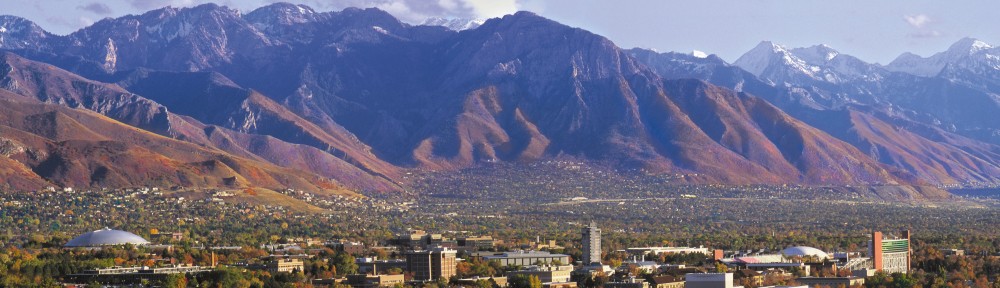
The building’s unique design catches people’s eyes as they enter the city. This structure stands apart because of its age, architecture and charm.  

IMG_7258

View inside of Murray Theater from the balcony

“The façade is an excellent example of Art Moderne complete with rounded corners, horizontal windows and a vertical marquee that serves as a landmark along heavily traveled state street,” Sorensen said.

When asked how this structure will enhance the community, Sorensen addressed that because this facility would provide year-round indoor space, and programming options will expand significantly. It will provide a venue for both small professional and amateur ensembles made up of members from local orchestras and band organizations.
IMG_7280

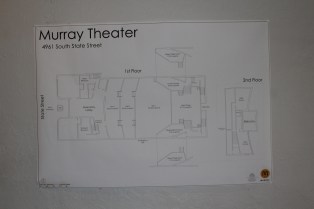
Layout of Murray Theater hung up in the Foyer

As the city looks at the plans to refurbish this structure, they are trying to look what will help create a long lasting concept that will draw people as it once did. 

Jeff Martin, city facilities manager, said, “The City has asked for an assessment about the theater that includes: asking the community how to best utilize the space and what costs and upgrades will be needed to meet the community’s needs.”

The building was bought by the City in 2016. Their plans were to be able to repurpose this building so that they could positively enhance the downtown area of Murray.

“It’s not everywhere that a historic theater is owned and operated by a city, and one where they are actively looking to renovate and provide a fresh venue to their citizens,” Martin stated.

IMG_7297

Detailed architecture in the front entrance of the Theater

The architecture helps to emphasize the old rustic feel when walking into the building. This building has played a big role in the history of Murray and they believe that it can still add value to maintaining cultural entertainment  and historic identities within the community.

Community members and visitors see the special features that add character to the city.  

“When working, the neon sign on the front of the building puts out bright vibrant colors that light up the surrounding block. It really attracts your attention as you’re passing by,” Martin said.

IMG_7248

Old piano located on Murray Theaters center stage

There are other unique features about the building that Martin indicated including that there is an air handler that provides cooling and heating for the main theater room. The original fan is up to 6 feet in diameter and approximately 6 feet long. They included that the original motor still drives the belts that turn a large pulley to operate the fan that still works to this day.

They believe companies that create neon signage is a dying industry. It is harder to find people who can make repairs to the glass work involved and components to keep it operating. The color and light output that comes from these types of signs is really unparalleled. The city officials believe that these building gives a sense of how far the City has come.

IMG_7245

View of the Theater from the stage

“As I have worked with these buildings, some visitors came to watch movies at the theater when they were kids. While others attended events and concerts. Those memories tie into future generations and connections to build upon. It adds another aspect of how Murray is unique to its surrounding entities,” Martin said.

The reinvestment in the building is going to add to improvement of properties that run through State Street, an important corridor for the Wasatch front because of it’s big transportation roadway. Any enhancements that will be made will better the community at large. There have even been long term plans by state representatives to try to create more reinvestment in properties on state street because of it.

“This project will help revitalize our downtown area which is in dire need. It will be a catalyst to get things going, drum up the old history of Murray!” said Susan Nixon, the Associate Planner of Murray.

The city administrators are confident that the enhancement of the Murray theater will be an important catalyst for redevelopment of the downtown of Murray. It will add value to the social and cultural elements of the community. This project will bring the past into the future and make the area of Murray vibrant again.

 

Building a ‘Cvlt’-Like Following   

Story by EVERETT OLSEN

Screen Shot 2018-04-11 at 6.22.17 PM

 OCDope Serenades the audience to her hit single “Pull You Under” Screenshot of video by Everett Olsen

Sweaty bodies pack the small Salt Lake City concert hall. It’s Saturday night at the Goldblood Collective, and the energy in the room is electric. This isn’t the first time that the local rap collective “The Peoples Cvlt” has opened the show here before, but no one in the group expected a crowd like this.

Mad$haw co-producer of the collective, yells over only five feet away.

“Do you see this? This is nuts there must be 100 people in here!”

The small venue overflowed with enthusiasm as the group paraded the stage readying the audience for their final performance of the night. Mad$haw raises the microphone to his lips.

“When I say Peoples, yall’ say Cvlt,” he cries out. “Peoples!”

“Cvlt!” The crowd energetically echos, then again.

“Peoples!

“Cvlt!”

“Now everybody sing along if you know this one, it’s called “Pull You Under,” off of our new mixtape! This will be our last song of the night thank you Salt Lake City!”

The crowd quiets in anticipation as OCDope, one of two female vocalists present in the group, takes center stage microphone in hand. With a confidence large enough for the whole collective, OCDope delivered a performance that mesmerized the crowd, wrapping up the groups most successful show to date.

Salt Lake City certainly isn’t known for its production of Hollywood rap stars, or any sort of celebrities for that matter. Yet scattered throughout the Salt Lake Valley is a network of independent artists all chasing the same dream. A dream planted in the mind of every kid who has ever turned on their car radio.To make millions of dollars and perform for thousands of people.

The Peoples Cvlts’ story is not another boring overtold narration of overnight success. This group serves as a realistic and practical demonstration of how to make the most of granted opportunities, establish a presence in a local niche, and use various tools to build a loyal supportive fanbase.   

Before all 13 independent artists met and decided to make records together, Riley Teague or Teague recalls the day when Max first approached him with a radical new idea.

“He said he was sick of the 9—5 grind and wanted to start making music and taking classes for producing.”

Teague explained it only took a few short months before Mad$haw

“Took off and started getting a lot better.”

Mad$haw continued to dedicate himself to this new passion setting aside time from his job and family to work on instrumentals and production each week.

While attending his weekly production class Mad$haw met another producer Sean Motta or 4K. The two young producers quickly hit it offand began working together on instrumentals each wednesday in Mad$haw’s basement studio.

Vocal artists like Teague and Kiefy Kush another Cvlt member started working with the two producers while slowly introducing in other artists. Teague remembers how it all started like it was yesterday.

“I started inviting friends that I knew could rap then it took off. We started meeting up weekly and making songs ”

While slowly growing and improving the collective continued to meet each Wednesday evening. Many members would come directly from school or the job to meet up, relax, and express themselves creatively.


Screen Shot 2018-04-11 at 6.33.52 PM.png

 The Peoples Cvlt, shown above, during an album cover photo shoot. Photo courtesy of Jade Larson


It’s low key, and is kind of a nice stress-free environment,” 4K explains. “There aren’t any expectations. I think that’s why our music turns out so well, because we enjoy the circumstances under process of making it at Mad$haw’s studio.”

Kiefy Kush, a Salt Lake rapper who has been making music for 15 years, shared one reason he believes the collective has had such early success in a market typically sodifficult to penetrate.

“With there being so many diverse creatives in one collective, we have the ability to produce, provide and promote much more efficiently than if it were just one person juggling everything,” Kush said.

Screen Shot 2018-04-11 at 6.37.38 PM.png

 Kiefy Kush catching a vibe. Photo courtesy of Jade Larson

With the release of their debut 14 song mixtape “Cvlt Tape 1,” The Peoples Cvlt averages 1,486 streams per song released on their soundcloud page. An impressive figure considering the recent founding of the group.

Outside of making the music, the collective is constantly networking and plotting their next moves towards breaking out. In the past month The Cvlt has gotten on the ticket of two much more high profile concerts, in hopes to expand and capture their ever growing audience.

The first is Redfest, an annual concert put on by the University of Utah for its student body. The headliners of this show are big names in Hip-Hop like the Migos and Amine, the concert will be held April 15. The show nearly sold out with in the first week of being announced.  

The next event is a three-day music festival held at the Bonneville Salt Flats early in june this year. This event will feature a number of artists performing on multiple stages. Both of these opportunities should bring along hundreds of new ears and potential fans for the expanding Peoples Cvlt.

This Salt Lake based collective has served as the perfect reflection of what it means to work together week in and week out, seize opportunity, and produce a collaborative sound that is pleasing to the ear. With each artist still chasing the same dream of exposure, The Peoples Cvlt will continue to grind on until they don’t need to remind others of the name.


Screen Shot 2018-04-11 at 6.41.43 PM.png

 Mad$haw, Father Cactus, and 4K. Photo courtesy of Jade Larson

“It’s hard to break out of the Salt Lake scene, like, really hard,” producer 4K said. “I don’t think anyone’s ever done it. We’re going to be the first ones to break out, though. I know it. I’m going to make sure it happens.”

The University of Utah brings benefits to local students through Piano Outreach Program

Story and gallery by KATYA WAGSTAFF

When school ends, many kids race out as fast as they can. But others stay to play music written hundreds of years ago. While they wait, some are doing cartwheels or chatting with other students about book fair and recess. Some eat a snack or run around the room. All are waiting for piano lessons.

Faculty, graduate and undergraduate students studying piano at the University of Utah School of Music extend group piano lessons to five local elementary schools through the Piano Outreach Program. Three of the schools are Title I, which means that a large percentage of students come from low-income families. Students at these schools participate in the Piano Outreach Program for free.

According to the program’s website, “The program not only helps them learn a life-long skill, but also seeks to improve their performance in core academic subjects, like math and reading, and to prevent behavior and truancy problems.”

The program’s website further states that the program benefits School of Music piano majors by providing teaching opportunities and the chance to “learn valuable life lessons through service, preparing them for future careers.”

Mio Cowden, coordinator of the Piano Outreach Program, has a short break between private piano lesson instruction. She holds a Doctorate of Musical Arts in piano performance and music history. She teaches at Salt Lake Community College, University of Utah Preparatory Division, and the Piano Outreach Program.

Her piano studio is a small, insulated room holding two sleek, black baby grand pianos side by side. In the corner is a small desk covered with music files. She relaxes on a piano bench with her back leaning against the wall.

Cowden’s role as coordinator entails training graduate student assistants, organizing fundraising and donations, scheduling assignments, observing each school once a month to check students’ progress, contacting principals and answering parents’ questions. “Basically I do a lot of stuff,” she said, laughing.

The program currently teaches approximately 200 students in five schools. These piano lessons expose elementary-aged students to the “joy of music,” Cowden said.

“There are so many kids, not just at Title I schools, who have never had the opportunity to learn piano,” she said.

“When a child walks into my classroom, the circumstances under which they live don’t really matter. That’s what I love about music, it is universal to anyone, no matter their situation. If anything, these children in tough circumstances are more grateful for an opportunity to do something new.”

– Claire Thueson, graduate instructor at Washington Elementary


When students begin piano lessons “they find another talent that they didn’t know they had and they get so excited,” she said.

Cowden explained that not only kids, but their parents also get excited. For example, a father told Cowden about his daughter, a third-grader from Afghanistan who attended one of the Piano Outreach Program elementary schools. Her older brother participated in the piano classes. She wanted to participate, too. However, in her family’s culture and religion, girls don’t learn to play instruments.

This girl still wanted to learn and asked her dad, “Why did you come to America?”

He responded, “To give you more opportunities.”

“Then give me the opportunity to learn the piano!” she cried.

“Let me think about it,” her dad replied.

The next day he decided his daughter was right and gave her permission to attend piano classes after school.

She was very dedicated, Cowden said, and learned Mozart’s “Turkish March” in just one year.

Cowden turns to the piano and plays the first few seconds of the fast-paced piece. This piece is generally for intermediate, not beginner students.

The young girl played this piece at the final concert, held at the School of Music’s Thompson Chamber Hall. Her parents and siblings attended the performance and were thrilled. Her dad realized that girls should also learn what they want to.

Shortly after, her dad called Cowden and relayed their story. He added that after the concert, he bought his daughter a keyboard as a present.

“I’m glad I got her a keyboard,” he says, “but I almost regret it because she’s unstoppable. She practices from morning to night!”

Her brother dropped out of the program, but she never misses a class.

“I’m not trying to change anyone’s culture,” Cowden adds, “because it’s really up to them. But it’s very exciting to see a girl take this opportunity and find a new talent.”

Claire Thueson is a doctoral student who also is currently a graduate instructor at Washington Elementary, a local Title I school.

She spends about 12 hours every week preparing for and teaching 24 students at the elementary school.

“I have students of all ages and backgrounds that come to piano class, anywhere from first-graders to sixth-graders,” Thueson said via email.

The kids are split into groups: one plays musical games or worksheets with an undergraduate assistant, while the other group practices on the keyboards for their recital. Thueson rotates the groups, “giving assistance and offering encouragement and correction when needed.”

Similar to Cowden, Thueson believes some of the strengths of the program are that it is  “able to offer exposure to music to a large number of children that otherwise may not get the opportunity.”

Some of the challenges she faces include making sure each child is getting “personalized education and attention,” despite their various ages and abilities.

Although she teaches at a Title I school with a high percentage of students from lower socioeconomic backgrounds, Thueson said, “I honestly don’t notice a huge amount of difference. When a child walks into my classroom, the circumstances under which they live don’t really matter. That’s what I love about music, it is universal to anyone, no matter their situation. If anything, these children in tough circumstances are more grateful for an opportunity to do something new.”

Another graduate instructor, Cheney Doane, teaches at Uintah Elementary. This school does not have Title I status, so the class is fee-based, though group class tuition is cheaper than private piano lessons.

His classes also include a range of students from first to fourth grade. Although it’s a challenge to keep them engaged despite different levels, Doane also considers the age range a benefit.

“It’s an asset to have this group of students together because they can learn from each other.”

Not all of these kids will continue studying music, but that’s OK, Doane said. If they want to continue, the Piano Outreach Program provides a “stable foundation” in music. If they don’t, it’s still a “positive, brain-healthy way to spend time after school.”

Doane wants his students to have fun and look forward to this class.

“I want their association with music to be positive, not filled with dread,” he said.

Doane’s most rewarding moments are at the end of lessons when parents come to pick up their children. A student will run up and say, “Mom or Dad, come listen to this piece that I can play!”

The Piano Outreach Program takes a lot of commitment and time. “There are days when you walk in thinking, ‘I don’t want to do this today,’” Doane said, “and you walk out thinking, ‘Man, I’m really glad I had Outreach today.’”


Arts Pass benefits University of Utah students, staff, faculty

Story and photos by MADELEINE M. PORTER

The University of Utah Arts Pass provides funding to programs, enables students to be in touch with their creativity, and gives the U community the ability to explore beyond their comfort zones.

The Arts Pass is “open to all students and faculty members at the U and includes screenings, performances, concerts, and exhibitions.” It is programmed into a person’s campus identification card, and permits them to attend some fine-arts events at a discounted rate and others free of charge.

When Bryan West Kilpatrick was in his second year of college, 2012, the Arts Pass was released. “It gives students access to discounts and anything in the performing arts, including the Pioneer Theatre which is the only professional theater on a Pac-12 campus,” Kilpatrick said in a phone interview. He is a logistics manager for the West Coast and was a theater major for four years.

Discounts are  particularly beneficial to U students. Many are on a college budget and don’t want to spend money on entertainment.

Some students still refrain from going to a wide array of the fine-arts events available, for the fear of having to attend alone. After speaking with multiple students, this fear is a driving factor as to why they do not attend.

Ali Lorenz is a dance major in the School of Dance, which is part of the College of Fine Arts. “It can be really intimidating to attend events, especially in the arts. That is a very unfamiliar field for a lot of people,” Lorenz said.

Pioneer Theatre Company advertises that “current University of Utah students may take advantage of student discounts through the Student Arts Pass to attend performances at discounted rates. With a valid University of Utah UCard, students may receive up to two tickets.”

Students with a valid UCard receive two discounted tickets per performance. Two tickets is intended to inspire students to involve their peers in the arts. Immersing themselves in a field that may be unfamiliar is a challenge that can be overcome.

Kilpatrick added, “There are some shows and exhibits that I wouldn’t end up going to because I didn’t want to attend alone.”

The fear of attending alone affects the number of attendees at the many different productions available. Lorenz noticed this very early on in her experience within her modern dance productions.

“The Arts Pass in our (modern dance) community is so blatantly obvious because we use it to attend productions required for class,” Lorenz said. “However, there is a gap between us, students in the College of Fine Arts, and the rest of the University as a whole.”

The University of Utah has an array of different fields that students are involved in. Students can enjoy the fine arts at a discounted rate while the Arts Pass is still available to them.

Saige Miller, a double major in communication and sociology, believes that fine arts are crucial in any form of education.

“The fine arts are a prerequisite to many different branches of education. You need creative writing or fine arts in engineering or in STEM education. I think it is so central to learning and people should want to learn more about it,” Miller said.

Kilpatrick also commented on the importance of fine arts. “If you are in a major that doesn’t do anything artistic or creative, it is still nice to go explore something out of your comfort zone. We have some pretty amazing student-run shows that are going on and some are even produced by students.”

Not only does the Arts Pass give students the opportunity to explore different types of fine arts but it also aids in the funding that is given to the College of Fine Arts.

The Arts Pass helps the College of Fine Arts keep track of how many students tickets have been used each year, which helps the budget manager determine the budget amount for the semester.

Lorenz said that when the modern dance program merged with the ballet program in summer 2017, it also merged the two separate budgets. Cole Adams, her production class professor, explained that the Arts Pass affects the amount of funding each program receives.

“We get funding through the Arts Pass based on how many students are using the Arts Pass. The budget manager for that year looks at the amount of students who have used the pass. The greater the number of attendees the more funding our program receives because that means people are interested and want to keep attending,” Lorenz said.

The funds that are available to the College of Fine Arts are used for the resources it takes to produce the event.

University of Utah students have the opportunity to immerse themselves in many different forms of fine arts. Attending events helps the College of Fine Arts’ budget grow so more intricate shows can be produced.


Day of the Dead, celebrating and remembering our dead

IMG_9221Story By: CHRISTIAN GONZALEZ

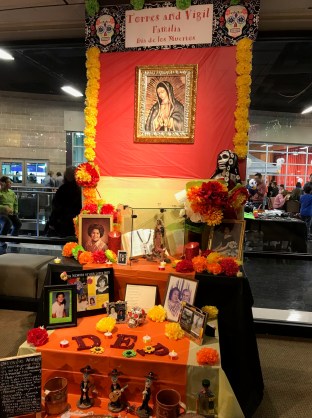
West Valley City, Utah -The Utah Multicultural Center hosted its 4th annual Día de Los Muertos celebration on Saturday, October 28, 2017. The festivities included traditional Mexican dances and a large variety of family-friendly activities such as skull-face painting and a dress-up contest. There was also a specific area where visitors could observe altars created in remembrance of loved ones who had passed away. “We want to make sure we don’t forget all of the good things our loved ones did while they were alive, day of the dead is way to let their stories live on through our generations,” said Francisco Perez, an attendee of the event. The event highlighted various aspects of Mexican culture and served to represent loved ones who have passed away by remembering the lives they lived.

Although this celebration was held on Oct. 28, 2017, the actual dates for the Day of the Dead celebrations in Mexico are November 1-2. Beatriz Aguilera, now a 71-year-old woman, has been visiting the cemetery for el Día de Muertos, going as far back as she can remember. For Aguilera, it has become less a celebration and more a day of remembrance.IMG_9226 She still retains the vivid memories of her past when she would visit her great grandfather’s grave at age ten. “I remember helping my grandma prepare a table filled with things that were my grandpa Chema’s. At the center of the table we would always place portrait of them from their wedding,” said Aguilera. She recalls waking up early to help her grandmother prepare her dead grandfathers favorite food, along with pan de muerto (a spanish bread). “After preparing food all morning, we would use my grandmother’s finest silverware and carefully place the food on the altar along with belongings that represented the wonderful life he lived. It seemed as if for that night we were expecting him to join us for dinner,” Aguilera explained. As the years pass, the traditions of this holiday allow her to remember both of her grandparents, her older brother who passed away at a young age, and her mother who died a few years ago. Every November 2, she travels to the cemetery with her children and grandchildren to spend time with all of those who have passed on. Aguilera and her family use this day to celebrate the life of their loved ones and remember the legacy they left behind.

IMG_9461


Many of the altars at the Utah Multicultural celebration were similarly decorated. They use flowers, candles, food, and short paragraphs describing the lives of each individual on display for all to see. Also showcased on the altars were statues of the Virgin Mary, who it is said watched over the graves and protect the spirits of the deceased as they travel through the after life.IMG_9222 Many of the items displayed on the altars may only seem relevant to the individual but one thing we can learn about this celebration is that nearly every object holds a symbolic meaning.

The flower “cempasúchil”IMG_9462 or in English, the marigold, is known for its powerful scent and vivid bright yellow color. There is much speculation regarding the purpose of this flower. However, the common belief derives from the ancient Aztecs, who believed the bright yellow represented the sun, and that the flower could guide the deceased in the dark using its petals. Today the flower is used to decorate graves, with its bright color, as well as to guide the spirits of the deceased toward their families during the night.

The previously mentioned pan de muerto or in English, “bread of the dead” represents the human skull. It contains four intersecting protrusions that are shaped liked bones. They are said to represent the four corners of the universe. The circular shape of the bread represents the never-ending cycle between life and death. Finally, one thing you will notice at almost every cemetery when celebrating the Day of the

Dead is a very strong odor.IMG_9463 Copal, a resin made from tropical trees, fill the air with its strong aroma when it burns. “The smell is said to guide the spirits of the dead to their altars and purify them of any evil,” said Javier Peña, a local dancer familiar with Aztec traditions.IMG_9464

Peña explained that although many who attend the Day of the Dead celebration are not familiar with the symbolic meanings, he said, the most important thing to remember and celebrate our dead. “We want our children to remember the importance of our Mexican heritage and, although we no longer live in Mexico, remembering our ancestors is as equally important to us as the relationships we have with the living.” said Francisco’s wife, Fatima Perez. IMG_9223Both have been celebrating this holiday since they were children. The knowledge they have of their ancestors has helped them live better lives, said the Perezes.  Overall, Dia de Los Muertos is a day is to remember loved ones and the lives they lived, and the festival was designed as a celebration of life more so than one of death.

https://unewswriting.wordpress.com/2017/12/04/christian-gonzalez

https://unewswriting.wordpress.com/2017/12/04/reflection


Women in music: a local look at a larger problem

Story and slideshow by TAYLOR LINES

Marny Proudfit pulls away from the microphone. She’s still singing but the melody is farther away and sounds eerie. Proudfit is doing it on purpose. It’s a technique she learned through years of performing. Stepping back from the mic gives her sound more depth.

The man in the sound booth turns the microphone’s volume much louder to combat the loss of vocal intensity. The microphone screeches with feedback.

Proudfit has told him not to do this two times before. “Come on, don’t touch the mic volume, dude,” Proudfit says sternly. “When I pull away I’m meaning to.”

This is a normal occurrence for Proudfit, a local musician in Salt Lake City. In an industry dominated by males, she often stands alone as a woman and has found people treat her like a damsel in distress.

It is no wonder Proudfit often is the only women in the room. According to Berklee College of Music, men make up 61 percent of professionals in the music industry. When it comes to promotion, live music and management, that number rises to 70 percent.

One week after the sound incident at WhySound in Logan, Utah, Proudfit sits at a friend’s house with her long brown hair covered by a baseball cap. She sips a hot toddy in the living room. The chatter of people in the kitchen buzzes down the hall.

Proudfit has a singing voice that commands attention but when she speaks she is calm and quiet.

“That was one of those moments I thought OK, this is because I’m a girl,” Proudfit says. “You didn’t do this to any of the other men who are playing. If they told you not to touch the sound anymore, you wouldn’t. But you are because it’s me.”

Proudfit is well traveled and has lived in Boston, Los Angeles and New York playing music and cultivating her sound.

She says her experience as a woman in the music industry didn’t change based on where she was living. Playing shows at venues that are popular tend to treat Proudfit like she doesn’t know what she’s doing.

Ben Thornton, also a musician, has played for many years with bands all over Salt Lake City. Currently he is the drummer for the female-fronted band, First Daze. Before playing with females, Thornton wasn’t aware of the issues women faced in the local music scene.

“Women go through experiences that men will never understand,” Thornton said while twirling his drum sticks. “Their experience creates stories that make really great music.”

By creating and performing music with women he believes he has gained a better understanding of certain attitudes within the industry. “People will say, ‘Wow she’s so cool, she can play the guitar.’ Well of course she can play guitar. Why couldn’t she?” Thornton said of his female bandmate, Gui Pelaez.

Pelaez has been playing music her entire life. She says music is an emotional connection, one she has spent the last five years developing.

Sitting at her volunteer job at Impact Hub in downtown Salt Lake City, Pelaez looks like she transported from the 1970s, sporting flared pants and a chunky belt. She is outspoken and passionate about the music she makes.

As the founder of an all-female fronted band, she says she regularly feels like a token. Venue workers will think the equipment she lugs to shows is for other people. Fellow musicians often don’t know how to acknowledge her because they aren’t sure if she’s performing.

“Sometimes I feel like it’s weird to meet other girl musicians. I sometimes don’t know how to act around them because they aren’t there that much,” Pelaez said.

The lack of women performing and tokenism within the industry is a problem on a large scope. Popular female musicians such as Grimes, Lily Allen, Lady Gaga and Beyonce have all come forward to talk about their struggle being taken seriously in the music industry.

Although women hold top spots in popular music, they are often overly sexualized or asked who the man behind their music is. A woman writing and producing her own music is unfortunately something that isn’t always widely accepted as fact.

Lari White, an R&B musician, highlighted the disconnect the music industry faces with women making music in a story by Nashville Scene. White was involved in every aspect, from writing to producing. When showing her album to a studio, executives turned to her husband and congratulated him on a job well done.

Music festival lineups are almost all predominantly male. A study by Huffington Post concluded half of the attendees at festivals are women, yet men make up 66 to 93 percent of lineups.

Pelaez said the hardest part about being a female musician was gaining the confidence to let go of insecurity and adversity and be comfortable calling herself an artist.

“I think that’s something empowered woman do,” Pelaez said of becoming comfortable in the music scene. “I think that they know who they are and I think they know what they’ve gone through and what hurdles are there. If you’re aware of the issues then it’s easy to talk about them and they aren’t mountains anymore.”

On every level of music, whether international or local, women are facing challenges to be heard and represented. Pelaez feels that not being afraid to shake things up within the industry can lead to change.

If women like Proudfit and Pelaez and men like Thornton continue to get up on stage or write music knowing what they are up against, change might not be that far away.

“Consider me for who I am and what I offer through my art,” Pelaez said. “Not what I am.”

This slideshow requires JavaScript.

Sugarhouse slam poets: breaking stereotypes and dropping mics

Story and gallery by SAMANTHA SHAW

Watchtower Cafe sits tucked between a tattoo shop and an art supply store on State Street in Salt Lake City. On the second Thursday of every month, slam poets from all over the city gather to share their art at Sugar Slam.

Slam poetry in its official form has been around since the 1980s and individuals craft poems for the purpose of being performed. Dorothy McGinnis, 19, defined slam poetry as “poetry, but for the masses.” She also described the art as removing poetry from the academic space.

McGinnis was first introduced to the idea of slam poetry by a junior high school English teacher in Salt Lake City who showed her YouTube videos of performances. At age 13, she began going to open mic nights.

In high school, her theater teacher was a nationally acclaimed poet and encouraged her to go to slams and expand her horizons. It was then that she performed her first slam poem and she’s been slamming ever since. McGinnis now serves her community as president of the Wasatch Wordsmiths, the nonprofit organization that holds the monthly Sugar Slam.

In October, McGinnis returned from representing the Sugarhouse neighborhood at the 2017 Individual World Poetry Slam (IWPS) in Washington, where she performed her favorite poem, “Pompeii (In Which I am Mt. Vesuvius).”

In comparing the national slam poetry scene to the one in Salt Lake City, McGinnis said, “We’re very very white.” Although the diversity of the community is something poets love about slam poetry, the demographics of Utah are not in their favor. However, McGinnis went to the IWPS Nationals on an all-woman team, which is rare on a national scale and a first-time occurrence in Utah.

While much of the Utah slam poetry scene is white, one will still see plenty of diversity at the monthly slams. Every gender, sexual orientation, age and socioeconomic class can be found ordering a classic latte or a Watchtower Café special like the Butterbeer. Competing poets and onlookers alike all squeeze around heavy wooden tables, surrounded by blackboards with doodles of video game and anime characters such as Princess Peach, the Avatar and Kirby.

Another prominent local poet is Bryce Wilson, 21, a student at Salt Lake Community College. He came in second place in the Sugar Slam that was held Thursday, Oct. 12, 2017. He started slamming after a breakup when a friend advised him to write down all the things he hated about the relationship. Wilson performed that list at his first poetry slam in Salt Lake City and took first place.

A typical slam starts with an open mic, where anyone can get up and perform anything. “There’s always one open mic that’s really good and you wonder why they aren’t competing,” Wilson said. Every slam has a host, who introduces the poets and keeps the audience engaged.

After the open mic, the host selects five people from the audience to judge the slam. The host attempts to choose judges have never attended a slam before, and they cannot know any of the competing poets.

Before the official slam begins, the audience calls for the “sacrificial poet.” Wilson’s favorite part of a slam, the sacrifice performs a poem for the newly appointed judges so that the competitors can, in Wilson’s words, “gauge the five random weirdos who are going to be giving these ambiguous points.”

After the sacrifice, the first round of the slam begins. Wilson said most poets will kick off the competition with a funny poem in round one and move on to a darker, more introspective piece in round two. In round three, anything goes! Some poets are eliminated after each round, based on the subjective scores. After the scores are announced, the host reminds everyone to “applaud the performer, not the score.” The final round’s scores determine first, second and third place. The only prizes are “bragging rights and experience,” Wilson said.

Both McGinnis and Wilson credit slam poetry with giving them more confidence, a better sense of self and connections within the community that will last a lifetime. They encourage anyone who is interested to get involved, whether that be as an audience member or as a poet.

Two regular events are held in the Salt Lake City area. The Sugar Slam takes place on the second Thursday of every month at Watchtower Café at 1588 State St. while the Salt City Slam is held at Even Stevens on 400 East and 200 South every last Monday. The Wasatch Wordsmiths keep the community updated on events and featured poets via their Facebook page.

Three Salt Lake City fashion creatives discuss the impact of social media marketing

Story and photos by BRITT BROOKS

A swipe, a like, a comment, a follow.

To get a look at marketing in the 21st century, go no further than your smartphone. Today you can look at any online platform and find a person, product, or brand that sparks your interest. But the businesses that perhaps utilize social media the most are those in the fashion industry.

Whether it’s celebrity-sponsored posts, live streams of runway shows, or notifications for product drops, fashion can be an immersive experience now more than ever. The elite fashion gods such as Gucci, Versace, Chanel and Balenciaga all have millions of followers on social media. But what about the startups?

Three up-and-comers in Salt Lake City’s fashion industry gave insight to their experiences with social media. The impact can be positive or negative depending on how active users are with the content presented to them.

Sydni Zaugg sat in a window seat at Salt Lake Coffee Break, her platinum blond bob stood out against head to toe black clothing and silver jewelry. Zaugg, 19, is a college student who attended the International Fashion Academy (IFA) in Paris in 2017. The program spanned three weeks and allowed her to attend Paris’ spring Fashion Week in early March.

Zaugg said she wouldn’t have even known about the opportunity had it not been for Instagram. After following IFA professor and trend specialist Agus Catteno on Instagram, Zaugg realized her wish to be educated about fashion in France was a possibility.

Zaugg direct messaged (DM’d) Catteno and asked questions about her job at IFA and  the opportunities for classes. Without her connection to Catteno, Zaugg wouldn’t have had a welcoming person to show her the ropes, and probably wouldn’t have gone to Paris for classes in the first place.

Parisian fashion influenced Zaugg’s personal style. And it serves as her template for advising others as she pursues a career as a stylist and photographer in Utah.

Social media give Zaugg a platform to share her availability for styling sessions and examples of her work such as dark, moody and romantic photoshoots with friends and models. But as with everything, it isn’t perfect. Zaugg mentioned the downside of pursuing likes and comments: a loss of creativity.

Avant garde clothing still graces the runways, but Zaugg has noticed brands moving toward more streamlined, minimalistic styles. This can be attributed to regular trend cycles. But Zaugg sees it as a reflection of the heavy use of social media marketing. Current fashion can be more about who you are, not what you wear. Big entertainment names like Kardashian and Hadid can be more influential than the brands themselves.

The integrity of the fashion industry can quickly fall victim to the whims of celebrities and influencers. Copycats are bad for any creative-based industry. To combat this ever-present sameness, Zaugg has a perfect mantra: “Clothes should give you confidence to express yourself how you want to, not how everyone else dresses.”

Someone curating new and wearable pieces for women is Madison Martellaro. A 21-year-old senior at the University of Utah, Martellaro has already started a company. In April 2017, she began working on her online clothing store, Fleur Fashion Boutique. She can be seen wearing multiple pieces from her boutique’s line including jeans, bomber jackets and everyday T shirts.

Martellaro came into the fashion industry alone, with virtually no connections. After months of research and hard work, she was able to start her business and advertise through social media to grow a following before the boutique launched on Nov. 9. She credits her online following of nearly 1,000 people to creating brand awareness before items were even available for purchase.

To get a good idea of what her customers actually want, Martellaro used polling features on social media. Polls and comments influenced the way the boutique website looks and functions. For example, followers wanted to know the models’ sizes and dimensions as well as see the clothing from multiple angles. These are two details about Fleur Fashion Boutique that came directly from future customers’ wish lists.

During her first photoshoot, Martellaro held a livestream. The feature on Instagram enabled her to connect even more with her future consumers. “I want to show people really what goes behind a business,” she said. In a world where new competition crops up every day, a behind-the-scenes connection with followers is priceless.

Martellaro takes a lot of pride in curating pieces that women of all sizes can wear and personalize. One of her biggest goals is to sell clothes that can be worn day to night, and look glamorous no matter the occasion.

Packaging is an important part of her brand’s final presentation and delivery. For a cohesive image, all clothing and accessories come wrapped in tissue paper with the greeting “Hello Beautiful” in bold font on the outside. Fleur Fashion Boutique encourages its recipients to take selfies with their deliveries, creating a wider community of people that talk about the products.

“That was the biggest thing for me,” Martellaro said, “making sure women felt empowered and special.”

Keeping a cohesive and unique image is one of the top priorities for Davis Hong. A polished and composed 24-year-old, Hong graduated from Salt Lake Community College with a design degree. Sitting in a wrap-around black coat of his own design, Hong said he likes to wear his own creations.

Recently rebranded under its new name, BYSHAO has been in the works for over two years, and is set to launch in 2018. Hong has made huge strides toward creating his ideal company and style.

Sustainable, ethically sourced materials are of utmost importance for BYSHAO. Only natural fiber fabrics like cotton and linen blends are used in the designs. To avoid creating more waste on our planet, Hong prefers working plant-to-piece with certified organic materials, and avoids polyester. Natural textiles and humane working conditions are the core of his passion for sustainable clothing, and it’s something he’s sticking to.

The pieces of BYSHAO are best described in Hong’s own words as minimalistic, gender-neutral and timeless. Specializing in overcoats and tops, BYSHAO is both modern and classic with structured silhouettes and neutral colors.

Participating at the 2017 Art Meets Fashion show in Salt Lake City, Hong’s brand was one of the five main shows. Events like this help secure a following that he hopes will subscribe to BYSHAO’s e-newsletter. Emails are more of a personal connection with consumers, directly informing them about lookbooks and future sale dates. A great way to foster a connection that leads to loyal customers is to start on platforms like Instagram and Twitter.

As Hong’s demographic isn’t necessarily in Salt Lake City, he finds it important to get to know his followers through social media. He mentioned his use of geo tags, event announcements, stories and live videos to view people from the other side of the planet. “You can basically be right there and see the people there as well,” Hong said.

Networking locally and internationally has furthered Hong’s knowledge and increased the presence of his brand. Social media form connections that wouldn’t otherwise be possible. He’s found photographers, models and hair and makeup professionals to work on photo shoots and runway shows.

The internet is a fantastic way for startup businesses to get their name into the hands of others. “Social media is very much an open portfolio,” Hong said. The ability to view others’ work passively before making real-life connections is something new to the world. This can acutely affect professional creatives, as a lot of their work can be judged from a 5-inch screen.

Without social media tools, Hong would have had a much harder time making local and international connections in the fashion industry. It’s unlikely that Martellaro would be the owner of a business she built from scratch at such a young age. And Zaugg never would have known about the opportunity to study fashion in Paris, or launch her career as a stylist.

Connecting with customers, mentors and possible collaborators — no matter where they are in the world — is perhaps one of the greatest online inventions of all.

Successes and advice from new Utah artist: Jennifer Seeley

Story by Danielle Haddad

Already by the age of 24, local artist, Jennifer Seeley, has already reached levels of success some artists can only dream of. Seeley was born and raised in South Jordan, Utah, where her paintings hang in galleries all across the state. She has also been a part of some of the most competitive shows and earned spots in numerous events throughout the state.

A few recent events in Seeley’s life includes a marriage to Roberto Mata and her Bachelor of Fine Arts degree with a double emphasis in Art Education and Drawing/Painting from Logan’s Utah State University. Seeley is currently teaching at Corner Canyon High School in addition to expanding her artistic career to Idaho, Colorado, Wyoming, California and soon Florida, where she plans to move this winter.

The Utah Arts Festival Holiday Show features one of Seeley’s most in demand pieces: a limited edition moose painting with a vibrant, yet deep, red background that was actually inspired “from being in Parmoosek City so much, and everyone loves the moose and kept requesting the moose,” says Seeley. The show includes 70 artists, 40 of whom are local artists showcasing jewelry, photography, glass, books, cards, clothing and more. The Utah Arts Festival Holiday Show is located at 230 S 500 W, in suits 120 and 125, which is where Seeley’s work can be found. The show is an opportunity for people living in or even visiting Salt Lake City to see how richly talented the community is in their creative and artistic abilities.

Becoming a known artist in a state filled with over 40 fine art galleries alone, is a journey Seeley  made in just a year and a half. “You get rejected all the time as a beginner artist,” Seeley explains. “I feel like the reason I’ve had success is because I’ve tried everything and I’m super persistent, and that’s what it takes.”

The fact that she’s been able to appear in the winter show as well as the Utah’s summer art festival, Park Silly Sundays, the Ogden Arts Festival, and more is due to her persistence and pre-application analysis. Seeley says that the application process for shows is “super competitive … you have to pay all of this money just to apply and then sometimes you don’t get in … and sometimes it doesn’t matter how good you are. It’s: do you fit into the gallery? That’s really important.”

Though only starting to promote her work a year and a half ago, Seeley has pertinent advice based on her own experiences for new and upcoming artists like herself. “The best thing to do as far as galleries go is to visit the gallery first. Take a look around at the prices and the type of work that’s there and if it fits, then you should go ahead and make a contact and follow up, follow up, follow up.” Seeley’s paintings of a bison and wolf that continue the new line she has been working on can be found in a St. George art gallery.

Furthermore, she discusses a common problem for artists, such as having a large body of work and not knowing which pieces to show. In response she says, “I’m trying to find a way to filter it, and I think limited edition prints is the way to do it, and it also keeps the value of the originals up.”

In addition to galleries, Seeley has been featured in Utah’s Summer Art Festival as well many other shows around Utah and neighboring states. Seeley explains that, “Utah’s art festival is really hard to get into; a lot of people don’t know that … Most people that they take are from out of state just because it’s so competitive and they only take the best of the best.” She states that “the hardest thing for a beginner is that you want to be in the biggest and the best shows,” and lucky for her, she was, since the festival is such a large event. According to the Utah Arts Festival, “Having garnered numerous awards internationally, nationally and locally, the Festival remains one of the premiere events that kick off the summer in Utah each June.”

Throughout her education and career, Seeley received several scholarships, awards and ample success and recognition. Utah will experience the loss of a great artist after Seeley moves out of state. However, she will have the opportunity to flush her talent over Orlando, Florida and gain even more recognition for her signature array of animal paintings signed by “Jenn”.

NYC to SLC: music journalist Charissa Che

Story by Mack Culp, chasingmack.com

I got to sit down with Charissa Che this week to find out what a life as a music journalist is like. I met Che only two weeks ago when I picked her up in the rain for an Uber ride. I learned she is also a student at the University of Utah and new to Salt Lake City. Che was equally excited to learn about my journalist aspirations, because she has been writing in New York City for 10 years. Instant best friends.

I’m waiting to meet her at The People’s Coffee downtown Salt Lake City. The air is crisp, even inside, and my approach might not be. But my plan is to ask questions on the cusp, see where the conversation takes us, because that’s what an interview is anyway. Nothing calculated for a new friend.

Che ordered an earl grey tea, and I a second late. I start by asking if I could record on my iPhone for my notes. Che politely agrees.

Che is somewhat unassuming, but that’s what a journalist should be. Blending into the environment she investigates. Pulling it apart for what it is. Asking the question when you least expect.

Culp: Tell me about your work for Salt Lake Magazine.

Che: For Salt Lake Magazine, I’ve written lots of pieces on local bands. They’ve been able to meet with me. It’s mostly been at coffee shops, but with the more major acts who are touring, they can’t meet, so on the phone. I already had some contacts at record labels, so once they found out I was writing for Salt Lake, I started getting emails from them inviting me to shows, interviews. I’ve written for so many magazines. I see these people, and I’m like, I know you. You’re from Columbia, Atlantic Records. Once they hear I write for a different magazine, they’re on top of it.

Culp: I’m curious what it’s like to write for the mobile app/magazine, SOUNDS.

Che: I can write for wherever I am [for] SOUNDS MAGAZINE. I used to write about the New York scene. Once I was here (Salt Lake City) I pitched to my editor, hey theres a lot of cool music coming out of here that I don’t think people give credit for.

CMJ Music Marathon 2013 Lower East Side, NYC. Photo by Charissa Che

CMJ Music Marathon 2013 Lower East Side, NYC. Photo by Charissa Che

Culp: What do you do for SOUNDS Mag?

Che: I just went around, interviewed some local bands, talked about who stopped by, took pictures. It’s a several page spread [called] The Salt Lake Scene report. The magazine itself is interactive, so it’s an app. We had Ellie Goulding a few years ago, Elton John. I did the Ellie Goulding cover story. My most recent one, was a Josh Stone cover story.

It puts all the control in your hands. You have to make the moves. As intimidating as it is. I used to be intimidated setting up interviews, and now it’s just like old hat. It’s kind of up to me, I fashion the story as I want. It makes you prouder as a reporter, once that final project it up, that you knew you were behind every part of it.

Culp: What is the future of working journalists?

Che: Journalism is a lifestyle. It’s not an office job. Not everyone is born with the inherent curiosity to want to investigate things. It will fulfill your need to get questions answered. I don’t know what the future of print is. Lifestyle magazines will always have a niche. You want to have it on your coffee table. I feel like eventually everything is going to be digital and that’s a little scary. I like magazines, I like print. I like things that you can touch, smell, and keep. But, I feel like however it goes there will be a novelty attached to it and we will find a way to like that too.

University creates Olympic exhibition

By: Meisha Christensen

SALT LAKE CITY – It was the moment hundreds had been training for and anticipating.  The bright florescent lights snapped on, the triumphant music began and athletes from all around the world greeted the roaring crowd at Rice Eccles Stadium kicking off the 2002 Salt Lake City Olympic Games.

The games hosted in Salt Lake are memorable for many as they think back on the exhilaration that entered the city 10 years ago.

The 10-year anniversary of the games is being honored with “The Olympic Experience Exhibition,” created at the University of Utah’s J. Willard Marriot Library.  The exhibition will include any documentation, specifically photographs, pertaining to the Salt Lake games.

So far more than 4,000 photographs relating to the games have been archived.  There have also been hours of video footage donated to the exhibition.

Designers of the exhibit are asking anyone who was involved with the games to donate their photographs and imagery.

The library’s special collections department is the official storehouse for documentation of the 2002 games.  All items donated will be part of official, permanent records.

All donations can be made at the Special Collections Department at the Marriot Library.  The exhibition began on Feb. 1 and will continue through the 29.

Multimedia archivist at the library Roy Webb said, “We’d love to see more donations from the public, it is through individuals that we are able to archive historic collections for future generations.”

The university played a large role in hosting the games through housing athletes and presenting the opening and closing ceremonies.  This exhibit serves as a reminder of the excitement brought during the Salt Lake Winter Olympic Games.

Historian says rock climbing culture has lost social aspect

story by ELLEN LEWIS

“Climbers’ tales cast light on themselves and the central themes of their time, nature, technology, ect,” said an environmental historian during his guest lecture March 5 at the University of Utah Marriot Library.

“Climbing Alone: The Estranging Trend in Outdoor Sports” focused on how climbing, once a social sport, has evolved to be individualized through changes in technology and society’s attitudes toward nature.

“I would have never expected climbing to have such a interesting history,” said Courtney Gaylord. She attended the lecture because of her affiliation with Mountain Hardware and their sponsorship of professional climbers.  “It went from being ‘us’ to ‘me’, it says a lot about climbers, but also about sports in general.”

The problem today is we only focus on the story of heroes said Joseph E. Taylor, a published history professor at Simon Fraser University. Beginning his presentation with a film clip of the 1963 Everest Expedition, Taylor said the sport of climbing has not always been about individuals celebrating risk and pushing boundaries.

Up until the 1960s climbing was a collection of friends out to have fun, environmental clubs with a social focus including dinner parties and often times dating.

“What they did in nature was deeply related to what they did outside,” Taylor said. These “middle class white playgrounds” focused on relationships rather than the individual approach climbing takes today.

Starting in the 1960s, as standards of living were raised and technology increased, the social way of climbing began to die out. Climbers began to separate themselves as heroes Taylor said, and became less collective.

Athletes had their own cars and equipment so the clubs became less necessary. Climbers aimed to separate themselves as heroes. The sport became more of a lifestyle than an activity.

“The ‘us’ had been lost in climbing culture,” Taylor said. Climbers went as far as breaking laws and living in Yosemite Park so they could climb full time.

Taylor’s lecture was based on his most recent book “Pilgrims of the Vertical: Yosemite Rock Climbers and Nature at Risk,” which won the National Outdoor Book Award for History.

Tall and clean cut, Taylor is a climber himself, and the historian in him drew him to find deeper themes within the climbing culture.

“[Utah] is the epicenter of the climbing and industry,” said Taylor. The lecture was hosted by the American West Center and Utah Humanities Council. Matt Bass, director of the American West Center brought Taylor here because of the local interest Utahans have in climbing.


Exhibit at the U. Features Activist Edward Abbey

by Mark LeBaron

In the end, Utah beat Stanford.

Not on the field, the court or the pitch, but on Eric Hvolboll’s list. Hvolboll, a lawyer and resident of California, collected many works of the activist-writer, Edward Abbey. Eventually, Hvolboll decided to donate his collection to either the University of Utah or Stanford. Ultimately, the U. won.

Abbey, who was born in Pennsylvania, authored 21 books. He spent most of his adult life working, traveling and living in the American Southwest. Two of his most famous books are “The Monkey Wrench Gang” and “Desert Solitaire”. Considered to be the pioneer of the environmental movement, Abbey worked hard to protect the land he grew to love.

A presentation to celebrate the collection took place on Sunday, in the Gould Auditorium in the Marriott Library on the campus of the University of Utah. Ken Sanders, a resident of Salt Lake and rare book collector, spoke about Abbey and his effect on environmental issues today.

“The majority of the traditional student body at this and other universities were not yet born on this planet when Abbey died,” said Sanders. “Ed Abbey still lives. Almost all 21 books he wrote during his lifetime are still available to be read.”

Tyson Gibb, a senior studying new media, is an example of whom Sanders was describing.

“I actually read Desert Solitaire,” said Gibb. “The way he talked and described things, his writing style is very abrasive.”

Gibb saw Abbey as a man who is looked up to for many people as someone who laid a foundation for the environmental movement, impacting people like local activist Tim DeChristopher.

In 2008, DeChristopher protested land sold by the Bureau of Land Management (BLM) by bidding on 14 parcels of land in Salt Lake City. After being arrested and put on trial, DeChristopher was sentenced to two years in federal prison, where he is currently. Gibb was in attendance of a protest following the sentencing and indicated his support for DeChristopher.

“I think Tim [DeChristopher] is a new American hero,” said Sanders near the end of his lecture.

After the presentation, the audience was invited to go up to the collection on the fourth floor of the Marriott Library.

In the end, the main motivation for Hvolboll is for the collection to open peoples’ eyes to environmental issues in Utah’s wilderness.

“There was one thing I failed to mention in my remarks earlier,” Hvolboll said. “My goal is for other people to see it as a spur [for environmental awareness],” he said.

The collection is entitled, “Brave Cowboy: An Edward Abbey Retrospective” and is in the Special Collections Gallery in the Marriott Library. It is free and open to the public until April 27th. Additional information can be found by visiting http://bit.ly/xn3Dks.

“We are very excited to house the fine work of Ed Abbey,” said Greg Thompson, Associate Dean of the Special Collections at the Marriott Library. “It is a collection we’re proud to have at the University.”

Marriot Library Celebrates The Life Of Edward Abbey

By: Bradley Hunsaker

An audience of about 150 people packed the Gould Auditorium in the Marriot library Sunday to celebrate the life and accomplishments of Edward Abbey, author of “Desert Solitaire” and “The Monkey Wrench Gang.”

“I haven’t read many of Abbey’s works,” said Jordan Ripplenger, an environmental studies major at the University of Utah. “But he seemed like he lived an interesting life.  Almost like a modern day Thoreau.”

The event’s main purpose was to open up a new exhibit dedicated to Edward Abbey.  The exhibit will hold many of Abbey’s works including rare first-edition publications donated by Eric Hvolboll.  Hvolboll donated most of the collection to the library back in 2008.  Through a 30-year period he has looked for rare Abbey works wherever he could find them.  He told the audience he became addicted to Abbey’s work after reading a proof for “Desert Solitaire” and seeing how much was removed before the book was published.

Hvolboll told the audience he was happy to find a resting place for the collection.  He talked about how he looked into many Universities such as the University of Arizona and Stanford before deciding that the University of Utah was the place for this collection to be.  Hvolboll wasn’t the only person happy to see his collection put to good use.

“This is the best print collection in the whole area,” said Gregory Thompson, director of Special Collections here in Utah. “We now have the ability to study Ed’s writings including a lot of his non-published works.  It will also be important in bringing scholarship opportunities and the students getting educated in Abbey’s works.”

The opening of the exhibit was kicked off by a speech given by a long-time friend of Abbey’s, Ken Sanders.  Sanders is a rare book collector and has worked with Abbey on many different occasions.  Most of Sanders’ presentation came from Eric Temple’s documentary “Edward Abbey: A Voice in the Wilderness.”  The presentation included a lot of audio clips from Abbey himself explaining points of his life and his works.

“My point here today is to let us see Edward Abbey and hear Edward Abbey.  Ed didn’t need anyone to speak for him and 22 years after his death he still doesn’t,” said Sanders at the start of the presentation.

Sanders wanted to emphasize to the audience that Abbey’s works live on and should inspire people to act on a lot of the environmental issues today.  He gave the specific example of legislatures planning on taking back 30 million acres of federal lands within the state and using them for exploration, energy and greed.

Although Abbey never considered himself a naturalist, nor did he even know what a naturalist was, through his works he inspired environmental extremist groups such as Earth First.  He never really condoned the extreme ways of bringing environmental reform but he always emphasized people standing for the cause of the wild.

“The wilderness needs no defense!  Only defenders,” said Abbey in one of the audio clips during the presentation.

Albeit Sanders said he and Abbey did acknowledge the need for exploration, gas, oil and energy, he called it a trade-off for the precious land that is left.  He warned the audience to find the balance between consumption and the wilderness remaining before we consume too much.

“As Ed said, ‘Growth for the sake of growth is the ideology of the cancer cell,’” said Sanders.

During his life Abbey wrote more than 23 books of both fiction and non-fiction.  His most famous is “Desert Solitaire” which documents his life as a park ranger in Moab’s Arches National Monument.  The book is about his experiences and thoughts during that time, mirroring Henry David Thoreau’s “Walden.”

At the time Abbey’s works starting getting popular he said he only had one main goal when it came to his writing, “I want to write one good book if possible,” said Abbey. “I’m not trying to do anything more than that.”

The exhibit, “Brave Cowboy: An Edward Abbey Retrospective,” opened to the public Sunday and will remain open until April 27.  The exhibit can be found on the fourth floor of the Marriot Library.  Features include signed copies of Abbey’s works, his contracts and correspondence with his publishers and other documents about Abbey’s life.

University to host Olympic remembrance exhibition

by Ryly Larrinaga

SALT LAKE CITY – In commemoration of the 2002 Olympic Games, the Utah Ski Archives at the J. Willard Marriott Library will host the Olympic Experience Exhibition.

The exhibit will showcase over 4,000 archived photographs and other documentation of the University community’s experience with the 2002 Olympic games and events.

With both opening and closing ceremonies having taken place at the Rice-Eccles Stadium, the university campus served as a central hub of the 2002 Olympics. Additionally, the Olympic Village, which now houses university students, lodged Olympic athletes.

However, the Special Collections Department would like to expand their collection and has asked that anyone in the university community – volunteers, event spectators or those with photos of the campus and the city – to donate artifacts they might have from their experience with the Olympics.

“We’d love to see more donations from the public,” said Roy Webb, multimedia archivist at the library. “It is through individuals that we are able to archive historic collections for future generations.”

Although it has been 10 years since Salt Lake City hosted the Olympics, the 2002 events can be assessable to future generations if the public shares their individual experiences by contributing photos or other documentation to the Utah Ski Archives.

Free and open to the public, the exhibit will be held February 1-29 in the Special Collections Reading Room on the fourth floor.

Kevin Pang On Mortal Kombat, Interviewing & Bacon

by RYAN LITTLEFIELD

When he was 13, Kevin Pang loved two things: Mortal Kombat and bacon.  The video game inspired him to begin writing as he strove to write about video games for a living.  Pang eventually accepted a job for the Chicago Tribune, where he began eating and writing about food; but interviewing is how Pang got his job today.

Offering to share his knowledge of interviewing techniques, which contributed to his success, Pang gave a speech in a news writing class at the University of Utah last Tuesday.

Being prepared and knowing the topic is the number one rule of interviewing, according to Pang.  It is important to ask follow-up questions and to clarify each question. While interviewing, it is important to listen and absorb. While taking notes, write simple prompts.

Pang believes the three best questions to ask in an interview are why, what do you mean, and how can you be sure?  Each of these explains motives and character, clarifies, and begs for complex explanations.

The final interviewing technique Pang offered to students is when an interviewee offers no comment.  Reply with, “I feel bad putting a no comment in the story because I feel the readers will think your trying to hide something; so let’s talk about it.”  Interviewing requires journalists and public relations professionals alike to be tough, yet compassionate and friendly.

Although Pang never achieved his teenage dream of reviewing video games for a living, his interviewing techniques led him to become a credible food critic who loves his job.

“I write about things that I like,” like cheap foods and restaurants, “that’s what interests me, so that’s what I want to write about,” said Pang.  He also suggests all writers find something they are passionate about – then write about it.  Oh, and always add bacon.

Controversy arising over Utah mall code of conduct

by Ryly Larrinaga

SALT LAKE CITY – With the recent opening of the City Creek Center in downtown Salt Lake City, reports of homosexual couples being escorted off mall property have arisen, creating controversy between citizens and mall officials.

The mall, which became open to the public on March 22, 2012, has received numerous complaints in regards to people being asked to leave the shopping center because of what they are doing.

However, City Creek officials are denying these rumors and attribute it to an exaggeration of the City Creek Center code of conduct that has been instated.

Hanna Kirsten, a student at the University of Utah and frequent City Creek Center shopper, feels that the code of conduct is often times exaggerated and made to seem over-the-top. Until, she witnessed mall security escorting two men off mall property that had been publicly kissing and holding hands.

“It was definitely interesting to see the reaction of the two men who were asked to leave. They looked devastated… It was saddening to watch,” said Kirsten.

Kirsten also said that she left the mall immediately after the situation occurred, mainly because she felt uncomfortable with the attention it caused from surrounding mall attendees.

“It’s not everyday that you see two men being escorted off premises for displaying affection. Especially, when the heterosexual couple next to you is doing the same thing, if not, even more inappropriately and over-the-top,” said Kirsten.

The code of conduct, which is posted on the City Creek Center website, states“…management reserves the right to prohibit any activity or conduct which is detrimental to or inconsistent with a first-class, family oriented shopping center.”

Although, nowhere in the code of conduct does it mention that public displays of affection are prohibited, regardless of the person’s sexual orientation.

“We will not tolerate any activity in terms of people not treating others with respect. Period,” said Karen MacDonald, a Taubman spokesperson, in a QSaltLake magazine interview.

MacDonald also said, “City Creek Center is a place for everyone and we want everyone to come here and have a great experience. There have been precious few times that we’ve had to speak to someone about their conduct in the Center and I have to say the experience has been very positive overall.”

Many are blaming the situation on the Church of Jesus Christ of Latter-day Saints, claiming that the church is responsible for enforcing the code of conduct and creating an unequal environment.

Taubman Centers, Inc., manages the mall property and says that the Mormon Church has not had a say or influence in creating the shopping center rules.

For Robert Yorgason, who was raised LDS and openly revealed eight years ago that he is gay, thinks the situation has just created an opportunity for people to protest and cause a scene.

“It is immature when you see people exaggerate the extent of a situation to raise awareness to a greater issue, it just gives us (homosexuals) a bad reputation,” said Yorgason.

City Creek Center currently has an appeals process in place and if patrons feel they have been unfairly targeted, mall management wants to hear about it, said MacDonald.

Blockbuster’s rental days hit a dead end

By: Kristin Bingham

SALT LAKE CITY-The well known video rental store Blockbuster, is losing its popularity. Established in 1985 in Dallas, it has grown and become known throughout the U.S. taking out competitors like Hollywood Video. Blockbuster is now facing a new competitor that could cause video rental stores to become extinct: advanced technology.

Company’s like Netflix, Comcast and Redbox have given video rental stores like Blockbuster a run for their money. The idea of a video rental store is to allow consumers to watch a movie in the comfort of their home. Netflix makes that idea even more realistic, since you don’t even have to leave your home anymore, you can instantly stream movies or have movies delivered to you. It’s a scary thought, since a lot of the 90’s babies have grown up with renting videos. The trip to the video store was an adventure for some and to think they might all become extinct is a bit overwhelming but it is happening. As hard as it might be for consumers to get a hold of, it is also difficult for the employees.

One employee, Refija Kavazovic has this to say about her store closing in West Valley:

“It is really tough because I have been working there for almost a year and have got used to the job and employees. Most of us at my store only have that as a part time job or just some extra money, but there is one person that it is his main income and uses it to support his family. They say they will try to transfer most of us, but with a Blockbuster closing every month it seems you can only place so many employees.”

A store manager at the Sandy store, who wants to remain anonymous, says she has seen a majority of the Blockbusters in Utah close and thinks that they will indeed keep on closing as they don’t have a chance.

University of Utah student, Breanne Thorup has this to say about the Blockbuster store closing by her apartment in Taylorsviille

“I am pretty bummed since it was so close to my house, now if I ever want to rent a movie from there I will have to drive further.”

With stores closing, Blockbuster still tries to stay in the game by following in the footsteps of Netflix. They offer video rentals on line which are delivered to your home. They also offer game rentals and guarantee that they have many new releases almost a month before Netflix and Redbox get them. The one thing they are missing is the capability to stream video like Netflix via computer or game console.

Assistant lab tech in the Telecom department of the University of Utah, Michael Hansen thinks Netflix will continue to stay strong.

“Right now the majority of feature film distribution is facilitated via FTP. It’s quickly becoming more rare now for a theatre let alone the studio, to deal with actual celluloid film. So Netflix is definitely a proof of concept and will last as they continue to innovate,” said Hansen.

Blockbuster hasn’t vanished off the earth yet and could possibly make a comeback if they convert over to the online watch immediately side. Until then, Netflilx remains the top dog in video “renting.”

Legacy of radical environmental activist and author is showcased in exhibit

by Ryly Larrinaga

SALT LAKE CITY –  “He didn’t need anyone to talk for him alive and he still doesn’t being 22 years dead,” said local rare book dealer Ken Sanders.

Nearly two decades after author and radical environmentalist Edward Abbey’s death in 1989 at the age of 62, Sanders is finally able to speak of the man he knew and his work that has spurred such a drastic movement in environmental crusades.

Before the opening exhibit containing Abbey memorabilia at the J. Willard Marriot Library on Sunday, about 150 attendees listened as Sanders gave his lecture, “R. Crumb meets the Monkey Wrench Gang: Edward Abbey and the Modern Environmental Movement, from EarthFirst! to Tim DeChristpoher.”

“I hope to bring a taste and flavor for what Abbey was all about,” said Sanders of his lecture that showcased footage of Abbey during his life.

Abbey, whose writing became a crusade surrounding the destruction of the environment, considered himself an entertainer and expressed that his main goal was to just write good books, according to Sanders.

Abbey’s writings are filled with themes of anarchy and rebellion, much like in his prominent novel, “The Monkey Wrench Gang,” that centers on activists who plan to sabotage the destruction of the Glen Canyon Dam. “The Monkey Wrench Gang” is cited as being a major inspiration to several radical environmental groups such as the creation of EarthFirst!.

“People need to do more. We need more people standing up and saying the emperor has no clothes,” said Sanders.

Sanders, said that Abbey’s view on environmentalism will just not cut it these days, emphasized that issues have become more frightening, which require a modern, stronger approach in order to create change.

“The new generation of people coming of age now, they’ve inherited the planet that we’ve messed up. It’s up to them to do something about it,” Sanders said in relevance to Tim DeChristopher.

DeChristopher, who falsely bid on oil and gas leases at a 2008 Bureau of Land Management auction, was convicted last July to two years in prison.

However, Abbey’s work was just not an attempt to stop the destruction of the environment through crusades of chaotic events like in “The Monkey Wrench Gang.” Several of Abbey’s writings were themed around the relationship between man and nature.

In his 1968 novel, “Desert Solitaire,” Abbey uses sharp and poetic descriptions to bring the reader close to the natural beauty of the desert without actually being there.

‘Desert Solitaire,” has since gone on to become one of Abbey’s most noted publications. However, as Sanders described, Abbey was not fond of how popular the novel became. Abbey refusing to allow excerpts to be reprinted from the novel for over three years, Sanders said that Abbey became upset when requests for “Desert Solitaire” became overwhelming.

Abbey successfully attempted to intensify the anger of moral people who share similar beliefs on the importance of preserving the environment. Saying that Abbey had a unique way of incorporating the reader with his writing, whether that is through mesmerizing or infuriating the reader, Sanders believes that the legacy of Abbey will continue to be carried on through those who become involved with reading Abbey’s writings.

Having known Abbey, this lecture and exhibit was monumental for Edward Leuders, who hired Abbey to be the first writer for the creative writing department at the University of Mexico.

“This collection of Abbey material is a blessing. Abbey’s work was so influential that this collection of material the university has accumulated is unparallel,” Leuders said of the collection.

The exhibit showcases 174 items including Abbey’s handwritten notes, manuscripts, signed publications of Abbey’s books and various articles written by and about Abbey.

Eric Hvolboll, a recently retired attorney from Santa Barbara, Calif., donated the large collection to the Marriot Library in 2008. Included in the collection are first-edition signed publications and several original Abbey proofs that Hvolboll has gathered over a period of 30 years.

The exhibit, “Brave Cowboy: An Edward Abbey Retrospective,” is free and open to the public until April 27 on the fourth floor of the J. Willard Marriot Library.

Silent House Movie Review

In recent years, the horror genre has become a familiar parade of startling jumps and characters with shaky psychological dispositions. Little about new film “Silent House” differs from the new genre norm, but the film isn’t trying to be innovative in plot points, but in technique. The problem with the film’s grand technical ambitions is that it only partially fulfills them.

“Silent House” is an English-speaking remake of the 2010 Spanish film “La Casa Muda” and stars Elizabeth Olsen (who broke into the movie business with her praiseworthy performance in “Martha Marcy May Marlene” last year) as Sarah, who is helping her father and uncle to fix up their old vacation home to sell. In the process, Sarah is left alone in the large, dark house as mysterious figures begin to stalk and taunt her. The problem with the plot is that it relies on familiar tropes and a “twist ending” that any rational person can see coming from almost the beginning of the film.

“Silent House” has been marketed as an hour and a half single take film with no edits. The filmmakers (Chris Kentis and Laura Lau) keep the camera focused on Olsen’s character throughout the film, giving you a sense of claustrophobia and the opportunity to experience the character’s terror first-hand. Olsen’s acting skill is truly what keeps this movie afloat: in the first ten minutes, the acting of her costars Eric Stevens and Adam Trese combined with the handheld camera work makes the movie feel amateurish.

The single-take idea is wonderful in theory: the movie happens in real time, and watching Olsen’s reactions give you a real sense of terror, even if the character makes some questionable choices. The facts have arisen that it was shot in rough ten-minute segments, and then edited to hide the cuts. If the plot of the film could stand on it’s own without relying on the marketing and filmmaking ploy of a single continuous shot, this would have been just fine. Although the bulk of the movie rests on Olsen’s very capable acting, the rest of the film leaves something to be desired.

Elm Productions presents Zigga and Bentley, rapping is their BIZ

Story and slideshow by HALEE CRAM

Many success stories in today’s world start out small. This one began with the idea to turn a pigeon coop into a photo booth.

Elm Productions started in the back of a house in Cottonwood Heights. Chase Reed and Evan Moore knew they wanted to do something big and weren’t afraid to use any resources at their disposal. Reed suggested that this photo booth idea evolve into a recording studio.

The two of them worked hard cleaning and reconstructing to create a place where they could follow their dream. The recording studio was finished in a little over a month and that’s when the real work began.

“From there we decided we wanted to be a production company,” Reed says. “Production to us meant everything from music, to merchandise, to events, to photography. Literally everything. Cut out the middle man.”

Reed and Moore put their thoughts into actions and started working with a few artists around the Salt Lake Valley, funding their projects. Their first show was Dec. 4, 2010, at In the Venue. It showcased Cunninglinguists and DL Incognito and was an all-ages concert. The producers’ main focus has always been to have all-ages everything.

They believe if they can get the younger crowds to their shows, they will establish audiences for their artists from the roots up and perpetuate their own business. Another core belief for Reed and Moore? No contracts. They have lost money because of this policy, but feel it has helped them filter out artists to find their most worthwhile relationships and projects.

After their first show, Reed and Moore decided to part ways with their current clients. They had no idea what would come next for them. To acquire additional business, they chose to give out free tracks to artists. Anyone could come in and record because Reed wanted to give local, new rappers a chance.

This is when Zane Dennison, “Zigga,” showed up in their studio and rapped songs “Rhythm of My Life” and a version of Wiz Khalifa and Curren$y’s “How Fly.” Reed said he “killed it.”

Mmusi Butandu’s entrance into the up-and-coming company was just as much of a coincidence. Butandu, “Bentley,” met Reed’s brother and expressed his ambition to become a rapper. As soon as could be arranged, Bentley was flaunting his skills for Reed and Moore just as Zigga had.

The producers knew instantly that both Zigga and Bentley had “it” and adopted them as the new face for their company. This is when Reed and Moore developed the concept BIZ as a brand and started producing merchandise associated with it and their new artists. Being “about your BIZ” is the “movement of living out your dreams,” Reed says. When Zigga and Bentley tell their stories, they make it clear how just they exemplify this.

“It’s just my life,” Zigga says. “Every song that I write is an inspiration in the moment.”

He explains that this is why rap is a harder genre to be involved in. Where many genres of music may express different emotions throughout their songs, rap audiences have a short attention span and an artist has maybe three minutes to get one emotion out.

“That’s why a lot of people don’t finish their songs. They don’t feel the same way the next day,” Zigga says.

Zigga has a lot from his past and day-to-day life to draw on. Born in Iowa, he lived in Oakland, Calif., from the ages of 5 to 12. During this period of his life, he played coronet, was in the band at his elementary school and composed poetry. The first song he ever wrote, he recalls, was on Fresno Avenue at his landlord’s house. It was called “Falling Down to Earth.”

At 12, Zigga moved to Utah with his father. Right when he moved here, he began to make music and rap. He says rapping was an “easy transition” from poetry. When his father decided to move back to California, Zigga was left here to make a name for himself.
Zigga’s inspirations include Jay-Z, Lil Wayne and Birdman, who he says has “passed into iconicism or whatever it is.”

Zigga’s already-released music includes the songs “Napalm” and “Ain’t Afraid.” In the near future, he will have an album that collaborates with the techno producing company Pretty Lights, called “Pretty Lights and Shifty Nights.” It will include his new material over Pretty Lights’ original songs.

Bentley’s story sounds similar to Zigga’s. The rappers agree that they are able to connect as a result of their past and their music.

“I swear I wrote my first rap around [the age of] 9 or 10. It was about ‘Why do all the girls love me? Is it the cars, is it the money?’ And this is coming from a 9-year-old who knows nothing,” Bentley says. His mother thought it was a phase that was funny, but he has proved rap is a lasting part of his life.

At 15, he and his family moved to Utah because his mother got a contract to work as an obstetrician. He says he didn’t always live in the best situations or have “a good sense of family” because his mother was always at work or school.

Bentley says he sees Reed, Moore, Zigga and the rest of the Elm crew as his family and appreciates the chance that they have given him. They have helped him to “make it on the stage, on the mic.” Bentley is featured on many of Zigga’s tracks including “Motivation,”  which is a remix of the original song by artist Kelly Rowland. He will be releasing more of his own tracks very soon.

Even though Bentley and Zigga are still working on their repertoire, they have already performed on the stage. Reed and Moore produced their first concert with the rappers on June 11, 2011. They opened for the well-known artist the Ying-Yang Twins.

“I was tripping out,” Zigga says. “I wasn’t nervous, though, that’s the thing. It was like winning an award, like an acceptance speech.” The show was well-attended and is considered a success by the whole crew.

Working altogether, Zigga and Bentley create music, while Reed and Moore continue to establish their company and brand. Their collective goal? To make it big. All four of them have been working with Capitol Records and have a clear view of what steps they need to take to become the next big names in the hip-hop industry. Because for them, rapping is their BIZ.

This slideshow requires JavaScript.

K-UTE Coming out and Faces Opposition

Story by Sean Gustafson

Five local bands, one comedian, and two entire tables of radio merchandise appeared for one night this past Friday for the first ever Holiday Bash, a benefit concert for Operation Chimney Drop.

K-UTE Student Radio and Salt Lake Head Start teamed up to raise money and presents for needy children in the local area sponsored the concert.

The concert was originally meant to be at the Heritage Center located at the University of Utah campus, but it was relocated to the Officer’s Club on Fort Douglas Boulevard due to frustrating circumstances brought on by the Heritage Center.

Anna Anderson, the station manager at K-UTE Student radio said that the station had booked the concert two months ago with the Heritage Center but hours before the concert the Heritage Center decided to not allow the event to go on.

Anderson continued by saying that the station wanted to use the Heritage Center out of convenience for the people planning on attending. The Heritage Center would also be a centralized location for people around campus.

As of now it is unclear on the reason for the Heritage Center’s sudden change of mind on the benefit concert.

After the concert was booked at the Officer’s Club, a massive wave of emails, social media messages, and texts went out to inform people of the change of location.

Despite the chaos of changing venues, people stilled showed up to hear the bands play and donate gifts for the children from Operation Chimney Drop. According to an email describing the official results from Holiday Bash, there was 146 dollars raised in “cash donations.” Despite the loss of “foot traffic” because of the confusion there were over 70 people who attended the event.

The K-UTE has been no stranger to seeing difficulties after the 2007 controversy over a sex hotline being aired. In addition to the controversy, a series of vandalism broke out as well. This caused the entire station to be taken off the air.

Even with the station’s return the following year, K-UTE faces problems like rebuilding trust and regaining listenership in addition to possible budget cost.

To counter these difficulties, K-UTE has produced many PowerPoint advertisements that can be seen on the plasma screens found on campus at the A. Ray Olpin Union building and other buildings around campus.

K-UTE has also begun sponsoring free concerts for University Utah students, the first being the 2011 fall break. This was done with the hope of raising awareness of the station and the changes the station has made since its return.

Students were asked about their thoughts on the station and if there were any additional changes they, as listeners, would like to see. A majority of the students who were asked knew that the station existed but not much beyond that.

David McCall, a junior studying entertainment and game design said he it would be great to know “what’s going on [at the] school today.”

In addition to McCall’s statement, Valerie Martin and Rebecca Edwards, seniors studying biology said they would like to hear about opportunities on campus and school gossip.

For further information on K-UTE or their events, check out their homepage http://www.kuteradio.org/

College Football Players Weigh in on Life as a Student-Athlete

Story by: Chris Washington

Every Saturday, from the beginning of September all the way until early December, millions of Americans attend college football games. Millions of others, who don’t make it to the games, watch them on television. However, the difficulties that these student-athletes face while attempting to juggle two full-time jobs is often ignored.

An average workday for a collegiate football player is typically not considered luxurious. After a six-o-clock conditioning session, a player will generally have to attend approximately three hours of classes. However, it isn’t necessarily the classes that give players a tough time; it is the fact that the player must fit the conditioning, along with the classes, into their schedule before one-o-clock, at which point they would be preparing for another 4 hours of practice and meetings.

A general defense, and common misconception that is often attributed to student-athletes, especially football players, is the idea that athletes live like kings on campus. Chandler Johnson, a wide receiver for the University of Utah football team, didn’t agree with that.

“People always think that professors just hand out passing grades and that athletes drive nice cars and have plenty of money, but in all reality that couldn’t be more false”, Johnson said.

According to Johnson, not only do many professors treat athletes in a stricter manner, due to the perception that football players might be expecting unearned grades, but a lot of players have less money than regular students.

Johnson elaborated by saying, “Most students have time to get a job when they are short on cash, but we don’t even have time to get jobs, so we basically just have to live off of the $910 scholarship check that we get every month.”

Sam Brenner, an offensive guard for the Utah Utes, believed that things like weight demands can make it even harder to live comfortably off of the $910 monthly check.

“We are expected to weigh a certain amount every week, some players are told to gain like 50 or 60 pounds, so we pretty much have to spend around 300 dollars of our money every month on food. If you add rent and things like that into the equation, before you know it your whole check is gone”, explained Brenner.

Things like this are often not thought about when millions of people are enjoying their favorite team’s triumphs on the field.

Fortunately it is possible to gain perspective from both the student-athlete’s side, as well as the experiences of the regular students on campus.

“I’m not sure what life is like for football players, but I would imagine it is probably not that great other than when they are playing in games and signing autographs”, said Liz Anderson, a student at the University of Utah.

Anderson went on to explain how she has time to go to school full-time and also work as much as she needs to.

Despite Universities bringing in millions of dollars on the player’s behalf, athletes everywhere often struggle, both mentally and financially.

Although life can be very difficult for a college football player, it is a life that each player signed up for completely of his own free will.

The good news is that life is not all frowns for these guys. There are numerous benefits to playing football at such an elite level. Sam Brenner explained how gratifying the life of a college football player can be, by saying,

“Even though there are times when it’s hard, at the end of the day I am doing what I dreamed of as a child. That’s all that really matters to me.”

With the possibility of college players being paid to play in the future, people like Sam Brenner might be the last of a dying breed.

Bold New Look

by Scott Stuart

The National Hockey League concluded its annual winter meeting on Tuesday, Dec. 6, with the league looking differently in comparison to when the meeting began.

Realignment of the NHL was the primary matter of business for the Board of Governors who met both Monday and Tuesday in Palm Springs, Calif.

The Board of Governors – comprised of the 30 owners of NHL teams – knew that a change would likely occur since the sale of the Atlanta Thrashers last summer. The team subsequently moved to Winnipeg yet has remained in the Eastern Conference – a place it did not belong.

“The idea was, I think, to create the best overall solution and I think that’s what they achieved today,” said Mark Chipman, governor and chairman of the Winnipeg Jets, in an interview on Tuesday.

The league voted in a 26-4 decision to realign into four conferences – instead of the previous two – which resemble what were once known as “divisions.” Two conferences will contain eight teams each while the other two contain seven teams each. The new alignment, with conference names yet to be decided, will look as follows:

Photobucket

Along with the restructuring of conferences, the league will now schedule teams to play the majority of their season against inter-conference opponents while facing out-of-conference opponents twice – once at home and once on the road.

“It’s going to be a little weird we’ll only be playing [the Vancouver Canucks] twice,” said David Bolland, a member of the Chicago Blackhawks and an arch nemesis of the Canucks. “I’m going to have to find some new guys to bother around the league.”

Although Bolland and the Blackhawks will miss the frequency of play against the Canucks, they are happy to retain their rivalry with the Detroit Red Wings, according to Joel Quenville, the coach of the Blackhawks.

Along with shaking up some rivalries, the NHL’s new format includes a change to the playoff structure marking the end of the Western and Eastern conferences. In place of the present system that admits the top-eight teams to the playoffs from each of the two conferences, each conference will now send its top-four teams. The first two rounds of the playoffs will be used to crown a conference champion who will then continue their quest to obtain the Stanley Cup.

“Down the road, if it means Calgary plays Edmonton in a playoff series, that would be a great thing,” said Kevin Lowe, the Edmonton Oilers president of hockey operations.

Edmonton and Calgary have a natural rivalry as the only two teams from the Alberta province of Canada. The two teams now have a chance to meet in the playoffs routinely as part of the same conference.

To some, this plan feels like a warm blanket, according to Greg Wyshynski of Yahoo! Sports. Wyshnski points out that the new format is reminiscent of hockey’s roots back in the 1980s – something that old puckheads will be fond of. Back then, the league consisted of four-divisions that resembles the new conferences.

Although many are happy, there are others making their discontent heard.

“I started in this league after the lockout and I’ve been used to two conferences, 15 teams, eight teams make the playoffs and I kind of like it that way,” said Alexander Burrows, a forward for the Canucks, on Tuesday. “Travel-wise, maybe we’re going to save on some flights going north-south as opposed to east-west. It might be easier to go to bed at night, but some teams might have less points than a team that will finish fifth in another conference and get in, so I don’t understand that.”

While the Canuck’s remained relatively unscathed by the realignment, the Tampa Bay Lightning’s situation worsened. Instead of playing the bulk of their schedule against Washington, Florida, and Carolina, they will be spending a great deal of time in the Northeast and Canada.

“Maybe we should build a practice facility in Vermont,” said Marty St. Louis, a forward for the Lightning. “And [we could] live in Vermont and take little flights here and there, live in the hotel when we come for home stretches.”

Similar reactions were felt throughout the NHL as players tried to grasp the outcome of Tuesday’s meeting.

“I think you have to do what’s right for the greater good of the 30 teams involved,” said Chipman. “I don’t think any one particular alignment is going to address everybody’s needs.”

The new alignment will become effective at the start of the 2012-13 season.

City Creek Center Marks the Beginning of a New Salt Lake City

Story by: Spencer Peters

The long anticipated wait for the opening of City Creek Center in downtown Salt Lake City is finally in the home stretch. The wait is down to a mere three months until the March grand opening, which will mark a new phase for Salt Lake City economy and its development as a major metropolitan area.
Announced in October of 2006 by the Church of Latter-Day Saints, City Creek Center, will offer over 800,000 square feet of shopping, restaurants and office space over 23-acres in downtown Salt Lake.
In addition, there is an underground parking garage offering 56-hundred parking stalls which has already been open to the public and the residents in the four residential towers which were a focal point of this massive project.
Chase Carpenter, City Creek condominium owner, said, “Having seen this project evolve over the past five years, it’s exciting to see it come together in its final stages.”
To help live up to expectations, Taubman Centers Inc. announced, via press release on Sept.  13, 2011, the first 20 retailers moving into the 800,000 square foot structure – all of whom are new to the market. Along with anchor stores Macy’s and Nordstrom, the shopping center will be opening nationally recognized names, such as Coach, Brooks Brothers and Tiffany & Co.
There are also a slew of unique features on the project, including a fully retractable glass roof, a sky bridge over Main Street and a re-creation of City Creek, the snow-fed stream that once flowed through the city.
Current Nordstrom employee, Ashlin Gunn, said, “They really are pulling out all of the stops to make this new location special…there is a lot of excitement in the air for the potential this new store will bring.”
One interesting fact that stands out significantly about City Creek it’s the only major shopping mall to open in the United States next year, according to the International Council of Shopping Centers.
Being able to build through a recession, high unemployment rates, and a diminishing housing market can seem like a daunting task, but not for the LDS Church.
No loans were taken out, nor was any public money sought. The $1.5 billion budget for the development was generated through church-affiliated businesses and years of putting reserves aside, which allowed them to build through a recession, according to Dale Bills, spokesman for City Creek Reserve Inc.
Assistant Dean at the David Eccles School of Business, Brad Vierig, said, “It’s simply amazing what they were able to put together during the recession…City Creek is going to have an extremely positive effect on the Salt Lake City and Utah economy.”
Hundreds of jobs have already been created for construction workers and developers with another 2,000 on the way once the project is completely finished., according to Linda Wardell, retail general manager for the project.  City Creek is estimated to contribute $1 million a day for the local economy.
City Creek Center is only the first piece of the puzzle for the future of Salt Lake City living and the visions of its metropolitan future. The LDS Church and the Salt Lake government have created their “Downtown Rising Project.”
Downtown Rising is a concept that was introduced in 2006 as a way to build off of the success of the 2002 Winter Olympics and the idea of turning Salt Lake into a “global community.”
In addition to City Creek Center, developers have drawn up plans for various other community buildings, including a Global Exchange Place, Performing Arts Center, Public Market and a Metropolitan Sports and Fitness Center. All of these projects are highly dependent if City Creek lives up to its vaunted hype.
March 22, 2012 will mark the official and highly anticipated grand opening of the new City Creek Center in downtown Salt Lake City. Approximately 80 stores and restaurants will be opening their doors to the public. It will mark the dawn of a new economic era for all of Utah.  (660)