Social media has become a keystone in profitability for startups

Social media has become a keystone in profitability for startups

by: Courtland Schwerdt

SALT LAKE CITY— Thousands of companies have found success marketing through social media and keeping their operations online. It may be the era where physical locations are no longer needed.

There are approximately 2.34 billion users of social media worldwide, Pew Research Center reports. In the United States alone, daily social media users are estimated to exceed 221 million people by 2021, and will revolutionize how companies market themselves. It is free and provides millions access to content provided through media platforms like Facebook, Instagram, Snapchat and Twitter.

Instagram has payed out over $1 billion to celebrities and “fashion influencers” who market themselves and products from a variety of businesses. Social media is now a center-point in marketing strategies for businesses all over the world, with access to a billion users who spend an average of two hours each-day scrolling through content. Instagram has become a dominant platform for many fashion startups, because it allows them to lower overhead costs and maximize customer interaction.

Taking advantage of these mediums, Giorgio Verdi, a custom suit company that operates through Instagram and Facebook, has created a large following. The company was founded in 2017 by Ronnie Green and Giorgio Cuellar, two former students at University of Utah dedicated to providing unique and high-quality Italian fabrics.
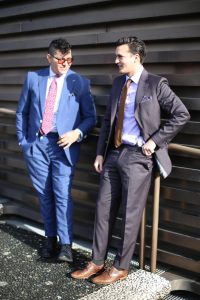
Founders of Giorgio Verdi, Ronnie Green and Giorgi Cuellar

Through the remote nature of Instagram, Giorgio Verdi is able work all over the world without the need for a physical location. This is important since Cuellar lives in Dallas, Texas, and Green lives in San Diego, California. One of the greatest benefits for Giorgio Verdi operating through social media is being able to save money on building a headquarters. This has allowed them to focus on working with clients remotely. Some of their most high-profile clients — and an example of their influence in the online market — are Olympic swimmer, Ryan Lochte, professional skateboarder, Nyjah Huston, the Dallas Cowboys, and various MLS soccer players.

Among the benefits of social media marketing for Giorgio Verdi—the ability to interact with their clients on a personal level. They are able to make impressions on thousands of their followers in their target audience which has also built their success as an online company. 

“You know what, the easiest way to target our direct demographic is not through traditional marketing avenues, it’s directly through social media,” says Green. “When we first started marketing we decided that we wanted to target young new athletes and young professional who are starting at financial firms, guys that are young and want to look good, who wear suits everyday. So, really the only option that we had was through Instagram.”

Giorgio Verdi communicates with clients by searching for young athletes that are moving to new cities, sending them direct messages, promoting their suits and giving discounts directly to those who provide free advertising by posting photos of their newly tailored suits.

Social media marketing is unlike most traditional methods of marketing, with direct messages and the ability to target desired demographics, it’s easy to influence other followers because all the marketing is done in one spot, when a customer posts a picture of a product, they are distributing that content to their friends who fit into similar demographics. It’s essentially a trickle down effect and heavily increases brand awareness.  

“Social media marketing has been huge because it is so intimate and people are taking a chance on us,” says Cuellar. “It has really shown previous clients what we have done, whether that’s celebrities or athletes, it builds a lot of credibility. As a young company it really boosts consumers’ confidence when they can see people that inspire them and can purchase these products right on their phone. We don’t want to be out of reach with our consumers and social media allows us to have a conversation with our customers and really makes them feel included in what we are doing.”

Instagram stories have been a successful marketing tool for companies like Giorgio Verdi by allowing them to show their clients how they create and design products. It also allows consumers to get an honest perspective on how those products are made. 

“With a social media-type business, if you have a product that you are pushing, it’s all about finding who your typical consumer is,” says Chad Hernandez, founder of Cash & Co, a children’s hat company operated online. “Ninety-nine percent of people that follow that person share similar interests. It’s also important to consider your followers, they’re just like people walking in your store, but with social media it’s so easy to catalog and display your work and get your product out in the market.”

Hernandez believes that operating online has several distinct advantages. “I feel like there’s going to be a day and age where there will be no stores. With the rising cost of real estate it’s really an advantage to be purely online and why not cut costs if you can. It’s been huge for us not to have overhead costs and as a small business other companies purchase our products and put them in stores for us.”

Online companies are finding success by cutting costs and focusing budgets on social media while lowering overhead costs, meanwhile stores like Sears and Toys ‘R Us are closing doors for good. The ability to compete in a market where consumer can purchase a wide variety of goods with a single touch is invaluable. Online businesses are paving the way for the future of commerce.

MY LINKEDIN:

https://www.linkedin.com/in/courtland-schwerdt-5463749b/

MY BLOG:

My Reflection Blog

The data in this graph was collected from the U.S. Census Bureau and a Bloomberg Analysis

Courtland Schwerdt: Reflection Blog

MY STORY:

MY BIO:

MY LINKEDIN:

MY BLOG:

Thinking about what I wanted to write about for my enterprise story I knew I wanted to write about something that I’m passionate about and would be informational to my audience. My story centers around two subjects that I think applies to a lot of college students, startups and social media. A critical component for this story is developing interesting leads to interview. I immediately thought about my two best friends that I did summer sales with four years ago. In 2017, they created a startup company, Giorgi Verdi, a custom-suit company that markets purely through social media. Originally my story was going to investigate if the Lassonde Institute and the David Eccles School of Business have incorporated social media marketing into their curriculum. The sources that I wanted to interview are the two founders of the suit company and one marketing director of the Lassonde Institute. When dealing with finding sources to develop my story I really learned about how different sources can affect the development of the story. I encountered a huge obstacle when trying to follow through with my sources. One of the key interviewees for my story was unable to work with my deadline. I was unable to contact someone from one of the business schools, so I had to come up with a third interviewee, fast. Coming up with a different source for my story, totally changed what I was going to write about. I actually think this was pretty cool about creating story because finding a new source changed my story completely. Instead of interviewing someone from the university about social media and its inclusion in the academic curriculum.  I decided to interview another company that operates through social media. I decided to change my story and focus on how social media has saved startups huge costs in marketing and how it has contributed to their success. I also wanted to write about the benefits that a company can have when purely operating out of social media. It was really cool working with what I had developing my story.

Pumpkin Nights Influences the Lives of Artistic professionals

Pumpkin Nights influences the lives of artistic professionals 

Three artists and an event organizer, illustrate the impact that the event Pumpkin Nights can have in the life of an artistic professional

By Tyson Zullo

SALT LAKE CITY — Since 2016, Pumpkin Nights has been an organization dedicated to showcasing local artists via a very unique medium. Pumpkins, (most of them artificial) of all different shapes and sizes are used, not only to showcase the superb talent of local artists, but to create a memorable experience for their audiences. Pumpkin Nights is held in four cities: LA, Auburn, Denver, and Salt Lake City.

“I’ve done a few things building up to this,” says Toby Draper, who became associated with the Pumpkin Nights organization last year. “I’ve done tech jobs before I was an

img_174811

A giant Octopus which is located in “Pirate Land” is being displayed, November 3rd, Salt Lake City, Utah. The artists Toby Draper and Katie Kasen assisted in the production of this artwork.

account executive. Now it’s hard to describe exactly what I do, but it’s definitely more fulfilling,” says Draper. This year Draper participated in the Pumpkin Nights production of the Giant Octopus and both of the Pirate ships.

Being affiliated with Pumpkin Nights has played a significant role in Drapers’ artistic career, “It’s mainly helped me with my creativity, I’ve really learned how people interact with the things that you build,” he said.

Katie Kasen, also became involved last year through her sister Chelsea Kasen who is both one of the founders of Pumpkin Nights. While she was studying at BYU Katie was offered a job to work with the organization, and she decided to take a semester off studying. This year Kasen was tasked with the Styrofoam projects, and the nine foot giant Jack-O-Lynn. “I was able to use so many of my artistic skills, but at the same time develop more, there is so much that they don’t teach you in school.” she said.

This experience inspired Katie to change her major from chemical engineering to graphic design. Since then she was interviewed by BYU radio, and engaged in a freelance project for a local haunted house. “Pumpkin Nights has been a milestone in my career,” she said.

Pumpkin Nights 2 (2)

The Friendly Spider is being displayed, November 3rd, 2018, Salt Lake City, Utah. Artist Katie Kasen assisted in the production of this artwork.

Alysa Orton graduated with a degree in illustration from BYU and became involved with the Pumpkin Nights project via a graphic design internship. “When I was in school I never thought that I would be working on Pumpkins” she said. Orton mainly worked on the owls, and the Day of the Dead sector. Along with working at Trader Joe’s, Orton would work two days a week at Pumpkin Nights, and she relished the experience. “It was really cool to have two days a week where I could be surrounded by a lot of creative people.”

Orton believes her portfolio has been “boosted” having participated in this event. Rather than just drawing, she was given the opportunity to be trained in, and utilize sculpting tools. “I had to learn how to simplify, which is such a big thing in design.”

As an event organizer, Chelsea Kasen has been involved for two years. At first she was seeking to start an event in Manhattan, but then she teamed up with John Tanner, and they decided to create an event inspired by Jack-O-Blaze in New York. Planning this event requires a full year, and before the event ends, the organizers are already planning for next year.

“As the event is going, I am thinking about what other markets we will go into next year,”

img_17551

A Mariachi Pumpkin is being displayed at the “Dia de los Muertos” sector, November 3rd, Salt Lake City, Utah. Artist Alysa Orton assisted in the creation of this artwork.

says Chelsea Kasen. The organization utilizes feedback from participant surveys to develop future plans, and as an event organizer Kasen not only works on the product, but sets up guides for current and future event directors.

The artists who work at this event, possess the skills to implement the vision, however they have never done it on such a large scale. “Working here they are forced to streamline processes, think of better ways to do things, use cheaper materials, and figure out how to make something last for a while,” says Chelsea Kasen.  Not only does Pumpkin nights showcase the talent of these artists, it also focus its efforts on recruiting other industrial design companies such as TEA, a company that specializes in global networking for artists.

img_17141

The main entrance to the event Pumpkin Nights, November 3rd, Salt Lake City, Utah.

Pumpkin Nights is much more than it appears to be on its surface. Artists who engage in the vision of the organization are presented with opportunities that challenge their abilities to think critically, work well with a team, and become more efficient. Pumpkin Nights not only focuses on showcasing local artists but training them as well; helping them reach new heights both in their knowledge and artistic abilities.

It is an unforgettable experience which enchants its audience, and provides the artists an opportunity to truly “do something that is meaningful,” says Draper.

WC: 883

Tyson Zullo LinkdIn


This slideshow requires JavaScript.

Tyson Zullo Reflection Blog

Reflection Blog 

When I learned that the primary mission of the organization Pumpkin Nights was to showcase local artists, I was really fascinated with the idea. It drove me to ask questions such as “To what extent does this organization go, to aid the artists in achieving recognition?” and “How has being affiliated with the organization Pumpkin Nights, benefited the artists?” I began to look at this organization through a new scope, and I was suddenly overcome with a desire to discover the answers to these questions and learn the truth for myself.  I decided to tell the untold story, of how Pumpkin Nights has made an impact in the lives of artistic professionals.

On the website there is no direct number that can be used to contact an event organizer, fortunately however the company does have a section on their Instagram page that contains the contact information of the participating artists. Via direct messenger, I was able to message artists Toby Draper, Katie Kasen, and Scott Hard. I never heard back from Hard, however Draper and Kasen responded immediately, they were very supportive with this story, and they referred me to their fellow colleague Alyssa Orton, and an event organizer, Chelsea Kasen.

I strongly feel that these sources were the best for this story in particular, because they all have experienced the benefits of being affiliated with this organization on a first-hand basis. It was so fascinating how each of the artists were able to provide diverse angles on the story, and have benefited from their association with this organization in their own unique way. The most remarkable thing that I was able to learn while writing this story is, Pumpkin Nights not only strives to help local artists gain recognition, but they also train, and help these artist develop the necessary skills in order to take their artistic careers to new heights.

My Story


Tyson Zullo

 My Story: Pumpkin Nights influences the lives of artistic professionals 0

About Me: Born, and raised in Salt Lake City Utah. I Enjoy, Hiking, Boating, and spending time with my family.

Experienced Guest Services Coordinator with a demonstrated history of working in the non-profit industry. Skilled in communication, analysis, adaptability, teamwork, and critical Thinking. Strong operations professional, who is currently pursuing a Bachelor of Science degree focused in Strategic Communication at the University of Utah.

My Story


Reflection Blog

By Laura Child

The “Me Too” movement and the effect on college campuses

As the Me Too social movement has become more prevalant in the last two years, I thought it would be a great topic to write my enterprise story on. I have become passionate about inequality issues surrounding women’s rights and wanted to learn more about how this movement has effecting women. Our enterprise story was supposed to be tied to the University of Utah so I thought that putting an emphasis on how sexual assault affected college campus’ would be my main focus. I hoped to provide a background on the movement and how it has affected universities and their safety protocols when dealing with sexual misconduct.

In order to find my story content, I wanted to provide on-campus resources, statistics, and personal experiences. I was able to interview some of our campus advocates and understand some of their hopes as sexual assault counselors. By talking to them, I was also able to gain a better understanding of how we can prevent these assaults on campus. Unfortunately, I wasn’t able to interview anyone that had had a personal experience to share with the story. I felt like this was going to be a stretch as this information is so sensitive. There were a lot of different angles I wanted to include within the story which helped shape my story beginning with the history of the movement to how we can improve our own safety at universities.

As I wrote this story, I was surprised by some of the statistics I came across. It has become such a significant issue that is in constant need of safety improvements. I wish I was able to connect with more of the police force on campus and individuals who have gone through their own personal experiences. I felt like I was able to create an interesting, educational piece which has allowed me to be more educated on the issue.

The “Me Too” movement and its impact on college campuses

By Laura Child

https://unewswriting.wordpress.com/2018/12/03/reflection-blog-laura-child/

SALT LAKE CITYThe Me Too movement’s purpose is to help survivors of sexual violence find healing, particularly young women of color from low-income communities. The movement began to gain traction when the MeToo hashtag went viral on social media platforms in 2016. Subsequently, the movement’s goal has evolved to include the expansion of global conversations around sexual assault, and to find advocates willing to share their own experiences and seek justice misconduct.

These shared experiences remind everyone of what it means to be sexually assaulted. Sexual assault is any type of sexual activity or contact that happens without consent.

The social media movement galvanized around the sexual assault case of Harvey Weinstein, but has resulted in many celebrities and individuals coming forward to share their own as victims of sexual misconduct. Men and women have found empowered and healing through sharing their voice and fighting for justice.

 Reports of sexual assaults in the workplace and on college campuses have increased since 2006. Universities have been criticized for a lack of enforcement and measure to protect students from misconduct. The social movement has forced universities to create new procedures, certifications, and resources for their students on campus. According to the National Sexual Violence Resource Center, 20-25 percent of college women and 15 percent of college men are victims of forced sex during their time in college. Unfortunately, more than 90 percent of sexual assault victims on college campuses don’t get reported. Since 2017, however, there has been an increase in the number of sexual assaults reported on college campuses. Many universities have worked to develop campaigns and rallies to help make their students feel safe and heard.

In 2017, thirty-two sexual assault cases were reported to the University of Utah. However, these cases were campus-only reports, which means they didn’t include the off-campus sexual assaults of U of U students, according to the Salt Lake Tribune.

Police Chief Dale Brophy doesn’t believe the school is seeing an uptick in sexual violence; he thinks more survivors are reporting. “More reporting is a good thing,” he says. Following an investigation on how the U handles their assault reporting, the U launched the SafeU website last year in hopes of better supporting their students. The website’s goal is to inform and provide students with several tools and resources. This website allows students to file reports under section IX. The U has also added additional forms of counseling, reporting, therapy, medical services, and police reporting.

 The U has a variety of resources for students who have been victim to sexual misconduct. “The Student and Wellness Centers helps those who have suffered by allowing them to chose the best way of healing from their own trauma,” says Ellie Goldberg, Assistant Director of Advocacy. The goal is to be a students support system by creating a safe, confidential atmosphere.

Survivor advocates, provide resources for students on campus to help heal, provide medical referrals, help financially, inform on legal justice options, or provide free counseling.  “No one should ever have to go through this trauma. If they do, we will do everything in our power to help them heal in a sensitive environment,” says Darrah Jones, one of the Survivor Advocates at the U.

 As members of the university community, it is important to become involved in the prevention of sexual assault campus. The police department at the U has held various bystander certification courses to help inform students, raise awareness, and provide skills to recognize, intervene, prevent and/or stop inappropriate comments, actions, and behaviors.

The U also provides seminars and guest speakers to help inform individuals on how to prevent these situations. ”We must teach our young adults about sexual misconduct from a young age in today’s society. The hard conversations about safe sex, intimate relationships, and social-emotional learning are conversations that can truly make a difference,” said Anita Hill, in a recent forum held at the University of Utah Alumni Center.  

As students and members of the University of Utah community, we can help end gender-based violence on campus by becoming better educated. We must unlearn rape myths, such as the belief that rapes are only committed by strangers or that alcohol can justify sexual assault. Myths like these protect the assaulters and create an environment where survivors aren’t supported. If we are aware of someone who is experiencing this, we can be supportive by believing, listening, and educating. By doing so, we can help guide them to the resources they may need. If this movement has taught me anything, it has made me believe that when we come together and voice our opinions, we can be heard and make a difference.

Word Count: 812

Kyle Lanterman: Reflection Blog

by Kyle Lanterman

My story covers the service exemplified by the Bennion Center on the campus of the University of Utah, as well as the people who are involved. I developed my story ideas by thinking of something relevant to the salt lake community and the campus of the U. Then I realized that volunteering is extremely positive in helping those two communities. I located my sources by viewing the staff on the Bennion Center’s website, and then seeing who would be good candidates for interviews. They turned out being the best sources for me and the right decisions. The only obstacles I encountered was loosing my notes to one interview source. I overcame this by speaking to her again through email, and then making sure the next person I interviewed I recorded on my phone. I made sense of all the information I gathered by feeling the attitude my interview subjects expressed while discussing the work that is done through the Bennion Center. I then made sense of this by telling a story about how that work is relevant to the area of Salt Lake City and on campus at the U. The writing process was lengthy, I learned that I should start writing the day I get the interviews so that the information gathered from them is fresh in my mind. Something interesting that didn’t make it into my story was a student named Katie Barber’s work. She is currently fighting against the drug naloxone in the state of Utah. This is something that surprised me, because I tend to forget about the prescription drug problem in Utah. I think its even cooler that a student is doing so much to help fight against an issue like that. Overall, this story was something that was exciting to cover. I felt a responsibility to accurately write about great work from great people at the Bennion Center.

Exemplary Service Through the Bennion Center

by Kyle Lanterman

SALT LAKE CITY─ Since 1987, the Lowell Bennion Community Service Center has been a valuable resource by aiding the Salt Lake Community. The Bennion Center provides service to others living in the region, with many University of Utah students involved in the process. The mission statement of the Bennion Center reflects that there are strong values rooted within the center such as integrity, collaboration, diversity, engagement, and optimism to name a few. Six office spaces, a conference room, and a few couches constitute the space where students make items for the homeless or construct sustainable gardens. The center itself is extremely small compared to the impact it has on the Salt Lake Community.

The Bennion Center delivers service to address a variety of issues in the community including hunger, homelessness, illiteracy, sustainability, and health care. The people that work to make these areas in the Salt Lake Community better have bought into the mission of the Bennion Center and the work that comes along with it. Not only does the Bennion Center extend its outreach in Utah, but students and staff have done service work in many other areas in the Country. In addition, there are two service trips that are located in Cuba and Costa Rica. The outreach to these areas are inspired by a spirit of wanting to help communities that have people and environments in need. The community of the Bennion Center draws students who have want to take action in service.

unnamed

An infographic depicting the locations of service projects by students and staff from the Bennion Center from the past year. Service projects have dominated the western United States and have gone outside the country in Cuba and Costa Rica. Graphic creation credit to nationalgeoraphic.com

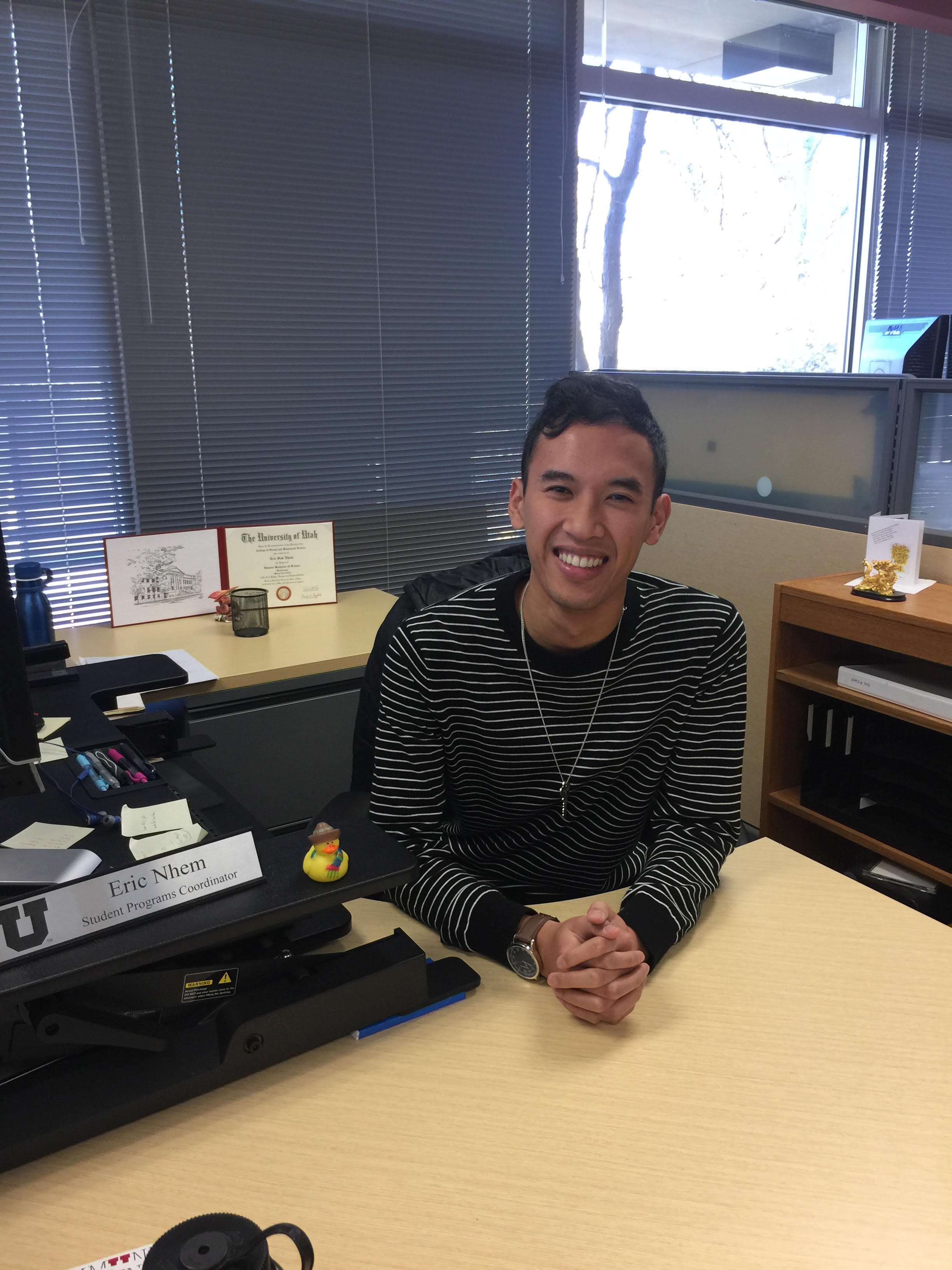
“So I was kind of involved with volunteer work in high school and wanted to continue doing volunteer work in college,” says Eric Nhem, a 22-year-old University student from West Valley City and Bennion Center volunteer. “My friend texted me one day and sheasked if I wanted to do this thing through the Bennion center,” Nhem continued, “I said what the heck is the Bennion Center?”

Eric

Eric Nhem, 22, a student programs coordinator the Lowell Bennion Community Service Center. Nhem hails from West Valley City and works with students to fulfill their needs for service projects. Photo courtesy; Bennion center website.

That “thing” turned out to be a once a month assignment with Project Youth, which helped Title I students learn about higher education. Nhem eventually became the director of Project Youth after two consecutive years of volunteering with them which lead him to become a student programs coordinator with the Bennion Center. Nhem’s role is vital for the Bennion Center and the work that is done there.

“Basically, my job is to coordinate with students about service projects they wish to participate in and then guide them about what needs to be done. For example, what resources they might need or who they need to take talk to,” says Nehm. “Those two areas are usually what needs to be tackled first in order for the projects to get going.”

Regardless of who needs to talk to who or what the students need, there needs to be a level of optimism brought to the table. This sense of optimism is needed for student run projects to flourish and along with enthusiasm for the service to continue. The students  display optimism in their work and and are enthusiastic about it every day and those elements are what brought Nhem to the Bennion Center originally. 

Bennion Center

The bulletin board located outside the Bennion Center, with the main sign in the background. The Bennion center is located in room 105 in the Union building on the campus of the University of Utah. The center specializes in volunteer work in areas such as hunger, sustainability, homelessness, literacy, and healthcare. Photo credit: Bennion center staff.

“I fell in love with one program that had a mission I believed in,” Nhem stated.

Believing is something that holds the Bennion Center together, as communications specialist, Jennifer Jones, will attest. As the communications specialist, it is Jones responsibility to make other aware of the great work being done at the Center.

“My job is awesome because I get to brag about all the fantastic things students are doing here!” says Jones, and there is no shortage of work to be discussed. “Just the other day we had a group of students ironing plastic bags to make beanies for hospitalized infants and sleeping mats for the homeless. That is the kind of stuff that tends to take place in the Bennion Center on a day to day basis.”

Jones is particular proud of the people she works with. “What motivates me to do my work is everyone who is involved with the Bennion Center. We have so many students from a plethora of backgrounds who are passionate about their work,” she says.

rsz_more_primary

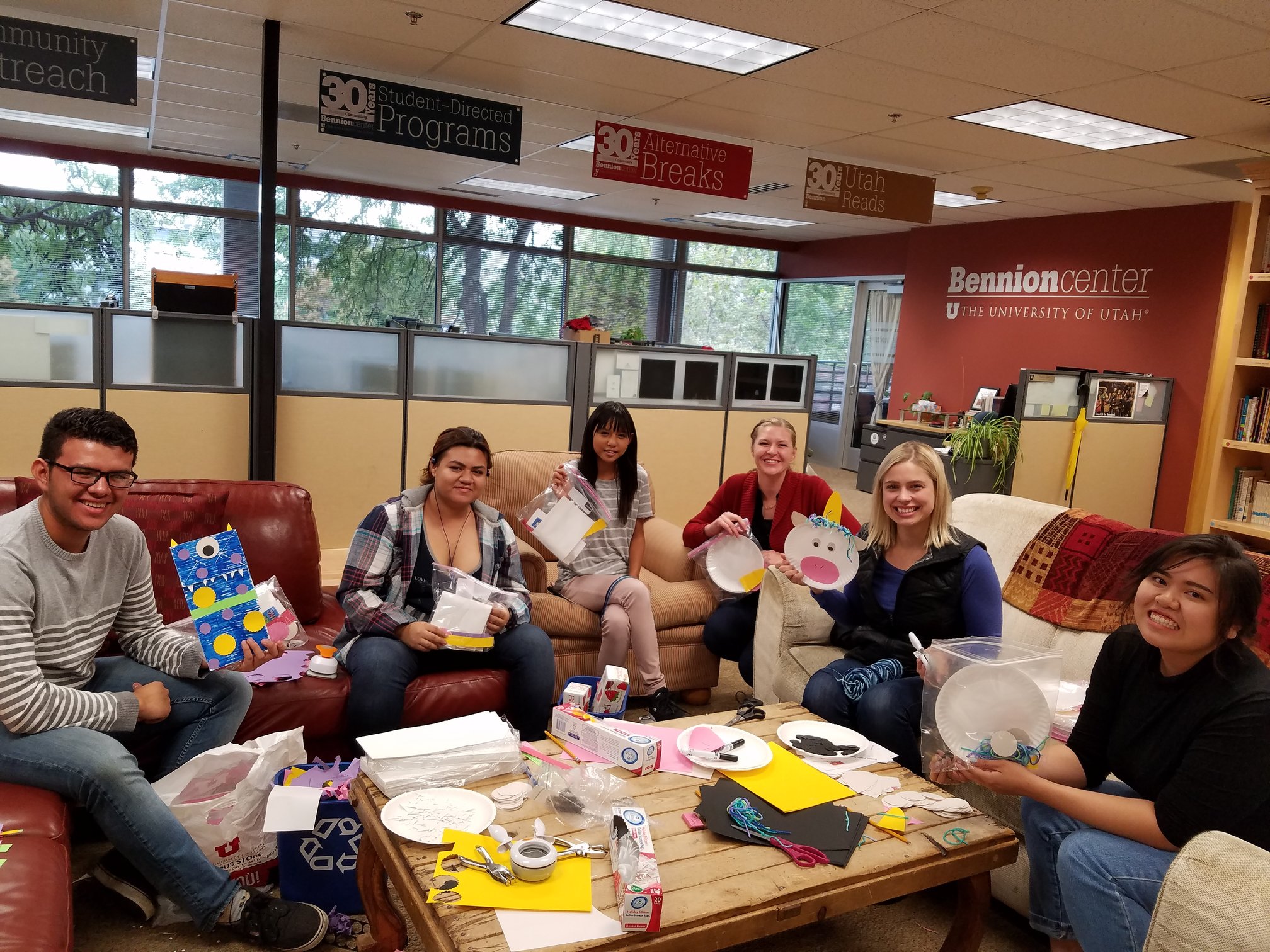
Students collaborate as they construct arts and crafts for the Primary Children’s Hospital in the Bennion Center. The center specializes in volunteer work in areas such as hunger, sustainability, homelessness, literacy, and healthcare. Photo credit: Bennion center online blog.

On a given evening, the Bennion Center is bustling with activity. This night, students sit on couches and huddle around a coffee table discussing their current work and planning out future projects. Nhem and Jones have their own workspaces where they speak to students or other parties about current or future projects. What goes on in the Bennion Center on a day to day basis continues to change the Salt Lake Community in a positive way.

The mission of the Bennion Center is “to foster lifelong service and civic participation by engaging the university with the greater community in action, change and learning.” This mission is being accomplished routinely through the meaningful work by students at the U with the help of staff members such as Nhem and Jones. Lifelong service is being given and will continue to be given as long as the belief in projects exists along with the drive to help others and make the local community of Salt Lake City a better place.


This slideshow requires JavaScript.

Hale Centre Theatre’s new updates are raising the bar for Utah performing arts

By Amy Boud

SANDY, Utah — The changes made to Hale Centre Theatre’s location, budget, and casting starting November 16, 2017, have increased the size of Utah’s footprint in the performing arts world and opened up job opportunities for aspiring performing artists.

Hale Centre Theatre (HCT) is a long running performing arts theatre company in the Salt Lake Valley. The theater’s founders, Nathan and Ruth Hale, opened the doors of their first theater in 1947 in Glendale, CA, to just six patrons. Now their legacy lives on in their home state of Utah through a theater that has become one of the nation’s longest running.

The Hale’s grandson, Mark Dietlein, serves as the CEO and executive producer of HCT. On November 16, 2018, Dietlein released a statement to celebrate the first anniversary of HCT’s new location in Sandy. “Our two new theaters are filling to capacity on a regular basis and we have added over 70 additional performances in this first full year,” he said in this statement.

“By the end of this year, our regional, non-equity professional theater company will have staged 800 performances over 10 productions.” According to the same press release, since opening the new Sandy location, HCT has grown from 280,000 to 540,000 patrons and is now one of the highest attended theaters in the nation.

IMG_8625

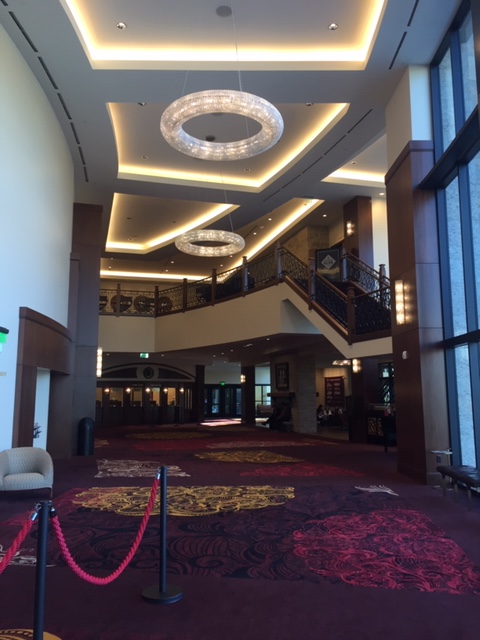
HCT Front of New Building

“The public’s support has been breathtaking!” said Sally Dietlein, HCT vice president, and executive producer. “We would not be here today if not for the community’s love and demand for well-produced, innovative, family-oriented theater. We are incredibly grateful to our patrons, sponsors, elected officials, HCT board, amazing staff and performers for helping make our first year in Sandy a positive experience that has exceeded our expectations.”

IMG_8636

HCT New Building

In Fall 2017, when long-time HCT patron Christian Winder attended Aida, he was amazed by the new updates and was excited to see if the new theatre would contain the same charm as the old West Valley location he had come to love.

The new theatre lived up to expectations. Winder said he was delighted to see some new additions that enhanced the audience experience such as the new screens surrounding the top of the theatre that are used to expand the perceived space and mood of the show.

IMG_8627

HCT Poster of The Scarlet Pimpernel starring Dallyn Bayles

IMG_8626

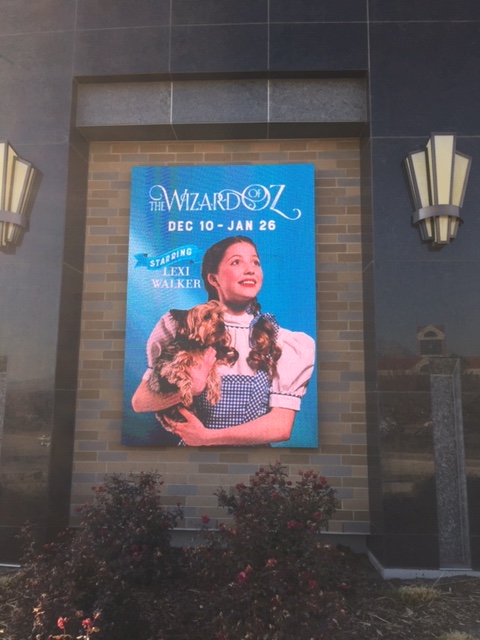
HCT Poster of The Wizard of Oz starring Lexi Walker

There are many reasons behind the rising patrons numbers beyond the new building and fancy decor. With the new donor budgets, HCT is able to hire higher caliber and more popular actors. For example, Utah sweethearts, Dallyn Bayles and Lexi Walker, appeared during the 2018 season and have brought with them additional advertising through posts about HCT on their personal social media platforms.

HCT also selected plays for the first season that have shown well in the past. Shows like Aida, Newsies, The Scarlet Pimpernel, and The Wizard of Oz are just a few examples of successful plays specifically selected to kick off the opening season of the new building.

In addition to the 900-seat, 10 row theater-in-the-round Center Stage Theatre, HCT built a smaller, 467-seat theater called the Jewel Box Theatre (JBT). The JBT has a proscenium thrust stage, a traditional rectangular shaped stage with one end open towards the audience and the other ends leading backstage.

The extra stage has allowed HCT to produce two shows at once, a first in the theatre’s history. This way HCT can expand their repertoire to support lesser-known artists, musicals, plays, or interactive shows that require a smaller space, all without losing any revenue from having to reserve the larger stage. This has expanded opportunities for local artists, playwrights, and production teams.

IMG_8638

HCT 2018 Season

Naturally with two stages, HCT must now also hire more performers.  “This growth has made Hale Centre Theatre the largest theater employer in the state, with 62 full-time and 150 regular part-time employees and 500 paid actors,” said Dietlein’s press release, “compared to 40 full-time and 75 part-time employees and 300 paid actors in 2017.”

Working in the performing arts has always been difficult for people who need a consistent income. “There are definitely more opportunities in Utah than there used to be and that’s exciting,” said Katya Wagstaff, a current student at the University of Utah double majoring in Musical Theatre and Communication. As a performer, Wagstaff has dreamed of making her career on the stage but said that any actor in Utah needs a day job as an acting teacher or private coach just to find some financial stability.

HCT is opening up some room for performing artists to grow more in their chosen field without having to leave the state for work. “I definitely want to work at HTC someday when I’m not a student,” Wagstaff continued. “Two theaters gives more job opportunities!”

HCT Info Graphic

This slideshow requires JavaScript.

Trevor Hofer-Blog

By: Trevor Hofer

My Story: Poor air quality continues to be an issue for residents of Salt Lake City

My first choice of what I wanted to do my enterprise story on was the American Football Association team starting here in Salt Lake City. However, finding sources for this story proved to be too difficult to find and to get a hold of. My next choice for my enterprise story was the poor air quality in Salt Lake City. The reason why I chose this as my enterprise story because I have lived in Salt Lake City my entire life and have dealt with this my whole life. Everyone to whom I talked about with this was always complaining about the air quality, and so this led to me being curious about how the city has plans for improving the air quality.

I first looked at the department of environmental quality for the state of Utah to see what they have planned for the air quality for Salt Lake City and what were their plans for improving our air quality.  I also chose to look at the American Lung Association because the air quality affects our lungs and one of the articles which I read mentioned the American Lung Association. I then decided to reach out to one of their experts to see how poor air quality can affect our health. One of the main things that I found most surprising was that how much of an impact the pollutant particles and the ozone can affect our health especially our lungs. I would suggest that one would study up more about this topic because us as residents of the state of Utah we should care about the environment. We should treat the world like our health, and we all desire to be healthy. Therefore, we should want the same for our city.  It is crucial to look at the programs and regulations that the DEQ has set out for us to improve the air quality.

Poor air quality continues to be an issue for residents of Salt Lake City

DSC_0571

By Trevor Hofer

SALT LAKE CITY—Poor air quality has been an issue for citizens of Salt Lake City for many years. The time of year when air quality is at its worst is December through February. During this time, residents must deal with inversion. Weather Questions, a website states, “inversion acts like a lid, keeping normal convective overturning of the atmosphere from penetrating through the inversion.” This definition explains that inversion contains various air pollutants which cause bad air quality to stay trapped within the valley and breathed in by the population.

Although Salt Lake City’s air quality has improved, the air quality is still ranked as the sixth worst in the nation by the American Lung Association. The American Lung Association gave the Salt Lake Valley an “F” in both the amount of particulate pollution and in the ozone. The American Lung Association based their ranks on two factors, particulate pollution, and ozone. According to Dictionary.com particulate pollution is “pollution of an environment that consists of particles suspended in some medium… [it] is a mixture of solid and liquid droplets floating in the air.” Particulate can affect every person in Salt Lake City, but those at higher risk according to the National Park Service website are those with heart and lung diseases, diabetes, asthma, and children.

The other factor that the American Lung Association bases their rankings on is ozone. According to AirNow, ozone can either be good or bad depending on where it is located. “Good” ozone is found 6 to 30 miles above the Earth’s surface where it protects us from the sun’s harmful ultraviolet rays. Bad ozone is near ground level and forms “when pollutants emitted by cars, power plants, industrial boiler, refineries, chemical plants, and other sources react chemically in the presence of sunlight” creating bad breathing air. The Center for Disease Control and Prevention states that ozone has linked poor air quality to adverse health effects such as with some being chest pain, coughing, throat irritation, wheezing, and trouble breathing during outdoor activities and exercise.

Peter F. Vitiello, an assistant scientist in the Environmental Influences on Health and Diseases group who is also a member of the American Lung Association, stated that “poor air quality is hazardous and is something in which we should not take lightly.” Vitiello suggested that we should try to keep the environment healthy as we would want our health to be.” As mentioned, many factors play a part in the poor air quality that is affecting the residents in Salt Lake City. Liberation News states one of the primary sources causing a significant decrease in safe air quality is the five oil refineries owned by Chevron and Andeavor. Also, mining operations in Salt Lake City also attribute significantly to poor air quality.


DSC_0583

Burning wood is one of the causes of pollution. The DEQ has put out regulations on how much and when you are able to burn wood

The Department of Environmental Quality (DEQ) mission is “safeguarding and improving Utah’s air, land, and water through balanced regulation.” The DEQ has a department solely focused on Utah’s atmosphere and is continuously looking for ways they can improve the air quality of Utah. They also have many other apps where we can view how the air quality is today and have also set up a few regulations by which we should live. Some of these suggestions are to turn your key, be idle free, travel-wise, conserve energy and use a shovel rather than a snow blower. These are just a few suggestions by which we should live to improve our quality of air.

DSC_0307.NEF

Cars are one of the leading causes of pollution at 50-55 percent for the Salt Lake Valley

Beau Call from the DEQ said that “they have a rule called the water heater and they suggest that the water heater when you buy a new one should have low oxides of nitrogen level.” Call also stated that, “they have an Air Quality board which listens to the suggestions from the DEQ and decide if this is the best path for better and cleaner air.”  They are also trying to put regulations on industries on how much they can produce. According to Call, “the major industry only attributes to 17 percent and cars produce 50 to 55 percent 25 to 30 percent are from buildings and homes. So the cars are the main issue; therefore, the newer cars are improving, and they are producing cleaner gas to minimize the pollution.” Call suggested that if we could use electric cars, it would vastly improve the air quality.

pie chart pollution

Stats from Beau Call about the causes of pollution.

Salt Lake City has taken a few steps to improve the air quality and to lessen the carbon footprint. Liberation News claimed that the first step was back in the year 1999 where the first electric TRAX light rail line was made available to the residents of Salt Lake valley. The DEQ also has a  few incentive programs and they will pay you to switch you to a new heating device that will be cleaner for the air quality; for example, if you have a wood stove. We have plenty of cleaner resources around us that we need to use rather than sit idly by. If we do these things that the DEQ has suggested, we will be able to create a better environment and we will be able to live healthier lives.


This slideshow requires JavaScript.

Nicholas Gruet: Reflection Blog

Reflections on A little side hustle never hurt nobody.

By Nicholas Gruet

When I was given this assignment, the first thing that came to mind was reselling. It’s an easy side hustle that anyone can do. All you have to do is a little research about what’s hot and what’s not and then buy and resell it later on down the road.

When locating my sources, I immediately thought of my friends. Many of my friends make all of their money reselling trendy items. My friends would bring first-hand knowledge to the story and how they got into the business. This would ultimately bring credibility to the story.

Continuing on with my story, I never came upon a problem. It was fairly easy to get in contact with my friends and get them to do an interview with me. The interviews were great and I was able to gather a ton of information. It was tough deciding what angle to attack this story from and in the end, I decided to make it a story about how college students can make a little side cash with an easy hustle.

The writing process was fun. I was able to write a story that I had much interest in and it was pretty easy to make the longer word count.

An important detail that didn’t make it into the story is that the majority of the items that you buy and resell are going to be about pop-culture. So, having a broad knowledge with pop-culture will help you decide what will sell best.

Overall nothing really surprised me in this story. I have been around reselling for many years and understand how it works. It was just really awesome to share something that interests me on my blog.

Reflection Blog-Kennedee Webb

Reflection Blog:

Scooting around Salt Lake City, the debate over the Lime and Bird Scooters

Scooters have been a big presence among this past year. I have seen them everywhere within the Salt Lake City downtown area and always wanted to try one out. When trying to come up with a story idea, I was walking around campus of the University of Utah and almost got hit by one of the riders who was riding throughout campus.

Then the idea came to me, to talk about the safety of scooters and whether they should stay or go. So I decided to contact the city, and talk to the director over transportation of Salt Lake City. I thought talking directly to the city would be a good source. I learned that overall the city is approving of the scooters. I then decided to interview one student who was supportive of the scooters and one businessman working downtown who is against the scooters. I wanted to see their opinions, so I could get some real life opinions about the scooters and their safety.

I already knew the direction I wanted to take with the story, so after gathering the interviews I knew they would fit in perfectly with each section of the story. The writing process went well with the story, it was a good flow and easy to connect the pieces. The most surprising aspect of the story would be how supportive the city and schools are of the scooters considering the safety issues that have been of concern.

Overall If I was asked whether I was supportive of the scooters, I would say yes. I think that the safety issues are being addressed and it is a great way to transport through the city and schools in a friendly environmental stance.

Link to story:

https://wordpress.com/post/unewswriting.wordpress.com/9710

Nicholas Gruet

MY STORY:

Nick Portrait

Nicholas Gruet, 21, junior, from Ogden, Utah. Currently pursuing a degree in Strategic Communication with a minor in Business.

MY BLOG: Earning easy side cash. 
ABOUT ME: I am a junior at the University of Utah majoring in Strategic Communication and minoring in business. I currently have an internship with the Utah Athletics office working with their sports information directors (S.I.D.). In this I cover Utah cross country and track and field, as well as write player features for the mens football team, basketball team, and women’s basketball team. I am an avid sports lover who loves to be active and outdoors. My favorite sports are basketball, baseball, and golf. I played all three of these sports in high school at the varsity level. Basically, my world revolves around sports and I wouldn’t want it any other way.

LinkedIn

Shane Bryan

IMG_7297My Story: Biking into the Future with Bike Utah

My Blog: Reflection Blog

About Me: Originally from New Hampshire and now a Senior at the University of Utah studying Strategic Communication. Currently Marketing Director for the University’s mountain and road bike team. Always on the move and seeking new challenges. In the future, a dream job would be marketing in the mountain bike or auto industry.

Check out my LinkedIn here

Shane Bryan Reflection Blog

By: Shane Bryan

IMG_7515

Photo by: Shane Bryan

I felt the need to write, “Biking into the Future with Bike Utah,” because it was a topic that I cared a great deal about. Coming from a small town on the East Coast and moving to Salt Lake opened my eyes for the need of safe ways for people to travel via bicycle. Where I come from, there were no such thing as commuting by bike so I was never exposed to all the things required to do so safely. I personally never wanted to ride on the roads with cars, however, in the last few years I have grown increasingly confident due to the infrastructure around Utah’s cities.

I decided to write this piece to educate both cyclists and car drivers that riding bikes is a form of transportation as well as to shed light on the work organizations do to put infrastructure in place to make it a safe environment for everyone. I contacted Bike Utah, an advocacy group for cycling, to understand how they help educate cyclists as well as take part in advancing cities and towns to better promote bicycle riding. After I spoke to one of the organizers of Bike Utah, I sought out a cyclist using one of the bike paths to see his opinion of the current bike lanes, traffic patterns and maybe what he does to stay safe on the road.  Lastly, I wanted to end the piece with some tips for people who commute or plan to commute by bike, and present ideas that could help them stay safe on their daily ride.

I hope this piece shows that bicycle commuting can be awesome, safe and rewarding if done right. People opposed to sharing the road with cyclists hopefully can see that bike riders are not lawless and abide by rules of the road. With the current and  future improving infrastructure, bikes and cars will be able to peacefully co-exist. 

A little side hustle never hurt nobody

By Nicholas Gruet

SALT LAKE CITY – College students normally don’t have a lot of money, and what money they do make goes straight to paying for college tuition. With a side hustle, students can make the money to go out and enjoy themselves during college.

Introducing the world of reselling — fashion, hype, and trendy products — the “side hustle.” It may sound silly at first, but the people doing it, known as “hypebeasts,” are smart, savvy, and can talk a customer into buying almost anything. It is so simple that kids from high school are making thousands of dollars a month reselling trendy items.

Initially, it wasn’t all about Supreme, Bape, Yeezy’s, and all of those other trendy brands that have taken over the reselling business. Air Jordan sneakers were among the first products to resell. Why? Because Jordan changed the game of basketball and brought a new swagger to the game. He was fly and tons of people wanted to be like him … like Mike. Over time Jordan grew into a lifestyle and eventually into a business. Demand for Jordan sneakers was at an all-time high. Every time there was a new pair 

afd08f34754ae7cd4c9f13e123f8ada1

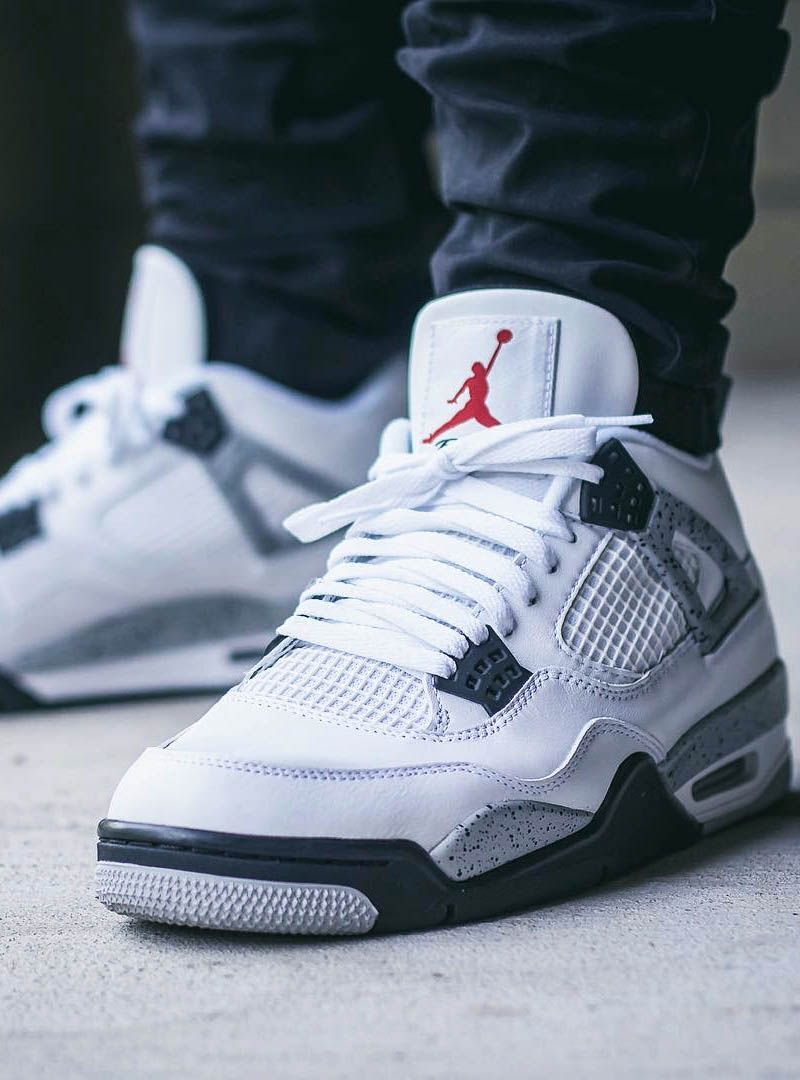
White cement retro 4 Jordan’s. One of the most coveted shoes on the market.

 that dropped everyone had to have them. There was a limited supply at each store, so they would tend to sell out fast. Some recognized an opportunity in the demand and began selling the sneakers for three times their original price. Why would anyone buy those sneakers for that outrageous price? These shoes represented a lifestyle that brought a community of people together. They represented memories and in some cases, they determined whether or not you had some extra cash.

See, many people couldn’t afford to buy shoes or even buy them for the resale price, but because they were so special, people saved up to make sure they could grab a pair of fresh Jordan’s.

 Mike O’Brien has first-hand experience with reselling and is a manager at a sneaker store named Finish Line. For O’Brien, sneakers have been a way of life. They are what makes him happy and what he likes to spend his money on. Sneakers are a big part of who he is and has grown to be.

Mike

Mike O’Brien holding a pair of Space Jam retro 11 Jordan’s.

“When I was little I loved the game of basketball,” says O’Brien. “Jordan was like my idol and I wanted to be like him. I always thought the shoes were cool looking and I wanted to have every single pair.”

As he grew up, he saw the opportunity at a young age to make a little money with his passion for sneakers.

“I used to camp out all night back in high school for a pair of some fresh Jordan’s,” he says. “It didn’t matter if it was a school night or if I had a test the next morning if there was some fresh Jordan’s about to drop then you already know I was going to be there.”

Today, reselling has shifted more to the fashion side of things. With brands like Supreme, Bape, Off-White, and many more, these companies are creating products that are desirable to people. The hype of these products and what it means to own them, drives the resale price sky high. Especially when these companies team up with a high fashion brands like Louis Vuitton — those resale prices are insane, and the profits, impressive. 

Supreme X LV

Supreme x Louis Vuitton backpack.

Just like a business, it takes dedication and time to build credibility as a reseller. It requires a clientele, research to avoid wasteful products that won’t resell at a high value, and some finesse. Finesse, is perhaps the most important of them all — the skill to use words in a way that convinces people to buy, what to buy and who to buy from. Jack Zhang, is interested in fashion and has become a successful local reseller.

Jack Zhang

“Fashion is one of my passions. I love looking and feeling fresh with some of the most exclusive clothing items on the market,” say Zhang. “Once I learned more about the business of reselling I was hooked. Buying these hyped up products and selling them for double, triple, and sometimes even quadruple the price is something you can’t pass up.”

The side hustle is easy; show up, buy it, and then resell it once all of the items have sold out. Soon there could be a nice little cash flow. Sometimes, a patient buyer who holds onto items for a year or so can make even more money. With Supreme products, a buyer who purchased 25 percent of the 149 items released in a year could pocket a profit of $10,000. Now that, is some serious cash, especially for a side hustle.

Reflection Blog

This slideshow requires JavaScript.

Curing homelessness with a focus on the individual

Story and Photos By Clara Welch

SALT LAKE CITY — Salt Lake City has been striving to relieve the burden of homelessness and make downtown safe. A 2017 study found 2,876 homeless people across Utah — 1,804 people in Salt Lake County alone.


IMG_0896

Rio Grande area has a high population of homeless and has been the center focus of efforts to combat these numbers in Salt Lake City. (Photo by Clara Welch)

Operation Rio Grande — Salt Lake City’s initiative to address homelessness along the Wasatch Front — has three phases focused on reducing crime, helping those with mental illness or addictions, and finding employment and housing for individuals. Improvements have been seen from these efforts and are expected to continue.

IMG_0900

A homeless man sits on a bench trying to stay warm on a chilly morning. Other people were walking around or sleeping. (Photo by Clara Welch)

Utah has been using a Housing First model since 2015.  Housing First departs from the traditional ideas that people need to be sober and employed before they can be given a basic human necessity. Finland and Japan have adopted this method and have very low numbers of homelessness. The success rates vary, depending on how you analyze it, from 40-80 percent of those being housed remaining housed. They are encouraging numbers from a tactic that focuses on the person as a human being, not as a burden.

Organizations all across the Salt Lake Valley are striving towards the same goal as Operation Rio Grande, providing multidimensional help from medical to social needs. Community efforts are changing the care that is provided, bringing the humanity back into relieving the burden of homelessness.

IMG_0913

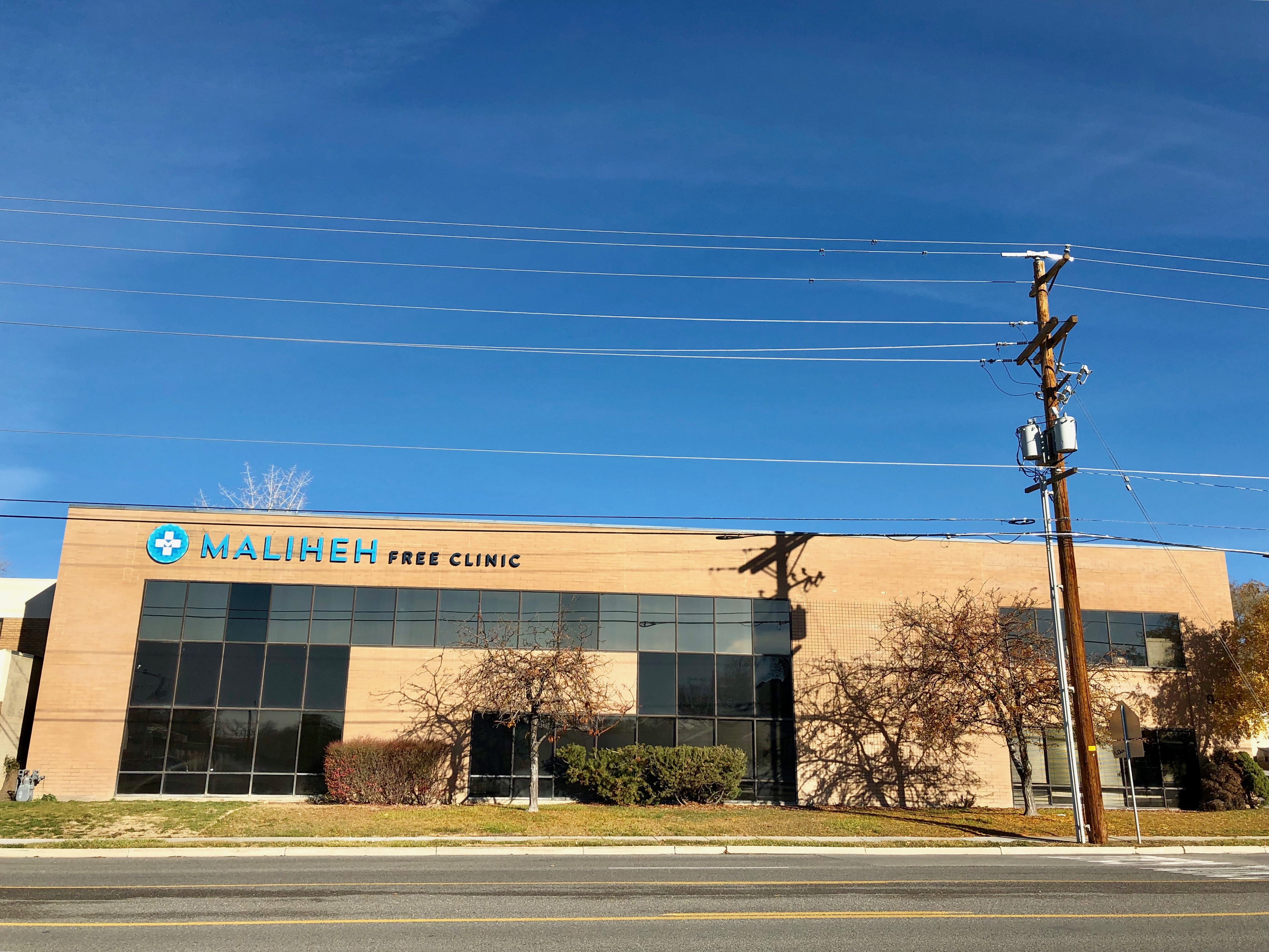
Maliheh Clinic is a free clinic serving those who earn less than 150 percent of the federal poverty standard. They offer multiple services, focused on providing quality healthcare no matter the ethnicity, religion, gender, or sexual orientation. (Photo by Clara Welch)

Maliheh Clinic

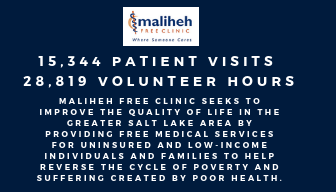
Maliheh Clinic’s mission statement and numbers for 2016. (Photo by Clara Welch)

Collin Hoggard, a student at the University of Utah, volunteers at the Maliheh Clinic. Hoggard explained how the Maliheh Clinic, “started as a way to reach out to the uninsured people in Utah.” It’s been serving patients who earn less than 150 percent of the federal poverty guidelines since 2005.

In 2016, Maliheh had 15,344 patient visits and 28,819 volunteer hours served. Providing preventative care, the Maliheh clinic reduces the burden that emergency rooms and hospitals experience with patients coming in with easily prevented emergencies.

Hoggard is a Spanish interpreter and accompanies patients on routine visits to therapy sessions. “It’s been amazing to connect with the patients,” says Hoggard, who sees real people with real needs. It has changed the way he sees those in different circumstances than himself. 

IMG_0902

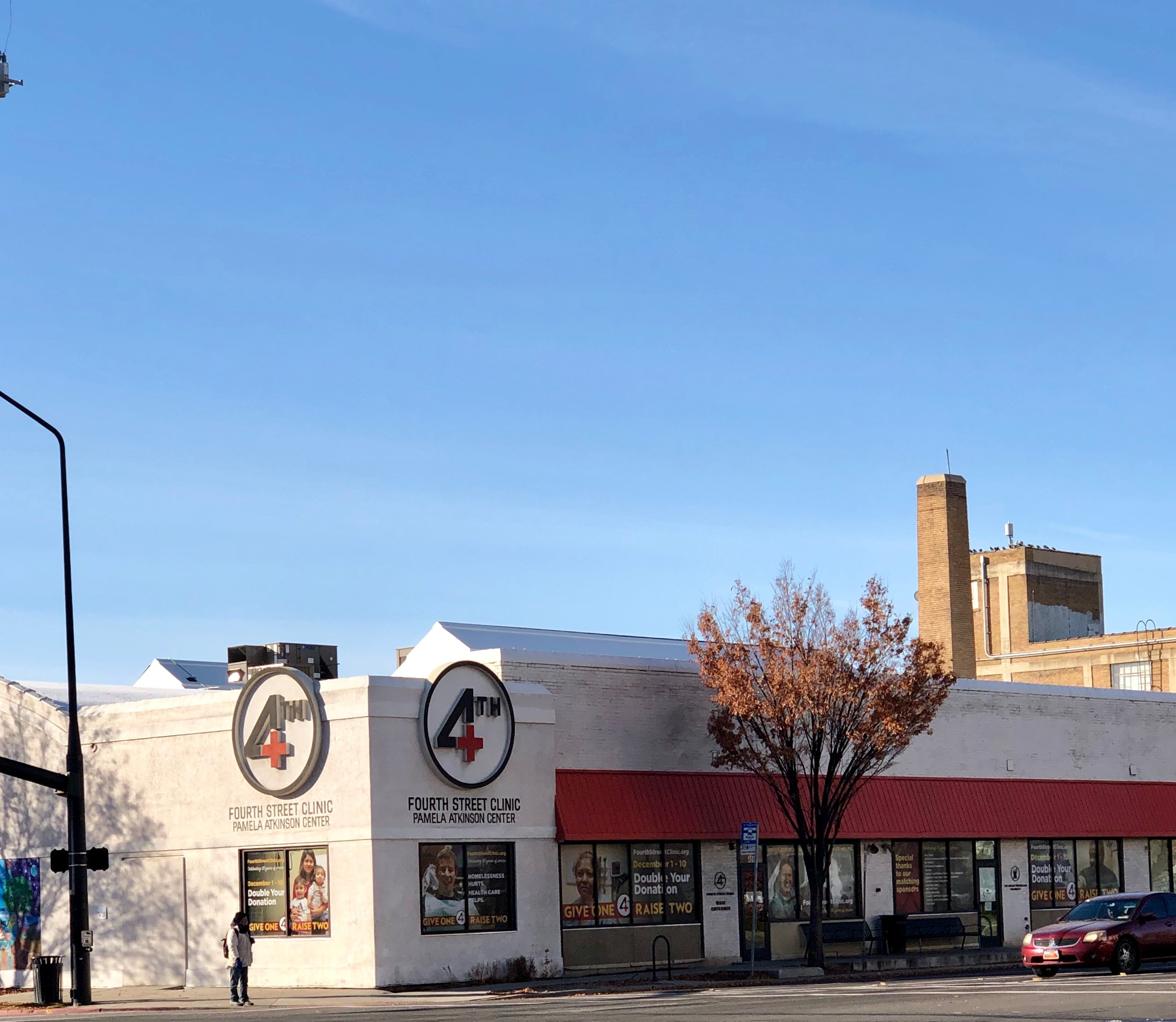
Fourth Street Clinic has been serving homeless patients since 1988 and was moved to this location in the early 90s. (Photo by Clara Welch)


4th Street Clinic

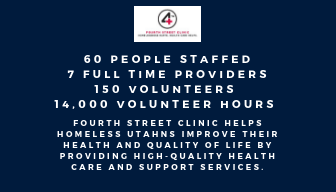
Fourth Street Clinic’s mission statement with their number reports for 2017. (Photo by Clara Welch)

Like the Maliheh Clinic, the Fourth Street Clinic provides free healthcare and is located near Rio Grande. It’s a convenient location for many of the homeless people located downtown. The Fourth Street Clinic has a staff of over 60 people, including 7 full-time healthcare providers, and 150 volunteers providing over 14,000 hours of volunteer service. James Jarrad, Development and Communication Manager at Fourth Street Clinic, explained that the network of donors, volunteers, and staff bring quality healthcare to 5,000 yearly patients, who otherwise, would have none.

Jarrad visits with real patients who share their stories for the clinic website. “Becoming homeless can happen to anyone and for almost any reason,” he says. “There are so many different things to get to where you are in life and they can add up to either completely build your life up or tear it down,” Jarrad explains. “Sometimes you have no control, sometimes it’s within your control.”  

 Jarrad emphasized that, “homelessness is so much more complex”, than what the general public might think.

Connect2Health

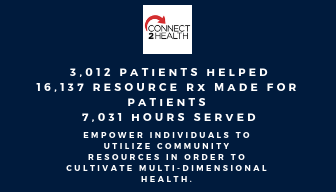
Connect2Health’s mission statement with their number reports for 2017. (Photo by Clara Welch)

Connect2Health is a non-profit, student-run organization with a mission to “empower individuals to utilize community resources in order to cultivate multi-dimensional health.” By enlisting eager students, Connect2Health strives to connect patients with the resources they need to get back on their feet.

Focusing on needs other than medical, Connect2Health volunteers work one-on-one with patients at multiple locations. Volunteers can be found at Fourth Street Clinic, University Hospital, Primary Children’s, and the Wellness Bus. Connect2Health is creating a new norm by sending patients out with not only prescriptions, but resources including food, clothing, child care, and degrees.

Knowing that help is available is empowering to homeless and low-income individuals, but volunteers are impacted in a powerful way as well.  “It really helps to break down bias, develop cultural sensitivity, and develop empathy,” say Alexis Lee, Director of Connect2Health.

Volunteers work with individuals, who right now, happens to be homeless, says Lee, but it is important to see these people outside of their immediate circumstances. Connect2Health engenders empathy and understanding for these individuals, Lee says. 

Helping the homeless is more than just making downtown safer, it’s about seeing people for who they are. Operation Rio Grande addresses part of the issue of fixing homelessness, but it is organizations like Maliheh, the Fourth Street Clinic, and Connect2Health that fulfill the bigger picture and long-term needs.

What keeps these organization going are the volunteer hours. Donating time and spare items can make a difference in another human’s life. Homelessness is a multi-dimensional issue. A combined effort from the state, city, organizations, and individuals will help lift people from the burden of homelessness and be seen as fellow human beings with just a different set of challenges than you.


This slideshow requires JavaScript.

Araceli Haslam

Processed with VSCO with kk1 preset

MY STORY: The aftermath of passing Proposition 2 in Utah.

MY BLOG

ABOUT ME: I’m currently a student double majoring in Strategic Communications and Fine Arts with an emphasis in photography at the University of Utah. I have an extensive background in media including video, film photography, editing, and alternative photo processes. I have directed and produced several short films. My short documentary, A Wealthy Diagnosis, won Best Student Documentary at the IFF in Burbank, California. During the 2017 legislative session, I worked with Senator Jim Dabakis, producing short videos for him on different legislature topics.  I spent a month and a half in Costa Rica volunteering in a cultural immersion program called Amigos de las Americas. Salt Lake City is my home and I’ve embraced our beautiful nature since I was a child. I learned to ski the second I learned how to walk.

Linkedin Profile

Trevor Hofer

Wedding picture

My Story: Poor air quality continues to be an issue for residents of Salt Lake City

My Blog: Trevor Hofer-Blog

About Me: Trevor Hofer was born and raised in Salt Lake City, Utah. Trevor is a student at the University of Utah. He is currently studying at the College of Humanities he is majoring in Strategic Communications and as well will be minoring in Business Administration. His goal after college is to pursue a career in marketing. Some of Trevor’s hobbies and activities that he enjoys participating in are photography, watching and playing sports.

 LinkedIn

Clara Welch’s Reflection Blog

Clara Welch

I spent a full year volunteering 10 hours a week with homeless and low-income populations at the University Hospital and Fourth Street Clinic. The concerns, realities, and needs of these people became very real to me. Trying to figure out a story for this project was hard and I went through a few ideas for it. This idea wasn’t even one of the two stories I pitched earlier in the semester. The idea came from another student. When she was talking about her idea to look at Operation Rio Grande, it hit me that I have a lot of personal experiences and feelings towards the things going on.

Figuring out that this is what I wanted to write about was easy, but it was hard to know what direction I wanted to go. My research began with learning more about Operation Rio Grande. Utah actually has done some things in the past that have brought national recognition when it comes to helping homeless. One of those thing is “housing first”, which I talk about in the article. Then I needed to get my interviews done, but was still unsure the direction.

My interviews were all exactly what I needed. The questions asked were general questions, but the conversations went to places that formed my story for me. It reminded me of the things that I had learned when I volunteered with these people that I came to really know.

Sitting down to write Curing homelessness with a focus on the individual, the ideas came once I had everything that I needed. It’s a cause that means a lot to me and ideas that I believe are most important in everything that you do.

Kate Pekuri: Reflection Blog

MY BLOG: 

For my enterprise story, I chose to write about the University of Utah Alumni Association after becoming more involved over the course of the past semester. As I became more involved, I was exposed to a plethora of opportunities and resources for current students that I had no idea about, so I thought I’d share some of the things I’d found.

Since the Alumni Association is located right on campus and part of the University of Utah, it was very easy to find sources from the office. I feel like when people already work for the U, they feel the need to give back and help students further their education. As for finding alumni sources, I just asked friends if they knew anybody that could help me out, which turned out successful. I feel that these were the best sources for my story because they demonstrate each step of the transition from student to alumni.

After gathering information, I tried to put it in perspective to write a story that the audience would be interested in. As a current student, I felt as though other students would be most intere

sted in the AlumniFire program, since we all have the constant fear of finding a job looming over our heads.

While writing this story, I really saw how tight knit the University of Utah community is and how students and alumni are constantly willing to help each other out. It’s been really cool to be a part of something so much bigger than myself.

MY STORY

ABOUT KATE PEKURI


Kennedee Webb

2015-09-29 17.54.34 (1)My Story:

My Blog: 

About me: 

Hello readers, my name is Kennedee Webb. I am a junior at the University of Utah, majoring in Strategic Communications. I am 22 years old and am from North Ogden, Utah. I have been attending the University of Utah for around 4 years and am looking forward to graduating. Some of my interests and hobbies include: boating, wake boarding, snowboarding, hiking, and photography. I am looking forward to share my experiences of learning about the bluebird and lime scooters with the readers.

LinkedIn:

https://www.linkedin.com/in/kennedee-webb-b67953138/