Salt Lake Gallery Stroll aids making art obtainable

Story and Photos by NATALIE MUMM

SALT LAKE CITY — From paintings to photography, contemporary to antique pieces, professionals to hobbyists, the realm of visual arts has a diverse assortment greater than our own imaginations. In Salt Lake City, see it all in one night as select downtown-area galleries open their doors after hours, waive admission fees, and allow guests to browse the various art displayed.

“The gallery stroll is valuable because it allows the public the opportunity to see the talents of local artists while also fostering a sense of conversation about those pieces with others in the community,” said Sara Kemp, a University of Utah student attending the event for a fine arts class assignment.

The Salt Lake Gallery Stroll is a gathering of local galleries and other businesses to promote visual art, and to bring the value of visual art to the forefront of Salt Lake City’s cultural identity.

On the third Friday of each month–with the exception of December, when the event is on the first Friday–the gallery stroll provides educational opportunities to introduce individuals to art. “I am not very educated in the arts, but the more galleries I attend, and more artists I speak to, my interest in art sparks a bit more, and I forget I was simply told by my professor to attend,” said Kemp. “It instantly started feeling like less of a chore to be there, and more eye opening and intriguing to learn more, and become more appreciative of art.”

The Salt Lake Gallery Stroll strives to promote and provide access to expression, interest, appreciation, and understanding of the visual arts throughout the city to further increase the reputation of Utah artists and organizations locally, nationally, and internationally.

Through the event’s website lists participating galleries including an address and a short description of what the gallery carries. Individuals can then choose which galleries are the most convenient and intriguing to themselves.

“Art is one of those things that goes under appreciated in our society, and having events to display this provides easier access to those who are not only interested by art, but inspired by it,” said Connor Cox, an employee for the Gallery Stroll located at 15th Street Gallery. “People should attend the Gallery Stroll in order to expand art culture in Salt Lake City.”

The Gallery Stroll is intended to expand art culture in Salt Lake City, as well as to encourage artists to continue pursuing their careers and developing their skills. The Gallery Stroll does not promote individual artists; it promotes galleries and visual- related businesses. While artists are frequently present  to share their work, some galleries feature work from artists who are physically unavailable. “Some artists come to us, some artists we go to, some artists we just have a standing network relationship with,” said J. Brett Levitre, a partner at ANTHONY’S Fine Art & Antiques, and a participant in the stroll.

“Some of the artists we have on consignment, where we sell it and split the sale price 50/50, involving the artist more in our establishment, while some of them we just like and buy outright and sell for what we like to sell it, displaying the art and artists name in our own possession.” Whether you attend a gallery to see the artist display their work, or view the work of artists not present, educated individuals involved for the time being leave every guest attending the Gallery Stroll, more knowledgeable about the art.
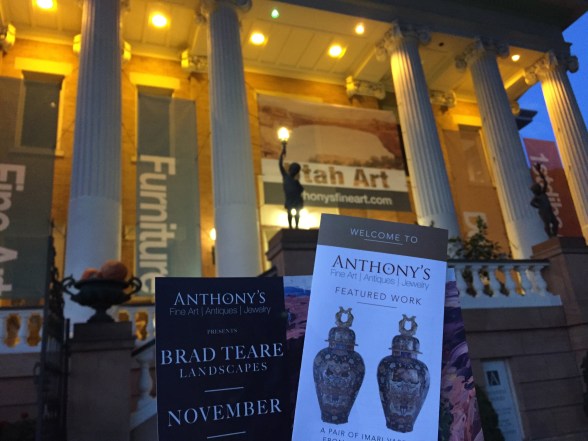
IMG_4758

Outside of Anthony’s Antiques located at
401 E 200 S, Salt Lake City, UT 84111
Taken on October 20, 2017 (Photo by Natalie Mumm) Enterprise Assets

With so many possible venues participating in the stroll on any given third Friday, it may seem like an overwhelming art maze. Be that as it may, The Salt Lake Gallery Stroll’s website is simple to navigate yourself through, to finally discover a new gallery in the area that you wish to attend. The level of enjoyment and education received from the event is entirely up to you.

Visual art time and time again surrounds everyone. “I was overwhelmed to see so much art in once place that was so beautiful and not commercialized,” said Kemp. “It reminds you that talented people can do this, and there is more to what we just see on the media.” The stroll takes viewing art to a more interactive and personal level, engaging conversation, and genuine reactions between the artist and the spectator. The Salt Lake Gallery Stroll aids making art more obtainable to the average individual. That being said, it should highly encourage everyone in the area to indulge themselves, and appreciate the art and culture representations their community has to offer for a night.

Reflection Blog


Tinder: Is it helping or hurting our dating culture?

Tinder: Is it helping or hurting our dating culture?

Story by Annie Ricks

SALT LAKE CITY — Tinder: an app where you can find a husband, a hookup, or a way to kill time by simply swiping right. This dating app fad has skyrocketed in the last few years. When a group of young college women were asked their reasons for using the app, responses varied from “boredom”, to “as a confidence booster”, “desperation”, or “as a rebound”. Maybe this increase is due to a lack of traditional dating methods, or perhaps it is our technology-crazed generation which drives people to online dating. In a growing app culture- our lives revolve around our phones- it is unsurprising that we have resorted to online dating to meet “significant others”.

Erin Wyness, 21, is a student at the University of Utah, and shared her method for “mastering the app”. After her multi-year relationship ended, Erin joined Tinder to pass time and to meet new people. If she got a “match” and the conversation was interesting, she would suggest they meet in person. “I feel like you can talk to people online forever and not really understand what they are really like in person,” she says “I did all this to avoid doing that whole hookup thing. I could nip it in the butt right away if we met in a coffee shop or somewhere public and I knew right away if it wasn’t worth my time.” Erin wasn’t looking for a boyfriend, she says, “but I also was not looking for a one-night stand.” After going on several Tinder dates Erin matched with Mike, a 24-year-old University of Utah graduate.  He messaged her first and they had an instant connection. They went out for coffee that same evening and ended up spending the night together. Since their first date last October, Erin and Mike have been together everyday and 10 months ago they moved in together. “I remember feeling really comfortable with Mike, we stayed up all night talking and we had a lot in common.”

Erin’s Tinder success story is shared by 20 percent of current, committed relationships that began online but what does that mean for the rest of Tinder users? 60 percent of female Tinder users say they are looking for a match yet how do we explain the remaining rise in online dating over the past years?

Perhaps the increase in Tinder usage is due to a hookup culture we have created as a society. Before online dating, people would either meet through their pool of interaction, which could mean their peers, their coworkers, those they meet at a bar/club, or even those whom they could be setup with. However, with the app, their pool of options has expanded to hundreds of people within a 10-mile radius.

Coincidentally, the upsurge of users on Tinder, about 50 million, has coincided with a precipitous rise in STD’s. “Some experts have pointed to the ‘Tinder effect’, the idea that online hookup sites are making casual anonymous sex easier and more common than it used to be,” says The Sun, a UK based Newspaper. A Tinder use can rack up several Tinder dates a week, according to one article from eHarmony, “33 percent of women who use online dating websites say they have sex on the first online dating encounter.”

On a state by state basis, the correlation between online dating and increased STD transmission is shocking. “In Utah, huge increases in the number of gonorrhea diagnoses since 2011 — 700 percent for women, nearly 300 percent for men — have been at least partly blamed on apps like Tinder. Apps make casual, anonymous encounters easier, and it’s almost impossible to find partners again afterward — meaning that it can be harder to track down others who have an STD and help them get treatment,” says Lynn Beltran, an epidemiology supervisor in the Salt Lake County Health Department.

In 2015, the AIDS Healthcare Foundation put up billboards throughout California encouraging Grinder and Tinder users to go get checked for STD’s. Angered, Tinder sent a cease and desist letter to AHF, demanding an end to the campaign. Although they did not appreciate those billboards, they did add a special feature to their app: a locator for STD testing.

Could that be a step in the right direction? Perhaps. But what are some of the other ways we can ensure safety? Dr. Jennifer Childs-Roshak, president and CEO of the Planned Parenthood League of Massachusetts said that, “Access to testing and treatment, along with education about STD prevention, are the best ways to ensure that people stay healthy and safe. Unfortunately, too many barriers stand in the way of health care and education, especially for young people”. Perhaps the popularity of these dating apps has finally drawn attention to the vitality of health care resources and education necessary to inform individuals of these dangers. It is unacceptable for online dating to have this much negative feedback and it is alarming that many young people don’t understand the problems that our hookup culture has brought about in recent years. Whether or not online dating has proved successful in one’s life, it has presented far more concerns than it has benefits.

To read the author’s reflection blog, click here.

FullSizeRender 5

Interviewees: Annie Crandall and Taylor Lenci. Image taken on Monday, November 6, 2017 in Salt Lake City, Utah.

tinder_age_chart

Graphic displaying percentage of Tinder users by age. Image was found in the public domain.

2000px-logo-tinder-svg

Tinder dating app logo. Image was found in the public domain.

21401344308_461a2e6d3c_b

Billboard produced by the AHF encouraging Tinder users to get checked for STD’s. Image found in the public domain.

FullSizeRender 2

Interviewees: Cameron Aragon and Chloe Garner. Image taken on Monday, November 6, 2017 in Salt Lake City, Utah.

FullSizeRender 3

Interviewees: Eliza Larsen and Haley Southwick. Image taken on Tuesday, November 7, 2017 in Salt Lake City, Utah.

FullSizeRender 4

Interviewees: Kira Wachter, Katy Hymas, and Sophia King. Image taken on Monday, November 6, 2017 in Salt Lake City, Utah.

FullSizeRender

Interviewees: Olivia Webb and Sarah Terry. Image taken on Monday, November 6, 2017 in Salt Lake City, Utah.

IMG_3768

Erin Wyness and her boyfriend Mike. Image taken on Wednesday, November 1, 2017 in Salt Lake City, Utah.

Processed with VSCO with a6 preset

Group of Interviewees. Image taken on Monday, November 6, 2017 in Salt Lake City, Utah.

Seeing Salt Lake City through light art and technology

By Eylül Yel

SALT LAKE CITY – Illuminate, Utah’s first light art projection and technology festival, took place on November 10 and 11 in downtown Salt Lake City.


According to the Utah Arts Alliance website, the free event for Utahns combines light art and technology. Artists presented their artwork by using the city’s architecture as a blank canvas for their projections. The purpose was to create a citywide museum that would illuminate Salt Lake City’s history and culture through art.


Illuminate used projection mapping – a technology to project light on any 3D object instead of merely using a flat screen. Projection mapping offers a new medium for artists to present their artwork. Illuminate is the first to use the technology in Utah.


I have been wanting to create an event like this in Salt Lake City for a few years as I have been observing light art festivals all around the globe.” said Derek Dyer, executive director of the Utah Arts Alliance and the producer of Illuminate. Dyer said that he had a few challenges along the way that prevented him from making Illuminate happen. Initially it was difficult gathering enough artists in Utah to create an event this big. Dyer started approaching artists during the Urban Arts Festival and eventually got enough participants.

Dyer’s next challenge was funding, but over the years technology has evolved and became more affordable and accessible. “Luckily, a lot of our artists have agreed to work under budget.” said Rio Wimmer, an employee for the Utah Arts Alliance. She explained that they have received a grant from the city and were also grateful for all the sponsors that helped them put the festival together. Of the twenty two sponsors, Mountain View Staging, the company responsible for setting up the technology and electricity for the event,  and Meru Interactive, which created the Illuminate AR app for the festival, were particularly helpful Wimmer said.


A big part of the Illuminate’s innovation , is an app called Illuminate AR said Dyer. Illuminate AR allowed everyone to interact with different artworks during the event using their phone.The app made it possible for participants to view additional artwork during the festival available only to those who use the app. The app also provided additional information on the artwork and it’s creator. Although the app was useful and provided an in depth information on the artworks showcased at the festival, unfortunately, during the event, the app proved difficult to navigate and had a technical bugs that prevented users from scanning markers on certain art pieces.


There were a variety of different activities for children in the Clark Planetarium, Discovery Gateway and Utah Film Center where kids could witness educational demonstrations. A separate part of the festival was held indoors at the Gateway. The Light Lounge, the largest part of the festival, participants met artists and learned more about the events creation. Several artists displayed their artwork and were available to visit with the public.


Two offsite locations were in an alleyway between the Utah Museum of Contemporary Art and Abravanel Hall and on Regent Street behind the Eccles Theater. The alleyway between the Utah Museum of Contemporary Art and Abravanel Hall showcased a demonstration regarding the short animation file, .gif, asking the question “what is contemporary art”. According to the Utah Arts Alliance, .gifs may have not been considered art in the past but now a combination of traditional color theory, the aesthetics of painting, and the use fractal mathematics make it possible for .gifs to be seen as art. The Eccles Theater was used project artwork on and there were food trucks and a DJ booth on site.


The Utah Arts Alliance website called Illuminate a festival where “artists working with technology and using light as their medium will use the city as their canvas and create projection mapped artwork, light art displays and exhibits for the community to enjoy and experience a first of its kind experience”. However, the initial Illuminate only used two buildings and it was only a small portion of the festival.


Illuminate was different than any other art festival Utahns have ever witnessed in the state. It was innovative and interactive. It was a good opportunity to see unique artworks by artists who use light and technology as their medium.


Though Utah Arts Alliance is a reputable organisation that organizes the majority of the art festivals in Utah, it was their first time creating a light art festival. Getting an event set up that involved this much power and technology was new to them. “There were little issues here and there, but overall we think the event was a success.” said Dyer on an interview after the event. “We were really pleased with the turnout, over twelve thousand people attended the festival.” said Dyer. According to Dyer, Illuminate will become an annual festival in Utah. He said that they will start contacting artists from an earlier date for next year in order to get more artists and artwork involved to expand the festival.

IMG_9692

More pictures can be found: Assets

Reflection Blog

Refection Blog – Tiffany Huyette

By Tiffany Huyette

In the beginning of pitching ideas for my enterprise story, I knew I wanted my story to be centered around athletics because that is where much of my knowledge and passion are found. I knew it would be easier to invest myself in a topic that I knew a lot about or had the motivation to learn more about, so I decided to write about UYSA. Growing up in Utah Youth Soccer was beneficial in teaching me life skills and in helping me learn to deal with adversity.

Upon gathering information for my story from previous coaches and the Utah Youth Soccer website, I was able to get in touch with individuals from the admin side of UYSA, and then eventually able to go to the new UYSA headquarters and interview a few different people. I reconnected with a previous soccer trainer who had coached girls and worked on the administrative side of UYSA.

I started my interviews asking each person their job title and how they had gotten to their current position. I asked about previous jobs and positions, and about their families. I went further into depth on the benefits of sports for adolescence. After the interviews, I reviewed my notes and was able to create a story. The best source for my story ended up being the man who had trained my team and other girls teams, and who also worked in administration for UYSA.

The struggles I faced were mostly in getting interviews and keeping my story to the word limit. How could I include the details I wanted and the details I needed, while also identifying the material I needed to take out? All while telling a story, intriguing readers, and fitting within the word limit.

I chose the focus of my story when I listened to my interviews and decided what would be interesting to readers of all types, and what wouldn’t be interesting. I also really wanted to tell a good story, so I had to find a point of view where I could story tell, while still being able to keep inline with my story topic. The writing process was lengthy, and the story ended up extensively exceeding the word limit. I then had to delete any parts that were not necessary, or that did not point back to the story pitch. It was a process of writing a story that would be both interesting and informative to readers, while at the same time telling a story well. I learned that I am much more of a story writer than a news writer but that it is beneficial to add brevity to whatever I’m writing.

Looking back, I am very surprised with where my story ended up going. It ended up being a feature story about a specific person and an organization. I learned much about UYSA through my interview with Bruce but also about Bruce as a person. I was able to attain life wisdom as well as coaching wisdom for young athletes and the parents of athletes.

For my story click here.


Tiffany Huyette

Ice cream tiff

I am a Sophomore at the University of Utah. I am also a U employee, working for a family practice clinic full of nurse practitioners, physician’s assistants, physicians, and resident physicians. For a while I had my heart set on becoming a dietitian, that dream has since changed, and I am settled as an undeclared student for now.

I was born and raised in Utah. For the longest time, I wanted to get out of Utah, but as I’ve grown older, I’ve begun to appreciate the mountains that are our backyard and the fall leaves that turn burnt orange.

I attended Jordan High School and grew up playing soccer. After playing soccer for 13 years and following a semester of college soccer, I gave up the soccer dream, and now play for fun in coed leagues. I enjoy distance running and pushing my mental barriers. Most days you can find me in a coffee shop, coffee in hand, doing homework or chatting with a friend. Other times you may find me in a nook somewhere, reading a novel of some sort. Gilmore Girls is my favorite TV series, and brownies and ice-cream are my go to dessert.

If your interested in reading my story click here.

If your interested in reading the reflections on my story click here.

For my LinkedIn profile click here.

Zane Law- Reflection Blog

The development of my story came about in a wave of ideas. I was, at first, stuck with only statistics. The data was a large amount that was both for and against the Greek system on college campuses. The statistics outlined things such as graduation rates, GPA within the system and outside of the system, numbers on rape, alcoholism, and more. I had put all of the information into my first draft, but was told to hold back on the information that I did not enjoy reporting. I had previously thought this to be bias and was trying to remove all side-taking from my writing, but was made aware that as long as I was not blatantly trying to promote Greek life, I was fine to report upon the positives. Telling of the benefits and stories of Greek life and its members was acceptable if the information was all factual and written clearly. It was still difficult to report on the information without being biased, as I was a Greek member for two years, but I believe the way I positioned my interview quotes and statistical information was fair.

I then had to plan my attack on the interview process. My sources were among the University of Utah’s most involved Greek members, being able to show what the system is truly capable of. The IFC President, the YAF President, and a fraternity social chair were all very different positions, but all positions that they said would help them in the future. Whether it be on resumes or using the connections they made during their terms, they said their time spent was extremely valuable to them. That seemed like enough to warrant an interview. The YAF President stood out to me most, as he had just accomplished a feat that made Salt Lake City headlines. He was able to invite, with the help of alumni, Ben Shapiro to the U’s campus. This was a true testament to what fraternities and alumni support can accomplish.

During this process I truly learned to plan ahead before stepping into an interview. After my meetings with a few of the folks I was left wanting to ask o many more questions. If I had better prepared, then I could have gotten some additional information for my article. I also learned that having friends and family review your work is a priceless tool. They were able to make suggestions that I would not have thought to include. Never be afraid to ask others to read your things, kids!

Fraternities are a valuable resource for many college men

Zane Law- Bio

Zane Law- Enterprise Story

Fraternities are a valuable resource for many college men
Story by ZANE LAW

SALT LAKE CITY— College campuses across North America are hosts to hundreds of men’s fraternities. These fraternities are seen by many as misogynistic and cruel, while others view them as places to build character, a resume, and a social network. With over 6,000 chapter houses and millions of Greek members across North America, the benefits outweigh the negative image for the many joining the Greek system.

For generations, fraternities have been linked to the cultivation and development of successful men. Forty three of the United States’ 50 largest companies are run by fraternity men, with 85 percent of all Fortune 500 companies having a fraternity member CEO. According to the New Jersey Institute of Technology, Greek men also account for all but two United States presidents born since the formation of the first fraternity in 1825, 76 percent of all U.S. Congressmen and U.S. Senators, and all of the Apollo 11 astronauts.

University of Utah’s Interfraternity Council President, James Morrell, explained why he thinks this is far from coincidence. Morrell says Greek life has helped him in three core areas: networking, leadership, and academics. The people he has met through his fraternity, “have served as an invaluable resource in my life, helping me further my career options and improve my academics,” he says. A current member of Beta Theta Pi at the U, Morell says several alumni remain actively involved. Through alumni he has received several job opportunities and plenty of guidance.

Dillon Clark, recruitment chair of Phi Delta Theta and president of the Young Americans for Freedom organization at the U, also praised his relationships with alumni. While Clark has received internship opportunities from active alumni, he credited one event in particular to the help of his older “Phis”. “I would not have been able to bring Ben Shapiro to the U without the help of alumni,” he says. The Ben Shapiro event that Clark hosted in Salt Lake City received significant media attention and hundreds of attendees. With donations from alumni that believed in his efforts, Clark was able to pool together the tens of thousands of dollars needed for the event.

Both Clark’s and Morrell’s achievements are significant in terms of resume-building, but are only a few of the things that they believe their organizations can help people achieve. Both are happy that they have support from their fellow Greeks and feel as though these people and opportunities give them an edge.

Fraternities help to hone interpersonal skills, time management, and team-building techniques, but are expensive and are not financially accessible to many. According to USA Today, the average cost per semester in a fraternity is $605, not including additional costs such as fines for absences, tardies, and other penalties. A national survey taken in 2014 by the Journal of Behavioral and Experimental Economics indicated that fraternity members are more likely to graduate on time, however, potentially saving thousands of dollars on tuition. Staff members at the U’s Fraternity and Sorority Life office even reported that that in 2016, 80 percent of all Greek life students had gone on to graduate, whereas 57 percent of non-Greek students had been able to do the same. Graduating at a faster rate translates to less tuition money spent, therefore negating much, if not all, of the per semester costs.

The North-American Interfraternity Conference also reports slightly higher Greek GPA’s than their non-Greek counterparts. Many fraternities and sororities require a minimum GPA to join and remain an active member, with chapters on the U’s campus requiring anywhere from 2.5 to 3.0. Fraternities even gather alumni donations to fund tutoring and “Chegg” accounts. Chegg is an online resource to help students with homework, rent textbooks, offers tutoring, and helps to identify scholarship and internship opportunities.

While such resources and encouragement are important, others benefit purely from having an organization that keeps them in check. “Our scholarship chairman is really on us about getting our big assignments in on time, constantly reminding us in meeting,” says Elliot Ansari, a third-year member of the Greek system. He and his fraternity brothers feel obligated to perform academically because one of their fraternity’s founding principles is “Sound Learning.”

Although personal development and social network expansion compose a large part of the good arising from Greek organizations, Greek members also participate in community service and philanthropic events. In the academic year of 2013-2014 alone, the North-American Interfraternity Conference reported four million hours of community service contributed by fraternity men. Making blankets for the homeless, writing letters to military personnel, and sorting goods at the local food bank are some of the events that the U’s fraternities and sororities do together, knocking out good deeds and creating fun memories with each other.

In terms of philanthropy, most fraternities “have two events per year and the money raised goes to a charity organization of our choice,” says Elliot Ansari. The University of Utah’s Sigma Chi chapter frequently makes the news, with the Huntsman Cancer Institute’s website praising them for raising $66,806.65 during the 2015/2016 school year.


To see the author’s thought process whilst writing this piece click here

For more about the author click here


The University of Utah’s Greek system welcomes students from all walks of life.

Story by MEREDITH SEARIGHT

SALT LAKE CITY — The last few years have been marred by racial issues, divisions, and strain in the United States. These concerns have extended to the Greek system at the University of Utah, where a lack of diversity that has been characterized as racial bias.

Here at the University of Utah, only 5 percent of the student body are members of the Greek community, which is approximately 1,500 out of 31,592 students. The nature of a small Greek system which lacks diversity has raised some concern, which Colby Judd, the president of Delta Sigma Phi, recognizes. “It is challenging to help members from diverse backgrounds feel comfortable in the Greek system,” he says, adding that there have been issues in the past where members have left due to a lack of diversity in the chapter. Judd, along with the rest of the chapter understands that changes need to be made, and has arranged for members of the Bennion Center to speak to them about diversity and equality.

Jess Turuc, Director of Sorority and Fraternity Life at the U has worked at three other collegiate institutions prior to Utah. This is the first school that she’s worked in that requires their students to take a diversity class, she says. “Essentially, this is the University of Utah and we are a very white institution. Not by choice, but by proximity and where we are,” says Turuc. She has not experienced any issues with regards to diversity in the Greek community at the U and finds the students in the community to be “respectful, mature, friendly, and accepting of all students from every culture and race.” Moreover, Turuc says that diversity is welcomed, and the Greek Council has partnered in the past with the Center for Ethnic Student Affairs on campus to learn more about what it can do to grow and improve the Greek experience for ethnic students.

According to Forbes Magazine’s “America’s Top Colleges,” the University of Utah is 68 percent white, 10 percent Hispanic, 8 percent non-resident aliens, 5 percent Asian, and 9 percent “other.” Colter Merritt, the Sigma Phi Epsilon president and a senior at the U, is well aware of these statistics. “This means that the Greek Community, although seeking a diverse population, struggles to generate a diverse base of recruits each year because we simply don’t have a large enough pool of non-white students to recruit.”

When you are given such a massive white population it can be difficult to recruit the smaller percentages that aren’t white, Merritt says. When Sigma Phi Epsilon does their recruiting, they aren’t looking for or seeking out diversity, rather, the “objective is to get the best possible members based off of values, academic achievement, community involvement, etc.,” he continues.

IMG_1295

University of Utah Delta Gamma house taken on Monday, November 13, 2017, in Salt Lake City, UT (Photo by Meredith Searight) Greek Slideshow

Quin Martz, the president of Delta Gamma says that she and her chapter have sought to promote diversity and reduce bias. “Delta Gamma fosters an environment of inclusivity and openness. Our sisterhood is made up of women from all walks of life” she says. Everyone has a different background and a different story. We recruit members based on the values of our sisterhood. We are accepting of all women in our chapter, of all individuals on Greek Row and at the University.” Along with Delta Gamma’s open and accepting members and recruiting process, the U’s Greek community also includes a Multicultural Community. “The Greek community is made up of the Panhellenic Council, Interfraternal Council, and the Multicultural Greek Community,” says Martz. “These councils work together to bond in brotherhood and sisterhood, and to set goals to improve each semester. Delta Gamma has partnered with Multicultural organizations for Greek Week for many years, and we always have so much fun celebrating the Greek Community and participating in healthy competition. When we come together, we can accomplish great things.”

According to Turuc, in a time of such negativity with issues regarding race on Utah’s campus, the U’s Greek system has managed to not let it bleed over to their community. When it comes to the chapter of Chi Omega at the U their ethnic makeup consists of, 110 Caucasian’s, three Hispanic’s, three African American’s, five Asian’s, and 11 members that identify as other. “Diversity allows us to have multiple perspectives and use them to enrich our peers around us. It makes us more accepting and communicative”, says Kira Wachter, president of Chi Omega. Even with a predominately white chapter, their president makes strides to grow their member’s perceptions of life. Amidst all the racial issues, division, and strain in the United States; the University of Utah’s Greek system strives in both the words they speak and in their deeds to be a safe, welcoming, and accepting place for anyone who wants to join.

Reflection Questions


Lori Kunz

MY STORY:

MY BLOG:

My story on Rescue Animals Needing Transportation (RANT) found me. I was scrolling through Facebook one morning waiting for the train. A childhood friend had posted about a new animal rescue organization she had founded. After reading her post, I knew that my story had to be about her and her foundation.

The sources for my story came with the organization. It couldn’t have worked out more perfectly.

The founder was the best source for my story. Her passion was inspirational and I wanted to communicate that in my story. I hope that everyone who reads my story will find value in it.


I fortunately did not encounter many obstacles that affected the story.

After many, many drafts and reading and re-reading my story, I started to see a flow of how the information should be written and told.

The writing process was slow at first. It gained momentum and flowed out of me. I learned that when I put my energy into writing it turns out to be something I can be proud of.

There was more detail than the story had room for.

I was surprised that after the first interview, the other two were easy. I wasn’t personally invested and I didn’t have to be. The story wasn’t about me. The story was about them and their passion for animal rescue transportation. I had to tell it in a way that they would make them proud.

ABOUT ME:

Lori Kunz has worked in real estate for over 25 years. She began working in residential mortgage. After a divorce she raised her daughter and found that working in residential and commercial mortgage provided her with a stable salary and benefits.

After her daughter was grown and had moved out, Lori made the decision to go back to school for a Bachelor of Science in Communication. Previously she graduated from Snow College with an associate degree.

Today she is employed at a commercial mortgage company and is a junior at the University of Utah as a part-time student. She hopes to graduate in 2020.

Savannah Bernardo

MY STORY: 

MY BLOG: 

Everything that I know about writing starts with passion. If there is no fire behind the words you are writing, then why are you writing at all? As I began to search for the topic of my story, I knew it had to be something I cared about.

On Oct. 1, 2017, there was a mass shooting that occurred in Las Vegas. Concurrently in my course, Family Health in Communication, we were reading on the topic of mental illness. Over the many different news sources that I read about the shooting, so many articles tried to link the shooter to having a mental illness. This idea instilled a stigma into so many people’s minds that because someone has a mental illness, they could be the reason behind a catastrophic event such as this.

This is where my new passion began.

My initial search of people to interview started with the thought that I needed to educate myself on the topic. And who better than some of the experts in the field, who work with people diagnosed with a mental illness every day. Once I became more educated on the topic I needed to find the reason why people would care.

Pulitzer Prize-winning journalist, Bob Woodward, who spoke at the University of Utah in November 2017,  discussed the importance of “plugging into people’s red hot center.” And that was exactly my goal. Within most of my interviews, I was able to locate that red hot center through questions that were difficult to even ask, let alone for my interviewees to answer.  

Although I chose a topic that is more sensitive than most, I learned so much throughout each part of the process. I must have listened to each of my recorded interviews about a dozen times. Then I would start dissecting each one to get exactly what I needed from it to start writing. Just to listen to them another dozen times, and rewrite what I had already written. This process was relentless, but completely necessary to get the right story out.  

The main thing that I really took from this class was that no matter what you’re writing about, you have to find that passion. If there is no fire behind the words you’re writing, you won’t give readers a reason to care. Although interviewing people may be difficult, if you show that you care through your questions, you’ll be able to plug into their red hot center. By doing this, you will get the answers you need, and most importantly — your story will mean something.

ABOUT ME:

Savannah moved to Salt Lake City in 2015 with a goal to finish her bachelor’s degree at a university. She was born and raised in San Jose, California, and although she was comfortable living in beautiful weather and close to family, she knew that she had to leave home to figure out life for herself.

Savannah began playing softball when she was 10, and made it her passion for the next 11 years. She played year-round on competitive traveling teams, and loved every second of it. But softball was more than just an outlet, it taught her many life lessons that she still incorporates in her life today.

Staying busy has always been a lifestyle for Savannah. Excelling in school, while working multiple jobs and playing collegiate softball all at the same time, allowed her to figure out the kind of person she is — busy.

Although playing softball at a four-year college didn’t end up being in Savannah’s future, finishing school at the University of Utah is.

Attending junior college allowed Savannah to save a lot of money when it came to school. However, transferring to the U this semester, has been the greatest experience she has been a part of since her move to Utah.

Savannah expects to graduate in December 2018, with a Bachelor of Science in Communication with an emphasis in strategic communication. She is not completely sure of what career path she will take after achieving her degree, but has a few ideas in mind.

Her passion for sports and what it can do for a person’s life has always struck her interest. Being able to have a career that involves constantly staying busy, as well as incorporating her passion of sports (sports journalism?), is the next goal she is striving to accomplish.

Reflection Blog – Faye Barnhurst

I began brainstorming ideas by thinking about current events in Salt Lake and on campus. As a student-activist, I considered different political issues in Utah, such as Operation Rio Grande, police brutality, etc. I thought of the Ben Shapiro event, as it had been the biggest activist action on campus in a while. I knew that the event was not current enough to suit the story, but the group who put it together, Black Live Matter Utah, had not gotten much coverage. Black Lives Matter seemed to be a new group in Utah, so I tried to consider what the public might be wondering about them, like who they are, why they started, what their goals are, etc.

I already knew some local activists, so I was able to use them as sources or connections. I also was able to schedule an interview with Lex Scott, the founder, which was fantastic. Lex Scott was a great source. I felt that it was very valuable to learn about the group directly from the source. I was also able to interview TK Flory, one of the first BLM activists in the country, which was really interesting. I’m thankful that these individuals were willing to be interviewed by me, especially as both of them are black, and I didn’t want to speak for them or their movement.

I had some difficulty contacting Lex Scott because she is involved with so many organizations, which makes her very busy. I had somewhat of an ethical dilemma because the only people I was able to contact from BLM Utah’s media team were white people, and like I said before, this is a black movement, so it’s important to prioritize black voices and not speak over them. I would have felt unethical to only interview white people from the organization. I continued to reach out to other people to get in contact with Lex, and luckily I was able to get the interview just in time.

When beginning the first draft of my story, I definitely had a different idea in my head than what I ended up with. I was planning on starting out by explaining the national BLM movement and some recent cases of police brutality in the US, but it just didn’t flow well. It took the focus away from the Utah Chapter, which was supposed to be the point of the article, so I made an outline and focused much more on the local issues BLM had been focusing on.

I learned that outlines are crucial. If you try to write an article start to finish, with no outline, it will take at least five times longer. I also learned that I like writing about activism. Lex Scott thanked me specifically for choosing to write about them and giving them a voice, which made what I was doing much more meaningful. It’s important to give a voice to those who are often silenced by the general public.

I’m thankful I had the opportunity to interview activists I admire, like Lex Scott, TK Flory, and Jacob Jensen. I hope to be able to cover more activist events in the future and to give a voice to those who are silenced.

Bio

Black Lives Matter has taken to the streets of Utah and they’re here to stay

Holly Vasic

About Me

Writing1

I am a student at the University of Utah seeking a degree in Communications, the journalism sequence. I write for the Arts and Entertainment section of the student newspaper, The Daily Utah Chronicle, and for the South Salt Lake City Journals. I have always been a writer and I am finally pursuing my dreams. I have learned a lot about news writing in class as well as from experience through the student newspaper. The more I learn and write the more I love the journalism process. My favorite part is meeting new people and interviewing them. The writing part is probably my least favorite, ironically.

Check out my story on Operation Rio Grande by clicking here.

Read my reflection blog on writing the Rio Grande story by clicking here. 

See my LinkedIn by clicking here.

Have a look at my portfolio by clicking here.

Holly Vasic Reflection Blog on “Operation Rio Grande may not be prepared, or be the answer, for homeless addicts”

The Operation Rio Grande story, “Operation Rio Grande may not be prepared, or be the answer, for homeless addicts“, idea stemmed from a discussion I overheard with a girl who worked at one of the treatment centers receiving financial disbursement from Operation Rio Grande. She was saying how awful it was because the place was not prepared when people began to come in and it negatively affected other clients. Originally I was planning to focus on the clients who were negatively affected.

I located sources by asking people that were too close to me to interview, to refer me to someone else. In an attempt to tell every side I tried to speak with someone that was an advocate for addicts, someone in government, and an addict themselves.  The biggest ethical issue and moral dilemma I faced was I am a drug addict and alcoholic myself and inherently bias. By finding sources from a variety of places I hoped to counteract that bias.  

As I interviewed people the focus of the story changed so I re-directed and was able to “make sense” of the new focus by listening to what my interviewees were telling me. The writing process consisted of me typing out all the conversations I recorded, reading through them, then I found the story. I was able to figure out an order to the story that made sense and kept it interesting by giving information upfront the reader would need to know, to understand the context, and breaking it down from there. I did not end up including an interview from a drug addict in recovery who was homeless on The Block because the one I spoke with spent time there prior to Operation Rio Grande. I felt like he couldn’t represent that side. I could not find a source who had been a success or failure from Operation Rio Grande sending them to rehab because the program is so new, but I still wanted that side represented. After reading the story I felt that because one of the clinical people is in recovery themselves that was represented without needing a separate person.

What surprised me is that the story ended up being about something else then I originally thought. At first I wanted to focus on everyone else in treatment and how they were affected by people who didn’t want to be there but then it turned into really the homeless addicts being swept up in Operation Rio Grande themselves.

I learned a lot from this experience. Being a writer at the student newspaper I found it hard to have such a long time to prepare and ended up doing my last interview about ten hours before the actual assignment was due. I discovered I do better writing on the fly and that adrenaline kicking in really motivates me, like I said I’m an addict… we do that. The other newspaper I write for, The City Journals, is a monthly paper and this experience has prepared me for future writing with them in that I can anticipate a further out deadline, letting some of that adrenaline rush go, and taking my time to get the full story.

By: Holly Vasic


Eva-Marie Putze

About Me

IMG_2002

I am a fourth year University of Utah student majoring in strategic communication with a minor in business administration. Originally from Las Vegas, I moved to Salt Lake City for my undergraduate degree. In the near future I have plans to peruse a Masters of Business Administration in Germany, where my family is from. In the past I have interned for Harper’s Bazaar, InStyle and ELLE Magazine Germany as a digital marketing strategist. As of recently I have a fashion column in Home and Table Magazine, where I update readers seasonally on the latest trends. My interests include snowboarding, painting and playing classical piano.

Click to read my story Coffee shops- reaching the minds of college students. Learn more about my writing process reflections on coffee shops and student customers.

Visit my LinkedIn here.


Black Lives Matter has taken to the streets of Utah and they’re here to stay

Story and photos by FAYE BARNHURST

SALT LAKE CITY – On Aug. 27 of this year, nearly 400 Utahns gathered on the University of Utah’s campus to protest a speech by conservative commentator Ben Shapiro. Protesters marched from the Park Building to the Behavioral Sciences Building, shouting phrases such as “Hate speech is not welcome here” and “Hey, hey, ho, ho, Ben Shapiro has got to go.” The protest was organized by Black Lives Matter Utah (BLM), an activist organization that has been making waves in the community and doesn’t plan on stopping any time soon.

“We’ve been here for years,” says Black Lives Matter Utah founder Lex Scott, “but we just didn’t have any people or press. But now Utah has discovered that we’re here, so it looks like we’ll actually get some things done.”

After the fatal shooting of 17-year-old Trayvon Martin by George Zimmerman in 2012, “#BlackLivesMatter” began to circulate on the internet. The hashtag sparked a national movement that altered the political climate of the nation and made Americans reevaluate race-relations in the United States. Since its inception, Black Lives Matter has utilized social media and direct action to raise awareness of issues facing African-Americans.

The organization has over 40 independent chapters across the country that each focus on their own regional issues. Earlier this year, the FBI categorized Black Lives Matter as a “Black Identity Extremist organization.” Local activist, Lex Scott, who was just named Utah’s “best tireless advocate” by Salt Lake City Weekly, decided to start the Utah chapter after seeing footage of Eric Garner, an unarmed black man, being choked to death by a Staten Island police officer. “I saw the video and thought ‘Okay, that’s enough. We’re going to stop this. We’re going to do something,’” says Scott.

In collaboration with Utah Against Police Brutality, Black Lives Matter Utah has held several rallies and protests calling for justice for victims of police brutality, such as Abdullahi “Abdi” Mohamed and Darrien Hunt.

“The necessity for a Black Lives Matter chapter in Utah unveils itself in the mere fact that it garners death threats to families of their organizers for the same sort of work that UAPB has been doing for years without any of the same hostility,” says Jacob Jensen, an organizer for Utah Against Police Brutality. 

Both activist groups have been pressuring local legislators to change police body camera policies. After Salt Lake issued an executive order last month that stipulates a 10-day delay on the release of police body camera footage where an officer injures or kills someone, both groups held a protest and sit-in at the Salt Lake City and Council Building to demand that the footage be released within 24 hours of the incident.  

Along with working to end police brutality, Black Lives Matter Utah also addresses other forms of racism.

“Black Lives Matter is all about inclusivity,” says TK Flory, one of the first BLM activists in Los Angeles. “Thinking about systemic oppression, economic oppression, political oppression, systems that uphold white supremacy – these affect everybody in some way, especially black people.”

One of Black Lives Matter Utah’s biggest successes in combating systemic racism is getting Steve Smith, a former Sandy City Council Member, voted out of office for making racist comments about African-Americans. The group canvassed, created a call bank, and even went on the news to get Smith removed.

The organization is also promoting its fourth annual Black Friday Black Out Boycott, to counter systemic barriers that limit black entrepreneurs. Members of Black Lives Matter will boycott all major Black Friday sales, and instead only shop at black-owned businesses. This action is intended to be a rejection of the economic racism facing black people in the United States.

In addition Black Lives Matter Utah opposes mass incarceration, the “school-to-prison pipeline,” and housing and wage discrimination. They advocate for fair and impartial juries, transparency between police and citizens, and adequate political representation for all marginalized groups of the community.

To encourage students to join and lead the movement, they have recently started working with Students for a Democratic Society, a radically progressive student-activist group on the U’s campus. 

The group already has more than 1,500 members on Facebook and is currently setting up new chapters all over the state to draw in support and gain influence in Utah. 

“Black Lives Matter Utah is important because Utah is only two percent black, which means there is just a tiny percent of black representation here, so there’s not a lot of black leadership here,” says Lex Scott. “Most perceptions of the black community come from the media and television where we are painted as unintelligent, ignorant thugs. If there’s a place that needs a Black Lives Matter chapter, Utah is the place.”

With the goal of bringing attention to the issues facing black people in Utah and pursuing equal rights for all, Black Lives Matter is a growing voice in the community.


Reflection Blog

Faye Barnhurst

IMG_9532

Faye Barnhurst lives in Salt Lake City, UT. She is a sophomore at the University of Utah, currently studying Communications, Journalism, and Studio Art. She plans to graduate with her BA in Communications in 2020.

Ms. Barnhurst has worked at LUSH Fresh Handmade Cosmetics in Murray, Utah, as a Senior Sales Ambassador and Visual Merchandising Ambassador, for the last two years. She has also done volunteer work with Vague Space, a local non-profit focusing on arts and education, as their social media coordinator.

Ms. Barnhurst is also a student-activist with the Students for a Democratic Society, a progressive student-activist group on the U’s campus. She has assisted in organizing events, hosting fundraisers, and running social media accounts for the group.

Her passions include art, music, activism, travel, and politics.


Black Lives Matter has taken to the streets of Utah and they’re here to stay

Reflection Blog

LinkedIn

Zaina Abujebarah

MY STORY:

MY BLOG:
I really wanted to write a piece that required putting myself into the community. By interviewing the owners of places I already visit at least once a week, I opened up the opportunity for those who may not know much about the vegan lifestyle to learn more about the things happening specifically in their own backyard. I found that the owners of Vertical Diner, Boltcutter, Monkeywrench and Mark of The Beastro were my best options, because they’re all located in downtown Salt Lake, which makes them more accessible and convenient to locate for those who are curious and because they’re easy to recognize.

DGu1lVBVoAA87RA

Enter a caption

I took all of the information I gathered and spun them to fit a more educational approach. Veganism is a somewhat “taboo” subject, especially to those who already have formed opinions on it. I wanted my angle for this piece to be serious and informative while also addressing the fact that vegans aren’t missing out on delicious food, and eating plant-based foods doesn’t have to be scary or “gross.”

I was surprised by how open the business owners were to answering the questions I had, and how willing they were to share their opinions on animal liberation and the state of the vegan community. I had a lot of fun talking to them, learning more about them and sharing stories. I hope this excitement resonates with you, as well.

ABOUT ME:
My name is Zaina Abujebarah and I’m currently working on my bachelor’s degree at the University of Utah. I’m a declared communication major with my sights set on journalism. On top of my school work, I’m currently fulfilling an internship at SLUG Magazine, while also working as a barista at The Coffee Shop. When I’m not working or going to school, I love being a part of the local music scene and attending shows. I have a passion for poetry, veganism, photography and film.

Vaofua Kaili

About Me

 Vaofua Kaili is in her third year at the University of Utah majoring in Strategic Communications with a minor in Political Science. She plans on going to law school for her graduate degree to become a prosecutor for special victims. Vaofua wants to help be a voice for those who have been assaulted and hopes to change the way the justice system unfairly treats victims. She hopes to use her skills as a writer to help educate and inform others about sexual assault and trauma. Her passion for traveling around the world has helped her to see the mistreatment of women and children in different countries. She hopes to one day expand her services to specifically help women and children receive the basic needs they deserve. Vaofua volunteers at women’s health clinics and special needs homes for the elderly in her free time. She will be interning this upcoming summer at Fox 13 News and at a legal clinic for special victims.

To read the story click the link: Victim Advocates – behind the scene hero

To read more about the making of this story click the link: Reflection Blog

Click here for Vaofua Kaili’s LinkedIn Profile


Albatross: Salt Lake City’s Best Kept Record Store Secret

By Ashley Meier

Timo Hatziathanasiou isalb the owner of local Salt Lake City record store Albatross, located on 900 E and 1300 S next to White Elephant Boutique and Koi Piercing Studio.

Hatziathanasiou was only 29 when he opened the first Albatross location. The original store was located in the back corner of what is now Diabolical Records. Originally from Utah, Hatziathanasiou moved to New York after high school for about 9 years. He opened the store when he came back in 2013, “After moving back I was just kind of drifting professionally and just personally trying to figure out what to do,” he explained, “As far as knowledge and skill set goes I kind of just combined it all into this. So yeah, opportunity came up in 2013 to share a shop, or to have two different shops in one space, so that was [for] about six months and after that I just decided to keep going.” The next year, in October of 2014, Hatziathanasiou moved to a store located at 9th and 9th and in January 2016, moved Albatross to its current location.

Hatziathanasiou explained that he believes the current location is by far the best, “As far as the space it’s much more comfortable, I like the separation into different rooms because I was able to create a different feel or space for each section. The structure is much more sound,” he said, “My neighbors on 9th and 9th were great but I wasn’t happy in the building, I didn’t enjoy spending time in that space at all. It never really felt right.” With neighbors such as White Elephant Boutique, Koi Piercings and Good Times Tattoos, the new location has a shared clientele.

As a kid Hatziathanasiou grew up around music, beginning to play guitar at the age of 7. He would ask his mother to drop him off at local record stores, such as Smokey’s records, while she would go grocery shopping. “I’m sure I was bothering all the employees there,” he chuckled, “but yeah it’d either be that or just Raspberry Records or other shops that aren’t around anymore. I just kind of grew up in record stores.”

Being around music all of the time, Hatziathanasiou gathers new sounds frequently. This year some of his favorite releases include Jenny Hval and Thor and Friends. Thor and Friends will be playing in Salt Lake City on November 19 and Thor will be doing a reading at Albatross that same day earlier in the afternoon. Hatziathanasiou tries to do events like these about once a month. He wants people to know that his door is always open from everything like performances, readings or other events.

The Albatross store is decorated very peculiarly. The walls are full of dark art that has been collecting over the years. The main room has Hatziathanasiou’s desk with a shelf full of records behind him, and a magnificent record player that has been engineered locally with some pieces from Seattle. “It’s my favorite part of coming in here every day,” he says, “I’ve just been kind of tweaking it you know just changing parts out and stuff so it’s been an ongoing project.” He described the speakers as being based off of the Western Electric 22a’s speakers or the sound of the theater speakers from the late 1920s.

Hatziathanasiou is always playing a record while he works. There is never an exact genre that he is playing; it’s different every day. In fact, unlike many record stores, he has no specific genre that he plays or sells. The variety of records in the store is wide. He even has been shipping records out of the country to places like Vietnam and Brazil. He gets his records from different distributors or even from the artist/label itself. The products in the store are mostly random. He collects things that he thinks sound well instead of trying to predict his audience. “I don’t do it anymore but I would think ‘oh yeah this is selling really well I should order more of these’ and it would always backfire.” Hatziathanasiou said, “Maybe just because it’s kind of cynical and you think you can kind of guess what’s going to work or guess your audience instead of just getting stuff that you feel is good… I don’t know how to describe it but. It hasn’t always backfired, but it seems like that stuff always sits longer than I expect it to.”

Hatziathanasiou has had live shows at the store, and plans on having readings, movie showings and even craft nights. His future plans include pressing records and using the name as a label. “I like the space and I’m happy to share it,” he said, “Otherwise, [my goal is] not just staying open but actually thriving.”

Follow Albatross Recordings & Ephemera on Instagram & Twitter @AlbatrossRecSLC

Anna Stump

My name is Anna Stump. I am a Junior at the University of Utah, studying Communications (Journalism) while pursuing a minor in Parks Recreation and Tourism. My dream job is to work in the outdoor industry, working in sales as a semi-professional climber and brand ambassador. I hope to someday travel as an adventure journalist, capturing stories that will empower women to defy the odds and look past gender limitations in the great outdoors.

me

My Stories:

Climate Change Sceptic in Office Could Help Environment

Life On The Rails

Opioids: Good or Bad?

By Allison Peterson

When you hear “prescription drugs” what is your first thought? There are many different reactions to this, good and bad. Some people have personal stories of loved ones who are either addicted or have died from addiction or misuse. On the other hand, there are those who will tell you that they have saved their life in a time of crisis. There are so many mixed emotions about this topic and it has been a big controversy, especially in Utah.

Utah has increased 400% since 2000 in prescription drug related deaths. You probably wouldn’t have guessed that right? The question is, why? According to Thegaurdian.com Utah has a high rate because of the primary religion, Mormon or LDS. It goes on to say that many Mormons fall back on prescription drugs to deal with the pressure of the religion. It talks about a faithful church member who was unknowingly addicted to prescription drugs. Her sister said that she had been addicted for about 15 years until they would not prescribe them anymore. She didn’t think that it was an issue or an abuse because they were prescribed to her, they weren’t illegal, but soon after prescription was taken away she went to more extreme measures. To cope with the sudden loss of her pills she tried heroine. She tried it one time, and then died. In the article it says that “Maline Hairup was a devout Mormon. No alcohol, no coffee. She didn’t smoke. Until the day she died, she had never used illegal drugs. Yet she was an addict for most of her adult life.”

According to Health.utah.gov every single month in Utah there are 24 people who die from prescription drug overdose. They are killing more people than fire arms, falls, and motor vehicle accidents in Utah. Some of the dangers with prescription drugs include: dependence, slower brain activity, irregular heart beats, high body temperature, heart failure, and lethal seizers. You may wonder how people get these drugs when they do not have a doctor to prescribe them, well a story from Strib.com can answer that. In this article it talks about the biggest opioid pill press in Cottonwood Heights, Utah. This man was a “narcotics trafficker” and was selling thousands and thousands of these knock off prescription drugs. He was said to have 1.3 million in cash just at his house. This was a huge bust in Utah’s history.

You may be wondering why we even have prescription drugs at all? What is the point with all these negative aspects? According to psychecentral.com “people who take their medications consistently demonstrate more healthy behavior overall.” I talked with Braxton Rose, a pharmacy tech at the LDS Hospital, and asked him his view on prescription drugs. His response was, “They are fantastic and do a lot of good for those who need it. There are blood pressure and cholesterol issues that these drugs help regulate. Pain pills that people genuinely need in hospitals after serious accidents.” He may be saying this just so he can keep his job, I still cant tell!

When prescription drugs are used correctly, they are a huge help with pain. Can you imagine shattering your femur and all the doctor gives you is a few ibuprofens? Or if you have a serious mental disease and the only way to regulate your behavior is through prescribed drugs? There are times when prescription drugs are at need for the comfort of others. Pharmacist need to make sure they are giving the right prescription as well, if not, it could be a bitter pill to swallow!

Prescription drugs cure what you need. If one uses their prescription exactly how they are told to, it can do much good, it can save peoples lives, and it can prevent other diseases in the future. They can be the answer to life threatening conditions. Something that is beneficial as well, is that they have short term effects such as,  helping when someone is sick with strep throat or another common sickness.

Some prescription drugs can not only help with what you are suffering, but other issues as well that you may not be aware of. According to AARP, there are drugs that have multiple benefits, some of these drugs include Paroxetine, an antidepressant, causes lower risk of heart failure, Beta-blockers, for lower blood pressure, can reduce risk of dementia, Metformin for diabetes, avoids breast cancer, and many more. Many people do not realize that prescription drugs can have benefits as well.

There are so many good and bad facts to prescription drugs. This is one of the reasons why it is a huge topic of conversation here in Utah. So next time you or a loved one is prescribed a narcotic, what will be your action?

Stigma Against College Students With Mental Illness

Story by Shaelyn Barber

Diagnosed mental illness is on the rise, particularly for college students, according to the American Psychiatric Association. BestColleges.com says that 25 percent of college students have a diagnosable mental illness. This means that one in four students have a mental illness that has been previously diagnosed or would be possible to diagnose if they chose to seek professional help.

PsychCentral says that some of the more common mental illnesses include depression, anxiety, schizophrenia, bipolar, addiction, ADHD, and eating disorders. Each disease varies in severity and different people can be affected in very different ways. Cases where multiple disorders are present add to the complexity of the illnesses.

Mental illness is often overlooked because it is less visible than a physical disorder. It is impossible to tell if someone has a mental illness just by looking at them. Furthermore, there is a negative stigma surrounding mental illness. Because of these factors, many people do not seek professional help even if they are exhibiting symptoms.

As the conversation surrounding mental illness grows, students are becoming more aware of the many different aspects of mental illness. A lot of students feel that mental illness is an epidemic that isn’t taken very seriously.

“I have many friends and some family who suffer from a variety of mental issues,” Briana McLaren, a student at the University of Utah, said. “I know that mental illness is a serious issue that is not taken as seriously as it should within society.”

McLaren is diagnosed with Asperger’s, clinical depression, anxiety, and excoriation disorder (which is a disorder where one compulsively picks their skin). “When I was diagnosed with Asperger’s it seemed to answer a lot of questions I didn’t even know I had,” McLaren commented. After her diagnosis she was able to make connections between Asperger’s and her symptoms, such as difficulty with eye contact and social skills.

Mental illnesses and its symptoms can make everyday tasks very difficult at times. Madison Adams-Young is a student at the U who has OCD, body dysmorphia, and depression.  She described the paradox of living with both OCD and depression. “OCD is like an alarm blaring in my mind of all of the things I need to be doing, both real things such as homework and cleaning and ritualized things like hand washing and checking the locks,” she said. “The depression is the opposite in that it makes it so difficult to get everything done.” Lately it has been hard for her to complete schoolwork. “I usually do very well in school, but as of late it has been hard,” Adams-Young commented. “I don’t feel comfortable telling people, especially professors, as it makes me feel like I’m making excuses. I lie about being sick or having an appointment in order to cover up for a missed class or a late assignment.” Many students have similar experiences, especially when professors downplay mental illness and the impact it can have on a person’s life.

Jake Hanson is a student at the U who is diagnosed with Bipolar 1 with a mild form of psychosis. He started experiencing symptoms when he was sixteen. “I had unexplainable amounts of energy, never sleeping, and doing really risky stuff like running away for 5 days, stealing neighbor’s dogs, jumping out of my bedroom window thinking I could fly,” Hanson said. “Then after a few weeks of all this energy would come my down swing, staying in bed all day long for a whole week maybe two. I’d be so depressed for no reason, not wanting to talk or listen to my parents or good friends, no motivation to do anything.” Hanson recounted that people sometimes treat him differently after learning that he has Bipolar 1. “I don’t really care what people think about it, but I feel it’s safer not to share that part of me.  People act like themselves around me if they don’t know I’m bipolar, which is what I want, so I tend not to tell people.”

Atticus Edwards goes to the U and spoke to me about his experiences with Purely Obsessive OCD and anxiety. He commented that the stigma surrounding OCD is very different from that of mental illnesses with more visibly symptoms, like anxiety attacks. “OCD is kind of joked about a lot,” Edwards said.

Most of the students that I spoke to felt that there was a negative stigma surrounding mental illness and those who have mental illnesses. “I know beyond the shadow of a doubt that there is a stigma against those who have mental illnesses,” Adams-Young said.

Mental illness can be treated with disdain, disbelief, or even fear. Many do not understand it, and this misunderstanding makes it difficult for people who do not live with mental illness to imagine what it is like to have one. While the family and friends of Adams-Young do not treat her differently, she said “those who don’t experience the same things don’t really understand.”

Some do not believe that mental illnesses are ‘real’ and only exist in a person’s head. “I hear of people talking about mental illness as an “excuse” to slack off or to sleep or stay home,” Adams-Young said.

Hanson said, “people will associate any mental illness with ‘being crazy,’ which is a negative stigma in itself.”

Kris Glad has Bipolar 2, generalized anxiety, and social anxiety. Glad does believe that there is a negative stigma around mental illness, but has a unique way of combating it. “I make a lot of self deprecating jokes about being crazy and unable to function that people are never quite sure if they’re supposed to laugh or not. This might be a little counter-intuitive, but it kind of gives me some measure of control over how people view me, or at least in the sense that I have control over how they find out and when they form opinions of it,” Glad said.

Susan Chamberlain is a licensed psychologist and outreach coordinator for the University of Utah’s Counseling Center. She is hopeful that the thoughts and stigma surrounding mental illness are changing. She commented that in the baby boomer generation, going to a therapist was seen only as something for crazy people. “The stigma is kind of on the flip side as far as what I see, which is my problems aren’t bad enough for me to see a therapist, and so people will wait and wait and wait until they reach a crisis point,” Chamberlain says. She encourages people to speak out about their mental illnesses, as well as to seek help if they are experiencing symptoms or difficulties.

The Counseling Center at the U offers group, individual, and couples therapy sessions. Students can have up to twelve sessions in a calendar year, and each session is only 12 dollars. For more information, visit http://counselingcenter.utah.edu/

Wal-Mart and the Homeless Population

By Felicity Henderson

I had the opportunity of interviewing a manager at the local downtown Wal-Mart in Salt Lake City, Utah. Seeing as Utah has had a slow, but steady, increase in the transient population over the past 10 years; also the fact that a large part resides downtown and mostly around the area of that Wal-Mart, I thought it would be a good idea to see the thoughts of people who come into contact with that population on a day to day basis.

Questioning Mary* who is a night time manager at Wal-Mart, she had quite a few insights into the company and the homeless population.

Sitting across from me is Mary, her hair slicked back into a ponytail and wearing the standard uniform. She’s clearly exhausted and she rubs her eyes as we sit together in the attached Mcdonald’s to the store. Her shift has just ended, it’s nearly 2am, and she’s been here for 12+ hours.

How prevalent is the homeless population in this Wal-Mart?

“Very. There are people in a here day in and day out. They are here… 24 hours a day basically.”

Does this have any effect on business?

“Yes.. and no. Example being, we like.. Don’t put out anything that could be moderately stealable on display. You might go to the other Wal-Mart here in the valley, and you’ll see a display of lotions saying “Try Me!,” that would never, never ever happen here. There are a lot of people who would take advantage of that, and walk out with products without buying them. I’m not saying it’s solely the homeless people, though . There is a lot of lower income people who come to this location as well. But definitely, I’ve seen both of these kinds of people take advantage of stealable things. They don’t even lock up their jewelry on the Foothill location. If we did that, our things would be stolen in a hot second). But also, business isn’t hurting. Lots of people come in here day in and out. We are a huge location.”

How often do you have to deal one-on-one with the transient population?

“I would say… that that is a hard question. I talk to them almost every day. See them every single day. Have to take action against their actions and our store? I would say like every other day. And you would be surprised. There is obviously homeless people, but also there are homeless people that you would have no idea that they are homeless unless you worked here and started to see them not go home. And maybe go wash up in our bathroom every now and again.”

How do you personally feel about the homeless population coming to this area?

“For the most part? Sad. I feel sad that there is nowhere else for them to go. In the winter it gets super cold out here. And once I was just barely coming into my shift, and there was this homeless guy just nodding off outside of the store. Later we had to call the police over, that we always have here. It snowed in the middle of the night, and he had fallen asleep on the ground. He had died. I was never the same after that. He had nowhere safe to sleep and, as a result, he passed away. I think we need better systems in place.”

What piece of advice would you give a customer who was annoyed by the homeless population present in the store?

“That.. (sigh) for the most part, they are harmless. We don’t want them here any more than you do. But a lot of them have nowhere else to go. Now obviously there are some homeless people who do drugs in our bathrooms and we have to kick them out or harass shoppers every now and again. But those instances aren’t often. And I just want everyone to know that the homeless people here, they see you buying your food. They see you complaining about prices, and they watch you cart away loads of fresh fruit and veggies and clean socks and new underwear. They don’t have  any of that. They couldn’t even dream of any of that. I know it’s the holiday season and a lot of people are going to start being the giving mood. But I wish more people cared more about others during the whole year in general. Try and be kind to others. And have compassion.”

Hearing the compassion I didn’t expect from this Wal-Mart worker, who is hands on with a lot of lower income, and transient people day-to-day; we can all learn a lesson and take heed to her her words about how some of our fellow Utahns living every day on the lower income side of Salt Lake City.

*Named changed for security of Wal-Mart employee.