Election Recap – What’s Next for Utah?

By Taylor Watkins

SALT LAKE CITY – Utah is an intensely partisan state with the majority of the votes going to the conservative party. In this kind of political climate, it can be challenging for constituents to find reasons to go to the polls and cast their votes. However, for many students at the University of Utah, this election cycle felt different. With a critical race in Utah’s 4th District and several progressive ballot measures, students were more motivated than ever to get out and vote.

Wyatt Hudgens, a first-year student at the U, said that he voted because, “Voting is a right that we often take for granted, and it is important to participate in the political process by electing your representatives.” Hudgens said that the non-binding Question 1 and Proposition 2 were his main motivators to vote in the midterm election.

Hudgens opposed Question 1 because he believes that gas tax should fund roads and infrastructure rather than education initiatives. Although Hudgens supported Proposition 2, he doesn’t believe that this ballot measure will have a substantial impact on Utahns until the medicinal marijuana program is expanded to a broader range of illnesses.

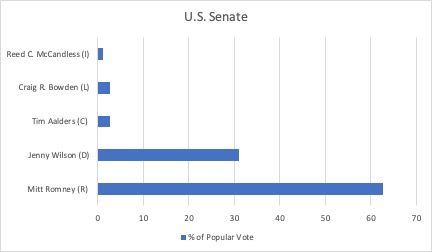
Mitt Romney will be representing Utah in the United States Senate after receiving over 62 percent of the votes. Although Romney faced many qualified opponents, despite public debates and funding, none of them managed to close the gap between themselves and Romney.
Senate

Results for the Utah U.S. Senate Election

Erin Sleater, a third-year student at the U, believes that “the election results will ignite the motivation we need to start real change within our state and country.” Sleater said that students at the U will be more motivated to vote in the future because of the different ballot measures; as well as the state and national races becoming more competitive, like the 4th District congressional race.

The 4th District U.S. House race was regarded as a toss-up until Ben McAdams gained a significant lead over incumbent Mia Love just last week. McAdams’ leads by a margin of 0.26 percent, just above the 0.25 percent needed to qualify for a recount.

The race between Love and McAdams was highly publicized and caught the attention of national donors and the Federal Election Commission after Love violated federal guidelines regarding campaign funding for primary elections. In Utah, candidates are not permitted to raise funds for primary elections if a primary is not expected to occur. Love admitted to improperly raising primary election funds and told the FEC that the campaign would work to refund the contributors or redistribute the money for the general election fund.

House

Results for the Utah U.S. House District 4 Election

Three constitutional amendments were proposed during this election cycle. The first, Constitutional Amendment A proposed a property tax exemption for active members of the military, this amendment passed. The second, Constitutional Amendment B, proposed a tax exemption for government-leased property, 71.62 percent of citizens voted against this amendment. Finally, Constitutional Amendment C passed, giving the legislator the ability to call a special session, limiting the power of the state executive branch.

Question 1 proposed a non-binding opinion about an increase in gas tax to fund education. Question 1 failed, with over 65 percent of constituents voting against the question.

Proposition 2, the medical marijuana initiative passed, however, legislators are working quickly to create an alternative bill to replace the ballot measure Utahns already voted on. With the proposal of the new bill, there would be more state-run pharmacies, but fewer licensed grow facilities. A special medical cannabis board would also be implemented and would require patients under the age of 21 to seek approval from the board before obtaining medical cannabis. Legislators are facing some opposition to the compromise bill because of the significant changes to the citizen ballot initiative.

The ballot measure to expand Medicaid to include people younger than 65 with incomes at or below 138 percent of the federal poverty line passed with 53.32 percent of the popular vote.

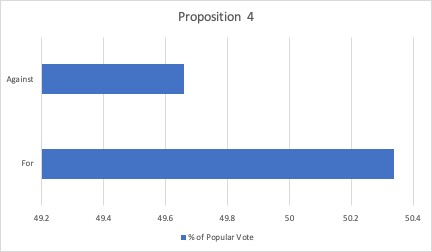
Proposition 4, the ballot measure to create an independent non-partisan redistricting seven-member redistricting commission for congressional and state legislative districts, is still a toss-up with 50.34 percent for the measure, and 49.66 percent against the measure.
4

Results for Proposition 4

Meghan Pollard, a fourth-year student at the U, majoring in Marketing said that Proposition 4 was a ballot measure that motivated her to vote. She believes that “Our voices are only heard if properly represented and loud enough, redistricting would allow for that.”

Meghan believes this election cycle is different because citizens are acting on their frustrations with the current administration and trying to create positive changes within federal and state governments. “People are angry, scared, and disheartened by the current state of the government. They rallied around that frustration and really went to work to improve their lives and the future of America.”

Voter turnout for this midterm election cycle hit a record high across the United States. Over 110 million people voted, compared to 83 million in 2014. In Congress, Republicans strengthened their control over the Senate, but Democrats picked up 29 seats and gained control of the House of Representatives.

Julianne Skrivan, a former White House Intern and current Johns Hopkins University masters student for Political Communications and Strategy, attributes voter increases to the increased publicity of the election cycle, especially with social media becoming more prominent to encourage political participation.


This slideshow requires JavaScript.

Kaeli Wiltbank Reflection Blog: Feminism in Utah

Reflections on Women in Utah recently rank more sexist than men 

by KAELI WILTBANK

I haven’t always been passionate about feminism, in fact, I used to think it was quite bogus how women were being so stubborn about their “rights.” I’m not sure when and I can’t even say what triggered the change, but I’ve recently become very passionate about women’s rights. As a member of The Church of Jesus Christ of Latter Day Saints in Utah, I’ve noticed that there are a lot of members who are very turned off by the word feminism. It’s a strange thing because I know that they would never support gender inequality and most of the members of the church are very passionate about living a life of good morals and ethics.

When I read the above-mentioned article from the Salt Lake Tribune and learned that not only is Utah one of the most sexist states in the nation but that it’s the women who are more sexist than the men, honestly I wasn’t surprised. There is an air of competitiveness among LDS women that can really be destructive.

Did you know that Utah is number six for the number of plastic surgeons per US capita? While I would love to attribute this statistic to men, I believe that it comes as a direct result of women living in a never-ending beauty pageant.

While writing this article and interviewing people, I found that others also expected no less from Utah. It didn’t come as a surprise that Utah was ranked so lowly, but some were surprised that it was women who were more sexist than men. Although, after conversing about the matter, women were able to see the destructive behavior that is present in our society.

This article was fun to write! I enjoy talking with people about feminism and it’s interesting to interview people and learn from them.


Zac Fox

MY STORY: website-bio

MY BLOG: Not a Master Procrastinator

ABOUT ME: Zac Fox is currently a fourth-year student at the University of Utah pursuing a Bachelors of Science degree in Strategic Communications, and is expected to graduate in August 2019.

In addition to completing his college career, Zac is currently the Director of Marketing and Communications at Project Embrace and the Creative and Marketing Director for  AdThing at the University of Utah. Zac had previously worked in several marketing internships in both Salt Lake City, Utah and Los Angeles, California. He had also worked for the University of Utah’s student newspaper, The Utah Chronicle, and the U’s student-run outdoor magazine, Wasatch, as the Production Manager for 3 years — leading his team to achieve over ten design awards recognized by the Society of Professional Journalists and the Utah Press Association.

When he manages to find spare time, Zac can usually be found with a camera in hand taking pictures of his environment. He likes to tell people he’s a “professional observer,” crusader for the brand bible, and hates writing about himself in the third person.

LINKEDIN: Professionally stalk me here.

Kaeli Wiltbank About Me

MY STORY: kaeliwiltbankphoto-4828

MY BLOG: Feminism in Utah

ABOUT ME: Kaeli is passionate about storytelling and advocacy. With a particular interest in gender equality and women’s rights, she dedicates much of her research and writing to that.

Along with being a writer, Kaeli is a fashion and wedding photographer who offers branding and marketing services for businesses.

She has created and shot imagery for a wide selection of clients and has a particular interest in collaborating with personal blogs, clothing lines, commercial businesses, and documenting weddings.

She is about to receive a BA in Strategic Communications from the University of Utah which will compliment her degree in Social Media Marketing from the LDS Business College.

LinkedIn


Taylor Watkins – Reflection Blog

By Taylor Watkins

Election Recap – What’s Next for Utah?

Initially, I wanted to write my Enterprise Story on the importance of voting in midterm and local elections. However, I changed my story idea and decided to write about the midterm elections and how students foresee the results impacting themselves and their peers. For the most part, I chose random sources that I had classes with, but I also wanted the results to come from a wider-range of students. I ended up interviewing three students and one professional seeking a Master’s degree in Political Communications focusing on Political Strategy and Campaigns. The best sources for my story were the students because they each gave a unique perspective on the issues they are facing and how this election impacted them.

One of the main issues I encountered while writing this story was keeping everything non-biased and trying to represent best the opinions I don’t necessarily agree with. I addressed this by maintaining a neutral tone throughout the entire article and focusing on informing the reader. I created a story with all the information I gathered by concentrating on the student perspective of the election and how the results will impact individuals.

One thing that surprised me when writing this article was how challenging it was to get started, and how long it took me to complete the project. The most challenging part was trying to decide how I wanted to present my article and what perspective of the elections I wanted to focus on. It was hard trying to write something that would attract a wide variety of audiences, especially something that would be meaningful to students.


Hollis Leja

MY STORY:

MY BLOG:

I came up with the idea for my story by brainstorming topics with my roommates. We were playing League of Legends when the topic of the University of Utah’s esports team came up. After looking up some background information on the topic and seeing that the U was the first university to do this it seemed like an awesome story.

One of the hardest parts was being able to find people to be able to interview. I was able to dig up a lot of information scattered about online, but had some difficulties originally finding people to interview.

When I was first thinking of the topic, I didn’t know what approach I was going to take with this story. I went over to the Entertainment Arts & Engineering building and met with Kenny Green, who is the head coach for the League of Legends team. He was nice enough to let me interview him. It wasn’t until after my interview with him and seeing his passion for the sport that I saw what direction I wanted to take with this story.

When I got home, I gathered all my research and the information from my interviews. I wanted to be able to link this cool story from the U to what was going on with the Worlds competition happening in South Korea. I really wanted to highlight how awesome it is that the U has a program like this and that this is something we should keep supporting.

This is the first article I have written, and I hope it will be able to show some of the great programs the U has to offer. I also hope to be able to watch the U’s esports team this year and cheer them on this spring.

If you want to support or watch the team you can do so by following the U’s esports Twitch channel.

ABOUT ME:

I have always enjoyed hearing the story of people’s lives, the events and struggles that shaped them into the people they are today. This is what has led me to pursue a degree in strategic communication. I am currently finishing my junior year here at the University of Utah and am starting to be able to see the light at the end of the tunnel.

My goal when I finish my degree is to be able to pursue a career in PR and marketing. When I’m not studying at school I work as a service adviser for Microsoft. I have been with the company for close to five years and have high hopes to be able to continue my career with them.

Outside of work and school I try my best to travel when I can and enjoy spending time with friends and family. Over the next few years I hope to be able to continue to develop my skills and live life to its fullest.

Taylor Watkins

ABOUT ME:

Taylor Watkins is a fourth-year student at the University of Utah majoring in strategic communication and political science. She is currently working as the Vice President of Media & Marketing for the Utah Panhellenic Association and is responsible for maintaining all forms of publicity for the Office of Fraternity and Sorority Life at the U.

Taylor grew up in Park City, UT and attended Park City High School. In her free time, Taylor can be found skiing at Park City Mountain Resort or spending time with her friends and family.

Taylor will be graduating from the College of Social and Behavioral Science and the College of Humanities in May 2019. After graduation, she hopes to work in marketing or public relations.

32.jpg

MY STORY: 

Election Recap – What’s Next for Utah?

MY BLOG

LINKEDIN

Women in Utah recently rank more sexist than men

Story and photos by KAELI WILTBANK

SALT LAKE CITY — Utah has recently been ranked the second most sexist state in the United States. Leading the pack of sexist attitudes is . . . well, surprisingly, it’s women. In a study done by economists at the University of Chicago, Northwestern University and National University Singapore, questions such as “Are men better suited emotionally for politics than are most women?” and “It is much better for everyone involved if the man is the achiever outside the home and [the woman] takes care of the home and family” were asked.

ARSEJ5B5MNESHCTVRLPYBSJE2UImage from Washington Post

The study showed that the queen bees of Utah held their position as No. 2, while the men dropped, granted, still quite low, but to No. 5 in the ranking of most sexist states. Yes, that means the women of Utah are more sexist than the men.

“You experience inherent sexism every day in Utah and I think a lot of it is stuff that you

kaeliwiltbankweb-4978

Real queens fix each other’s crowns.

don’t really notice,” says Becca Rettenberger, Operations Manager at a Salt Lake City-based marketing agency, Friendemic. Rettenberger continues to explain how our communities, our workplaces, our homes are all tainted with gender inequality and have been for as long as we can go back in the textbooks. Unfortunately, we’ve become so accustomed to swimming in it that we can hardly distinguish what gender inequality looks and feels like.

“From a business standpoint, I can list several different instances where I was working alongside other women or reporting to women,” says Rettenberger, “it was very much not an ‘I’m up here and I’m going to pull you up here as well so you have a voice at the table, it was a stay in your lane conversation the majority of the time.”

Why did Utah rank so high in the study on gender inequality? 

Rachel Griffin, a professor at the University of Utah who specializes in race and gender studies, says there exists an inherent sexism in Utah.  “It’s not just gendered, it’s power-laden with religion.”

The strong presence of The Church of Jesus Christ of Latter-day Saints must be considered when analyzing the results of the study. “Akin to every major religion we have, Mormonism is deeply anchored in patriarchy,” says Griffin. “Feminism offers a critique of patriarchy, and most people aren’t a fan of being critiqued.”

kaeliwiltbankphoto-6584

Mother’s arms hold more than they realize.

Whitney Baggaley is a University of Utah graduate and stay at home mother. She is also a member of The Church of Jesus Christ of Latter Day Saints. “It’s such a social church. If every woman at church is a stay at home mom, there are a lot of social pressures surrounding that,” she says. 

Not only is Utah a very religious state, but it’s also a very conservative state. Still, this can’t simply be regarded a red vs blue issue. Typically conservative states such as Wyoming and Alaska led the country in gender equality. That’s right, these conservative states pay the same salary for the same job, regardless of gender. People feel valued in their workplace, regardless of their gender. There are equal opportunities for both men and women to lead the company meeting. n these conservative states, all of these rights and opportunities are offered, regardless of gender.

“Utah is the land of extremes,” says Baggaley, where stay at home mothers are extremely passionate about their role as wives and mothers, and the working women and the women in politics are equally passionate about what they do. Perhaps such an extreme spectrum anomaly creates an atmosphere where women have a hard time supporting other women who don’t do things the same way as them.

At an event hosted by the Communications Department at The University of Utah, Dialoguing Across Differences, a small group of community members discussed how to approach polarizing topics, such as politics, religion, and sex. The conversation turned towards discussing intentions. Perhaps you’re standing in line at the grocery store and someone in front of you takes a step backward, stepping on your toes. Did the person intend to step on your toes? Probably not. Nevertheless, those good intentions don’t take away the pain of your toes being crushed. Until we get the courage to tap our linemate on the shoulder and say “Excuse me, you’re stepping on my toes. That hurts,” the person may not see how their actions are affecting those around them.

There’s something to be said about intentions, they are a powerful driving force behind our thoughts and actions. While Utah is filled to the brim with well-intended women, perhaps we need to take a step back and see who’s toes we may be stepping on. No matter which side of the feminism line we stand on, there seems to be discord among the women of the state. How powerful a force we could be if we realized the pain we may be causing others by our good intentions, then found the courage to join together in mutual support, regardless of differences.

Reflection Blog

This slideshow requires JavaScript.

Sicily Romano

Image

MY STORY: Motorsports athletes conquering the business world

MY BLOG: Writing Motorsports athletes conquering the business world

ABOUT ME:

Sicily

Sicily Romano, 17 years old, Junior at the University of Utah, Strategic Communications Major

I’m currently a Junior at the University of Utah and will hopefully be graduating in the spring of 2020 with a degree in Strategic Communications . I have always had a high interest in sales and marketing and working in the strategic communications degree has just made me fall in love with it that much more. Before college I was a professional ski racer, I spent more time skiing than anything else which made me grow up in a very untraditional way. From skiing I got to travel and experience a lot of the world but with everything I gained I lost even more. I never got the normal high school experience, my friends were also my competition which made it difficult for all of us to get along and balancing school and my competition schedule was near impossible. So, come my senior year of high school I ultimately decided that ski racing was no longer for me and come January I would go to college to pursue my dreams of working in marketing. It was the best decision I ever made. Now in college I havent given up sports completely, I am on the U of Us club wake board team because I just couldn’t let the competitive side of me go. Being on the wake board team has helped me create so many amazing memories in college and meet so many unique people. I currently work full-time as a food runner at Ruth’s Chris steak house in Park City. though this isn’t the sales job I want it has taught me how to interact with any type of person and create an interpersonal conversation with every guest I meet.

Linkedin: Sicily Romano


Reflection blog: Motorsports athletes conquering the business world

By Sicily Romano

My STORY: Motor Sports Athletes Conquering the Business World

When exploring what I wanted to write about I thought about the community I grew up in, which was the extreme sports community. I tried to tell the story of amazing athletes like people hadn’t heard before. I believe that many people think that athletes live off of their winnings and sponsorships but that’s not true for all athletes, it’s actually not true for most athletes.

My story encapsulates what these athletes do to have an income and how they have used the knowledge they have gained from the sports that athletes have competed in and the businesses they created from them. A significant part of making this story happen was securing an interview with high-profile athletes. I had hopes of interviewing five Motorsports athletes being Travis Pastrana, Andy Bell, Todd Romano, Roland Sands, and Robby Gordon, but as you could guess these athletes are extremely busy running the business and doing what they love, so I was only able to secure three interviews. I do have a conflict of interest with one of the athletes I interviewed being Mr. Romano Romano is my dad so I had to be objective with the interview I got from him, so it didn’t turn into a marketing story, which I think I did perfectly.

This story showed me that I need to take out the fluff and just get right to the point. Which can kinda be difficult? I have had minimal experience writing news articles and a lot of experience writing college essays which contain a lot of fluff usually. After finishing this article, I had to go through and take out almost 100 extra words.

While learning about these athletes, I learned about so many different types of business that I really never thought of before or even saw as options for me. The more I talked to them the more I not only saw other options of careers but a way to continue to enjoy what you love while making an income.

Motor Sports Athletes Conquering the Business World

Andy Bell competing In freestyle motocross

Story by Sicily Romano

SALT LAKE CITY — In motorsports, winnings, and sponsorships don’t generate enough income for athletes to sustain their lives. Subsequently, these athletes compete and accomplish things in sports that some can’t even fathom, all while conquering the business world.

Andy Bell, formerly a freestyle motocross rider, knew from a young age that he wanted to own his own company. “I started racing FMX (freestyle motocross) in 1999 till about 2004,” he says. While riding FMX, Bell saw his first business opportunity. “A lot of athletes, when they are at the top, act too cool for school,” he says. “I saw the opportunity to not only befriend all the athletes but the promoters as well.”

When promoters wanted athletes at their event, Bell realized that he could broker the deal. He leveraged the friendships and connections made as an athlete to start his own production company. “Even while competing, I was never interested in just being an athlete, I knew I wanted to do more,” says Bell.

After several years on Nitro Circus, Bell tried to work as a stuntman, but stunts weren’t bringing enough income. He decided he needed to make something else work.  “I knew nothing about production, other than being in front of the camera,” says Bell. Still, he started his own company with a plan to create 3-D content around action sports “because, at the time when you went into stores and looked at 3-D TVs, all they had for content was, like flowers opening.” Though Bell’s original idea for 3-D videos got sidetracked, his production dream came true when Travis Pastrana asked him to star in a webisode for Red Bull called “On Pace with Pastrana.”

IMG_5718.jpg

Travis and Andy Bell on set for On Pace with Pastrana

Bell asked Pastrana if they had a production company yet. One thing led to another and Bell was a producer. After two seasons producing “On Pace with Pastrana,” with Red Bull, Bell expanded his business, using his connections from “Nitro Circus” and as an FMX rider. He contacted Toyota, told them about Sweat Pants Media (his production company) and immediately started producing content for them.

Recently Bell traveled to Canada to produce Toyotas TRD pro commercial, which will showcase Toyotas’ new vehicles expected to hit the market later this year. The commercial will be shown in February at the Chicago auto show.

Bell is one of the many athletes who has taken their love of motorsports and created businesses. Travis Pastrana has done amazing things through the connections and knowledge gained from competing in motorsports. Pastrana started in motocross which because of his success MX, opened additional opportunities.

23578_107812875925817_5759213_n

Travis Pastrana Jumping Over a plane

Pastrana has always been a daredevil. “(Producer) Gregg Godfrey sent me a Sony 2000 camera and Final Cut Pro 3 to edit on,” he says, “Everyone was coming over to learn backflips that summer. I documented everything and helped build jumps to make their dreams and nightmares come true.”

That was how “Nitro Circus” began. Pastrana has been able to help other athletes make their dreams, or in his word’s “nightmares,” come true. Not only did he created “Nitro Circus,” but he has started a two-event series around it — “Nitro Circus World Games” and “Nitro Circus Live.” Pastrana hosts 70 plus live shows a year, and although his primary business is producing spectator events, he still gets to ride motocross and race cars.

Todd Romano has also created a business by leveraging his knowledge and connections. Romano started out racing mountain bikes in college and soon realized that the guys beating him on bikes were also racing motocross. His sponsors, Specialized and Fox, supported his switch to MX (motocross) where he found his competition racing something even bigger and faster: off-road cars.

Romano discovered a market for aftermarket products for off-road vehicles, specifically side by sides. His first company was Dragon Fire Racing, which sold aftermarket products for (RHINOS). Later,  he sold Dragon Fire and opened Finish Line Marketing, a business to help other motorsports companies with everything from basic business strategy to marketing.

FullSizeRender

Todd Romano Jumping Wild Cat XX. Glamis Califronia

Romano has many lucrative connections with sponsors and companies he’s met. He’s been successful pitching himself and his company, leading to partnerships with industry leaders like Hawk Performance. Romano was contracted by Hawk to help grow their company through improved marketing and smoother business operations. Currently, Romano is working with Textron where he has partnered with Robby Gordon to design and produce the Wild Cat XX. He also owns a company that sells aftermarket products for new Textron vehicles called Speed Side by Side.

These are not the only athletes to create business out of the knowledge they have gained from competition, and their success goes to show, you don’t have to give up on your dream to make an income.

Wc 917


This slideshow requires JavaScript.


Kim Davison

MY STORY:

MY BLOG:

When I was thinking of topics to write about for my Enterprise Story,
I knew it needed to be something I was passionate about. I threw
around ideas of something to do with Greek life, interviewing theater
companies around town and something having to do with visual art. I
immediately realized that those were too broad. I tried narrowing
ideas down by making them more specific. I finally came to the idea of
writing an article detailing the Utah Shakespeare Competition that
happens every fall. I knew it was specific enough, but was also part
of the bigger and more widely known Utah Shakespeare Festival. I knew
that people probably knew about the festival, but probably did not
know that there was a high school competition attached to it.

I was already planning on going down to Cedar City, Utah, for the
competition with my work, so it was a perfect choice! My only worry
was that I was going to be too personally and emotionally attached to
the piece. I competed in the Shakespeare Competition for three years
and have gone back working with Youth Theatre at the University of
Utah for the last four years. I knew that if I committed to covering
the competition as a whole that I would not get tied up in my past
experiences.

The sources that I chose to use were good ones because
they varied in experience with the competition. I talked to my boss,
Penny Caywood, about her experiences with the competition and what it
has been like to take a non-traditional high school group for the last
seven years. Then I decided that the best people to interview would be
students who were attending the competition. I talked to several
students from different schools — one who it was their first year and
another who had been competing for many years. Their views were
different, but they both shared that the Utah Shakespeare Competition
had been a very positive part of their high school careers.

The writing process for this article was fun and easier than I
expected. Because I had previous knowledge about the basics of the
competition, I was able to dive in and learn more about the details. I
did gather a lot of information, and it was hard to decide what to put
in the article. But when I decided that my structure would be breaking
down and describing each element of the competition, it got much
easier to pick and choose what information actually added to my piece.
Through writing my Enterprise Story I learned that I like to
incorporate a more playful and informal tone into my writing. I’m not
sure if that is a good or a bad thing, but it is definitely a thing! I
loved writing this piece and hope that you enjoy it and check out the
Utah Shakespeare Festival and Competition in years to come!

ABOUT ME:

Screen Shot 2018-11-05 at 9.53.00 AMHi! I am Kim Davison and I am a fourth-year student at the University of Utah double majoring in strategic communications and theatre studies. I am very involved on campus and love everything about the U!

I am currently the president of an online magazine on campus called Her Campus Utah. Her Campus is written by students for students and has been one of the best parts of my college career.

I am involved in Greek life on campus and am a member of the Alpha Chi Omega sorority. I am also on the Greek Council as the vice president of events for Panhellenic. Through that position, I have planned all
of the Greek-wide events for 2018. I have also held positions on ASUU, It’s On Us, Student Media Council and more!

Here are some quick fun facts about me:
1. I love to travel and have been to over 30 countries.
2. I am very crafty and love to sew, embroider and paint.
3. I have two dogs and a cat.
4. My favorite animal is a whale.


The importance of organ donation from many points of view

Story and gallery by HANNAH COOK

It’s a choice that can save a life.

Many people in this world don’t know the importance of organ donation. They don’t understand how many people are affected by just one organ that is donated.

For Bob Daniels, receiving an organ would be a second chance at life. A chance to attend his son’s wedding. A chance to be a grandpa.

Due to genetic failure, Daniels is currently waitlisted for a kidney and has been waitlisted for one year. Daniels lives in South Weber, Utah, and is currently working for the railroad to continue to provide for his family.

Daniels and his family are doing everything they can to prolong his life,while he is on the wait list. His wife is even donating her kidney to someone in need to help move him higher up on the list.

Daniels said in a phone interview that organ donation is much more than what is done with your body once you have died. It is what gives some people a second chance at life.

“Though I am biased, I wish people knew that organ donation is not a bad thing and should actually be praised. Many are concerned with what happens with their body afterwards, but they don’t see that good that is done,” he said.

In the subject of people offering to be organ donors and if people should be forced to donate their organs after they’ve died, or if it should always be a choice, he said. “I do believe that everyone should have a choice. I just wish they would make the right choice.”

Though becoming an organ donor is a choice that each person makes, there are many logistics that play into being a donor. Intermountain Donor Services is a company that takes care of those logistics for people who are waitlisted.

Intermountain Donor Services is a nonprofit organization located in Salt Lake City that retrieves organs from a body of a person who has died. It is the only organization in Utah that can retrieve all organs. Organs that can be retrieved are the heart, lungs, kidneys, liver, pancreas and occasionally the small bowel and tissues can be taken and used in organ donation.

All organs can be used from the body of someone who has died if that person has given consent by becoming a donor.

“Organ donation affects many people. Both the recipient and the donor, both of these parties have parents, and friends, and coworkers, and neighbors that are affected by a successful transplant,” said Alex McDonald, director of public relations for Intermountain Donor Services.

Nationally, there are about 115,000 people who are waiting for a transplant. These people range in ages from newborn to 70 years old. Of those, approximately 80,000 are waiting for kidneys. McDonald said “numerically, kidneys are the most needed.”

“With a failing liver, there is no artificial way to keep a liver going. If a person needs a kidney, they can be temporarily sustained with dialysis. If a heart is needed, it can be artificially sustained, and lungs can be helped with oxygen. But there is no way to artificially represent a liver and its functions to the human body,” McDonald said.

If McDonald were to say anything to someone who was becoming an organ donor, he would tell them, “About 21 people die every day waiting for a transplant. This would equal about seven thousand and four hundred people a year, nationally, who die waiting. Utah alone has approximatively 800 people on the waitlist.”

McDonald would like anyone who is considering becoming a donor to think that no one just woke up one day and decided they wanted a new organ. They were put into this situation and now they are in need. “Would you wish someone would be a donor, so you could live? Would you be willing to do the same?” McDonald said.

A person can choose for themselves at the age of 16 if they’d like to be a donor or not. If a donor is under the age of 18, Intermountain Donor Services will honor the parents’ wishes. Some parents can’t fathom the thought, but for parents such as Kathy Shelton, it was a miracle.

Shelton is a resident of Roy, Utah. Her daughter, Heidi, lived in Salt Lake City. She died in the summer of 2014 of an accidental overdose. Kathy was able to donate her daughter’s corneas and some of the larger bones in her arms.

Organ donation is important to her because due to her daughter donating, someone is able to see again, or someone who needed a bone graft is now able to receive one. Shelton strongly believes in the benefits of organ donation and explains that organ donation is the only way that science and medicine will every advance.

Shelton’s daughter at some point actually needed a bone graft and had received one from a cadaver.

“You hear about the parents get to meet the people whose organs go to many people. Think if a person can recover eight organs that’s eight people that are affected. And eight people with parents and families and friends who get a second chance at life,” Shelton said.

Shelton is a donor herself and said she plans to donate her entire body to science. This will help doctors to be able to practice and to help the advancement of medicine.

Organ donation can touch many lives and is very important to many. You can grant someone a second chance at life. You can change the lives of thousands by just saying “Yes” to becoming an organ donor when obtaining your driver license. You can also register to become an organ donor online through Intermountain Donor Services.


Link

MY STORY: MKP_4175

  • Hale Center Theater’s new updates are raising the bar for Utah performing arts


MY BLOG: Hale Centre Theatre


ABOUT ME:  Amy Boud

I am a current Communication major at the University of Utah, and an Assistant Event Coordinator with Stadium and Arena Event Services.  My plan is to graduate and become a destination wedding planner in Park City, UT.  My husband Troy is a solar engineer, and we are the proud parents of a little Schmorky (Schitzu, Yorky, Maltese mix) puppy named Goob.  Together we hope to make the world a better place by helping the environment, and helping people to live their dreams.

Cool Runnings 2.0: Ghana and Skeleton in the Olympics

by KATIE ANDRESS

SALT LAKE CITY— Ghanaian skeleton athlete, Akwasi Frimpong, became the first skeleton athlete from Ghana to compete in the Winter Olympics in 2018. Today he, along with several former U.S. skeleton coaches and athletes, is forming Ghana’s first Bobsled and Skeleton Federation. Just like the Jamaican bobsled team before him, Akwasi Frimpong is pushing the boundaries of the Olympic status quo.

Frimpong’s goal is the modern-day version of the 1988 Jamaican bobsled team memorialized in “Cool Runnings,” a 1993 movie about the Jamaican team’s road to qualifying and competing in the 1988 Winter Olympics. Thirty years later, Akwasi Frimpong is walking down the same path.

A sprinter on the Dutch 4×100 team, Frimpong had aspirations of being an Olympian since he was 17-years-old. Unfortunately, he missed qualifying for the 2012 Summer Olympics in London. Later, the Netherlands bobsled team recruited him due to his sprinting ability. After making the bobsled team in 2012, he competed and narrowly missed qualifying for the 2014 Winter Olympics in Sochi, being named as the alternate brakeman. In November 2016, his coach convinced him to try skeleton.

IMG_2104 2.JPG

A scenic view from the top of the Lake Placid, N.Y. track in the fall. AP Photo/Katie Andress

Similar to bobsled, skeleton athletes slide on their stomach, headfirst on a large, lunch-tray style sled. Top athletes reach speeds of over 80 m.p.h., sliding through approximately 15 curves on a mile-long ice track.

After deciding to become a competitive skeleton slider, Frimpong then had to decide what nation to represent; The Netherlands, where he began his track and bobsled career, or his birth country, Ghana. “I was 30 and realized that I had not done anything for the country where I was born and this was a huge opportunity for me to go after my dreams of becoming an Olympian.” The only logical choice would be to compete for his birth country, Frimpong concluded. He also hoped that by doing so, he would inspire the youth of Ghana to venture beyond the comfortable and dare to dream.

Frimpong qualified for the 2018 Winter Olympics in PyeongChang, South Korea; making him the first athlete from Ghana to represent skeleton in the Winter Olympics. There, he was aided by Lauri Bausch, a coach for the U.S. team who occasionally helped coach athletes from smaller nations on the side. Bausch has been a coach for the U.S. team since 2015, after a hamstring injury ended her own six-year skeleton career.

“Akwasi has a charm about him that is attention-getting which aided him in sharing his unique upbringing and efforts to represent his birth country and continent,” says Bausch. “He is positive and hardworking, and does much to stay connected especially to the youth of Ghana and is not just focused on himself.”

Frimpong ended up being an unexpected hit among the fans. He didn’t really expect to receive as much attention as he did. “I was honored to touch the hearts of millions of people all over the world to dare to dream and to go after their wildest dreams,” he says.

After returning to Utah, where he currently lives with his family, Frimpong set out to accomplish his next goal: start the Ghana Bobsled and Skeleton Federation and bring Ghanaian athletes to the Winter Olympics.

Frimpong has hosted multiple skeleton clinics in Ghana to introduce and inspire Ghanaian youth. He hopes they’ll be inspired to try the sport. Meanwhile, he held a combine event in Salt Lake City to recruit potential skeleton athletes with Ghanaian roots.

Recently, the developing Federation appointed former U.S. skeleton coach, Zach Lund, as the head performance director. Lund competed for 11 years on the U.S. skeleton team before switching over to coaching for the last eight.

Lund decided to join Ghana after philosophical differences with the U.S. program and is excited for the burgeoning Ghanaian Federation. “Akwasi came to me with his vision for the Ghana program. His vision was inspiring and felt like something that was bigger than just skeleton,” Lund says.

Lund hopes to turn Ghana into a sliding sports “powerhouse,” which is not out of the realm of possibility. Not only was Lund an Olympian, he also coached U.S. athletes to three Olympic medals. Moreover, he intends to do more than just go fast.

Lund and Frimpong both want to make history, and that’s what he likes most about Akwasi. “Instead of trying to inspire a continent, we are trying to bring diversity into a sport and Olympic movement that lacks.” There are not nearly enough African nations involved in the Winter Olympics, he says.

IMG_7384.jpeg

Zach Lund and Akwasi Frimpong are standing at the starting line preparing for a run. Frimpong was competing in his first race of the season on November 7, 2018 in Whistler, Canada. AP Photo/Akwasi Frimpong

That’s what special about the Olympics, bringing nations together, big and small, on one stage to compete. “It’s not about the nation winning medals,” Lund said in an interview with GhanaWeb, a website all about Ghana. “It’s about being with people who are there for the right reasons. The Olympics are about bringing people together.”

The number of countries that have competed in the Winter Olympics have steadily been on the rise. According to olympic.org., the 1972 Olympics in Sapporo, Japan,  had 35 competing countries, growing to 92 now in the most recent 2018 PyeongChang Winter Olympic Games. These figures however, don’t compete with the Summer Olympics. During the 1972 Summer Games in Munich, 121 countries competed, which increased to 207 during the Rio Olympics in 2016.

Lund hopes the creation of the Ghanaian Bobsled and Skeleton Federation will be the beginning of other African countries competing. “It’s about the small nations being on the same playing field with the larger nations, competing against them,” says Lund. “That’s what I love about the Olympics.”

This slideshow requires JavaScript.

Natural remedies to reduce stress and anxiety

Story and images by  CLAIRE HILLARD

Take a long run or sit still with a glass of tea and feel the weight of stress drift away.

In the United States, a majority of people with anxiety either neglect their troubles or use pharmaceuticals to dull their anxious feelings. People do not have to suffer through anxiety nor do they have to use medications with negative side effects.

For some, natural remedies may be the answer.

Dr. Uli Knorr is a naturopathic doctor who practices in Salt Lake City. He received an education from the National College of Naturopathic Medicine in Oregon.

Knorr said something that many people with anxiety may like to hear — that anxiety has little to do with an individual’s personality. Most commonly, stress is caused by some hormonal imbalance in the body.

rowing small

Knorr recommended physical activity as well as spending time outdoors to help reduce stress.

To some extent, humans need stress. However, too much stress can be detrimental. If the body is experiencing constant stress, it continues to act in a fight-or-flight state. “People who are very stressed are surviving, but they’re also perceiving life as life during war time,” Knorr said. This is not a healthy state to remain in long-term.

The method of stress relief that Knorr recommends above others is exercise. The many health benefits of exercise are well documented. Additionally, while exercise releases stress, it is also a type of stress itself. Knorr says that because exercise is a type of stress, it can help the body adapt to other types of stress in the future.

Mia Gallardo has found a passion in aerial — a type of acrobatics done while hanging from fabric. For her, this combination of physical demand and artistic expression is a major relief for stress.

ashwagandha small

A personal health routine including various vitamins and ashwagandha.

Gallardo is an avid believer in natural medicines. Throughout her personal journey, she has used a number of natural techniques to reduce her stress. Many of her favorite stress-relieving techniques perfectly exemplify the practices that the two professionals recommend.

Knorr’s advice to anyone who struggles with stress is to not ignore their feelings of anxiousness, to participate in some form of exercise, consider taking a complete B vitamin and vitamin C, and consider herbs that may help. And if none of those things help, book an appointment with a health-care professional.

Tea edit small

Upon sitting for the interview, Josh Williams poured each of us a cup of warm tea.

Over a piping cup of local, Native American tea, Josh Williams shared some of his thoughts on stress and ways to address it. Williams is a clinical herbalist who received his education from East West — an herbal medicine program in Sarasota, Florida. He currently owns an herbal shop in Salt Lake City called Greenthread Herbs.

Williams believes that the key to reducing stress lies somewhere in self-care. Whatever that means to each individual, self-care is a good way to approach good health.

For Gallardo, self-care is a big part of her stress-relieving practices. To reduce stress she is known to meditate, bake, spend time with loved ones, or read “Harry Potter” books. Taking time just to do something that makes a person happy can be incredibly therapeutic.

For Williams, he sees taking herbal medicines as a form of self-care. For example, he shared his love for tea. “Tea taught me how to slow down,” he said. Simply being able to sit in peace can do wonders for a person’s mental state.

coffee small

Acts of self care can be as simple as taking time to sip a cup of coffee and read a good book.

While herbal medicine is less commonly used in the United States, the practices are used worldwide and throughout history. There are many herbs that for centuries have been used to help people manage stress.

Interestingly enough, Knorr, Williams, and Gallardo all mentioned “ashwagandha” in their interviews. Knorr suggested it, Gallardo takes it every night, and Williams said it is his “spirit plant.” Ashwagandha is a plant that is known for its many medicinal benefits — especially for soothing anxiety.

Jars edit small

A wall inside Greenthread Herbs displaying just a few of the available herbs.

Plants like ashwagandha will not take the pain away. Instead, they aid the body in overcoming the stress it is under. While many people want a quick fix to their anxiety, using natural products may be beneficial in the long run by helping someone improve their ability to handle stress.

Using herbs helps the body get better at responding to stress, as opposed to simply ignoring or medicating for it. When referring to common pharmaceuticals for anxiety, Williams said, “Instead of learning how to deal with these stresses and learn from them, we numb out.”

In the same way that lifting weights helps people gain muscle mass, individuals can train their body to overcome stress. By experiencing stress in a calm manner, the body begins to adjust and approach it differently. Over time, individuals can feel calmer in the face of stress and train the body to respond accordingly.

This means overcoming anxiety as opposed to relying on numbing medication.

Many people struggle with high levels of stress every day and use different methods of dealing — or not dealing — with it. Wanting to make a change and knowing your options are two steps in the right direction.

Whether it be exercising, drinking tea, or adding a touch of herbal medicine to your daily routine, there are ways to reduce stress. Finding what works best for you is part of the journey.

Tea Sign small

A sign in Greenthread Herbs offering customers the opportunity to create custom tea blends.

Local Business Cross E Ranch Celebrates Its 50th Anniversary

Story and images by EMMA CHAVEZ

Cross E Ranch is a small local cattle ranch in the Salt Lake City neighborhood of Rose Park. It celebrated its 50th anniversary in 2018.

IMG_3934

The Great Red Barn was built in 1880.

David Hinckley purchased the land from the Jeremy family, of Jeremy Ranch Park City, in 1968. David kept the business in the family, as his son, Dalon, and daughter, Heather, are the current co-owners.  

Cross E Ranch has a long history. Dalon, 29, began working with his dad when he was just 8 years old. He explained that originally the ranch was in the business of sheep, but his father quickly turned over to cattle. “We don’t do sheep anymore because, well, we’re just not that crazy. Sheep take a lot more work and are kind of a delicate animal,” Dalon says. Instead the ranch now raises black Angus beef. That’s just fine by Dalon, though. The cows are his favorite part of the job.  

IMG_3939

The ranch now raises black Angus beef.

“The cows keep us grounded in what we do each day,” Dalon says. The most interesting part of the ranch’s history, in fact, is its cattle brand. It is the cross E, and the namesake of the ranch. It is the oldest cattle brand still in use west of the Mississippi. It is a bit of a mystery. “We know it was used by a commander in Brigham Young’s Mormon Battalion, most likely Ethan Jeremy, but we aren’t sure,” Dalon says.

But the Jeremy family would not sell the ranch to David Hinckley unless he promised to keep using the brand, and David’s family have felt very honored and proud to be owners of such a historic brand ever since.

There a plenty of photo ops all over the ranch.

Running a cattle ranch is difficult work, but the hardest part isn’t the manual labor like you would think. Dalon likens being a rancher to that of a gambler, playing the highest of stakes. The nature of the business is luck. “There’s a lot of hope involved,” Dalon says. “You can gamble up to $300,000 on a crop of produce, and then you’re weather dependent.” Or in the case of a festival, “you’re hoping that in six weeks you can recuperate your investment and then make enough to make it worth it.” 

In the last 50 years, though, the stakes have increased tenfold. The entire business has changed. Dalon explained that he is now competing on a global agricultural market. His operation is now expected to be equally as efficient as a ranch that is working for a mass retailer, and shipping globally. It puts a strain on his resources.

Even more concerning has been the encroachment of development. Hundreds of acres of Dalon’s land have been bought out by the state government due to water accessibility, or shut down due to new EPA regulations. The changes began to greatly affect the business. “About seven years ago, we started losing hand over fist money, nearly $400,000,” Dalon says. “We had to completely reinvent the diversification of where our money was coming from.”

A display outside the Cross E Ranch pumpkin patch.

These changes forced the family to get creative with their revenue streams, which is how the Cross E Ranch festivals began. The ranch puts on three major festivals a year, the Summer Fun Free Days, the Baby Animal Festival and the Fall Festival. It also offers a multitude of private events, such as weddings, summer camps and corporate events.

Despite the stress the festivals cause him, Dalon says the creative aspect they bring to the job is the real fun part of the business. His goal is to constantly come up with new ways to make the farm better and more entertaining for the guests. Dalon just wants people to connect with agriculture, so he spends his time thinking of new ways to make the farm experience more accessible.

The Fall Festival, specifically, has been a major success since it started in 2014. Mother-daughter working duo Teresa and Kristal Hyde consider it their favorite festival. Kristal, who is the ranch’s event coordinator, described the Fall Festival as “fun, family, and good times.” Teresa, who helps run the ticket booth, nodded in agreement and added, “I’ve gone for the past three years before either of us worked here. They make their own doughnuts and it’s my favorite.”

IMG_3932

“There’s something for everyone.”

Of all the activities available, both Kristal and Teresa recommend the hay ride as a must-go-on when the festival next comes around, while Dalon insists everyone try the food. “There’s a doughnut shop, caramel apples, kettle corn, and a concessions shop where you can try a Cross E hamburger,” Dalon says. “There’s something for everyone.” This 2018 Fall Festival included a 14-acre corn maze, a 12-acre pumpkin patch, hay rides, slides, animals, and plenty of food. Check the Cross E Ranch website for more details on its variety of year-round festivals and activities.

Dalon is very excited with the direction the ranch is heading currently, but admits that it is expensive to change. He and his sister Heather haven’t taken a paycheck in two years. “Herding people and cows are really similar,” he said with a laugh, “but they do require different fencing. We haven’t made any money on the festivals yet because we keep reinvesting in them.” It’s quite a strenuous transition period.

An old tractor turned display on the edge of the ranch.

In the future, Dalon hopes the ranch will stay in the family. Heather has four daughters that she would like to see be involved. The siblings would both like to continue toward the direction of mixed use, with plenty of entertainment, but also maintaining the interactivity and ambience of the ranch.

Chi Omega Sorority Promotes Make-a-Wish

Story and gallery by VIRGINIA HILL 

As a college student, it can be hard to get involved with service or even think about anything other than yourself and school. But an unlikely group is encouraging students to get involved in philanthropy and making it fun. Chi Omega, or Chio, is hosting a service-oriented week to raise money for the Make-A-Wish Foundation.

Chi Omega is a national sorority with the local chapter being part of the University of Utah campus. Chio attracts hundred of women every year and encourages friendship and sisterhood. According to the Chio’s mission statement, it strives to promote friendship, personal integrity, service to others, academic excellence, community, campus involvement, and personal development. While sororities throughout the country may get a reputation contrary to this mission statement, the annual efforts of the local Chio chapter to host a Wish Week in service to the Make-A-Wish Foundation demonstrate its devotion to the sorority’s mission.

Savanna Dubell, president of the local chapter of Chi Omega, made it clear how important service is to her and the members. She explained Chio’s history with Make-A-Wish and the dedication to service. “For almost 30 years Chio has had a national philanthropy, it is a cause that the sorority believes in and that all chapters would work to raise money for. A while ago they made a partnership with Make-A-Wish and that is who we continue to work with today,” she said.

From Sept. 24-27, Chio hosts Wish Week, a week completely devoted to planned, paid admission events that attract peers to come and participate in philanthropic efforts. This annual event changes from year to year depending on plans made by the director of philanthropy.

Eliza Parkin, the 2018 director, gave a brief summary of the week she planned: “Monday was dessert night, where girls bake or buy treats and other students come and buy them, Tuesday we partnered with Buffalo Wild Wings to bring wings to our house where boys or girls can compete in a wing eating contest, Wednesday we partnered with Chipotle so they will give us a portion of all profits made at one of their locations, and Thursday we hosted a big soccer tournament for anyone who wants to watch or participate.”

With all these events there is some sort of purchase or buy-in, and Parkin explained that 100 percent of the money went toward Make-A-Wish to help one particular child.

This child is an important one and the focus of all of Chio’s efforts. With the philanthropic efforts each year, Chio is able to donate the money to a particular child through Make-A-Wish. Both Parkin and Dubell feel that this personal approach to donation and philanthropy “incentivizes the girls to work towards something meaningful and feel that their efforts and money are going toward something real.”

This year’s 2018 Wish Girl is Mackenzie, a 13-year-old who has been battling cancer. According to Chios interviewed for this story, Mackenzie has a bubbly personality that has not been diminished by her personal health struggles. Mackenzie has a wish to go to Disney World and with the efforts of Chio, they hope to reach this goal by the end of the year. The women have all been able to meet Mackenzie and are touched by her story.

Meggie Nelson, a sister of Chi Omega, said, “Mackenzie and Make-A-Wish are very close to my heart and our chapter wants to do everything it can to raise money for her.”

Chios are pushing to completely fulfill her wish and are on track to do so. The Chio women’s efforts to do just that are tremendous, they worked tirelessly to plan and orchestrate great events, they posted announcements and calls to action on social media to encourage friends to come and participate. These events turned out to be packed with students and peers enjoying themselves and contributing what they could to this cause.

The women’s devotion to this has been encouraging and sets an example to others about service. This devotion seems to be a national effort as well. According to the national Chi Omega website, chapters have raised “more than 20 million dollars and have volunteered over a million hours for Make-A-Wish.” But Wish Week is just the beginning of Chio’s philanthropic efforts this 2018 school year. According to Parkin, the chapter will continue to host events and find ways to raise money for Mackenzie through the end of the school year. There is even talk of hosting a masquerade ball to further their efforts. The work of Chio and its leaders has made for a successful Wish Week.


IMG_4756

Sorority members flashing the Chi Omega sign at Dessert Night.

IMG_9046

Sorority members and their peers showing support for the week’s events.

IMG_4754

Gearing up for the wing contest.

IMG_4751

Sorority girls posing with Wish Girl Mackenzie.

IMG_4753

Rows of college students prepare for the wing competition.

IMG_4755

Mackenzie is introduced to the group of students.


Reaching out to China’s past

Story and gallery by PORTER L. ANDERSON

The Family History Library in downtown Salt Lake City has for many years been a free and open facility where visitors can come and conduct research about their ancestors. The library is the largest genealogical library in the world and attracts people from all walks of life to travel to Utah just to take part in the work that takes place there.

Recently the library has implemented a new interactive activity for those visitors who come from China. “The Genealogical Society of Utah and the Family History Library have always been working to build an open and informative experience for visitors of our great state,” said Yvonne Sorenson, the library’s administrative representative.

The Family History Library is located on Temple Square, which is the most visited tourist site in all of Utah. Temple Square is a large plot of land with many different facilities that are owned by The Church of Jesus Christ of Latter-day Saints, a Christian church that has a strong following in Utah.

The interactive experience that can be found on the main floor of the Family History Library is meant to be the first look into genealogical work for those who haven’t had much experience before. Visitors are guided by the volunteers that work in the library to several different stations where they are able to learn about famous relatives, facts about their birth, interesting stories about ancestors, and so much more.

The newly remodeled main floor has been open for almost two years but just recently the administration decided to create an experience specifically for Chinese guests who couldn’t take part in the regular activities due to lack of Chinese records in the library.

“We realized that so many international visitors would come to visit Temple Square but, we would often have to turn them away from our interactive activities. We wanted to help reach out to these people in any simple way we could to help the guests get excited about family history work while making them feel welcome to our facilities,” Sorenson said.

The Chinese experience has been in place for almost three months and the results have been nothing short of amazing. One of the translators for the library, Charles Garrett, said, “It is so amazing to see these wonderful people come to the library and be so excited to see that they can learn simple things like the origin of their last name. They just seem to light up and get excited to learn more about their families.”

While the program is still in the testing phases it remains very simple but, with the results that have been observed over the past few months, the administration of the library is really excited to continue building on the experience. “I would love to see the experiment we have created grow to a more substantial point,” Garrett said when asked how he felt about the future of the program.

While the future of the program seems bright, no concrete plans have been made to improve the activities or even keep them up and running after the test period is over at the end of the year. The patrons of the library are very inspired by the activity and seem genuinely excited to revisit the library if they were to visit Utah again.

“This was very interesting for me because it taught me a lot of information about myself that I didn’t know. I only wish the building had the materials for me to do more searching into my past,” said Li-Wei Chen, a visitor who is traveling from Shanghai.

This is the exact result that the library administration was hoping to see from these visitors. “We were hoping that we could build the excitement that we see the locals get when visiting but, we’re a little short on resources to do it. I think the team in charge of the program has done a wonderful job creating this experience and I hope that we decided to put more effort and keep the program for the long-term,” Sorenson said.

The library has access to thousands of genealogical resources but few of those are Chinese, which makes the program that much more impressive. The program being added for the long-term would be a great addition to the library but would also help the state of Utah as well. Creating global attractions like the Family History Library builds the state’s reputation as a place that welcomes all visitors.

With the inclusion of the Chinese experience in the Family History Library, it shows that the LDS church is aware of the importance it holds in building tourism and attending to the growing international attention that Utah is getting.

Sorenson added, “We want to continue to create a global experience here that can be enjoyed by all. The journey may be difficult and we may struggle to find a way but, we are determined to help all find the joys that genealogical work can bring to an individual.”

New menu for a new conversation being unveiled at J&G Grill, Deer Valley

Story and gallery by REGINALD HODNETT

After three days with very little sleep, Rachel Wiener tasted the elusive umami flavor found in haute cuisine. She put her pan down. All the cutting and prepping with different ingredient combinations had finally come together. It was delicious.

“When I get in the kitchen, it is like this huge build up and a release, this is what I like,” Wiener said.

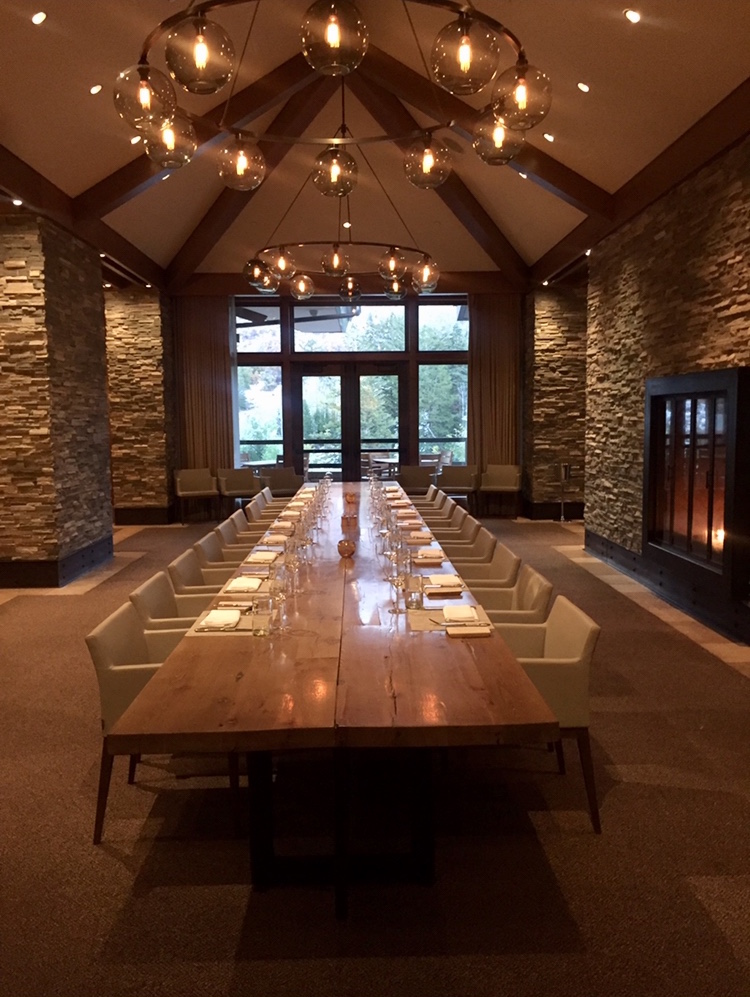
Wiener is the executive sous and chef de cuisine at Jean-Georges Vongerichten’s J&G Grill St. Regis Deer Valley. Wiener was tasked with a Dec. 1, 2018, soft opening. She is leading the rebranding effort for the St. Regis restaurant that renowned chef and restaurateur Vongerichten opened in 2009.

Wiener said she’d never say a bad thing about Jean-Georges, the man’s a genius. However, his concept of cooked meats on plates with a la carte sides and sauces had become stale. Wiener wanted to get away from that style of food presentation so she started writing a concept menu seven months ago.

She has taken inspiration from what’s available in Utah. Wiener said she has worked hard to find amazing products for her organic and fluid menu, from finding great farms, the right cattle ranchers and the best cheeses that will be available in season and at its peak.

Wiener said with all these beautiful ingredients there’s no need to hide them under a complex sauce.

Chip McMullin, executive chef at the St. Regis, said he was not on board with the J&G overhaul at first because things had been working great for so long. The food was trendy, it was good for what it was supposed to be. However, the dishes did not change; the creativity came to a standstill. Jean-Georges and his partners were scrambling to open new restaurants using the same tired old model.

So, the chefs said they had reached a point where they felt, “We’re done with this old model. Give us something new or we’re changing it!”

Wiener said everything with the new concept revolves around building a story to create a conversation. Food is supposed to connect people. “The whole reason we get into this is to create experiences with people,” she said. “I want to start the conversation again.”

She added, “So there’s a lot of shared dishes, you are not just sitting there eating off your own plate. So even if the conversations are like, ‘Can you pass that or you should try this, it is great,’ at least guests are talking to one another.”

Wiener said she is still working on the descriptions for the new menu. However, it is going to be “vegetable-forward, seasonally driven and regionally inspired.” She said, “You can make these amazing vegetable dishes where you’d never miss having meat, so I think it is super important to highlight the veggies.”

McMullin calls the menu “contemporary industrial,” which consist of tapas-style small plates and large plates along with a signature table-side carving cart service with food that’s made from scratch and is chef-driven. “It is what Rachel does so well. She blends the cultures, the spices, the ingredients from multiple cultures into this new American cuisine,” McMullin said.

Andres Jiménez is the culinary director for Pure Grey, a New York-based consulting group that focuses on hospitality, specifically luxury brands like the St. Regis and Ritz Carlton. Pure Grey offers bespoke concepts for restaurants/hotels based upon the specific needs and locations of each property.

Jiménez said he does not encounter obstacles when taking on a new project. It is about having a clear understanding of what the needs are because it is easy to throw ideas into the air. However, the magic lies in observing and asking questions to see where the needs are, where he and his team can have the most significant impact. For instance, he said he asks questions such as, What are the needs of the business? Who are the clients and what are their expectations? What are the food trends going to be in the coming years?

Jiménez described the process for selecting new floral designs, votive candle holders, flatware, glassware, silverware, hand-made china, uniforms and menu covers. “We looked at what’s the concept of the restaurant, what do we want to do, what is the physical space?” he said.

It is like a puzzle trying to come up with something different than what’s currently out there, and that people have not seen before, he said. All the right pieces have to fit together.

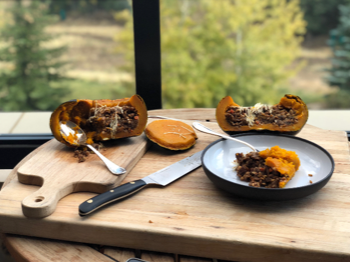
Once Wiener got close to deciding on food and design elements, Jiménez traveled back to Deer Valley and served as a sounding board, helping her flesh out her ideas. For example, they discussed a winter dish consisting of a stuffed kabocha squash. “Sometimes you’re too close to a project. So when I put so much into it I need that outside objectivity,” Wiener said.

“Dining has become a lost art,” she said. The whole idea of the new concept is to have it center around the food. And, the complete dining room experience needs to complement the food.

Wiener is proud of the new menu that she has spent seven months on. “So, if you don’t like it don’t tell me,” she said. “This menu is literally my heart and soul on a plate.”


How part-time job affects GPA and tips to success

Story and gallery by SEOK LEE

People work in companies and students go to college to study to get better jobs after they graduate. To study in a university, students pay lots of tuition fees to university administration. The reason why people go to college is that some jobs require a university diploma.

In other words, people want to have better jobs by investing money in college tuition like a stock market. Parents bankroll money for their child’s future and child spends time for their future. Even some students supply money by themselves without parents’ financial support.

Students have a part- or full-time job to earn money for tuition fees. Also, some students work to gain industry experience and to be a more competitive applicant in the job market. Moreover, some people work part-time to earn pocket money for themselves. These show that college students work a part- or full-time job for various reasons.

As a result of a survey with 10 college students at Marriott Library, eight out of 10 students currently have a part- or full-time job, and two students have worked a part-time job in the past, but they mention that they are now concentrating more on their studies.

More college students who are currently working answer that they work 11 to 20 hours a week. Nine out of 10 respondents to the questionnaire say that working less would lead to higher academic achievement.

They say that if they worked fewer hours, they would have more time to spend studying. Also, they respond to the questionnaire that working while attending college had somewhat negatively affected their GPA.

One respondent said that working less would not lead to higher academic achievement. He said in the questionnaire that it is only an excuse for not having time to study because of a part- or full-time job.

He points out one survey question and says if people want to get higher GPA or college success, it is essential to study a lot. The survey question that he answered was: how many hours a week do you study for classes?

According to survey results, most respondents respond that they study 11 to 20 hours per week. He said that he studies more than 30 hours per week. He said working a part -or full-time job to earn money for tuition is not a good idea.

Instead, studying hard and trying to get a scholarship is more beneficial for the future. He says that he applies for scholarships and he also accepts subsidizing financial aid in the university.

Good scholarships are needed to study hard. ASUU offers a tutoring system to all university students. It is located in the Student Services Building, third floor. ASUU provides tutoring service in its office and library. Kassidy L. Giggey, a learning specialist in ASUU’s Learning Success Center, says, “Large numbers of students use tutoring and one or two students per week come to ASUU and ask for tutoring.”

In order to get good grades while working, she suggests making a schedule and posting it where a student can see at easily. She recommends doing this for a month as a habit. When a student plans to make a schedule, she says, “It is recommended to study six or seven hours per class.”

She emphasizes, “It is regrettable that many students are not yet familiar with this program, and our office is ready to help students at any time.”

The Learning Success Center, which is located in the Student Services Building, third floor, also provides online resources to support study tips such as better note taking, study guides, time management, study skills and more. These online resources help students to study easier and better.

The Academic Advising Center, located in the Student Services Building, fourth floor, and major advisors also help students succeed in college. One academic advisor named Steve Hadley says, “Lots of students work part-time but they take over 15 credits. This is one of the reasons students get tired before graduation.”

He says, “If students have a part-time job, I advise them not to take more than 15 credit hours and if students have a full-time job, I advise them not to take more than six to seven credit hours. For a better school life, balance in work and study is needed.”

He also says, “In fact, many students want to get good grades and ask me for advice that they do not have enough time to study because of work. It is always welcome to help students so please make an appointment on the website anytime.”

The Student Success Advocate Office is in Sill Center near the Union. This program was made five years ago and it also supports students’ college success. Because it is not the old program, it has not been known to many students yet.

April Ollivier, who works in the Student Success Advocate Office, says, “Learning Success Center and Student Success Advocate Office is quite different. The ASUU tutoring system in the Learning Success Center is providing more academic skills to students but the Student Success Advocate Office gives advice to students with ordinary issues too.”

She also mentions, “Student Success Advocate Office provides texting system so they text students whether they are fine in college or not.”

According to survey results, a part- or full-time job affects GPA somewhat negatively but there are some tips to succeed in college life. Both studying hard gives success in university and engaging in clubs and activities help students succeed in college too.

University provides lots of programs for students to succeed in college life such as Learning Success Center’s ASUU tutoring system or Student Advocate Office provides. Hopefully, all students have a good university life before doing social activities after graduate.

Bags to Beds program makes a lasting impact upon the homeless community in Salt Lake City

Story, photos, and video by SPENCER K. GREGORY

A local student has created a service project that has impacted the homeless community in Salt Lake City.

Kaitlin Mclean, creator and director of the Bags to Beds program.

Kaitlin McLean, a fifth-year student at the University of Utah, has created a system in which the participant recycles plastic bags, creates plastic yarn, and produces mats that she said can then be used to “help our homeless neighbors.” This service project has been referred to as Bags to Beds.

“Bags to Beds is a community service project that’s looking to reduce waste for our community by breaking down plastic bags that can’t be recycled,” McLean said.

She organized this student-directed service project through the Bennion Center. The Bennion Center is a nonprofit organization on the U’s campus that serves the local community.

Since then, McLean is now the director of the program and has made a tremendous impact upon sustainability within the Salt Lake Valley.

She said that it averages about 40-50 hours of service per mat.

Students can get involved with however much time they want to spend.

One U student, Megan Peterson, said, “The project itself was really easy, and not hard to understand.”

Peterson is currently a third-year student who is studying communication with an emphasis in strategic communication. She specifically loves to help out the Bennion Center Scholars program.

Peterson mentions how she was first introduced to Bags to Beds at a Scholars social where they just ate pizza. In the meeting they casually discussed goal setting with students pursuing their work for their personal engagement within the community.

Afterward, the Scholars were unified in their efforts to cut plastic bags into objects that would later be used into “plarn.”

U students hard at work with “plarn.”

“Plarn” is the term that Bags to Beds has adopted to describe the unique process of creating the service phenomenon.

Bryan Luu offers insight as to the process and functionality of plarn making. He said, “Plarn is a form of plastic yarn. It’s what wove together these giant mats. All of it’s made from plastic bags that have just been cut into strips and tied together to resemble the yarn.”

Once the mats are made from the plarn, they are immediately distributed to a local resource center or to Project Homeless Connect.

Homeless Connect is a one-day event that helps provide services and outlets for those who are homeless. People can learn how to get involved in this project by visiting the website.

The program has a tremendous connection to the Project Homeless Connect happening in downtown Salt Lake City. “We’ll have all the mats we’ve finished throughout the year for those that are anticipating they’ll be outside this year,” McLean said.

McLean said they expect to help more than 600 individuals during 2018.
“It also gives us an opportunity to work with other people who work with this population, and also get to know the people we are serving,” she said.

This program has made a great impact upon a tremendous social issue.
Peterson said, “Even though homelessness itself is such a huge issue, they’re just trying to help a little bit by taking waste that can’t even be recycled, and then re-using them for something useful.”

Peterson added, “It also helped me focus in on an issue that I’m not thinking about all the time.”

Bryan Luu - FIXED_Moment2

Bryan Luu shares his experience with Bags to Beds.

Luu, a fifth-year student at the U studying civil engineering and urban ecology, said, “My time with Bags to Beds really has shaped a lot of my community involvement because I feel as if I can continue making a difference. Just having that knowledge, is just really important. Then I can be able to still give back to my community.”

Students or other patrons can visit Bags to Beds to get actively involved. Visitors can then fill out a volunteer interest form.

Bags to Beds has trained organizations and individuals to work independently on the service project at the Bennion Center or even at home.

Bags to Beds Website2 - Copy_Moment

Bags to Beds was founded by University of Utah student Kaitlin McLean.

So if you’re a community member, student, or local citizen in the community there are many ways for you to get engaged in this great organization. According to McLean, Bags to Beds can even personally deliver plarn right at your door.

Peterson said it’s an “easy way to get involved.”

Paige Remington, another student at the U, said, “Although I am not directly helping people who are experiencing homelessness, I am using my hands and my time to create something that will hopefully alleviate a small amount of suffering.”

Debbie Hair, the administrative assistant for the Bennion Center.

Debbie Hair is the administrative assistant for the Bennion Center. She has helped the founder of Bags to Beds from the beginning. She said, “This project went off miraculously with a lot of attention.”

Hair added, “There’s a couple of different reaches this program has, one is environment. We’re not just reaching out to the homeless to give them comfort, but we’re also repurposing those bags.”

According to Bags to Beds, the program has collected over 12,000 plastic bags for active sustainable use in the community.

Bags to Beds has a plan to prepare a model that is sustainable moving forward. McLean said, “The project will continue to flourish no matter how many students there are.”

Students through the Bennion Center and community members in the Salt Lake Valley have been the main community engagement resource, providing service hours for the program. However, the organization plans to spread to other cities.

Since the early years of the program, it has now officially become an incorporated business outside of the Bennion Center.

McLean said, “Bags to Beds is now in the process of becoming a tax-deductible nonprofit organization.” Bags to Beds has made a tremendous impact upon the homeless society in the Salt Lake Valley and will continue to change countless future lives.

YouTube video:

Clara Welch

MY STORY: DSC00474Curing homelessness with a focus on the individual

MY BLOG

ABOUT ME: I’m a junior at the University of Utah studying Strategic Communications. I’m from a small town in Utah called Farr West, but love living in Salt Lake City and can’t imagine living anywhere else in Utah.

I am working towards finding a career that will help me make a difference in this world. Making meaningful connections with people is important to me and I strive to find the best in every person. I’m always looking for opportunities to learn and grown and am excited for what the future holds.

When I have free time, I enjoy playing the violin and piano, reading, listening to podcasts, and spending time with my friends and family.

LinkedIn

Laura Child

IMG-0909 (2).JPG

The “Me Too” movement and the effect on college campuses

https://www.linkedin.com/in/laura-child-852870ab/

ABOUT ME:

I’m a seasoned digital executive, leader, and strategist. I’m in an expert in strategic communications, business management, event management, and design. After receiving my Bachelors Degree in Strategic Communication at the University of Utah, I’ve been able to be a CEO of a successful commercial cleaning company, an event, and marketing manager, a financial account manager, and have had the opportunity to work on different projects and events with several different non-profit organizations.

Any project I take on, I take pride in completing it to the best of my abilities. I love a challenge and welcome them in all aspects of my life. I am the hardest worker in the room, always striving to gain additional skill sets.

In my free time, I enjoy working with non-profit organizations and traveling internationally. I am passionate about engaging in other cultures, foods, religions, and the environment. My dream would be to become a travel writer, working with National Geographic…. maybe one day.


Katie Andress

IMG_0224.JPGMY STORY: 

MY BLOG:

ABOUT ME:

I was born and raised in Mission Viejo, Calif. before moving to Salt Lake City to attend the University of Utah and pursue the sport of skeleton.

At the U, I began my educational career majoring in mechanical engineering before switching to math, business and currently I am a senior majoring in strategic communication.

While pursuing a degree I participated in the sport, skeleton for five years with the goal of going to the Olympics. Eventually I decided to stop sliding due to the high cost, time commitment and safety hazards.

LinkedIn