Building a ‘Cvlt’-Like Following   

Story by EVERETT OLSEN
Screen Shot 2018-04-11 at 6.22.17 PM

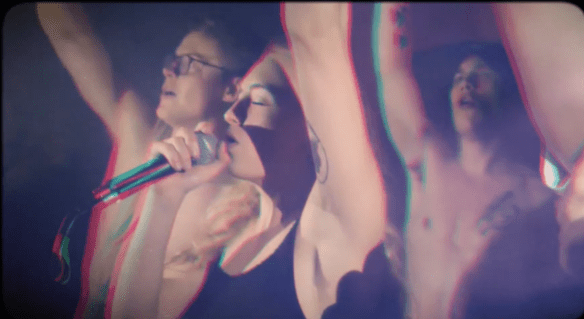
 OCDope Serenades the audience to her hit single “Pull You Under” Screenshot of video by Everett Olsen

Sweaty bodies pack the small Salt Lake City concert hall. It’s Saturday night at the Goldblood Collective, and the energy in the room is electric. This isn’t the first time that the local rap collective “The Peoples Cvlt” has opened the show here before, but no one in the group expected a crowd like this.

Mad$haw co-producer of the collective, yells over only five feet away.

“Do you see this? This is nuts there must be 100 people in here!”

The small venue overflowed with enthusiasm as the group paraded the stage readying the audience for their final performance of the night. Mad$haw raises the microphone to his lips.

“When I say Peoples, yall’ say Cvlt,” he cries out. “Peoples!”

“Cvlt!” The crowd energetically echos, then again.

“Peoples!

“Cvlt!”

“Now everybody sing along if you know this one, it’s called “Pull You Under,” off of our new mixtape! This will be our last song of the night thank you Salt Lake City!”

The crowd quiets in anticipation as OCDope, one of two female vocalists present in the group, takes center stage microphone in hand. With a confidence large enough for the whole collective, OCDope delivered a performance that mesmerized the crowd, wrapping up the groups most successful show to date.

Salt Lake City certainly isn’t known for its production of Hollywood rap stars, or any sort of celebrities for that matter. Yet scattered throughout the Salt Lake Valley is a network of independent artists all chasing the same dream. A dream planted in the mind of every kid who has ever turned on their car radio.To make millions of dollars and perform for thousands of people.

The Peoples Cvlts’ story is not another boring overtold narration of overnight success. This group serves as a realistic and practical demonstration of how to make the most of granted opportunities, establish a presence in a local niche, and use various tools to build a loyal supportive fanbase.   

Before all 13 independent artists met and decided to make records together, Riley Teague or Teague recalls the day when Max first approached him with a radical new idea.

“He said he was sick of the 9—5 grind and wanted to start making music and taking classes for producing.”

Teague explained it only took a few short months before Mad$haw

“Took off and started getting a lot better.”

Mad$haw continued to dedicate himself to this new passion setting aside time from his job and family to work on instrumentals and production each week.

While attending his weekly production class Mad$haw met another producer Sean Motta or 4K. The two young producers quickly hit it offand began working together on instrumentals each wednesday in Mad$haw’s basement studio.

Vocal artists like Teague and Kiefy Kush another Cvlt member started working with the two producers while slowly introducing in other artists. Teague remembers how it all started like it was yesterday.

“I started inviting friends that I knew could rap then it took off. We started meeting up weekly and making songs ”

While slowly growing and improving the collective continued to meet each Wednesday evening. Many members would come directly from school or the job to meet up, relax, and express themselves creatively.


Screen Shot 2018-04-11 at 6.33.52 PM.png

 The Peoples Cvlt, shown above, during an album cover photo shoot. Photo courtesy of Jade Larson


It’s low key, and is kind of a nice stress-free environment,” 4K explains. “There aren’t any expectations. I think that’s why our music turns out so well, because we enjoy the circumstances under process of making it at Mad$haw’s studio.”

Kiefy Kush, a Salt Lake rapper who has been making music for 15 years, shared one reason he believes the collective has had such early success in a market typically sodifficult to penetrate.

“With there being so many diverse creatives in one collective, we have the ability to produce, provide and promote much more efficiently than if it were just one person juggling everything,” Kush said.

Screen Shot 2018-04-11 at 6.37.38 PM.png

 Kiefy Kush catching a vibe. Photo courtesy of Jade Larson

With the release of their debut 14 song mixtape “Cvlt Tape 1,” The Peoples Cvlt averages 1,486 streams per song released on their soundcloud page. An impressive figure considering the recent founding of the group.

Outside of making the music, the collective is constantly networking and plotting their next moves towards breaking out. In the past month The Cvlt has gotten on the ticket of two much more high profile concerts, in hopes to expand and capture their ever growing audience.

The first is Redfest, an annual concert put on by the University of Utah for its student body. The headliners of this show are big names in Hip-Hop like the Migos and Amine, the concert will be held April 15. The show nearly sold out with in the first week of being announced.  

The next event is a three-day music festival held at the Bonneville Salt Flats early in june this year. This event will feature a number of artists performing on multiple stages. Both of these opportunities should bring along hundreds of new ears and potential fans for the expanding Peoples Cvlt.

This Salt Lake based collective has served as the perfect reflection of what it means to work together week in and week out, seize opportunity, and produce a collaborative sound that is pleasing to the ear. With each artist still chasing the same dream of exposure, The Peoples Cvlt will continue to grind on until they don’t need to remind others of the name.


Screen Shot 2018-04-11 at 6.41.43 PM.png

 Mad$haw, Father Cactus, and 4K. Photo courtesy of Jade Larson

“It’s hard to break out of the Salt Lake scene, like, really hard,” producer 4K said. “I don’t think anyone’s ever done it. We’re going to be the first ones to break out, though. I know it. I’m going to make sure it happens.”

Everett Olsen

IMG_3990

Blog: 

The idea for my enterprise story originally stemmed from my experience at “The Peoples Cvlt’s” third concert, hosted inside the Goldblood Collective. I happened to be one of the only 20 or so people in the audience for the group’s first show. Seeing the rapid progression in the number of fans the group had gained for this performance, immediately had me asking myself, “How?”  

After I had decided on my topic and the angle I was going to work, it was time to reach out to members of the groups for interviews. I first reached out to Max Bradshaw or Mad$haw, a friend from high school who happened to be co-producing for the group. While Mad$haw himself preferred to stay behind the scenes, he gladly introduced me to the other producer, Sean Mota (4k), as well as other group members Teague and Kiefy Kush.

I wanted to make sure for this story I captured the setting properly for my interview, to get the most intuitive and honest answers I could from these creatives. To do so I stopped into Mad$haw’s basement studio on a Wednesday night, the night the group meets and collaborates each week. Although I came to the house ready as a journalist, I chose to put this on the back burner, and simply talk with the group members casually building rapport until I felt ready to get down to business.  I think in doing so I was able to capture much more natural and honest responses from these artists.

Bio:

Everett Olsen is a junior at the University of Utah studying communication. After an intensive two-year search for a major, Everett has found an outlet for his voice though journalistic writing and reporting. Born in Salt Lake City, Everett developed a love for the outdoors as well as a profound passion for music. He plans to cover more stories and events that parallel these personal passions, as they seem to yield his best writing.

Becca Carr


IMG_3858

MY STORY

Utah Cops Struggle to Enforce Texting and driving law 

MY BLOG

While looking for a topic to do my story on I started off with a Google search. I looked at local cities and came across a Salt Lake Tribune article about lawmakers killing a bill on texting and driving that could save lives. I then started to focus on the police and what the double standard was for them using cellular devices. From doing my interviews I moved my story more in the direction that because the law in place for texting and driving is so hard to enforce is it worth even having.

At first, I was nervous that I wouldn’t be able to connect to the people I needed to interview. I then started to think about people I knew and family connections, using sources that I could reach out to. I then got in contact with Rich Ferguson and Eric Johnson. Rich is Chief of Police while Eric is Detective Sargent. By talking to them I asked if they had anyone I could talk to that was a Highway Patrol Officer. I then called Jeremy Horne who was a Highway Patrolman for 10 years. After I had my main interviews I decided that it would benefit my story by having someone giving their opinion and thoughts about texting and driving, so I took it to campus and found Audrey Emery, a senior at the University of Utah.

I think the sources I got were the best I could have gotten for my story. I found police officers that are high in ranking and also found a specific officer that worked as a highway patrolman. I also think that information that I looked us about specific laws in place and looking up different counties news I found great information that benefited my story.

The main obstacle that I faced was looking for interviews. I didn’t know where to start because I knew I had to talk to people in high-ranking positions. But after I talked to a family member and got my resources together, it was smooth sailing from there.

I got a lot of information about police and the double standard, thoughts on texting and driving, how the law is enforced and so on. These questions gave me a lot of information that I had to narrow down. I narrowed it down to how and why police officers enforce the particular law of texting and driving along with what the solution can be for texting and driving. I decided these as my main focus because this is what most of my interviews focused on and what seemed more important.

The writing process was a little bit difficult to start. I have never written a news article and had never interviewed someone before, so the task was scary. As I started the process I started to become comfortable with talking to people and asking questions. I also had to learn how to narrow down information and make sure what I was writing down was correct and okay to quote.

I think what surprised me most through this whole process and story was that law enforcement doesn’t even enforce the law against texting and driving because it’s so difficult to detect the particular use.

ABOUT ME

I currently live in Salt Lake City, Utah where I am a Junior at the University of Utah. I am a communications major with my focus in strategic communications. As I continue to pursue my degree in communications – focusing on advertising, branding, marketing, and public relations – I hope to gain on-the-job experience that will help in my career. By doing so, I would ideally get a job with a respectable cosmetic company where I can work with the marketing or public relations team. Although the focus of my major is not journalism, I have found an interest in it and have piece of work that I am excited about.

Alexis Lefavor

image-73

Blog

I used to love Ichiban Sushi but in recent news I found out they were closed down by the health department. I noticed that they were popping up everywhere. I have noticed recently that sushi has been a trend. It can be really expensive! Ichiban Sushi has sushi that is advertised for half off. My story talks about how they opened back up. I want to make local sushi lovers aware of this restaurant. I also want to make people aware of the health department’s website. They are required to post all of the health inspections at established restaurants. I was not aware of this until I started doing my story.

I used Yelp and Facebook to find my sources. I read many reviews positive or negative. Many of the negative reviews matched some of the reasons that lead up to the closing of the restaurant.  I interviewed people who left these reviews and asked about their experiences. I also interviewed somebody from the health department to figure out how they run the inspection.

As I got more information from my sources, I felt I was really able to write my story. The information I received is what guided my story and made the focus. The hardest part of this was trying to find people to interview. I also reached out to the Sandy Ichiban for comment and didn’t receive anything from them. I was hoping to incorporate into my story how they were planning on making sure they were able to stay open and not face another closure. I think it’s really important for restaurants to ensure that their customers feel safe eating there, especially anything with raw meat.

About Me

My name is Alexis Lefavor. I am a junior at the University of Utah majoring in Communication. I hope to graduate by Summer 2019. My focus is strategic communication. I have always been interested in marketing, branding and public relations. I hope to find myself somewhere in one of these fields in the future.

Mallory Bell

MY BLOG:

I have always had an interest in criminal justice and the judicial system. I decided to research the Sexual Assault Kit Initiative in Utah and find out what the future was for Sexual Assault Kits for my story.

My sources included employees of Utah’s Department of Public Safety, state senators and local organizations who helped write the upcoming bills. They were the best sources for this story because they gave me a variety of information while being employed by different entities. I was able to gather information from each source about the new bill, the part they played in helping the victims and helping to get the bill passed. I did encounter ethical or moral dilemmas while trying to find other sources that could give me information from the victims side. The sources I did have weren’t able to give me names or information about victims because it went against their advocacy.

I made sense of the information gathered by researching the topics that my sources were speaking to even more on my own. I also listened to the interviews that I recorded multiple times so that I was sure I understood the points they were trying to get across.

I made a plan for my story, and organized my ideas more after each person I spoke to or each thing I learned. I learned that being organized and having really great, well-thought questions helped get the information I needed. I learned a lot about the national initiative SAKI, but wasn’t able to include every detail. I thought it was interesting to find out where each state was in their project and how long it took them to get through the backlog. I was very surprised at some of the facts about how kits were handled in the past, such as kits being thrown away because it seemed unsolvable.

I ended up enjoying learning about my topic more than I even thought I would. I saw many opportunities and avenues for volunteering as I spoke with the different government organizations.

0.jpg

ABOUT ME:

My name is Mallory Bell and I am a communication major at the University of Utah. I enjoy being able to show my creativity through painting, fashion, and writing. I grew up in Salt Lake City, and I was excited to quickly move to new places and learn new things. I moved to New York City, and returned home to complete my associates at Salt Lake Community College in fashion merchandising.

I love to constantly learn to be a better communicator in my personal and professional life. I also love to be with my family and friends, and especially in the outdoors. I love to hike, rock climb, ski and swim.

Victoria Tingey

Me 1Blog:

When I was coming up with ideas for story topics, I tried to think of something interesting that would grab the reader’s attention and also create a subject that could hold true meaning. As I ran through a couple ideas, I remembered our old Murray Theater located on the corner of downtown State Street. This is a building that truly captures the charm and history of Murray. It has an old-fashioned neon sign that welcomes people as they drive by. There is such an appeal about the building that has held so many memories for citizens of our city. It was used for great live entertainment, shows, concerts and also hosted Judy Garland and more recently Adele.

I was able to locate my sources by speaking with city developers directly in charge of the downtown area projects and gain their insight on the building. It was helpful to get information from their perspective and understand their thoughts on the building. They were the best sources to be able to communicate with because they have all of the information on the building. They are the people who are directing the project to reestablish the building.

I didn’t really encounter any issues during this project. Everything ran pretty smoothly. I was able to get information right from the start. They were all willing to speak to me and help me contribute to this story. I was given a lot of information so there was a lot that I wanted to make sure to include for this story. I wanted to maintain though focus of repurposing the building and finding out the history as well. I wanted to make my story unique and informative on what people have to look forward for this future of this unique building. I wanted to capture the essence of what it stands for and what it means to Murray.

The writing process was interesting because I gained new insights and knowledge. It was fun to put my story together. I feel like I learned so much on the special qualities of the building during this process. There were details that I had to leave out of the story to make sure that it met the requirements, however, I did include as much detail as possible.

I would say the most surprising aspect of my story was that I found out so much new information on the building. It was amazing how much history was a part of it that really added so much character to the Theater. I loved being able to learn more about it and piece together information. There are so many great qualities about this downtown theater. I believe it is important to keep as much history alive in our local cities and try to repurpose building that keep our city alive and unique. I really appreciated the opportunity that I had to research information and create a story out of the Murray Theater. It was such a wonderful experience. I appreciate the Murray city directors who took time out of their day to let me ask them questions and teach me more.

This was a great opportunity and I have grown to love this special little theater with so much character and charm even more so. This city definitely has an exciting future!

About Me:

My name is Victoria Marie Tingey and I am a student at the University of Utah. My plan is to graduate in Strategic Communications and later get a job in marketing or Public Relations. I love the University of Utah and I am grateful to the opportunity to attend. I plan to graduate in the spring of 2019.

I have a passion for learning and setting new goals for myself. I love to write and learn skills. I grew up playing tennis in high school. I love to travel and learn about new places. History has also been an interest of mine as well. I also love photography and the outdoors. I am proud to be from Utah. I enjoy having all four seasons within our state.

I am excited to learn and to be able to broaden my views and perspectives on writing. I love to accomplish things and better myself every day.


Women in STEM underrepresented in Utah but begin to rise in the field

April 17, 2018

Women in STEM underrepresented in Utah but begin to rise in the field

By Kara D. Rhodes

SALT LAKE CITY- Science, Technology, Engineering, Mathematics (STEM) has generally been a place for males in the past but the in recent years females have started to make a change. Utah women are on the rise at the local Universities and STEM related jobs.

The rise of women in these fields is becoming more noticable but has yet to become equal with men in STEM. According to the U.S. Department of Commerce, men filled 76 percent of STEM jobs while women are at 24 percent as of 2017. Women are 47 percent of the workforce and only 24 percent of them are in STEM related fields. Throughout early education and following into the ACT male and females are head to head. Half of high school graduates showed interest in STEM majors and careers. 

A recent update in 2017 gave the same information in this figure.

22041938_1557222884368626_1472723404792142076_o

Cambria Hobbs

Cambria Hobbs, a Utah native who works for a software company, feels she is less likely to be taken seriously than her male colleagues. “There is a very masculine expectation for the way we approach our work, and every day it’s a battle for me to prove that there is another way it can be done.” Hobbes says the gender gap is closing slowly in STEM and she encourages more women to study or work in field. “Women have so much to offer in these fields and we need each other to break through these gender barriers that a lot of people don’t even think exist,” she says.

Gender discrimination is something most women face on a daily basis. A study shows that a science faculty rated material from applications of their students without knowing who was male or female but assigned different names from their actual sex. The materials did not differ from applicant both male and females had the same qualifications. Members of this faculty rated male applicants higher than their female counterparts as more qualified for that job position. The sex of the faculty did not waver the reponses men and women both voted the same. Further analysis showed that the female students were less likely to be hired for that position. The results of this particular study show that it was culture that played the biggest role in how faculty chose males for the job. 

Processed with VSCO with b5 preset

University of Utah.


Kelsy Rhodes, a Math/Statistics major at Utah State University, has yet to step into the STEM workplace but has experience in the classroom. Rhodes has not encountered any gender bias in the classroom setting but would love to see more women in STEM positions at her school such as, Science Senator, research positions, SI instructors, and TA’s. When asked if she believed the gender gap was closing, Kelsy stated, “I think that more women are choosing to study STEM majors, but that they are still predominantly male.” She believes this is because women may be afraid to step into an area that they believe they’ll be less accepted. Kelsy, like Cambria, encourages women to study STEM because “There’s an irrational stigma that men can handle the course load and long study hours, but many women feel it might not work out for them. If a female is interested in the subject and works hard then they are fully qualified and prepared to get a STEM degree.”  

15822771_1165572983498508_2126945703506654787_n

Kelsy Rhodes.

Influences by society have a significant role in the way women view STEM-related fields. There are many things being done to close the gender gap. Starting with students in lower grade schools. Girls in 4th-8th grade can participate in an annual “Girl Start” conference that offers discovery of STEM related careers. “The SciGirls Seven” is a PBS television show that encourages girls to join STEM. Early exposure seems to be the best pathway in showing young girls that STEM is a field that they can participate in as well as enjoy. Utah has a local STEM action center and its mission statement is, “The STEM Action Center is Utah’s leader in promoting science, technology, engineering and math through best practices in education to ensure connection with industry and Utah’s long-term economic prosperity.” Its website has multiple sources for those females who are interested in more information on STEM.

Processed with VSCO with b1 preset

Zane Yarbrough.

Zane Yarbrough, a computer-engineering and physics major at the University of Utah. Zane stated, “As a male in STEM I fully recognize a gender gap in STEM majors.” He believes that the gap is slowly starting to shrink because stereotypes are starting to be ignored. What once was a masculine set of majors and jobs is now becoming something that anyone can do.

“Gender roles are being thrown out the door,” he says, insisting that anyone interested in STEM should study it, regardless of their gender.


Lois Brady Reflection Blog

For my enterprise story I chose to write about women in the film industry because, as a woman looking to be a filmmaker, I feel passionate about the changes taking place in the industry in the wake of movements like #MeToo and #Time’sUp which are finally drawing public attention to the issue of inequality and sexism in film.

This past semester I took a film course called Woman Directors that had a huge impact on the way I think about film, particularly when it comes to defying common tropes in film writing. In this class I was introduced to the concept of “The patriarchal language of film,” which includes not only the literal language we use to talk about films but also the assumptions about how a film is written, directed, shot, and performed and the  gender inequality behind the camera as well as in front of it. I interviewed the professor who teaches this class, Dr. Sarah Sinwell, for this piece because she introduced me to new ways of thinking about film and the roles women play in building the collective narrative of film and media. Her ideas on the importance of finding ways to include and value diverse voices in filmmaking, especially when they don’t adhere to the traditional cinematic structural ideals, helped me to frame my understanding of where I wanted to go with this story.

In particular she emphasized that different institutions have different values when it comes to filmmakers and there is a difference in promoting equality in, for example, the Sundance Film Festival and the Sundance Institute. When films are awarded at the festival it is based on their merits as a film within its category, they aren’t necessarily focused on who made the films, though some festivals have mission statements like Sundance’s that value diversity and try to promote equality. The Sundance Institute, however, recognizes that much of the actual inequality of opportunity occurs before a film is even submitted to a festival during the process of finding funding and support for the actual creation of the film and so has created programs specifically to aid female filmmakers. With this distinction in mind I was able to better focus on the actual source of the problems I wanted to address and better frame my questions for future interviews.

Read the story here.

Bio.

Deaven Dell

MY STORY: Utah Speedy Drivers 

fullsizeoutput_8f3

MY BLOG

ABOUT ME: 

I am a Junior at the University of Utah studying Strategic Communication BA. I work full time at the Jewish Community Center here in Salt Lake as an Aquatics Supervisor. I love swimming, hiking and biking. I have a passion for music and dancing and enjoy expressing myself through creative outlets. I love connecting with other people and learning new ideas. I am very active in my church and enjoy connecting with my inner spiritual self through prayer, scripture study and attending church meetings.

LINKEDIN


Reflection Blog: Spencer B

Reflection: The Future of Capital Punishment in Utah

By Spencer Buchanan

LinkedIn: Spencer Buchanan

My story regarding the death penalty was inspired by the recent a bill introduced in the Utah Legislature to repeal the death penalty. Given the historically staunch position, those on the Right take on the position I found it interesting. Two of the sources I came about came with the help of Professor Whisenant and his connections. The other two, I found from searching around campus. Professor Burbank from the Political Science and Nicholas Colemen, the President of the Utah College Republicans gave me the interesting dynamic of conservatives regarding capital punishment. The momentum behind the efforts to repeal the death penalty in Utah come from position changes within the Republican Party. Both Colemen and Burbank’s comments on the matter gave both a professional and personal insight into the matter.

Developing this came with relative ease due to the already expansive reporting and research was already done on this topic. The debate regarding capital punishment has been long fought and there is much in data and reports dating back several years. What I really wanted to focus on the changing views on it. For most the history of capital punishment, Republicans and conservatives had been strongly for it and Democrats have usually been against it. I read research as to what could explain the steep decline in support for the policy across the board and more specifically with conservatives. My aforementioned interviews with Coleman and Burbank gave this explanation.

From this experience, I have learned that you need a lot of facts, knowledge, and original sourcing to make a good story. Of the facts and interviews you do, only about 20 percent of what you do and find is used. Professor Burbank, when I met with him, gave a lot of information regarding the history, and other factors that play into the support or opposition to the death penalty but I to widdle at he had given to find what works best for the story.

Reflection Blog

University of Utah students voice their opinion on Bears Ears

By Courtney Ruttan 

April 17, 2018

    The inspiration for this story came from my passion for protecting and preserving the Earth. I was personally offended when I heard the possibility of the Bears Ears Monument shrinking. I wanted to gain more knowledge and do research on exactly what this was going to effect. Having grown up in Utah, I am so proud of all of the beauty this state has to offer.

    I wanted to focus my story on what students at the University of Utah had to say on the matter being protests broke out on campus. I was interested to see the passion that students had for the issue ranging from both sides of the issue but mainly on protecting the land.

    During the writing process, my sorry initially was a great editorial article that was very story based. I learned that this story needed to be filled with facts and evidence for my claims. It wasn’t until then that my story gained focus. I tailored my story towards the reasoning and effects shrinking Bears Ears would have. I also tried to keep my story focused on what is going on currently with the issue.

    I was surprised when I discovered several people were upset when President Obama made an executive order to protect all of the Bears Ears land. I later found out that executive orders typically have a short longevity.

    I decided to use the interviews from Hess, Hughes, and Christensen because they were able to speak the most on the topic and were educated on the issue. Each was confident in their opinion and where they stand. Christensen and Hess have both traveled to the Bears Ears Monument and were able to enjoy everything it has to offer.

    I am very happy I was able to write an article on this topic because it is very controversial in Utah. I will be interested to see if the monuments land does, in fact, decrease.

Linkedin: Courtney Ruttan     


The Future of the Capital Punishment in Utah by S. Buchanan

The Future of Capital Punishment in Utah

By Spencer Buchanan

Salt Lake City–In Utah’s 63rd Legislature an effort by Rep. Gage Froerer, R-Huntsville, sponsored HB379, a bill that would prohibit Utah prosecutors from seeking the death penalty after May 8, 2018. Effectively, it would end the use of capital punishment in the state.
“What’s interesting is that this debate is being pushed by Republicans, by conservatives. Whereas before it was an issue you didn’t discuss. This has opened the debate in many conservative states,” stated Professor Matthew Burbank of the University of Utah Political Science Department.
Professor Burbank elaborated on the debate and the changing public support for capital punishment. “We have two particular reasons for the change. One, a number of high profile cases, with DNA particularly, have led to a number of exonerations. Those have struck people.”
Since 1973 there have been more 155 exonerations nationwide according to the Death Penalty Information Center.
One of the most recent exonerations, reported by the Chicago Tribune, was former Illinois death-row inmate Gabriel Solanche, who prosecutors dropped their charges after Circuit Court Judge James Obbish overturned his conviction, finding that disgraced Chicago detective Reynaldo Guevara had lied under oath when he testified.
According to Burbank though, what has really moved the discussion regarding death penalty to the forefront has been the changing the attitudes of conservatives. “There has been a change in conservatives as to judicial practices, like mandatory sentencing, like the death penalty and it’s cost to benefit.”
A recent study prepared for the Oklahoma Death Penalty Review Commission found that seeking the death penalty in Oklahoma “incurs significantly more time, effort, and costs on average, as compared to when the death penalty is not sought in first-degree murder cases.”
The study which was prepared by Seattle University criminal justice professors Peter A. Collins and Matthew J. Hickman and law professor Robert C. Boruchowitz. The study reviewed 15 state studies of the death penalty found seeking the death penalty imposes an average of approximately $700,000 more in case-level costs than not seeking capital punishment.
According to the Salt Tribune, Utah’s own legislative analysts in 2012 estimated that a death sentencing and years of appeals cost $1.6 million more than a life-without-parole sentence. Another recent report estimated that Utah and its counties have spent almost $40 million to prosecute the 165 death-penalty-eligible cases that have been filed in the past two decades. Only two cases in that time have resulted in a death sentence.
The ability for states to actually execute prisoners has become difficult. Lethal injection has been the primary method in recent decades and is regarded as the most humane form of execution. In 2016 however, Pfizer joined over 20 American and European pharmaceutical manufacturers that had previously blocked the sale of their drugs for use in lethal injections, effectively closing the open market for FDA-approved manufacturers for lethal execution drugs.
Shifting public opinion also shows that support for the death penalty has waned greatly. According to the Pew Research Center, half of Americans (49 percent) now favor the death penalty for people convicted of murder, while 42 percent oppose it. Public support for capital punishment peaked in the mid-1990s when eight-in-ten Americans (80 percent in 1994) favored the death penalty and fewer than two-in-ten were opposed (16 percent). Opposition to the death penalty is now the highest it has been since 1972.
These practical obstacles to implementing a death sentence have shifted many of those on Right.
Nicholas Coleman, President of the Utah College Republicans, stated that younger conservatives his age seem to match the larger group and has seen the debate regarding the practicality of the death penalty in his organization.
“There are more than just a few. The thought is usually based on fiscal conservatism.” Coleman stated. He expanded saying the price to litigate a death sentence and the cost to house death-row inmates are often cited as reasons behind some conservatives’ desire to do away the death penalty.
Salt Lake County Mayor Ben McAdams, who served in the Utah Senate as a Democrat from 2009 to 2012, has watched with interest has noticed the shift among the Republicans and Conservatives he knows and works with. McAdams noted that he sees a general mistrust of government competency beyond conservatives as well that has played into this debate being opened up.
“It has been interesting to see the debate on both about how this might go.” McAdams said “As I speak to many of them, it’s more a reflection of a distrust of government. Government gets it wrong.”
Support for the death penalty though is still majority opinion among Republicans as of 2016 with 72 percent of still in support of the sentence according to Pew Research. Support is the lowest among Democrats at 34 percent while Independent support is 44 percent.
If trends continue in the same decline that has been seen the past couple decades, capital punishment may soon be a sentence of the past. And for conservatives states like Utah, it’ll be the upcoming voters and dynamic lawmakers to see that change.

Reflection on Story

LinkedIn: Spencer Buchanan


This slideshow requires JavaScript.

This slideshow requires JavaScript.

Hunter Wallin

Born and raised in Utah, Hunter Wallin is highly adaptable. With hard working characteristics, and a positive attitude he has accumulated many talents and skills. Currently attending the University of Utah, soon finishing up his Strategic Communications degree, Hunter has worked his way through college while still working full time as a warehouse manager at local company called RotoPax. Hunter is set to graduate from the U of U in the fall of 2018 and sets out to start his own future businesses.


Hunter Wallin

My LinkedIn: https://www.linkedin.com/in/hunter-wallin-bb51b7139/

University of Utah Meal Plan Story:   https://unewswriting.wordpress.com/2018/04/17/university-of-utah-required-meal-plans/

Reflection Blog:https://wordpress.com/post/unewswriting.wordpress.com/8612

Hunter Wallin- Reflection Blog

  • When I first started my news story, “University of Utah required meal plans”, there were a lot of driving factors behind it. When I first started school at the U I looked into living on campus with a group of friends. When we found out that meal plans were required while living on campus it immediately drove all of us away. While writing my story, I spoke to a few different people with different backgrounds. One of those was a longtime friend who lived on campus his first year, another was an upcoming student who also was against the requirement. I also spoke to a representative from diner services on campus. All of these were good sources because it allowed me to gain perspective from all sides of the issue. While writing this story, I found that it was really easy to write the main guideline of the story. I broke down what I wanted to write and what I wanted to report to the readers and went from there. It was basically just gathering more and more info each day until I had a well-rounded story that got the point across to the reader. I think this story really helped me create a good, effective process for more writing projects in the future. If I had to change one thing about this story I think there would be a little more research into how many students really use their meal plans and how much money is forcefully wasted by the students.


Author LinkedIn: https://www.linkedin.com/in/hunter-wallin-bb51b7139/

Sarah Terry: About Me

Story Title: Salt Lake City youth respond to revealed intentions behind Bears Ears and Grand Escalante Staircase shrinkage

Reflection Blog: Response to article 

About Me: Sarah Terry is a 20 year-old student double majoring in Art History and

Strategic Communications while minoring in Honors Ecology. She currently is the Utah Symphony | Utah Opera Public Relations / Marketing intern. Sarah plans to use her degree in Arts Administration, continuing Public Relations work for nonprofit arts organizations.

Sarah grew up in Los Angeles, California where she sang with the Los Angeles Children’s Chorus for 11 years. She moved to Utah in 2015 to attend the Honors College at the University of Utah.

When not working or in school, Sarah loves to read, be with friends, practice yoga, climb, surf, and snowboard. She can be contacted at sarahterryy@gmail.com, or on twitter at @scterrywrites.

LinkedIn Profile

Reflection Blog: Sarah Terry

By Sarah Terry
April 17, 2018

I was inspired to write my story, “Salt Lake City youth respond to revealed intentions behind Bears Ears and Grand Escalante-Staircase shrinkage” after the damning New York Times article “Oil Was Central in Decision to Shrink Bears Ears Monument, Emails Show.” The investigative staff analyzed more that 25,000 pages in total to provide rock solid evidence that indeed, the Interior Department’s intent was to source natural resources — coal, mineral, and oil — from the prior national monuments, despite Ryan Zinke promising he wanted to resize the monuments to appropriate amounts, and had nothing to do with potential coal or oil reserves.

There was a lot of information to analyze, but thankfully there were a lot of professional news sources that helped to compile and find the highlights. I did have to double check, but that wasn’t too difficult to do since most of the journals cited their sources.

Locating sources was easy; most of my friends are directly involved in at least some aspects of activism, whether that’s environmentalism or not. All of the people I asked said yes and were more than willing to go on the record.

The only real ‘moral issue’ I had writing the paper was trying to stay neutral. Obviously, I am passionate about the outdoors and its well-being. I had to do a lot of research to understand exactly why politicians and citizens were ok with the dismantling of the national parks. However, once I got into that headspace I think I was able to accurately report the most important facts.

Final thoughts:
I am thankful that I wrote about this topic! The Utah outdoor “cannon” is so vicious (for good reason) to outdoor-opposition in any form. It’s good to find direct statements from representatives so you can know exactly what they believe and hold them accountable.

It is so easy to be so blind to the positives of the opposition, especially when you’re passionate. Understanding motives helped to “de-villify” Utah politicians to an extent, but definitely not Trump’s cabinet.
Word Count: 336

LinkedIn Profile

Reflection Blog: Deaven Dell


Reflection Blog:

I wanted to learn more about a new bill in Utah regarding red lights. I have always been told that Utah drivers are the worst and I have seen some bad drivers here but are we really that bad or just different? Why would we make things more confusing by enabling people to run red lights when failure to yield is one of the leading causes of crashes in Utah? What is being done to improve the safety? What can be done? How do our regulations differ from that of other states? I believe that one person can make a difference and I would like to inform others of the real problems and how we can improve the safety of roads here in Utah

While researching more about this bill and interviewing some people I recognized that there are many causes of reckless driving. The biggest thing that I found was that speeding is a big contributor to crashes here in Utah. Personally, I am part of the problem. Everyone is always in a rush and I believe we need to make lifestyle changes to be on time. I find when I am not in a rush I am a better driver, I am calm, polite and I even slow down a ton. When I am in a rush however, I find myself irritated, speeding, and not very polite.

Writing this story was kind of hard for me to write because I am part of the problem and I didn’t want to put in my own bias on the topic. I do believe that we should have stricter laws, more law enforcement and new regulations. There are some cool things that other states are putting into place like speed capturing cameras that send tickets to those who speed by them. I thought that this was an interesting idea. Although with its own problems, it seems to be a good way to reduce people from speeding in these areas. Another interesting thing that I would like to research more that would have been cool to add to the story is automatic self-driving cars and the future development of this technology. Self-driving cars could potentially reduce cars from speeding because you could set a limit for the roads that the cars are driving and they would detect that and only go that limit. This however causes us to rely on technology more than our own reacting skills, which I think if implemented correctly could be an amazing thing for most people.

Reflection Blog: Kara Rhodes

As a Gender Studies major I have always been fascinated with career choices of females and males. Why do they want to do what they do? I decided that I would write a story on women in STEM (Science, Technology, Engineering, and Mathematics). I have never been interested in STEM but, I knew that they are difficult fields to be involved in. I located sources that I knew personally because I knew it would be the quickest response time while still being valid. I reached out on social media platforms to find people willing to be interviewed. I went researching on good ol’ google for statistics on women in STEM. These sources were the best sources for my story because they are local and they have real experience in these areas. There were a few obstacles that I had to work around because research on women in STEM is difficult to find. There were no moral issues but I had a difficult time not giving my own opinion and bias. Bringing it all together was fairly easy because the questions I chose to ask were filtered toward a few questions in mind. Why aren’t there as man women in STEM as their are men? I really enjoyed writing this story and I learned a lot about my writing as well as how to improve it. There will always be something to learn about writing and that is why I’d like to become a journalist upon graduation. STEM is such an interesting field and I wish there were more that I could contribute to letting children know that anyone can be successful in whatever they pursue.

Reflection Blog: Paula Garcia

The cruelty-free cosmetics industry is currently booming

I decided to write about a controversial issue that shouldn’t be as controversial as it actually is: animal testing in the cosmetics industry. It is controversial because people have to take a stance and convince others that animal testing in the cosmetics industry is wrong – but it shouldn’t be that way. The horrors that animals endure for reasons related to vanity are evident, and anyone can get educated about them through a simple Google search.

I work at LUSH Cosmetics and our company’s slogan or whatever is “FIGHTING ANIMAL TESTING.” They are a global leader in the fight against animal testing and have inspired and educated me deeply on the topic, which has made me passionate about it. I knew that the cruelty-free cosmetics industry would be the best topic for me to cover because of this.

I located my sources for my story by going to the root of everything – the Lush store I work at. I interviewed one of my coworkers, and a close friend of mine that used to work at the store too. Although my close friend no longer works at Lush, she is passionate about the fight against animal testing. They were the best sources for my story because they are passionate and educated about the cause.

I encountered the moral dilemma of exposing certain companies or not, but I overcame it by deciding that the wellbeing of animals is more important than the financial wellbeing of a corporation.

I was surprised by how passionate I actually am about this issue. I was also surprised by how willing the people I interviewed were to be interviewed.

Salt Lake City youth respond to revealed intentions behind Bears Ears and Grand Escalante Staircase shrink


By Sarah Terry

April 17, 2018

SALT LAKE CITY – A court-ordered release of emails between President Donald Trump and Senator Orrin Hatch’s offices reveal that oil and coal were behind the controversial shrinkage of two national monuments, a discouraging revelation to Bears Ears and Grand Staircase-Escalante supporters.

In the New York Times’ review of all 25,000 pages of released documents, the Department of the Interior focused from the start on coal, oil, and gas resources inside both monuments. In the remote Kaiparowits Plateau, an area at the heart of the prior Grand Staircase boundary, lives a deposit that the Utah Geological Survey estimated to have more than 11 billion tons of “technologically recoverable” coal.

Released email, publicly available online

Documents also reported that the Grand Staircase monument held 550 barrels of oil in tar sand deposits, worth between $2 billion and $18.6 billion.

When national monument reductions were first announced, Secretary of the Interior Ryan Zinke emphasized that his process was not aimed at any particular outcome, instead aiming to “right-size” the monuments’ land that he believed exceeded the scope of the Antiquities Act, the first legal protection of cultural and natural resources signed by President Roosevelt in 1906.

Zinke, as well as Utah Rep. Rob Bishop, even publicly rejected propositions that oil and gas existed within the bounds of Bears Ears. Rob Bishop currently chairs the House Natural Resource Committee.

Briton Black (left,) Brighton Resort, Sarah Terry

“It’s truly despicable, but unfortunately not surprising,” says Briton Black, a 19-year-old environmental advocate with Patagonia and the Southern Utah Wilderness Alliance. “I can’t even believe that our government can just get away with outwardly lying. What kind of standards are we holding them to?”

In an email sent March 15, 2017, from the office of Utah Sen. Orrin Hatch, one month prior to the Trump administration’s review of monument boundary lines, Edward Cox, Hatch’s legislative aide, provided a map of the senator’s ideal reduced monument protections.

“The new boundary depicted on the map would resolve all known mineral conflicts for SITLA (Utah School and Institutional Trust Lands Administration) within the Bears Ears,” said the email. SITLA currently manages the 110,000 acres near the prior monument, with intentions to generate revenue from trust lands for public schools, colleges, and hospitals, steward the land, and “deposit proceeds into 12 individual permanent endowments, which are invested by…the School and Institutional Trust Funds Office.”

Trump’s new boundaries nearly parallel the map provided in Hatch’s email.

Only a sophomore in college, Black’s work with two large organizations motivates youth to have their voices heard. Black says the experiences and people she meets volunteering has given her hope for the future. “Yes, it’s annoying, it’s not ideal, but for now it’s just what we have to do. The future of Utah is in our hands, and that’s a really great thing.” Black’s concerns are shared views among many of the youth in Salt Lake City, however much of the population remains positive.

Jaya Muehlman, Argentina, Sarah Terry

“The only thing we can do right now is trying to have our voices heard,” says Jaya Muehlman, “and work hard to ensure that when our generation is in power we can do the right thing.” Muehlman is a junior in college studying biology with plans to study decline in Southern Right Whale populations after graduate school.

Orrin Hatch, Wikipedia Commons

“While some on the Left and in the media have attempted to portray supporters of this executive order as greedy energy tycoons,” wrote Hatch’s office in an official statement, “the real [beneficiaries] are Utah schoolchildren and the people of San Juan County.”

The statement continues, “Senator Hatch is grateful these emails have been released, because they make very clear that his priority in addressing the Bears Ears situation was looking out for the people of Utah, and particularly the people of San Juan County who were ignored when this monument was designated.”

Molly Davis, a 23-year-old Policy Analyst at the Libertas Institute, finds state interest in additional funds for education interesting.

Molly Davis, Utah State Capitol, Sarah Terry

“This past year was a tax surplus year,” says Davis. “It seems strange that despite having extra spending money, the state is looking for more funds in the destruction of lands that bring in millions of dollars in tourism every year.”

One positive outcome of these losses has been higher political engagement in the community, especially youth, in all kinds of different issues, not just environmental related.

Police estimated that around 8,000 people attended the recent “March for Our Lives” gun-reform protest at the Utah State Capitol, making it one of the largest rallies in Utah history. The “March Before our Lives,” a rally to support second amendment rights an hour prior to the scheduled “March for Our Lives,” drew a crowd of 1,000, the 2017 Women’s March drew approximately 6,000 participants, and an air quality march in 2014 drew a crowd of 5,000.

“The views of youth are not represented in our government, and that silencing is really bad,” says Black. “I think it’s becoming obvious that we’re not going to just sit around and wait for political figures to die off for actions to be taken.”

Total Word Count: 867
Reflection Blog
LinkedIn Profile


University of Utah students voice their opinion on Bears Ears

By Courtney Ruttan

April 16, 2018

SALT LAKE CITY — Utah civilians have been up in arms on President Trump’s decision to shrink national monuments. Bears Ears, one of the most affected in this matter, is home to several of Utah’s native tribes and most beautiful landmarks. Moreover, the land contains a history, artifacts, and archeological wonders.

    In 2014, President Barack Obama issued an executive order to create a 1.3 million-acre national monument in Utah land known as Bears Ears. He not only protected this land for its natural beauty but to protect the native tribes that inhabit the land as well.  These tribes include the Navajo, Hopi, Ute, and Zuni. Several Utahn’s were very pleased to see that this land was going to be protected — however, some believed that protecting the land was getting out of control.

    In 2017, President Donald Trump announced plans to reduce Bears Ears by 85%. In a recent New York Times article, “Bears Ears National Monument Is Shrinking. Here’s What Is Being Cut,” “Bears Ears has attracted controversy since President Obama announced in December 2016 that he would protect the 1.35 million-acre site in southeastern Utah as a national monument.”

    People travel all around the world to see everything Utah has to offer. President Trump issued a reevaluation on all National Monuments created since 1996 in search of land with unused resources. Trump has chosen Bears Ears specifically for mining and drilling of oil. Protests all over the state broke out including protests on the University of Utah campus.

    According to the article, “Trump was greeted by thousands of Utah protesters, some who blocked downtown Salt Lake City streets and faced off with police dressed in riot gear,” by the Salt Lake Tribune, “before President Donald Trump even arrived in Salt Lake City, he had a crowd waiting to tell him he’d be wrong to revise the boundaries of two national monuments in southern Utah.” The article continues, “Hundreds of people soon became thousands at the footsteps of the Capitol, most decrying the anticipated announcement that Grand Staircase-Escalante and Bears Ears national monuments would be drastically shrunken and broken into parts.”

    Sydney Hess is a recent graduate of the University of Utah and is upset with the decisions Trump is making. “I believe the land needs to be protected,” Hess says, “it is not the government’s place to take away the land for mining.”  A self-described lover of all things Utah, she enjoys traveling to the national parks, including hiking, camping, and exploring the outdoors. “Bears Ears needs to be protected. President Trump needs to look into the future,” she says.

    Dalton Hughes, a current student at the University of Utah is displeased with President Trump’s decision.  “While Donald Trump is creating a great number of jobs like he said he would, these jobs are not worth taking away Utah land. Hughes believes that we do not need the oil that can be drilled for within the land. “There are several other locations for mining and the land that contains Bears Ears needs to be protected.” Hughes is not originally from Utah; his family made the decision to move here for all the beauty Utah has to offer.

    Mat Christensen, another former graduate of the University of Utah, is not afraid to fight for what he believes is right. Mat has attended several protests in honor of protecting the Bears Ears Monument. “Everyone needs to educate themselves and take a stance on the matter. It is time we find the alternative to oil so we don’t need to drill into the land. Instead of drilling, polluting, and destroying this earth, it is time that we start to clean it up,” Christensen said.

    Utah continues to fight for the Bears Ears land. As of February 2018, the courts are in great debate over the issue. The Trump Administration is putting in a great effort to transfer the case to Utah courts. Until then, the NARF (Native Americans Right Fund) is continuing to surveillance the land ensuring there’s not detrimental damage to the land. On February 16, the courts put a public comment process into effect.  Residents of the Bears Ears boundary are very supportive for an expansion of their protected land but very opposed to taking away land.

    The public comment process period is coming to a close with less than one week left. Federal land managers have begun drawing up new land boundaries for this area. However, the case is not settled. Several issues related to reducing the size of National monuments include economic impact, culture history, science, and law. The government still has to undergo several obstacles before Utah may lose a great deal of protected land. The Trump administration continues to hold several meetings regarding this issue. University of Utah students, Native Americans, and Utahan’s alike will continue to fight for the protection of this sacred land. 

830 words        

Reflection Blog 

Linkedin: Courtney Ruttan 

9th & 9th: shop, dine, and live local

by Noelani Blueford

Reflection Blog

LinkedIn Profile

SALT LAKE CITY–10 years since an architectural rejuvenation brought a remodeled theatre, freshly paved streets, and brightly colored sculptures posed in front of hip, eclectic storefronts, Salt Lake’s 9th and 9th neighborhood is thriving. Located at the intersection of 900 East and 900 South, just east of downtown, this business district at the center of a small but busy neighborhood features a growing selection of small eateries and boutiques. The shops and neighborhood are a featured piece of Utah’s Buy Local First movement, which seeks to promote stronger communities through local business ownership. But further growth may be difficult due to conflicting interests and limited space.

The Tower Theatre is the oldest and most iconic institution still in business in the area; it originally opened in 1928. 90 years later, the Tower Theater has only risen in popularity, notably as one of the venues for the annual Sundance film festival. Additionally, the Salt Lake Film Society (SLFS), a non-profit organization dedicated to giving Salt Lake residents access to a diverse selection of film choices, was founded in 2001 with an initial mandate to restore the crumbling Tower Theater. Ten years after that restoration, the SLFS continues to provide access to non-mainstream films that reflect “the lives and cultures of everyone in our society.” The Society enjoys strong support from the community and the theater stands today as a testament to Salt Lake City’s commitment to independent film, arts, and culture in the Intermountain West.

On the newer end of the spectrum, The Stockist is a sleek specialty clothing store originally opened in 2009 under the name Fresh by siblings Helen and Ian Wade. Helen Wade is on the board of Utah’s Buy Local First movement, and remembers when the neighborhood was very different. “Back when we opened there were only maybe 3 places: Pago, Mazza, and if you wanted a sandwich you’d go to Great Harvest,” she says. As part of her work with the Local First Utah alliance, Wade has created the Buy First Movement’s Place Makers Map, which lists more than 50 local stores in the 9th and 9th area.  

Next door, The Children’s Hour is a rainbow of color, featuring shelves neatly packed with shoes and books as well as racks of brightly colored children’s garments and stuffed animals. The clothes and stuffed animals are carefully curated —owner, Diane Etherington, has been curating high-end European childrenswear, books, toys, and gifts for her shop for 31 years with the help of her daughters. Etherington said that once finished, the rejuvenation was great for her business. However, trying to work in the midst of the construction was difficult because “Everything was ripped up.”

These shops and more are tucked behind red lamp posts and lime green metal benches which line the sidewalks around the 9th and 9th neighborhood. A popular eclectic hangout for students and artists, the neighborhood is in a continual process of getting a facelift courtesy of a public-private funding initiative. Most notable are the Nine Muses, kinetic sculptures commissioned from Seattle artist Troy Pillow, which were chosen in part by Etherington and have taken up residency on the busy corners of the cross street. This rejuvenation did not end with the statues and the benches: on May 14, 2016, 900 South was dedicated Harvey Milk Boulevard, after the late LGBT civil rights leader.

The cosmetic changes on the corner of 9th and 9th have been welcomed by many in the city, however, not everyone was in favor of further development plans for the area. The Salt Lake City Planning Commission approved a Conditional Building and Site Design Review (CBSDR), a proposal for a mixed-use building in the 9th and 9th neighborhood, in February of 2017. The building plans had initially been rejected by the commission 2 years earlier, in part due to issues with inadequate parking space. Construction is now underway for the new building on the Southeast corner of the intersection at 900 South and Lincoln Avenue; this lot previously held a single-story beauty supply store and outdoor parking lot, and will now feature a 35,000-square-foot 3 story development with mixed retail and residential space.

Limited space and conflicting interests are 2 of the biggest problems 9th and 9th faces, now and in the future. Currently, construction also continues east of the cross street to continue rejuvenation of the road and sidewalks leading up the hill to East High. “The construction of 9th and 9th was already fully scheduled and underway when we opened,” says Brass Smoothies co-owner Erin Miller, “So we just don’t know anything different.” With continuing reconstruction comes rejuvenation, pushback, and more people; all of which are emblematic of the growing pains of the restored 9th and 9th neighborhood. Diane Etherington, for her part, is looking forward to it. “I have faith in this neighborhood,” she says with a smile, “Actually, I’m kind of excited about the apartment building–now that they’ve figured out the parking lot.”

Sarah Terry

MY STORY: Salt Lake City youth respond to revealed intentions behind Bears Ears and Grand Escalante Staircase shrinkage

MY BLOG:

27459496_10204441059341964_1536578359639639342_n

ABOUT ME: 20 year old Sarah Terry moved to Salt Lake City in August of 2015 from Los Angeles, CA. She currently is the Utah Symphony | Utah Opera Public Relations / Marketing intern, and is enrolled full time at the University of Utah Honors College as an Art History and Strategic Communications double major and Ecology minor. When not at work or school, Sarah can be found snowboarding at Brighton resort. She loves reading, yoga, music, art, climbing, traveling, and hanging with her friends in the Chi Omega sorority. Sarah plans to continue with Arts Administration, hoping to eventually assist in the operation of non-profit art organizations. Sarah can be contacted at sarahterryy@gmail.com, and can be followed on Twitter at @scterrywrites.

Tanner Kirk: Reflection Blog

Reflection Blog: Utah teen suicide on the rise

By Tanner Kirk

Suicide takes more teen life’s then any other drug or killer out there. On February 6, 2018 one of my best friends, Sean Carne killed himself in the garage of his own home. He had been dealing with major depression and suicidal thoughts, sadly Sean decided to end his life. Because so many of my  family and friends deal with depression, I decided to write my paper on teen suicide in hopes to raise awareness of this enormous problem. Teen suicide rates have been dramatically increasing over the past several years and it will continue to rise if something is not done about this serious issue. The community needs to come together to deal with the problem and find solutions. Social media is a recent trend and has made a huge impact on how teens feel about themselves in this day.  The research I discovered, especially with social media, has affected the wasted time I spend on the different social apps. I wrote this story in hopes to raise awareness to those who have little to know idea on truly how bad teen suicide is. Everyday teens are committing suicide, and its up to us to find a solution. If you haven’t already, please read my story: Utah teen suicide on the rise, I believe you will find it interesting and enlighten you on how serious a problem in Utah this is.

Linkedin profile click here