
Story by HENRY ALLEN
SALT LAKE CITY – It’s a quiet fall evening on the University of Utah campus, that is, aside from the constant buzzing. Resting underneath the windowsill of a dorm room in Shoreline 829 is a flat glass case filled with thousands of Apis mellifera, the European honeybee.
The glass case is an observation hive, and it is used by education-eager beekeepers to demonstrate the workings of a beehive. Behind the glass panels, sturdy wooden frame, and fine mesh, is a hive that writhes and squirms; a colony of constant churn. Frankly, it’s unnerving to have nearby for more than an hour, the low thrum of the hive rising and falling just enough so as not to become background noise. I was holding the case as a favor for Quaid Harding, president of the U’s Beekeepers’ Association, while he went to dinner.
Actual beekeepers don’t have a problem with the buzzing – Harding sleeps soundly with the hive next to his bed. “I like it,” he says, “it’s calming, kind of tranquil.” A senior at the U majoring in biology, Harding joined the club last fall, after completing his Global Environmental Issues community service hours with the club. Upon finishing, Harding wanted to do more – “I went up and talked to the club’s advisor, and asked ‘how do I get more involved?’” Harding says. “There wasn’t anybody taking initiative to set up meetings or recruit, so I offered to take on the leader’s position. We really needed more members.”
Harding has an infectious enthusiasm for bees, and has been an active and capable recruiter for the club. The observation hive was a boon: nothing attracts interest quite like walking around with several thousand bees.“The bees do the recruiting for me,” he says. Leota Coyne, a new member of the club, says the observation hive caught her interest immediately. “I saw the hive at Plaza Fest, I couldn’t just walk past that.”
The Association maintains four sets of hives on campus: one on the fourth-floor of the Union; another outside the Health Sciences Library; and two in the Marriott Library. The hives are nestled in easily-seen but unobtrusive outdoor locations, carefully placed for both bee and human safety. “There are roughly four beehives at each spot, and each hive can house anywhere between 20,000 and 60,000 bees,” says Harding. The hives need regular inspections for bee health and maintenance checks, which Harding uses as field trips for the Association.
It begins with proper clothing – a full body beekeeping suit. The white canvas outfits look like space suits made out of leftover painters’ smocks, but thicker and with mesh face masks instead of helmets. Once suited up, the inspectors use coffee-tin-like smokers to puff smoke onto the hives. “The smoke simulates a forest fire” Harding says, and “the bees’ response is to gorge themselves on honey to protect it, which makes them docile and sleepy. It’s kinda like how people are tired after stuffing themselves on Thanksgiving dinner.”
Some weeks later I attended a honey-extraction event, where I met Amy Sibul, the club’s faculty advisor. “We use the honey to help fund the club,” says Sibul. “We sell bottles of honey, as well as tubes of lip balm made with the beeswax.” The events are open to the public, which the Beekeepers’ Association uses to teach people, both about the club and the bees. “The main importance is the awareness it raises,” Sibul says, “we need to be aware of the impacts humans have on honeybees.”
Beekeepers around the world have reported precipitous decline in their hive populations – a loss of around 30 percent annually. This phenomenon is referred to as Colony Collapse Disorder (CCD), and the full cause is still being investigated. What we know for sure, however, is that humans play a big part in the disorder through their use of pesticides. Some countries are making strides to curb their impact on bees – such as the European Union’s push to ban various bee-harming chemicals – but other countries are lagging behind. CCD is in an odd position: people acknowledge that it is a problem, but don’t understand the gravity of the issue.
One reason why CCD is so alarming is that bees are more than honey-makers – they play a huge role in pollinating the world’s agricultural industry: “One in every three of our bites of food depends on honeybees” says Sibul. The loss of honeybees would be a huge hit to the global food supply, and losing millions of agricultural jobs would be economically devastating.
Clubs like the Beekeepers’ Association are important for combating CCD. The Association does its part to help stabilize the bee population by maintaining healthy hives and raising public awareness. Every bit of progress, from the local level to the global level, helps keep the bees – and the world – buzzing.



 stian Gonzalez I am currently a student at the University of Utah, majoring in Strategic Communications with a minor in Spanish. I received my A.S. in General Studies from Salt Lake Community College. I have been employed full time with Lexington Law Firm for over five years and currently hold a position in operations.












 Story By: CHRISTIAN GONZALEZ
 She still retains the vivid memories of her past when she would visit her great grandfather’s grave at age ten. “I remember helping my grandma prepare a table filled with things that were my grandpa Chema’s. At the center of the table we would always place portrait of them from their wedding,” said Aguilera. She recalls waking up early to help her grandmother prepare her dead grandfathers favorite food, along with pan de muerto (a spanish bread). “After preparing food all morning, we would use my grandmother’s finest silverware and carefully place the food on the altar along with belongings that represented the wonderful life he lived. It seemed as if for that night we were expecting him to join us for dinner,” Aguilera explained. As the years pass, the traditions of this holiday allow her to remember both of her grandparents, her older brother who passed away at a young age, and her mother who died a few years ago. Every November 2, she travels to the cemetery with her children and grandchildren to spend time with all of those who have pa
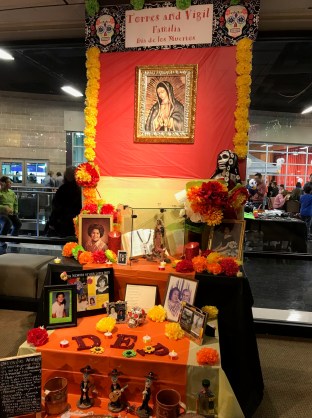 Many of the items displayed on the altars may only seem relevant to the individual but one thing we can learn about this celebration is that nearly every object holds a symbolic meaning.
  or in English, the marigold, is known for its powerful scent and vivid bright yellow color. There is much speculation regarding the purpose of this flower. However, the common belief derives from the ancient Aztecs, who believed the bright yellow represented the sun, and that the flower could guide the deceased in the dark using its petals. Today the flower is used to decorate graves, with its bright color, as well as to guide the spirits of the deceased toward their families during the night.
  Copal, a resin made from tropical trees, fill the air with its strong aroma when it burns. “The smell is said to guide the spirits of the dead to their altars and purify them of any evil,” said Javier Peña, a local dancer familiar with Aztec traditions.
 Both have been celebrating this holiday since they were children. The knowledge they have of their ancestors has helped them live better lives, said the Perezes. Overall, Dia de Los Muertos is a day is to remember loved ones and the lives they lived, and the festival was designed as a celebration of life more so than one of death.



 U NewsWriting