Riley Spear

MY STORY:

MY BLOG:

I developed my enterprise story idea through my target audience, being university students. Social media is targeted toward university-aged students, and educating them and creating awareness on how businesses use social media to advertise would be interesting.

I located my first business source, Beauty Industry, through a friend. However, I had never met Paige Johnson, the woman I interviewed. My second and third source, The Hut Group and STEM, I found through googling startup companies in Salt Lake. These companies were one of the few I heard back from after emailing businesses with a wide social media platform, therefore being suitable for my topic.

The three sources I selected for my topic were the best choices because they all use social media, specifically Instagram to advertise their products. The three individuals I interviewed had positions dealing with social media, and gave me feedback I felt was important for my audience to know.

An obstacle I came by was with my third interview with STEM. While I managed to gather enough information, it was a difficult interview. It really forced me to use all the techniques we’ve read in class to push my interviewee to give me critical information that would benefit my story. In the end, she was able to help a lot and I am confident with her as my third source.

Luckily with the questions I prepared all of the information I gathered would have fit into my topic. The issue was deciding which was the most influential, and I chose the aspects I did out of what I thought were most crucial to know to my target audience.

I separated my writing process into the three interviews I did, choosing a space in my story for each of the interviews and forming the story around their responses. After the interviews, the writing came easy because I based the opening and closing off of what I received from them. I realized then just how important the interviews are in creating a good story, to a great story!

I have a few quotes I didn’t add into my story directly from my sources I feel could be interesting to add into my blog. However, they aren’t the best ones; those were in my story. Below, I’ve included something interesting I gathered from Jasmine Reynolds with The Hut Group:

“Instagram marketing is used in an assortment of aspects, whether it is to bring awareness of a cause or to advertise and sell products. It has drastically changed the game from billboards, and TV commercials to a free platform being used by billions.”

An aspect through this whole process of creating my story was how once I became comfortable with the people I interviewed, how much they wanted to engage. At first I felt as if I was an annoying student who had begged for an interview. However, two of my sources were more than happy — excited even — to give me the information I needed to create my piece.

ABOUT ME:
1610807_10203591191740793_8009901870086539677_nRiley Spear grew up in Madison, Wisconsin, until moving away to attend the University of Utah in Salt Lake City, after she graduated high school. She is currently taking classes to fulfill her degree in journalism, and will graduate in the spring.

In her free time, she is involved in Make-A-Wish philanthropy through her Chi Omega sorority. Through her sorority’s involvement and fundraising, members have been able to grant several wishes to children who suffer from cancer. It has been a rewarding experience to her, and she has made friends for life through it.

At her time at the university thus far Riley has completed a study abroad program in London, England, and performed an internship in Melbourne, Australia, through the Hinckley Institute of Politics. She has been able to fulfill her passion of traveling through both of these experiences.

In London, Riley studied digital multimedia, and through her internship in Australia she managed all social media accounts for her company and wrote blogs. This is one of the reasons she chose to focus on social media advertising, specifically Instagram, for her enterprise story.

The company she interned for revolved around global technology energy. Through her interviews she was offered new, and different viewpoints from beauty and health companies.

After graduation Riley plans to travel and see as much of the world as she can. Afterward, she plans to find a career in journalism, creative writing, or in public relations.

Reginald Hodnett

MY STORY:

MY BLOG:

When Professor Mangun told the class that we would be writing an enterprise story I immediately knew what I wanted my story to be about. I chose to write my story on Rachel Wiener, who is a personal friend and a talented chef.

The reason I chose to do a story on her was that I knew that the restaurant where she worked was doing a complete rebranding of its menu and an incremental design overhaul. I knew Wiener would be the point person who would be making the major decisions regarding the front of the house and back of the changes. So, I felt this would be an interesting topic because I enjoy food and design.

The J&G Grill at Deer Valley is a destination restaurant because of its cuisine but also because it’s attached to a hotel as well its proximity to the mountains.

I had never interviewed anyone before, so it was nice that my first one was with a friend. I didn’t let her or my other sources know what questions I was going to be asking them. I think that was good because it set a professional tenor regarding my interview. It was a fun experience but also a different one because you’re asking behind-the-scene information that in some cases their culinary team wasn’t quite ready to divulge to the public yet.

I was told things off the record that I promised wouldn’t be a part of my story.

The creativity and execution have to be perfect because a lot is riding on Wiener’s vision regarding returning guests and new guests alike. The dynamics of my story revolve around food, specifically, what is Wiener trying to convey with her new menu, and how will these changes enhance her guest’s dining experience? I wanted to understand what sets her culinary concepts apart from other restaurants.

Overall, getting a chance to see how decisions on a large scale are made and the process by which a company starts with just bullets points on a page that spring to life or are negated was fascinating to learn and observe. Food and design are two ways to communicate new concepts and ideas artistically. Surprisingly, I was left with the impression that diners don’t have the full picture of what it takes to ensure that their dining experience is memorable.

ABOUT ME:

0I have lived in Los Angeles, New York and now in Utah. Traveling has given me an appreciation for different cultures and an understanding to accept people the way they are. I’m forever the optimist and enjoy helping others.
The importance of family can’t be overstated. It’s the reason I am the way I am. I can’t thank them enough for always being in my corner, cheering me on.

Currently, I am finishing my junior year at the University of Utah. I am graduating in the spring of 2019 with a degree in strategic communication. I like the different aspects of branding, marketing, and advertisement.


Allison Pferdner

MY STORY:

MY BLOG:

Choosing to write about Prevent Child Abuse Utah was an easy decision for me because it is an organization that is so motivated to do good and I wanted to learn as much as I could about it. The way I discovered it was through my aunt, who does volunteer work for PCAU and Operation Underground Railroad.

Due to my aunt’s involvement in these organizations, she was able to put me in touch with the community outreach program administrator, Gwen Knight. Knight was kind enough to suggest a few other people whom I could interview. I believe they were great sources because they are heavily involved in the success of their respective programs and they also believe so strongly in PCAU. When speaking with them, I could tell that they were passionate about what they were doing.

The topic of child abuse is a sensitive topic and should not be taken lightly. At the same time, it is something that needs to be discussed due to the severity of its impact in Utah and everywhere else in the world. I tried to be empathetic and respectful of the things I learned through this process and while I can’t relate to anyone who has gone through something like child abuse, I know that there could be someone who reads my story who can. I wanted my story to be sympathetic toward them as well.

My sources were also great because they provided me with so much information. It was hard to narrow it down to just the specifics of the two programs I talked about, Parents as Teachers and teaching in schools. I felt like those were the two most important things I could write about because of their direct impact on the communities they work with.

This writing process was very interesting because it was the first time I have done something like this. Of course, I had a general idea of what I wanted to write about but I was constantly pulled in different directions after each interview.

PCAU has so many learning opportunities on the website. I would recommend to anyone interested in learning more about this organization to visit the website and take some of the online courses geared toward your age group.

It was a great opportunity learning more about Prevent Child Abuse Utah and I hope anyone who reads my story is able to understand the importance of what PCAU does here in Utah.IMG_031E9FBEC29A-1

ABOUT ME:

I was born and raised in Sandy, Utah, five minutes away from a handful of hikes in the Wasatch mountains. Some of my passions include playing tennis, hiking and reading. I also love traveling and hope to go to Iceland and Switzerland one day.

I am currently a junior at the University of Utah studying communication. Choosing to earn my college education at the U was an easy decision for me because I love Salt Lake City, I have always wanted to be in the MUSS, and the campus is absolutely beautiful. It has been everything I dreamed to be able to study here.

While trying to decide on a major without any real idea of what career I would like to pursue after getting my bachelor’s degree, strategic communication stuck out to me and I have enjoyed it ever since. Learning how to write, speak and critically think better has been helpful and exciting.

As of right now, consistently trying new things and obtaining a wide variety of useful skills are two of my main focuses in hopes of stumbling on something that I would love to build a career out of.


Emma Chavez

MY STORY: Local Business Cross E Ranch Celebrates its 50th Anniversary

MY BLOG:

My enterprise story merely started with a conveniently timed event, but the focus soon shifted into a piece on the importance of supporting small local businesses.

I came across Cross E Ranch two years ago while looking for a nearby pumpkin patch and have attended their Fall Festival every year since. While buying this year’s tickets at the beginning of October, I discovered it was the ranch’s 50th anniversary, and immediately wrote it down as a possibility for my story.

I was lucky enough to get in touch with one of the owners, Dalon Hinckley, who was my main source. He was able to give me a full history of the Cross E Ranch, as it was originally owned by his dad.

Dalon answered all my basic questions, but he offered up even more stories and information that made it so easy to form my story. He was the reason I redirected my attention to the business aspect of the ranch. He detailed how the business has changed in the past fifty years, and how he had to creatively overcome the obstacles.

The writing process was hard, as I expected, but it was not hard for the reasons I had expected. I ended up with so much information, that I didn’t know what to cut out. That has never happened to me before. I also had a problem shifting my story focus. I was originally just going to cover the Cross E Ranch Fall Festival as a current event, but my interview with Dalon led me a different direction. I struggled with trying to focus on both, rather than letting my obvious true topic lead the story.

In the end I learned so much from writing this article. I was intimidated by this assignment at the beginning of the semester, but I really enjoyed the whole process. I feel that my writing has improved, and I gained interview experience at the same time.

The biggest lesson I learned is to not force the material into an originally conceived topic. Some stories will lead you.

ABOUT ME:

IMG_3885I am 22 years old, born and raised in Salt Lake City. I started my college journey at Utah Valley University, where I spent two years earning an associate degree in Dance Education before transferring to the University of Utah. This is now my third year at the University of Utah, and I am set to graduate in the Spring of 2019 with a degree in Strategic Communication.

I love writing, but my true focus is in brand creation and design. My hope is to work for a business involved in the arts, and get back to my roots as a dancer.

When I am not in school or working, I spend my free time with my family and boyfriend. I can also be found reading, at a yoga studio, or doing my own or a friend’s makeup at any given time.

Claire Hillard

MY STORY:

MY BLOG:

This article was a particularly interesting one to research and develop. I chose to write about natural remedies for stress relief because it is a topic that interests me but is outside of my comfort zone. I don’t think I know a single person who doesn’t feel stress and some people struggle with it more than others. Partially for my own benefit, I wanted to know what sort of non-pharmaceutical options are available for those who experience regular stress and anxiety.

Contacting the best sources was surprisingly simply. All it took was one phone call or email and everyone seemed happy to help. People really do love sharing their passions. I think the people I chose to interview were perfect for the piece. Dr. Knorr is a naturopathic doctor who specializes in natural remedies for all sorts of ailments. Josh Williams is a clinical herbalist who regularly helps prescribe herbs for people with anxiety. I chose Mia Gallardo as my final interviewee because I felt it added to the story to showcase a person who practices some of the treatments the two professionals recommended.

Writing this article was an interesting experience. The answers I received in the interviews were fascinating and not what I was expecting. I was expecting the article to end up in a sort of Buzzfeed style and name the various recommendations from the two professionals. However, natural medicine is not black and white. There isn’t just one answer or one herb to solve a person’s problems.

Because of the nuances in natural medicines, I had to pivot my intention for the article. Instead of focusing on products a person can use, I focused more on their general advice for those with stress. It raised a few ethical issues in not wanting to give blanket advice that may not help some. While the products they recommended were interesting, I didn’t want to give the assumption that by reading this article, a person could self-medicate and solve all their problems.

I think the hardest part of putting this story together was having to cut out so much material. My shortest interview lasted 35 minutes and my longest was about an hour. There was so much material and I learned so much. When I wrote my first draft of the article, it was more than double the desired length. I ended up having to cut out more than half of the original content — some of which were my favorite bits of information. There were just so many interesting details that I didn’t want to leave out.

As a writer trying to keep an interesting, useful and concise article, I chose the information I thought would fit best together and be most easily absorbed. While this wasn’t easy, it was a good process to experience.

Writing this article was a wonderful experience. I made really neat connections with three new people. I learned some things that I was able to apply to my own life. I even purchased some Ashwagndha for myself to see if it helped. It was a great learning experience in working on my writing as well as gaining useful knowledge.

IMG_2282ABOUT ME:

I’m in my third year of my undergraduate education at the University of Utah. I am studying strategic communication and minoring in business. Both in school and in my personal life, I am fascinated by the impacts of nature, kindness, and positivity on the mind.

My interest in strategic communication began when I discovered a connection between psychology and marketing. I think human behavior and cognition is fascinating and wanted to find a way to incorporate this into a profession. I was a creative child and everything seemed to fit together.

As of now, my dream career is to do marketing or advertising in the outdoor industry. Because I am a huge outdoor adventurer, I know the outdoor industry well and know how to appeal to the market.

For me, home is on an inflatable sleeping pad under the stars. When I’m not studying for finals, I spend most of my time in the Utah desert. Some of the most impactful moments in my life have happened while surrounded by good company and towering red cliffs. I camp, rock climb, canyoneer, raft rivers, and do just about anything outdoors. I am a self-care enthusiast and an eternal optimist.

Spencer K. Gregory

MY STORY:

MY BLOG:

I have always been passionate about capturing the story.

I have been a volunteer student leader at the Bennion Center for about two years. As I have been able to serve my community and local students in their service journey, I have been able to develop a desire to increase in my own civic engagement and awareness and strive to help others learn the same.

Photography has always been my passion. I was the photography team leader on the communications team at the Bennion Center. Over time, I have developed to be the design team leader over the graphic designers as I focus on the media developed for the TV monitor screens in the Union building.

Although I have not always been actively a part of direct service, I believe my efforts have primarily been to help increase awareness of the active participants of the Bennion Center. This has helped me to develop skills dealing with graphic design development, photography, and videography.

My desire for this project was to apply the skills I have learned from my involvement at the Bennion Center into developing and capturing the story of the Bags to Beds program.

Bags to Beds has been such a great program that has done so much good for the community, and I wanted to capture the story of how it started and developed into the unique program that it is. It offers solutions to two community problems, homelessness and plastic waste.

Kaitlin McLean has been an inspiration to so many individuals, and I believe that we can all have a great impact as we strive to look for ways we can get actively engaged in our local community to make a positive change.

ABOUT ME:

I strive for civic engagement and community awareness.Professional Photo (Spencer Gregory)

I grew up loving to explore and create. My favorite things to do were playing with Legos or traveling outside. As I have grown up, I continue to love exploring what I can do to engage myself more in the community.

Throughout my whole life, I have been interested in photography, writing and design. I always try to see how I can portray the story in the best way. Whether it’s an event I’m trying to promote, a product I’m trying to capture, or a story about someone’s life, I make sure to portray to the best of my ability to create something intriguing.

I now major in strategic communication with a multidisciplinary design minor and an arts technology major. I plan to strive to enhance my skills to continue to develop as an active part in my community.

Josh Ludlow

MY STORY: Goalkeeping done right, from TIP Goalkeeping

MY BLOG:

For many weeks I wondered what I was going to write my enterprise story on. I debated in my head whether I should write a story on a restaurant I really enjoy, a business I am interested in or a person who has an interesting story. But as I continued to think about what I enjoy doing, the thought came to me to contact my old friend Brian Simmons about his goalkeeping start-up company.

Brian and I had worked together when I was in high school playing as goalkeeper for the team. He was my goalkeeper coach. We became close friends and had stayed in touch off and on throughout the years following my high school career. I remembered he had said something once about starting up some goalkeeping deal with high schoolers. So I contacted him and asked about it.

When I asked Brian about what he had been doing with his small business he said to come and see. He invited me to one of the Saturday morning sessions, which started at the ripe time of 8 a.m. Upon attending I was able to gather contact information for those whom I could interview for details about TIP Goalkeeping. Watching the session was enjoyable and provided more insight into what was happening at TIP than actually interviewing. They even let me kick a few soccer balls at the kids who were training.

When I left the field I couldn’t have felt more confident about the story I was going to put together. I had details of the environment, the type of training that was happening and a better grasp on what could make the story enticing. I want to thank Brian for letting me come and let me see what good he is doing for those he works with.  

ABOUT ME:

The sport world carries my heart — especially college football and the international sport of soccer.

IMG_20180317_143950 (1)I have always had a ball at my feet since I can remember. I began playing at the age of 5 in the local recreation league. I was not the best on the team but I enjoyed playing. Later on I learned that I was pretty good at playing goalkeeper. I stuck with that all throughout high school and was offered to play at a few colleges. I turned the offers down.
Playing, however, sparked something I have come to love: coaching and teaching the younger generation what I wished I had known about correct technique and form. I currently coach for a club in Davis County.

I am a student at the University of Utah where I am studying communication. However, that will be changing come the next semester as I pursue my dream of studying sports psychology.

It is my hope that one day, I will be able to look back through my life and be able to say that I was able to help people.

Kowhai Anderson

MY STORY:

MY BLOG: 

When the Enterprise Story was introduced, I knew exactly what I wanted to write about. My goal was to interview a successful female business owner and capture their story. In the words of Sheryl Sandberg, CFO of Facebook, “Today in the United States and the developed world, women are better off than ever.” For my project, I hoped to find a woman who exemplifies these encouraging words. I wanted to find a woman who is passionate about what she does and uses her success to better the lives of the people around her. In my search, I found Stacy Kelly, the owner of Construction Material Recycling.

For this project, I had to step outside of my comfort zone. A wallflower is a noun I would use to describe myself. Reaching out and contacting someone I was unfamiliar with, asking if I could visit their business and take an hour out of their day for an interview, was an intimidating thought. I fortunately conquered my fears and successfully reached out to Kelly. I am thankful I did, as it was an honor to interview her. She was welcoming, honest and vulnerable. I was moved by Kelly’s story of strength and compassion. Additionally, I got to speak with two of Kelly’s close friends who are also successful entrepreneurs. Their words of admiration and respect were inspiring.  

unnamed

As I began combing through the information I gathered, I decided I wanted the focus of my article to be on Kelly. I organized the story in a chronological order, filled with quotes to make the story more personal. In the process of writing this article, I realized the value of creating a timely narrative. Interviewing a successful businesswoman is an opportunity I’m thankful to have had.

ABOUT ME: 

Kowhai Anderson is studying to receive her bachelor’s degree at the University of Utah. She is a declared communication major with an emphasis in strategic communication. Her aspirations include building a career in advertising, marketing and public relations. Anderson is an avid reader with a passion for photography, live music, film and fashion.


Alex Stein

MY STORY: 

MY BLOG:

Processed with VSCO with a6 preset

ABOUT ME: 

Alex Stein is currently a Senior at the University of Utah, pursuing a double major in Strategic Communications and Psychology. Some of her career interests include social media marketing, PR, event planning, and advertising. She grew up in Seattle, Washington where she graduated from Tahoma Senior High School. Some of Alex’s hobbies include being a member of the College Fashionista program, actively participating in the Type I Diabetes community,  and spending time doing photography and videography.

Check out my LinkedIn

University of Utah eSports program welcomes NCAA involvement

Story and photos by ALEX HALE

SALT LAKE CITY—Despite nation-wide hesitation about whether or not the NCAA should get involved in eSports, members of the University of Utah’s eSports program believe the organization’s involvement would bring much-needed resources and legitimacy to the world of competitive collegiate video gaming.

In December 2017, the NCAA announced that it would be seriously considering if it has a place in college eSports. Since then, many eSports athletes and faculty have been quick to express their distaste of the NCAA’s potential involvement. However, those at the University of Utah think differently. A.J. Dimick, the Director of Operations of eSports at the U, and Kenny Green, head coach for the U’s League of Legends team, both come from traditional sports backgrounds. They said their experiences with the NCAA were nothing but a good thing for them. They passionately believe that collegiate eSports only stands to benefit from the NCAA.

Dimick and Green have both observed that one of the largest sources of hesitation toward the NCAA’s involvement stems from restrictions that would be placed on monetized streaming. Currently, college gamers are allowed to earn money by independently streaming their gameplay to online audiences. Under the NCAA’s jurisdiction, the students would still be allowed to stream, but monetization would be prohibited.

However, the NCAA would make partial and full scholarships for eSports athletes more accessible than ever. In most cases, the money awarded from a scholarship would be greater than the amount earned from monetized streaming. There are only a small handful of streamers who earn enough income that they would be losing money if they demonetized and instead accepted a scholarship. Dimick called it “ludicrous” that people would push away the NCAA to protect streaming income that is “barely even enough to pay for a movie ticket every month.” He continued, “I want the most amount of resources for students who are passionate about eSports, and monetized streaming isn’t the way to do that.”

The U’s varsity eSports program already prohibits its students from monetizing their independent streams. In fact, the U’s team members already adhere to many NCAA-inspired regulations. Official team practices may not exceed 20 hours per week, they must be enrolled as full-time students, maintain a 2.5 GPA, and progress 20% of their degree within each season, and they are eligible for 4 seasons of play within 5 years of first enrolling. If the NCAA stepped in, “We wouldn’t feel stifled since we already follow a lot of the same rules” said one of the U’s eSports athletes. “Our program would just get better.”

Dimick and Green want to create a path to the greatest academic and professional success for their student athletes. The U is already doing what it can. For example, all competition winnings are collected by the university and put toward eSports scholarships. With the NCAA on their side, Green knows they can do more. “I want scholarship money for simply being involved, not just for winning. The NCAA can make that happen.”

Greater support from the NCAA wouldn’t just equal more scholarships, explained Green. It would mean access to better facilities, coaching, compensation, and greater research into proper nutrition and exercise. Even though athletes wouldn’t be allowed to market themselves with monetized streams, the NCAA would pour a huge amount of resources into promoting and fostering each athlete’s brand presence. If athletes want to go pro after college, the NCAA paves a helps them gain the recognition they need to break onto the scene.

It would also give the athletes a means to identify with their school that they’ve never had before. “For so long, gamers have been considered ‘other,’” said Dimick. “They deserve to feel like they’re part of the greater community.” If the NCAA officially welcomed eSports onto the scene of college athletics, Dimick believes the athletes’ passion and energy would be a favor to the university. Green agreed, saying “If the NCAA gives us the formal recognition we think we deserve, our sense of school pride and camaraderie will shoot through the roof. When we win, the entire campus cheers us on. When we lose, they’re helping us get back on our feet.”

Dimick believes eSports can finally find its place with the NCAA’s help. Currently, without a common umbrella like the NCAA to fall under, eSports programs are placed wherever they can fit. The U’s program resides in the academic department, specifically under Entertainment Arts and Engineering. Though some people from both ends of the traditional sports VS eSports spectrum would consider it a “cultural violation,” Dimick thinks eSports belongs in the athletics department alongside traditional sports. He observed that their needs and functions are similar, and the “nerds and jocks don’t mix mindset” is fading. “Why create an entirely new, identical program when we would already fit so perfectly within the athletic department?” he asked.

Dimick said, “If you’re trying to put college eSports on the biggest stage it can possibly be on and have resources devoted to eSports and the students that are interested in this, then you certainly want to explore NCAA membership and participation in college eSports.” For the faculty and students at the U, the NCAA and eSports are a natural fit. Green and Dimick encourage those who are skeptical to learn more about what NCAA membership, involvement, and regulation would really mean and to carefully weigh the benefits against the drawbacks.

Alex Hale

Bntr0yrCAAAr4T1

Photo by Dawni Angel

MY STORY:

MY BLOG:
Above all, I wanted to write about a topic involving the U that I am invested in. I stumbled across a news article about the NCAA’s potential involvement in eSports and immediately latched onto the idea. I enjoy watching eSports competitions, I know that the U’s varsity eSports team is making a big impression on the scene, and I quickly learned that the NCAA’s involvement with eSports is a hot-button topic for a lot of people.
To locate sources, I went straight to the U’s eSports program. I interviewed the director of operations of eSports, the head League of Legends coach, and a student athlete. I was actually surprised to learn about how passionately they support the NCAA’s involvement, because I encountered a lot of skepticism during my online research process.
Since their opinions favor the NCAA, I wanted my focus to be why they think the NCAA would be such a positive addition to collegiate eSports here at the U. I feel very lucky that A.J. Dimick and Kenny Green, two of my interviewees, have both participated in the world of traditional sports and gaming at both a professional and student level. That made them excellent sources, since they can pull from both ends of the spectrum to form their opinions. A.J. Dimick even gave a presentation at the NCAA Board of Governors meeting last Fall about why the NCAA should embrace eSports from the perspective of a large college.
One thing I’d like to do to further develop this story that I wasn’t able to do this time is also interview someone involved with traditional sports at the U and see if they have an opinion on the matter. But that might be a whole other story!

ABOUT ME:
I am Strategic Communication student at the University of Utah with emphases on branding and social media marketing. I have always been passionate about geek culture and one day hope to work for Crunchyroll, an anime streaming service. Currently, I am a marketing events intern for FanX Salt Lake Comic Convention. In my spare time, I enjoy cosplay and watching anime.

MY LinkedIn


BRADY MCCARTHY

IMG_1848Reflection Blog:
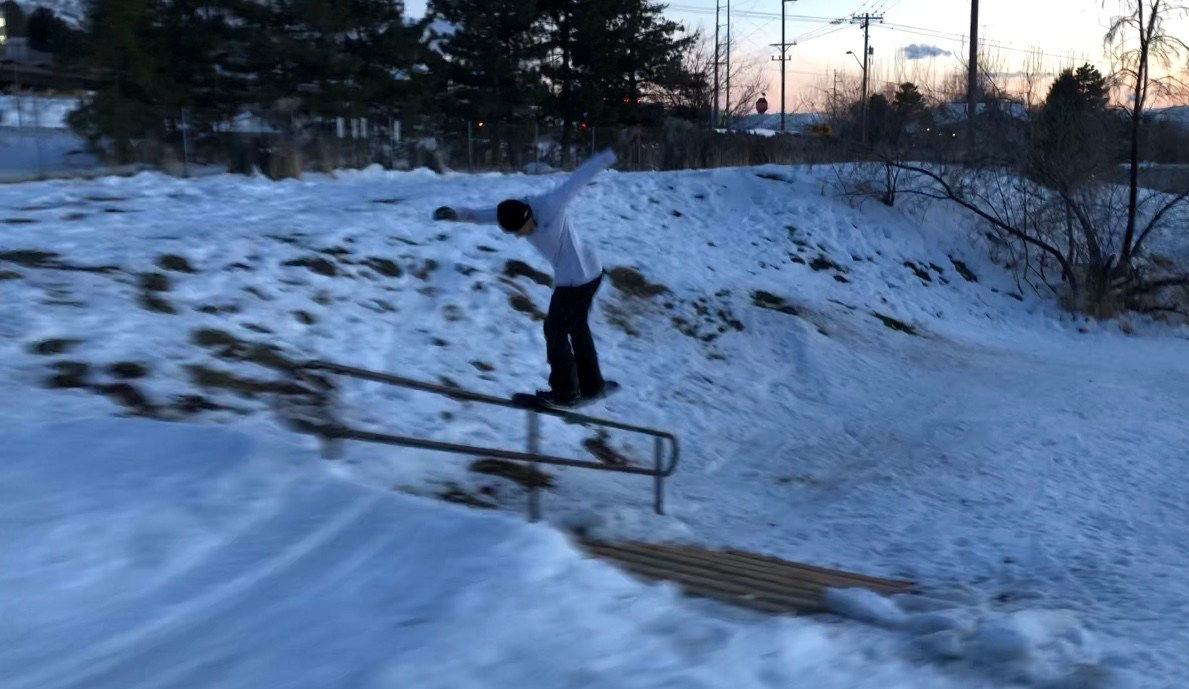
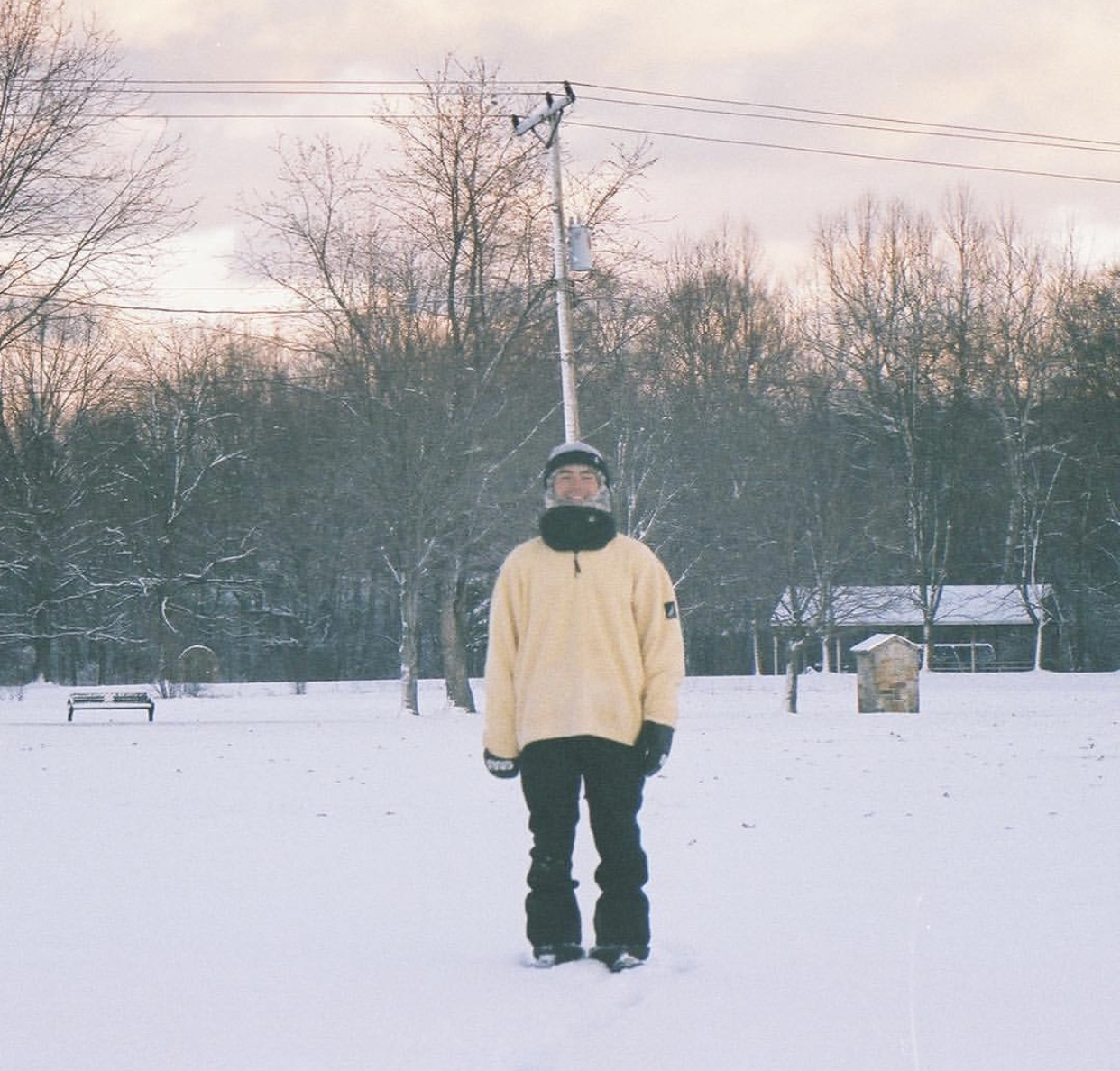
Coming up with an idea for my enterprise story was not very hard. I just thought of topics I might enjoy writing about, and what would be relevant. After less than a minute I came across the idea of writing about the current media transition in the snowboarding industry. When I went home for winter break, I learned that my home mountain Seven Springs wouldn’t be producing their web edits anymore. They were doing it to pursue a heavier social media presence, and at first I was upset. After noticing that Think Thank was putting out content throughout the season instead of their typical full movie, I soon realized the snowboarding community as a whole was going through a media shift.

To locate my sources I contacted a few friends that work in the snowboard industry and ride for a few companies to see if they were down to let me interview them on the current media situation. Luckily they were all happy to help me out and share some knowledge. I also contacted a few people I didn’t know, such as Justin “Stan” Leville, to  get some opinions from their perspective.

Choosing my sources was relatively easy. I tried to get well-rounded perspectives from different people in the snowboarding industry. I contacted Ian Macy, who produces content for a few different companies and ski resorts, to get a filmer’s opinion on the media shift because he is the one standing behind the camera filming stuff.

I also tried to get an opinion from a riders perspective, because they are the ones actually being filmed for the content produced. To get a rider’s perspective I contacted my friend Cameron Dunmyer, who rides for Oakley and Gnu Mid-Atlantic. I also quoted one of the riders from the DC video series I was talking about in my paper, Brady Lem, because in the video he gave his opinion on starting to film street so early in the season.

Lastly, I contacted “Stan” because he runs a snowboarding news show, “Last Resort,” where he shares his opinion on subject matters within the snowboarding community in a satirical way. I thought having his opinion would be important because many people watch his show, and he is one of the voices of the snowboard community.

The presentation of snowboard media has been a controversial topic for as long as I can remember. I knew going into the story that I wanted to write something neutral that focused more on the factual side of things, as I didn’t want to offend anyone. Instead of focusing on what the best way to portray snowboarding media is, I just focused on how it is being portrayed and how it is different from the past.

Over the course of my research, I gathered an insane amount of information regarding how the snowboard industry is today, how it was, why it changed, what’s better for business, how it’s going to be in the future, if it’s a good or bad thing and many other opinions. I would have loved to write a longer paper that involved all of these topics listed — and many more — but it would have been confusing for the reader if they were not an active member in the snowboard community.  To keep it simple, I focused on what the media used to be, what it is today, unbiased factual reasons about why it changed, and how it could possibly be in the future, making sure not to offend anyone in the process.

My rough draft was hard to put down on paper because I had an overwhelming amount of information, prior knowledge and an opinion of my own, so I wasn’t sure what to include in the story. After finally figuring that out, putting words on paper became relatively easy. The hard part has been editing and figuring out AP Style. Because I have very little background other than participating in class, I struggle to notice when my AP Style isn’t correct, and therefore don’t realize to look it up and fix it. I also struggled with quote placement, but after realizing my faults I added more quotes and fixed the positioning of them to make the story a more enjoyable read.

The most surprising thing about writing the enterprise story was how willing people were to give me their opinion, even though they didn’t have to and wouldn’t benefit from it in any way. Part of me believes that was what made the experience such a great one. It allowed me to get out of my comfort zone and think about something that is such a major part of my life in a different light. It forced me to think about it not only from one perspective or opinion, but in a way that everyone could understand, relate to and feel unbiased about. Writing the enterprise story was a great experience, and I am glad I picked the topic that I did.

Bio:

Brady McCarthy is a first-year student at the University of Utah. He is 19, and a Pennsylvania native. He plans to attend business school with a focus on marketing. His favorite activities include snowboarding, skateboarding and doing anything fun with his friends.


Beyond the water cycle: Life and environmental lessons from a former BLM director

Story and Photos By: JAKE PHILLIPS 

Patrick Shea’s beard was wet.

It was an oddly fitting picture of the former director of the Bureau of Land Management, who despite being out of government for 20 years, has water on his mind a lot these days. It was a rainy Thursday morning, and Shea, 70, was strolling to class.

Not on the University of Utah campus, where he’s been a research professor of biology and taught a class on urban streams for years, but at a local elementary school.

Every Thursday morning Shea teaches a class on water to fourth graders at Rose Park Elementary School in Salt Lake City. He arrived to a roomful of damp students who had just returned from recess.

As their teacher, Hannah Dolata, instructed her students to find their seats, Shea dried off his bushy white beard. He asked them what they had learned the previous week. The students couldn’t wait to tell him about the written equation they’d learned that showed how much water they used when showering or teeth brushing.

One student proudly exclaimed that if he brushed his teeth with the water running for three minutes and showered for 10 minutes he would have had used 52 gallons of water in the process.

“I try to conserve water every day because my grandma complains about the water bill,” said Valentine, 9.

Shea then asked the students what they should do after wetting their toothbrushes.

“Turn off the water!” the students yelled in unison.

While most elementary school students learn about the water cycle, Dolata’s fourth-grade class at Rose Park Elementary School is getting a much more in-depth education about water and how it affects them. With Utah’s less-than-abundant water supplies and growing population, water conservation has become more important than ever.

Salt Lake is winning water conservation fight

Around 33 percent of Utah is considered to be true desert, meaning the state receives 5 to 8 inches of precipitation annually, according to Utah’s Comprehensive Weather Almanac. The heavily populated Wasatch Front receives around 15 inches of precipitation annually.

Along the Wasatch Front, Salt Lake City appears to be winning in its fight to conserve water. According to the 2014 Salt Lake City Water Conservation Master Plan, conservation has exceeded expectations and the overall trend is a reduction in water use in the area. Classroom programs like Shea’s are crucial in these efforts, the city’s Department of Public Utilities said.

Yet, with climate change and other environmental concerns an increasing reality to students both in childhood and their future adulthood, it’s especially important to teach children today about ways to address these issues, Dolata said.

While Salt Lake City has responded to calls to conserve water, planners expect the city will need to do more in the future. According to a University of Utah study conducted in 2017, the state population is expected to grow from 3.2 million to 3.9 million by the year 2030, an increase of about 22 percent.

If Salt Lake residents continue to use water at the same rate they did in 2000 Salt Lake City’s water usage is expected to increase by 23 percent by 2030, according to the Salt lake City Department of Public Utilities.

Shea asked the students about where the water they use every day comes from. He explained the majority of water in Utah comes from snow in the canyons. Then the children attempted to name some of the canyons near Salt Lake.

The class’ homework assignment was to look at the weather and to document whether it was an accurate report.

“The biggest problem for you growing up is figuring out what is true and is not true,” Shea said.

A different kind of ‘water bucket’ challenge

Shea wasn’t totally out of his element. It had been five years since he had last taught elementary students about proper water usage.

The daughter of a colleague, who Shea worked with on state water laws, was teaching fourth graders and challenged the research professor to speak to her class.

Hesitant at first, Shea said he’s come to enjoy the experience.

“The students are like sponges and want to learn more,” he wrote in an email.  

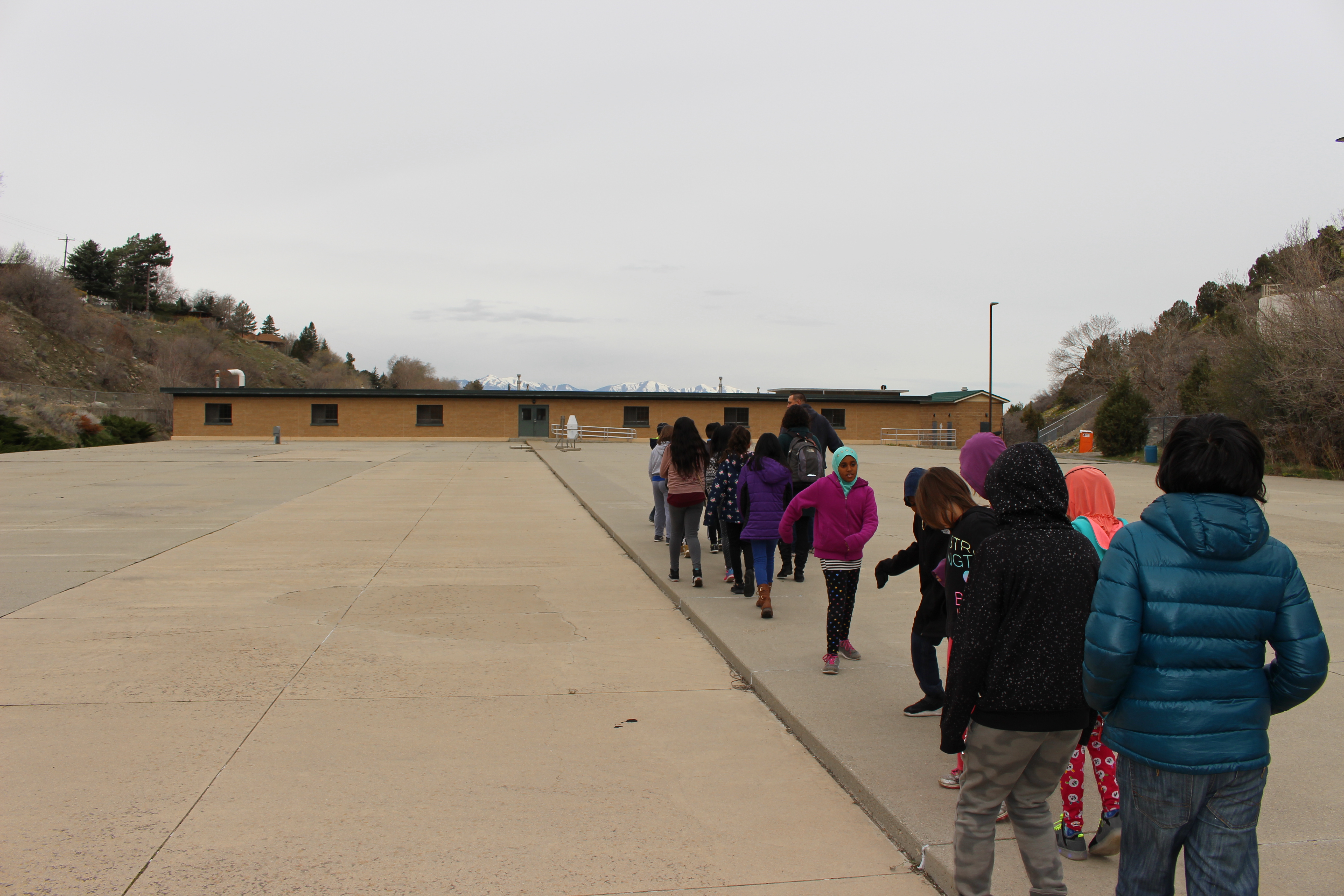
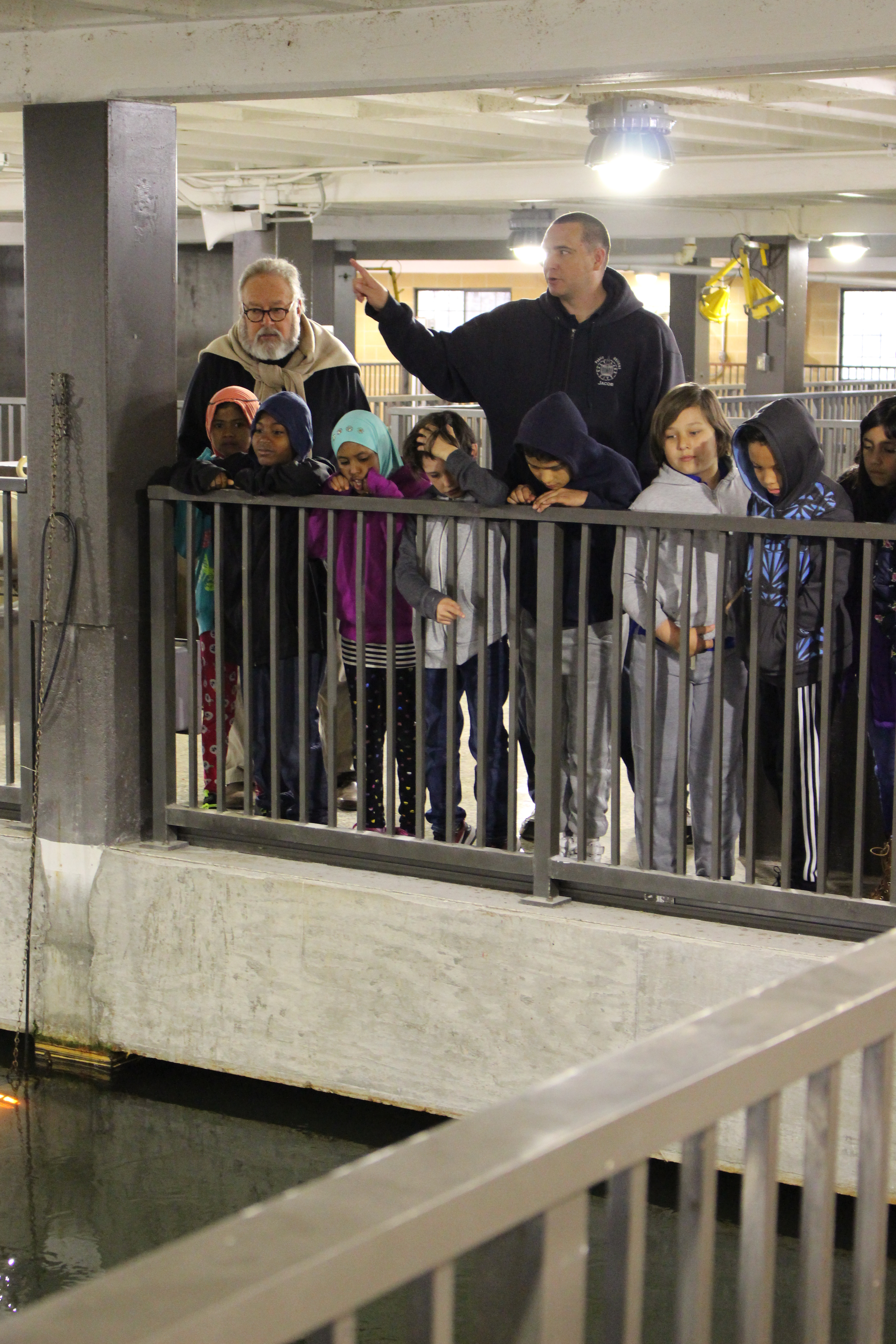
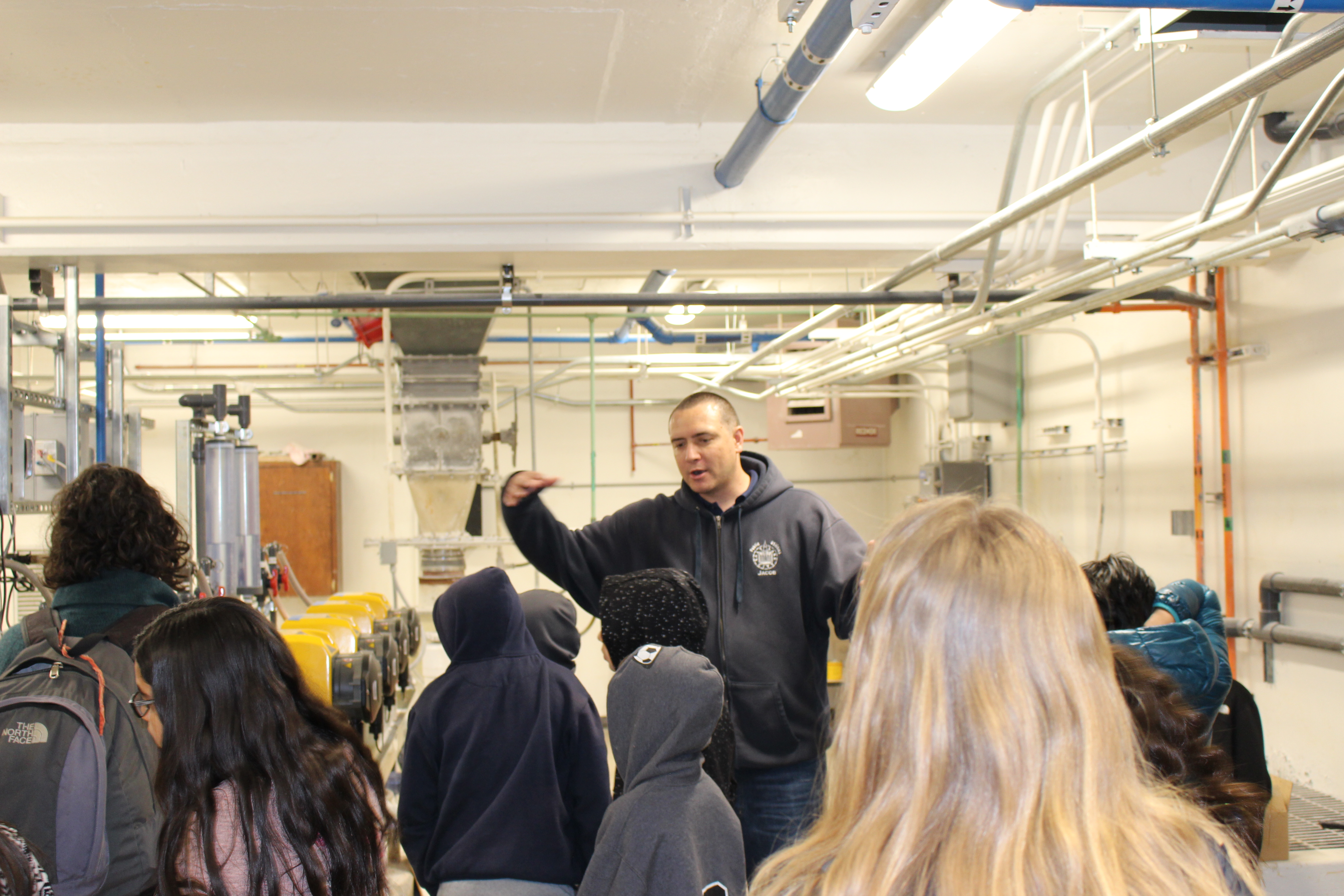
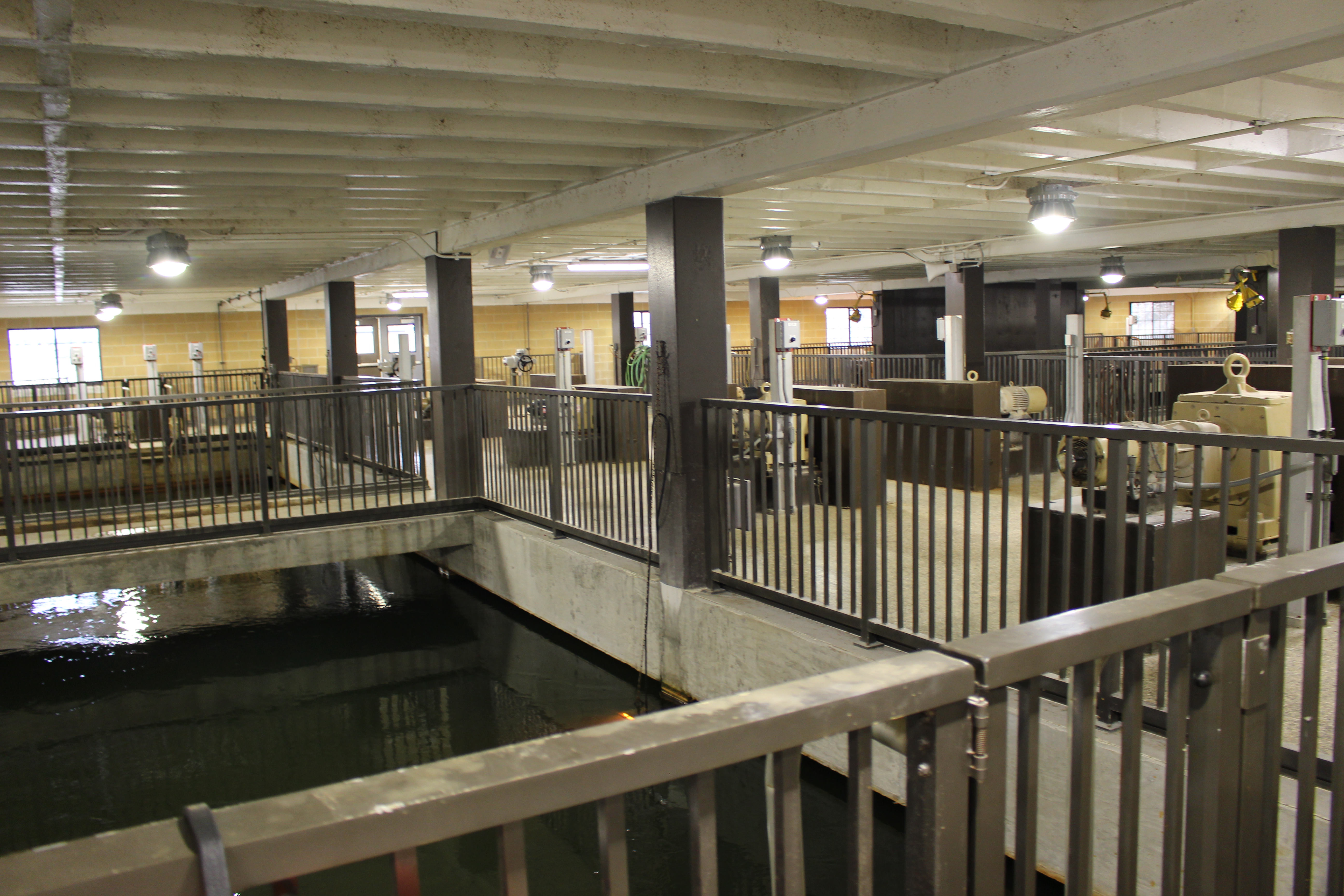
A few weeks later, the professor was back, this time leading a field trip to a water treatment plant up Big Cottonwood Canyon. With Shea was Jacob Maughan, treatment plant operator, who led a tour of the plant and explained how the facility purifies water to make it potable. From there, the energetic children then returned to their bus and traveled to City Creek Canyon.

At City Creek Canyon, a popular biking and hiking destination for Salt Lake residents, the students were met by John Wells, who manages the city’s watershed operations. With students trailing behind, Wells led the class on a walk up a winding, paved canyon road while explaining why it’s important to protect the watershed.

He told students that dogs are not allowed in the canyon to protect the water quality in the streams that the city depends on. As the students fidgeted and chatted, Dolata, their teacher, stressed the importance of showing students the real-life connection to the water cycle.

“In fourth-grade science they’re learning about Utah science and start to connect what they’re learning to the world,” she said. They “see themselves as scientists.”

IMG_1402

Hannah Dolata and her class overlook a water storage unit and the Salt Lake Valley.

IMG_1395

Dolata’s class walk across a concrete platform that serves as water storage at the Big Cottonwood Water Treatment Plant.

IMG_1391

Patrick Shea looks on as Jacob Maughan explains how snowmelt is cleaned and transformed to drinking water.

IMG_1387

Maughan telling the students what chemicals are added to unclean water to make it potable.

IMG_1376

Maughan advises students to be cautious in his lab, because there are dangerous chemicals present.

IMG_1380

IMG_1396

IMG_1400

Dolata and her class watch water spill over a weir used to control water flow and filter out solid matter.

The Women Behind the Silver Screen

SALT LAKE CITY, (April 24, 2018) — In light of recent allegations against Harvey Weinstein and movements like #MeToo and #TimesUp finally bringing public attention to the marginalization of women in the film industry, institutions like the Sundance Institute are creating programs to help even the playing field for female filmmakers.

While these initiatives are presenting new opportunities for women, there is some concern that this reactionary response will become a band-aid solution to the broader issue of sexism in the film industry. The women leading these movements are determined that this will not end with a conversation, it must evolve into action. They acknowledge that change on such a large scale, especially when it is so institutionalized, demands time, conscientiousness, and ongoing effort. “I am hopeful, I have a lot of hope in the #Metoo and #TimesUp movements,” says Dr. Sarah Sinwell, a professor at the University of Utah. “I believe with celebrities coming out and telling their stories it enables other people to tell their stories. I believe that by putting money and funding and resources behind these kinds of institutions and what, for instance, McDormand talked about with inclusion riders and all those sorts of things that the general public is aware, not just the movie going public or not just the women, female film directing interested–people public. So many people are aware of this and I think that the constant publicity and the constant discussion and the way it’s entering schools and non-profit spaces and the way it’s kind of not just about those celebrity experiences but that it’s framing all these other contexts. I think that is why it may move into a space beyond this present one.”

Solutions must go beyond simply honoring the women who are already making films, and must take into account the inequality in resources and opportunities women face in making films in the first place. A study released by Women In Film in collaboration with Sundance found that even with the recent shift to more progressive attitudes toward female filmmakers very little actual change in the film industry has taken place.


“Currently, the presence of women behind the camera in popular films is infrequent at best. Assessing 250 of the top-grossing U.S. movies of 2011, one study found that only 5% of directors, 14% of writers, and 25% of producers were female. These statistics have fluctuated very little since 1998, seeming to suggest that the traditional Hollywood economic model or power-structure is a leading impediment to access for women filmmakers.”

-Exploring the Barriers and Opportunities for Independent Women Filmmakers Phase I and II Research By: Stacy L. Smith, Ph.D., Katherine Pieper, Ph.D. & Marc Choueiti

This slideshow requires JavaScript.


The nominations at the Sundance Film Festival this year reflect their efforts for greater representation but, while higher than mainstream Hollywood representation, only 37% of the 122 films presented at the Sundance Film Festival were made by women. “What that says to me is that they are working harder to try to be more inclusive of women but we’re still not even at the 40 percent,” says Sinwell. “So, the numbers are growing, but they’re still not high enough, and I think that’s an issue not just of Sundance but I think it’s across the board that there’s not enough women directors, there’s not enough women directors getting high budgets like male directors, there’s not enough women directors working in a variety of locations and a variety of production companies.”

Sundance Stat Image

37% of the 122 films at the 2018 Sundance Film Festival were made by women.

­­One often proposed solution to the problem of unequal representation of women in film festivals is the creation of separate categories for women and there are festivals created specifically to honor women in film, however some believe that this could lead to further marginalization or othering of women in film. “I think we need to value both, I think we need to value festivals that are specifically focused on women, that talk about the ways they value women, that incorporate women and that are inclusive of women and I think we need to promote quality filmmaking and make sure that women are a part of that narrative, of the general quality filmmaking or Sundance independent filmmaking narrative as well,” says Sinwell. “This is actually something that comes up a lot when people hear I’m teaching the Women Directors class, they say ‘why do we need a Women Directors class, isn’t that excluding all these other categories right?’ But I always remind people the reason we need it is because there are so few women that are talked about in general film history classes or intro to film classes, that the class is made necessary because the lack of women in our history textbooks and cinema kind of classes general classes.” Lois Brady

Speeding, Utah Driver’s bad habit or lack of punctuality?

Speeding, Utah Driver’s bad habit or a lack of punctuality?

By: Deaven Dell

April 17th 2018


SALT LAKE CITY–Many Utahns believe that the drivers in Utah are the worst, but residents in other states also believe this about their own state. With accidents being the 4th leading cause of death in America, safety and prevention is huge concern for government officials. In Utah, when looking at the numbers there seems to be a huge speeding problem.

Amelia Wolfgramm, Public Health and Health Promotion professional, believes the cause of reckless drivers is their constant need rush to get where they are going. When talking about drivers she said, “I think Utah drivers aren’t as considerate as other drivers out of state. I think it can be attributed to the rush mentality we live up to” in Utah “we’re always in a rush” said Wolfgramm, “Mistakes I often see are attributable to risky driving. Speeding is also a huge factor in risky driving that leads to a lot of confusion for other drivers and can even lead to probable death.” Unfortunately, Wolfgramm like many Utahns recognizes the riskiness of speeding still feels like she is part of the “problem” and finds herself driving risky also in order to be on time.

According to the Utah Department of Public Safety Highway Safety Office, speeding was the number one cause of death in 2016 Utah car crashes. This would be explained by the rushed behavior of Utah Drivers.


Crash Summary (Utah 2016)

Leading Causes of All Crashes


  1. Followed Too Closely (24%)
  2. Failed to Yield (20%)
  3. Speed (15%)
  4. Failed to Keep in Proper Lane (13%)
  5. Distracted Driving (9%)


Leading Causes of Death

  1. Speed (37%)
  2. Unrestrained Occupants (28%)
  3. Failed to Yield (16%)
  4. Drunk Driving (13%)
  5. Overcorrected (11%)


A new Utah red light bill has caught the attention of many reporters and Utah residents the past couple of months. The bill would allow Utah drivers to run red lights. Other states, including Pennsylvania, have put into place similar bills allowing people to run red lights or proceed through a red light if it is clear.

Denise White, Utah resident and mother of three, does not think that the passing of this bill would be wise. “People are constantly running stop signs and cutting it way too close when they think they can make it before another car” she thinks that this bill would cause too much confusion. “Many people who are going through a green light will not be prepared for someone to be passing in front of them. That may cause more accidents because they will just keep going at their rate of speed and a car could pull out at the stop and  be going too slow for them to avoid being hit.”

However, Ken Ivory, the bill representative, said the bill would still require drivers to come to a full stop, but allows them to proceed if no other vehicles, bicycles or pedestrians are nearby. It would essentially convert a red light into a stop sign. “This is a safe-on-red bill. It’s not a run-a-red-light bill,” said Ivory. But could this lead to more problems? Out of the 62,471 motor vehicle crashes that occurred in Utah in 2016, 20% of them were caused by failure to yield.

White just recently reported an accident which occurred at her own home in Salt Lake City, a young driver with a learners permit ran through White’s fence “confusing the gas from the break”. “I spoke with a police officer after a driver with a permit drove through our fence. The young driver was confused about gas and break” said White, she believes that children are not getting enough instruction, “That is something that should be done in drivers ED or with a trained professional. The officer said that they have so many crashes because new drivers haven’t had proper instruction. They are being taught by parents who have bad habits, have been driving so long they don’t know the laws or don’t even take the time to properly teach their children as is required.” As a parent, White is very concerned about the safety of her children. She has two children driving and is very concerned with the number of fatal accidents on our Utah roads.. White did not allow her children to drive on the freeway for the first year of driving for fear of speedy drivers.

In 2016, there were 11,508 speed-related crashes which occurred in Utah which resulted in 5,550 injured persons and 105 deaths. Out of those crashes, drivers aged 15-24 years had the highest percentage of total speed-related crashes.


Jager K Chynoweth


IMG_7088

MY STORY: Technology advancing Utah’s music scene


BLOG: 

This news story brought with it its own struggles, but definitely helped me to become better and smarter writer. My original topic idea was to address the opioid crisis in Utah and how marijuana legalization may alleviate the problem. I quickly found out that I bit off a little more than I could handle with article’s time requirements and my everyday responsibilities. I struggled to get in contact with interviewees, and when I did I had a lot of rain checks and no shows.

I quickly changed topics and settled with a topic closer to home. My idea for my topic on advancing music technology and its correlation with the rising hip-hop scene in Utah came from friendships with a few of Salt Lake’s local producers and rappers.

I knew my friends would be great sources for my article because a lot of their rising success can be attributed to the technological advancements happening in music today. After switching topics, my interviewing and writing process went very smoothly. It was a topic I was interested in and I felt like I could help bring attention to Utah’s growing music scene.

I definitely noticed that the writing process goes a lot smoother for me when I have strong knowledge of the topic at hand. I was able to achieve this by doing my own outside research on the topic and then conducting thorough interviews that I later reanalyzed. After experiencing all the turmoil with the first topic, it was a relief to see the outcome I had with my current story.

BIO:

Jager Kole Chynoweth is enrolled as a student at the University of Utah. He is majoring in Strategic Communication, while focusing on digital marketing and advertising. When he is not in school or working he loves to hike and backpack Utah’s amazing landscapes with his husky.

Kara Rhodes

MY STORY: Processed with VSCO with c1 preset

  • Women in STEM underrepresented in Utah but begin to rise in the field

MY BLOG: Reflection 

ABOUT ME: 

Kara is a University of Utah Student graduating Spring 2019 with two B.S. degrees–in Communication and Gender Studies. Kara has a passion for making a positive change in the ever changing world today. Journalism assists her by making her Gender Studies degree applicable to the world. Kara began her love for writing by reading all the Junie B. Jones novels and creating a blog in her adolescent years that dramatically explained why boys didn’t like her.

When Kara is not studying at the University she is participating in every yoga opportunity that she can. Licensed with a 200 HR YTT (Yoga Teacher Training), Kara is passionate about yoga. Music, fashion, and film are other hobbies that Kara enjoys talking, writing, and speaking about. She dreams of leaving her home state, looks at dog videos on Instagram, and reads books she wishes to understand.

LINKEDIN:

15 seconds to fame: How Instagram turned the snowboard world on its head

Story and Photos by BRADY McCARTHY

Facing a potential avalanche of unhappy snowboarders and the snowboarding industry as a whole, production companies and even ski resorts are in the midst of a change of seismic proportions on how they promote snowboarding.

In the past, snowboard media has been consumed through magazine subscriptions, “ski porn” movie releases by production crews every fall and online videos posted to websites such as Snowboarder.com.

But Instagram turned that all upside down five years ago in a shift that leveled the slopes. The social-media platform effectively democratized the self-promotion and exposure of the elite and those clawing their way to the top of the sport.

In June 2013 the social-media platform started to allow users to post 15-second videos, and with that Instagram changed from being a photo-sharing platform to primarily video sharing. Users were then able to receive instant gratification — and responses — by opening up the app and simply scrolling down through 15-second videos.

Soon these 15-second videos became one of the main ways to view snowboard media, allowing snowboarders to share and view snowboarding media without spending as much time — or money — consuming them.

“It allows up-and-coming snowboarders to get more exposure and make a name for themselves,” Gnu Snowboards Mid Atlantic rider, Cameron Dunmyer, said about the introduction of videos to instagram.

IMG_1363

Cameron Dunmyer by a street spot at sunset, February 2017. Photo by Brady McCarthy

Independent snowboard production companies began to decline a decade ago. Today, they are almost obsolete. Ian Macy, the content creator and video content specialist for Woodward Copper and Terrain park Marketing Coordinator for Seven Springs, Pa., said production companies aren’t receiving the same backing from snowboard companies to “buy-in” their riders to the movie.

“The amount of full-production snowboard video crews in the last five years has dropped significantly,” Macy said.

In the past, companies’ underwriting money would not only pay for companies’ rider’s participation, but the entire production, from film crews and their equipment to travel and other expenses. Instagram and other social-media platforms have eroded much of that spending as companies realize they get more reach — and their dollar goes farther — with brand videos and other content distributed over social media.

Instead, snowboard companies increasingly turn to contract filmmakers, who are now paid to produce online content and even full-team movies, because they then have complete control over the project rather than underwrite independent film crews.

In an attempt to stay relevant, video crew Absinthe Films has leveraged social media in promoting their new project. Last year Absinthe had to resort to crowdfunding after struggling to keep people interested and in turn receive enough money to produce their project, Turbo Dojo.

This year they have been incorporating social media and live streams of filming sessions at famous spots with big-name riders, allowing the consumer to get a behind the scenes look at the filming process. This method of presenting media has also proved to keep potential consumers excited about the upcoming project.

Independent film companies aren’t the only ones taking advantage of social media as a marketing strategy. The No. 1 park on the East Coast, according to Transworld Snowboarding’s 2017 Park Poll, Seven Springs has decided to switch their media marketing to only involve social media for the 2017-2018 season.

IMG_1384

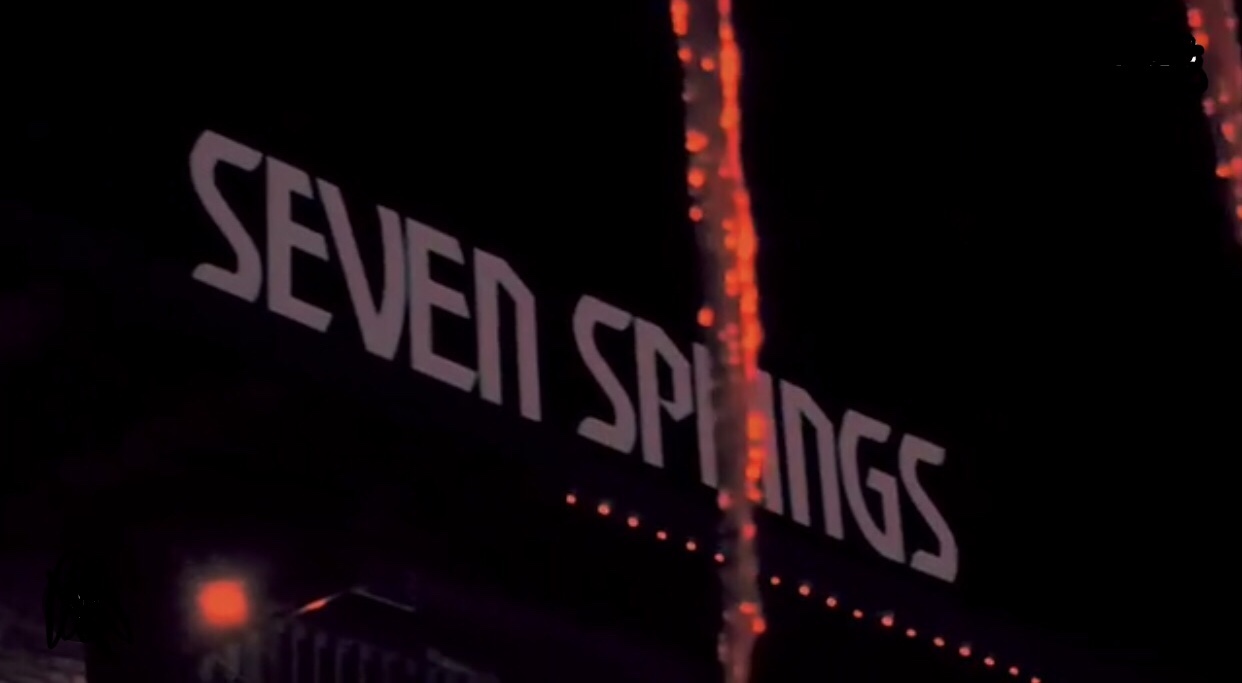
The Seven Springs sign illuminated by Christmas lights. Photo courtesy of Tanner Scott.

Historically, Seven Springs released a web series on Snowboarder.com, “The Seven Deadly Edits.”  Macy explained people aren’t watching those videos the way they did just five years ago. He also said that single Instagram clips of one trick are getting more views, likes and comments than a full three-minute video that required more effort, meeting internal demand for more viewers.

“If it’s the right thing and it’s presented a certain way, it could blow that typical three minute edit out of the water,” Macy said.

Macy said it’s hard to predict the future of snowboarding media, but there isn’t consensus when it comes to consumers’ tastes. He said a mix of the old and new ways of presenting snowboarding will work the best.

Instead of filming for a video and incorporating social media into the process, some productions are being released incrementally as videos throughout the year. DC Transistors and Forest Bailey’s FSBS are two examples of video projects being released throughout the year highlighting specific trips that would usually constitute a full movie.

IMG_1386

“DC Transistors” crew member Jordan Morse at the Rail Gardens. Photo by Brady McCarthy

It’s also forced filming to start earlier in the year for riders in the DC crew.  Brady Lem, a DC Transistors crew member, said he wasn’t excited at first about the early street mission experience in “DC Transistors Episode 1: The Early Hunt.”

“Kinda was bummed on going on a street trip this early at first, but now looking back on it I’m pretty excited that we did it,” Lem said.

Think Thank, a film production company known for its creative take on snowboarding videos, has taken a similar approach but with a different layout. The company’s project this year, “Falling Leaf,” has followed riders throughout their travels. Think Thank now releases “Leafs” at certain points throughout the season.

What makes their project different from others is that it’s presented in a mini-magazine format on the internet. The “Leafs” include photos, videos and text allowing the best of all forms of media that can be quickly accessed by viewers without giving up the interactive experience of a magazine or movie.

“I mean the short of it is that riders are more in control of content now because movies are less viable,” said Justin “Stan” Leville, host of the popular snowboarding news show, “Last Resort With Stan.”


This slideshow requires JavaScript.


Outdoor Retailer show says bye-bye to Utah, but does the Beehive State care?

Annual shows have new home but its departure from Utah may have less impact than you think. 

Story by LUKE FORTUNE

A tourist staple and economic driver for 20 years, the renowned Outdoor Retailer shows, which brought the outdoor industry’s blue-chip businesses and top athletes to the Wasatch Front, no longer calls Utah home.  

In 2017, the shows’ organizers, citing opposition to reducing Bears Ears National Monument and other land management policies by federal and state officials, announced their decision to leave Utah for Colorado.

“We chose Denver because of Colorado’s long-term commitment to protecting and nurturing public lands,” Marisa Nicholson, director of the Outdoor Retailer trade show, said.

While the departure has left a black mark on the Beehive State outdoor recreation industry and image, how much of a hole it will leave in Utah’s economy is unclear. Nate Furman, a University of Utah professor in the parks, recreation and tourism department, said it’s more of a lost opportunity that will affect Salt Lake City in the short term.

“In the long term, I don’t think that it will have major effects, as the gravity of national politics will drown out any effects of whether or not the show is held on the western margin of the Rocky Mountains or the eastern margin,” Furman said.

The Outdoor Retailer shows have drawn tens of thousands of tourists and athletes from around the world who come for the latest in outdoor equipment and to sample the state’s recreational offerings.

The trade shows pulled out of Utah in protest after the Trump administration and Utah politicians chose to shrink two controversial national monuments. Along with the proposed reduction of Bears Ears by 85 percent, Grand Staircase-Escalante National Monument is slated to be cut in half. As a proponent of public lands, the trade shows’ leadership took a stand in protest, as did many companies that attend the convention.

Outdoor industry stalwarts, including California-based retailers Patagonia and The North Face, met with Utah Gov. Gary Herbert after President Trump’s the decision to reduce Bears Ears and Grand Staircase-Escalante National Monument. The companies ultimately decided that moving the show from its longtime home of Utah would be the best choice for their industry as a whole. 

“I say enough is enough,” Yvon Chouinard, Patagonia’s founder, said in a statement. “If Governor Herbert doesn’t need us, we can find a more welcoming home. Governor Herbert should direct his Attorney General to halt their plans to sue and support the historic Bears Ears National Monument.”

Over the past 20 years, Outdoor Retailer has brought 40,000 visitors annually to Utah during their twice-yearly shows, which run for three days at a time. Additionally, the shows have brought $45 million in consumer spending.

While these numbers may seem large, the loss hardly puts a dent into Utah’s roughly $13 billion tourism economy. The outdoor recreation industry brings in $12.3 billion in consumer spending a year as well as $737 million in state and local tax revenue, according to the Outdoor Industry Association. While Utah as a whole will most likely see little impact, local businesses may see mixed outcomes, depending on their size.

Smaller companies may have a harder time as they relied on the increased sales the shows brought, but shouldn’t be hit too hard, said Sunn Kim, the retail store manager at local Utah company Backcountry.com.

With annual revenue of $634.54 million, Backcountry.com makes most of its sales online, allowing it to weather the shows’ departure with little impact on its bottom line. The company has a small retail shop that may be affected by the departure.

I believe the departure of [Outdoor Retailer] will have a more immediate impact on Utah’s outdoor industry and economy,” Kim said. “I believe that smaller businesses focused on tourism will suffer, but this impact will only be temporary.” 

Nicole Cardwell

My Story:

Is the air we are breathing, causing disabilities?

IMG_1082

REFLECTION:

We were asked to write about something that interested us or that we could make newsworthy. I was in Houston for 18 months and came back to Utah in the middle of the winter. This is when I realized how bad our air was. There was a drastic change and I couldn’t believe I had lived here my whole life and never thought that it could really affect my life and health. I started to look more into this and since then I’ve had a desire to help others be aware of what’s happening and what can be done.

I started with the big guys that record air quality and contacted the manager, who was happy to help me. I wanted a perspective from a student that was studying climate change at the University of Utah and I decided to look through the colleges to find what would best fit. I contacted a department and they directed me to the geography department that helped me find Rebecca Steve. She was very helpful and open to meeting with me and sharing information about her future project.

I had my goal of where I wanted the story to go and worded my questions and follow up questions around that. After having all of the information, I made an outline and organized things by putting it down and filling in the gaps. It was harder with the more scientific definitions and phrases but I made sure I understood it, and put it simply.

The writing process flowed and I had other people go over it before our peer reviews and that helped me. I made sure they understood that it was supposed to be a news story and that helped them critique my paper and make it feel and sound descriptive. It helped to have the peer review because he was able to help me through every section and gave good suggestions. It helped to see his paper and his style. It definitely helped to have all of the writing exercises before and getting used to writing outside what I’ve always known.

I think I could add more of the personalities and back stories for the people I interviewed on my blog. That says a lot about why they are there and what has made them passionate about what they do and why. I think I could add why I decided to research this information and my theory and experience as well.

AUTHOR BIO:

Nicole is a student at the University of Utah in the Communication major. She is a 1st degree Bachelor student and will graduate in the spring of 2019. She is passionate about making goals and working hard and had many plans for the future. 

Nicole plans to go into marketing for Science, Health, Environmental risk and wants to work with public health. She hopes to help with non profit organizations and programs to help with Utah’s environment. 

On her 18-month mission in Houston, Nicole taught English as a second language in schools, libraries and churches. She is fluent in Spanish and her parents are from Mexico and El Salvador. Since then, service has been a priority for Nicole and she enjoys helping those in need. 


Everett Olsen

IMG_3990

Blog: 
The idea for my enterprise story originally stemmed from my experience at “The Peoples Cvlt’s” third concert, hosted inside the Goldblood Collective. I happened to be one of the only 20 or so people in the audience for the group’s first show. Seeing the rapid progression in the number of fans the group had gained for this performance, immediately had me asking myself, “How?”  

After I had decided on my topic and the angle I was going to work, it was time to reach out to members of the groups for interviews. I first reached out to Max Bradshaw or Mad$haw, a friend from high school who happened to be co-producing for the group. While Mad$haw himself preferred to stay behind the scenes, he gladly introduced me to the other producer, Sean Mota (4k), as well as other group members Teague and Kiefy Kush.

I wanted to make sure for this story I captured the setting properly for my interview, to get the most intuitive and honest answers I could from these creatives. To do so I stopped into Mad$haw’s basement studio on a Wednesday night, the night the group meets and collaborates each week. Although I came to the house ready as a journalist, I chose to put this on the back burner, and simply talk with the group members casually building rapport until I felt ready to get down to business.  I think in doing so I was able to capture much more natural and honest responses from these artists.

Bio:

Everett Olsen is a junior at the University of Utah studying communication. After an intensive two-year search for a major, Everett has found an outlet for his voice though journalistic writing and reporting. Born in Salt Lake City, Everett developed a love for the outdoors as well as a profound passion for music. He plans to cover more stories and events that parallel these personal passions, as they seem to yield his best writing.

Becca Carr


IMG_3858

MY STORY

Utah Cops Struggle to Enforce Texting and driving law 

MY BLOG

While looking for a topic to do my story on I started off with a Google search. I looked at local cities and came across a Salt Lake Tribune article about lawmakers killing a bill on texting and driving that could save lives. I then started to focus on the police and what the double standard was for them using cellular devices. From doing my interviews I moved my story more in the direction that because the law in place for texting and driving is so hard to enforce is it worth even having.

At first, I was nervous that I wouldn’t be able to connect to the people I needed to interview. I then started to think about people I knew and family connections, using sources that I could reach out to. I then got in contact with Rich Ferguson and Eric Johnson. Rich is Chief of Police while Eric is Detective Sargent. By talking to them I asked if they had anyone I could talk to that was a Highway Patrol Officer. I then called Jeremy Horne who was a Highway Patrolman for 10 years. After I had my main interviews I decided that it would benefit my story by having someone giving their opinion and thoughts about texting and driving, so I took it to campus and found Audrey Emery, a senior at the University of Utah.

I think the sources I got were the best I could have gotten for my story. I found police officers that are high in ranking and also found a specific officer that worked as a highway patrolman. I also think that information that I looked us about specific laws in place and looking up different counties news I found great information that benefited my story.

The main obstacle that I faced was looking for interviews. I didn’t know where to start because I knew I had to talk to people in high-ranking positions. But after I talked to a family member and got my resources together, it was smooth sailing from there.

I got a lot of information about police and the double standard, thoughts on texting and driving, how the law is enforced and so on. These questions gave me a lot of information that I had to narrow down. I narrowed it down to how and why police officers enforce the particular law of texting and driving along with what the solution can be for texting and driving. I decided these as my main focus because this is what most of my interviews focused on and what seemed more important.

The writing process was a little bit difficult to start. I have never written a news article and had never interviewed someone before, so the task was scary. As I started the process I started to become comfortable with talking to people and asking questions. I also had to learn how to narrow down information and make sure what I was writing down was correct and okay to quote.

I think what surprised me most through this whole process and story was that law enforcement doesn’t even enforce the law against texting and driving because it’s so difficult to detect the particular use.

ABOUT ME

I currently live in Salt Lake City, Utah where I am a Junior at the University of Utah. I am a communications major with my focus in strategic communications. As I continue to pursue my degree in communications – focusing on advertising, branding, marketing, and public relations – I hope to gain on-the-job experience that will help in my career. By doing so, I would ideally get a job with a respectable cosmetic company where I can work with the marketing or public relations team. Although the focus of my major is not journalism, I have found an interest in it and have piece of work that I am excited about.

Alexis Lefavor

image-73

Blog

I used to love Ichiban Sushi but in recent news I found out they were closed down by the health department. I noticed that they were popping up everywhere. I have noticed recently that sushi has been a trend. It can be really expensive! Ichiban Sushi has sushi that is advertised for half off. My story talks about how they opened back up. I want to make local sushi lovers aware of this restaurant. I also want to make people aware of the health department’s website. They are required to post all of the health inspections at established restaurants. I was not aware of this until I started doing my story.

I used Yelp and Facebook to find my sources. I read many reviews positive or negative. Many of the negative reviews matched some of the reasons that lead up to the closing of the restaurant.  I interviewed people who left these reviews and asked about their experiences. I also interviewed somebody from the health department to figure out how they run the inspection.

As I got more information from my sources, I felt I was really able to write my story. The information I received is what guided my story and made the focus. The hardest part of this was trying to find people to interview. I also reached out to the Sandy Ichiban for comment and didn’t receive anything from them. I was hoping to incorporate into my story how they were planning on making sure they were able to stay open and not face another closure. I think it’s really important for restaurants to ensure that their customers feel safe eating there, especially anything with raw meat.

About Me

My name is Alexis Lefavor. I am a junior at the University of Utah majoring in Communication. I hope to graduate by Summer 2019. My focus is strategic communication. I have always been interested in marketing, branding and public relations. I hope to find myself somewhere in one of these fields in the future.

Mallory Bell

MY BLOG:

I have always had an interest in criminal justice and the judicial system. I decided to research the Sexual Assault Kit Initiative in Utah and find out what the future was for Sexual Assault Kits for my story.

My sources included employees of Utah’s Department of Public Safety, state senators and local organizations who helped write the upcoming bills. They were the best sources for this story because they gave me a variety of information while being employed by different entities. I was able to gather information from each source about the new bill, the part they played in helping the victims and helping to get the bill passed. I did encounter ethical or moral dilemmas while trying to find other sources that could give me information from the victims side. The sources I did have weren’t able to give me names or information about victims because it went against their advocacy.

I made sense of the information gathered by researching the topics that my sources were speaking to even more on my own. I also listened to the interviews that I recorded multiple times so that I was sure I understood the points they were trying to get across.

I made a plan for my story, and organized my ideas more after each person I spoke to or each thing I learned. I learned that being organized and having really great, well-thought questions helped get the information I needed. I learned a lot about the national initiative SAKI, but wasn’t able to include every detail. I thought it was interesting to find out where each state was in their project and how long it took them to get through the backlog. I was very surprised at some of the facts about how kits were handled in the past, such as kits being thrown away because it seemed unsolvable.

I ended up enjoying learning about my topic more than I even thought I would. I saw many opportunities and avenues for volunteering as I spoke with the different government organizations.

0.jpg

ABOUT ME:

My name is Mallory Bell and I am a communication major at the University of Utah. I enjoy being able to show my creativity through painting, fashion, and writing. I grew up in Salt Lake City, and I was excited to quickly move to new places and learn new things. I moved to New York City, and returned home to complete my associates at Salt Lake Community College in fashion merchandising.

I love to constantly learn to be a better communicator in my personal and professional life. I also love to be with my family and friends, and especially in the outdoors. I love to hike, rock climb, ski and swim.